
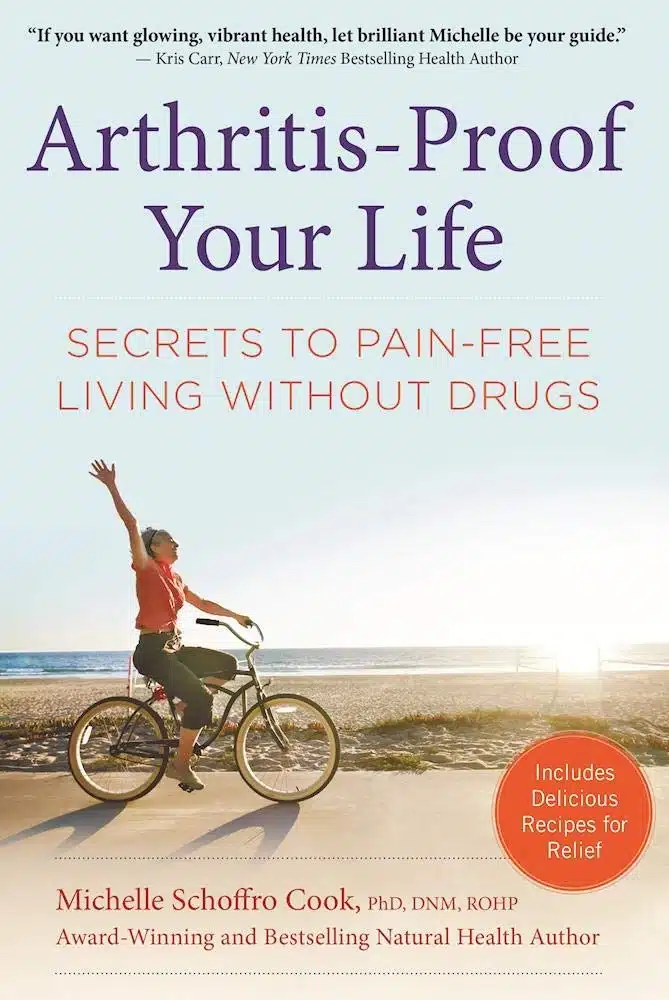
Arthritis-Proof Your Life – by Dr. Michelle Cook
10almonds is reader-supported. We may, at no cost to you, receive a portion of sales if you purchase a product through a link in this article.
First, a note about that title of doctor. Sometimes we will mention “you may be wondering, is that an MD or a PhD? It’s both!” because there is some physician-scientist with an MD plus a PhD in, say, neurology or biochemistry of some kind or be it what it may. In this case, the author has two claims to doctorship: a PhD in traditional natural medicine, and a “DNP”, the “doctor of naturopathic medicine” qualification which is usually a four-year degree, and/but is not generally considered a medical degree, or equivalent, or similar.
This may explain some medical errors in the book, such as the claims that “Fibromyalgia is a type of arthritis” (it isn’t, and in fact by definition will only be diagnosed as such if other disorders such as arthritis have been ruled out as the cause of the symptoms) and “Tylenol is a non-steroidal anti-inflammatory drug” (it isn’t, it’s an antipyretic analgesic, which despite the similar uses and shared reference to the imagery of fire, is a completely different class of drugs and works differently to NSAIDs).
However, it’s not all bad. One thing this book has as a strength is that it offers a lot of things to try, if you’ve already tried everything else, ranging from dietary tweaks to try outside of the usual anti-inflammatory recommendations (but yes, those too), complementary medicine methods such as acupressure and aromatherapy, and the two-way relationship between arthritis and mental health.
The style is bold and lively, and proceeds without citations to interrupt one’s flow, though there is a bibliography at the back, mostly for references to herbalism.
Bottom line: if you have arthritis, have tried many things, and are looking for more things to try, this book may have options you wouldn’t have thought of!
Click here to check out Arthritis-Proof Your Life, and get creative with your problem-solving!
Don’t Forget…
Did you arrive here from our newsletter? Don’t forget to return to the email to continue learning!
Recommended
Learn to Age Gracefully
Join the 98k+ American women taking control of their health & aging with our 100% free (and fun!) daily emails:
-
Here’s how to help protect babies and kids from RSV
10almonds is reader-supported. We may, at no cost to you, receive a portion of sales if you purchase a product through a link in this article.
What you need to know
- RSV is a respiratory virus that is especially dangerous for babies and young children.
- There are two ways to help protect babies from RSV: vaccination during pregnancy and giving babies nirsevimab, an RSV antibody shot.
- If someone in your household has RSV, watch for signs of severe illness and take steps to help prevent it from spreading.
Respiratory syncytial virus, or RSV, is a very contagious seasonal respiratory illness that is especially dangerous for infants and young children. Cases rose dramatically last month, and an increasing number of kids and older adults with RSV are being hospitalized across the United States.
Fortunately, pregnant people can get vaccinated during pregnancy or get their infants and young children an RSV antibody shot to help them stay healthy.
Read on to learn about symptoms of RSV, how to help prevent infants and children from getting very sick, and what families should do if someone in their household is sick with the virus.
What are the symptoms of RSV in babies and young children?
RSV symptoms in young children may include a runny nose, decreased eating and drinking, and coughing, which may lead to wheezing and difficulty breathing.
Infants with RSV may show symptoms like irritability, decreased activity and appetite, and life-threatening pauses in breathing (apnea) that last for more than 10 seconds. Most infants with RSV will not develop a fever, but babies who are born prematurely, have weakened immune systems, or have chronic lung disease are more likely to become very sick.
Who is eligible for an RSV antibody shot?
The Centers for Disease Control and Prevention recommends that babies younger than 8 months whose gestational parent did not receive an RSV vaccine during pregnancy receive nirsevimab between October and March, when RSV typically peaks. This antibody shot delivers proteins that can help protect them against RSV.
Nirsevimab is also recommended for children between 8 and 19 months who are at increased risk of severe RSV, including children who are born prematurely, have chronic lung disease or severe cystic fibrosis, are immunocompromised, or are American Indians or Alaska Natives.
Nirsevimab is typically covered by insurance or costs $495 out of pocket. Children who are eligible for the CDC’s Vaccines for Children Program can receive nirsevimab at no cost.
How can families help prevent RSV from spreading?
It’s recommended that children and adults who are sick with RSV stay home and away from others. If your infant or child has difficulty breathing or develops blue or gray skin, take them to an emergency room right away.
People who are infected with RSV can spread the disease when they cough or sneeze; have close contact with others; or touch, cough, or sneeze on shared surfaces. Help protect your family from catching and spreading RSV at home and in public places by ensuring that everyone covers their mouths during coughing and sneezing, washes their hands often, and wears a high-quality, well-fitting mask.
For more information, talk to your health care provider.
This article first appeared on Public Good News and is republished here under a Creative Commons license.
Share This Post
-
Heart Health Calculator Entry Issue
10almonds is reader-supported. We may, at no cost to you, receive a portion of sales if you purchase a product through a link in this article.
It’s Q&A Day at 10almonds!
Have a question or a request? You can always hit “reply” to any of our emails, or use the feedback widget at the bottom!
In cases where we’ve already covered something, we might link to what we wrote before, but will always be happy to revisit any of our topics again in the future too—there’s always more to say!
As ever: if the question/request can be answered briefly, we’ll do it here in our Q&A Thursday edition. If not, we’ll make a main feature of it shortly afterwards!
So, no question/request too big or small
❝I tried to use your calculator for heart health, and was unable to enter in my height or weight. Is there another way to calculate? Why will that field not populate?❞
(this is in reference to yesterday’s main feature “How Are You, Really? And How Old Is Your Heart?“)
How strange! We tested it in several desktop browsers and several mobile browsers, and were unable to find any version that didn’t work. That includes switching between metric and imperial units, per preference; both appear to work fine. Do be aware that it’ll only take numerical imput, though.
Share This Post
-
Fast. Feast. Repeat – by Dr. Gin Stephens
10almonds is reader-supported. We may, at no cost to you, receive a portion of sales if you purchase a product through a link in this article.
We’ve reviewed intermittent fasting books before, so what makes this one different?
The title “Fast. Feast. Repeat.” doesn’t give much away; after all, we already know that that’s what intermittent fasting is.
After taking the reader though the basics of how intermittent fasting works and what it does for the body, much of the rest of the book is given over to improvements.
That’s what the real strength of this book is: ways to make intermittent fasting more efficient, including how to avoid plateaus. After all, sometimes it can seem like the only way to push further with intermittent fasting is to restrict the eating window further. Not so!
Instead, Dr. Stephens gives us ways to keep confusing our metabolism (in a good way) if, for example, we had a weight loss goal we haven’t met yet.
Best of all, this comes without actually having to eat less.
Bottom line: if you want to be in good physical health, and/but also believe that life is for living and you enjoy eating food, then this book can resolve that age-old dilemma!
Share This Post
Related Posts
-
Blackberries vs Mango – Which is Healthier?
10almonds is reader-supported. We may, at no cost to you, receive a portion of sales if you purchase a product through a link in this article.
Our Verdict
When comparing blackberries to mango, we picked the blackberries.
Why?
Both have their merits! But…
In terms of macros, blackberries have nearly 4x the fiber (and for what it’s worth, which isn’t much with the numbers in involved, more protein) while mangos have 50% more carbs. So, an easy win for blackberries with their extra fiber, in particular.
In the category of vitamins, blackberries have more of vitamins B5, E, and K, while mangos have more of vitamins A, B1, B2, B3, B6, B9, and C, winning in this round.
Looking at minerals, blackberries have more calcium, copper, iron, magnesium, manganese, phosphorus, and zinc, while mangos have more selenium, yielding a 7:1 win to blackberries here.
In other considerations, blackberries have far more polyphenols, so that’s another point in their favor.
Adding up the sections makes for a clear overall win for blackberries, but by all means enjoy either or both, as diversity is best!
Want to learn more?
You might like:
Enjoy!
Don’t Forget…
Did you arrive here from our newsletter? Don’t forget to return to the email to continue learning!
Learn to Age Gracefully
Join the 98k+ American women taking control of their health & aging with our 100% free (and fun!) daily emails:
-
Green Beans vs Okra – Which is Healthier?
10almonds is reader-supported. We may, at no cost to you, receive a portion of sales if you purchase a product through a link in this article.
Our Verdict
When comparing green beans to okra, we picked the okra.
Why?
In terms of macros, it’s very close. Technically green beans have very slightly more carbs, fiber, and protein, but the difference is so small that in practical terms this round is a tie, if not the slenderest of wins for green beans.
In the category of vitamins, green beans have more of vitamins A and E, while okra has more of vitamins B2, B3, B5, B7, B9, and K, winning easily. Most of the margins of difference are significant-but-modest, but an outlier is vitamin B9. While a cup of green beans gives 11% of the RDA of vitamin B9, a cup of okra gives 111%, so the difference is literally an order of magnitude.
Looking at macros, green beans have more iron, while okra has more calcium, copper, magnesium, manganese, phosphorus, potassium, and zinc, again winning easily.
In other considerations, okra is high in polyphenols, especially quercetin, and is noted for its antihyperglycemic properties (i.e. it alleviates elevated blood glucose levels).
Adding up the sections makes for a clear overall win for okra, but by all means do enjoy either or both, as diversity is best!
Want to learn more?
You might like:
21 Most Beneficial Polyphenols & What Foods Have Them
Enjoy!
Don’t Forget…
Did you arrive here from our newsletter? Don’t forget to return to the email to continue learning!
Learn to Age Gracefully
Join the 98k+ American women taking control of their health & aging with our 100% free (and fun!) daily emails:
-
Drug-Free Knee Pain Therapies: Which Ones Work?
10almonds is reader-supported. We may, at no cost to you, receive a portion of sales if you purchase a product through a link in this article.
Knee osteoarthritis is one of the most common causes of chronic pain (with lower back problems being another hot contender for the title), and anti-inflammatory drugs are most people’s go-to, and is often what doctors will suggest first too.
For those who want “non-drug drugs”, i.e. natural remedies that do a similar job, there are options, for example: Five Supplements That Actually Work vs Arthritis
However, there are other options, and we’ve discussed some of them previously, for example: Avoiding/Managing Osteoarthritis
Today we’ll be looking at some of those treatments and more, ranked against each other. Of course, most of them aren’t “either/or” options; you can usually do multiple things if you want, but it’s worth knowing which ones are more worth investing time and energy into.
No need for drugs?
A recent meta-analysis of 139 clinical trials with 9,644 patients compared 12 different non-drug therapies, namely:
- low level laser therapy (LLLT)
- high intensity laser therapy (HILT)
- transcutaneous electrical nerve stimulation (TENS)
- interferential current (IFC)
- short wave diathermy
- ultrasound
- lateral wedged insole
- knee brace
- exercise
- hydrotherapy
- kinesio taping (KT)
- extracorporeal shock wave therapy (ESWT)
…and ranked them according to following methods, and subcategories thereof:
Western Ontario and McMaster Universities Osteoarthritis Index (WOMAC):
- pain
- stiffness
- function
- total
Visual Analog Scale (VAS):
- rest
- activity
Because different therapies were better or worse in different categories, it’s difficult to produce a pure-and-simple 1-to-12 ranking without being misleading, but the top 3 are quite clear:
- Braces ranked highest overall for reducing pain, improving function, and easing stiffness
- Hydrotherapy was especially effective for pain relief
- Exercise consistently improved pain and mobility
All three consistently outperformed drugs, making them excellent choices, especially since they avoid gastrointestinal and cardiovascular risks (which are common problems with popular arthritis drugs) while being low-cost and accessible.
On the other end of the scale, it’s worth noting that ultrasound consistently performed worst, followed by short-wave diathermy. So maybe skip those.
You can read the paper in full, here: Clinical efficacy of different therapeutic options for knee osteoarthritis: A network meta-analysis based on randomized clinical trials
Before you get shopping for knee braces…
Of those top 3 that we mentioned, there are some further observations we can make.
About hydrotherapy, that can mean a lot of different things (hot water therapy, cold water therapy, exercising in a swimming pool, etc). You can read about that here: How Useful Is Hydrotherapy?
It’s likely that the latter one (exercising in a pool) works well since it is in some ways a combination of exercise and bracing the knee—since the water provides support, while the exercise can still take the knee through a range of motion, which is important.
See for example: The Most Underrated Mobility Exercise (Not Stretching) ← this is written with hips in mind, but it’s about making sure to get a full range of motion, and it applies just the same for knees
Now, about knee braces and exercise…
A likely reason that braces perform better than exercise overall is that it is zero-effort, which likely makes adherence higher, especially if using “intention to treat” scores, as many studies in the meta-analysis did.
What that means: instead of carefully checking how good adherence was (i.e. how much people consistently followed through with treatments, did things correctly, etc), the qualifying factor can simply be that the treatment decision was made, that this patient has been referred for such-and-such, has been given access to that treatment, and has agreed to embark on it.
Which, when applied to this situation, means: a patient who has been given knee braces is more likely to wear them, than a patient who has been given daily exercises to do is likely to do them. Consequently, the patient the patient with the knee braces enjoys greater relief, even if the exercises might have actually worked better, had they been undertaken more seriously.
What exercises, you wonder? Here’s a good example: Knee Pain Won’t Get Better Unless You Fix This First
Want a knee brace in any case? We don’t sell them, but here for your convenience is an example product on Amazon 😎
Want to learn more?
For a much deeper understanding of treating knee pain, here’s a great book that we reviewed a little while back:
Treat Your Own Knee – by Robin McKenzie ← he’s a physiotherapist and not a doctor, but with 40 years of practice to his name and 33 letters after his name (CNZM OBE FCSP (Hon) FNZSP (Hon) Dip MDT Dip MT), he seems to know his stuff. His work is very well-respected, and almost any English-speaking physiotherapist will have read his books.
Take care!
Don’t Forget…
Did you arrive here from our newsletter? Don’t forget to return to the email to continue learning!
Learn to Age Gracefully
Join the 98k+ American women taking control of their health & aging with our 100% free (and fun!) daily emails:


