
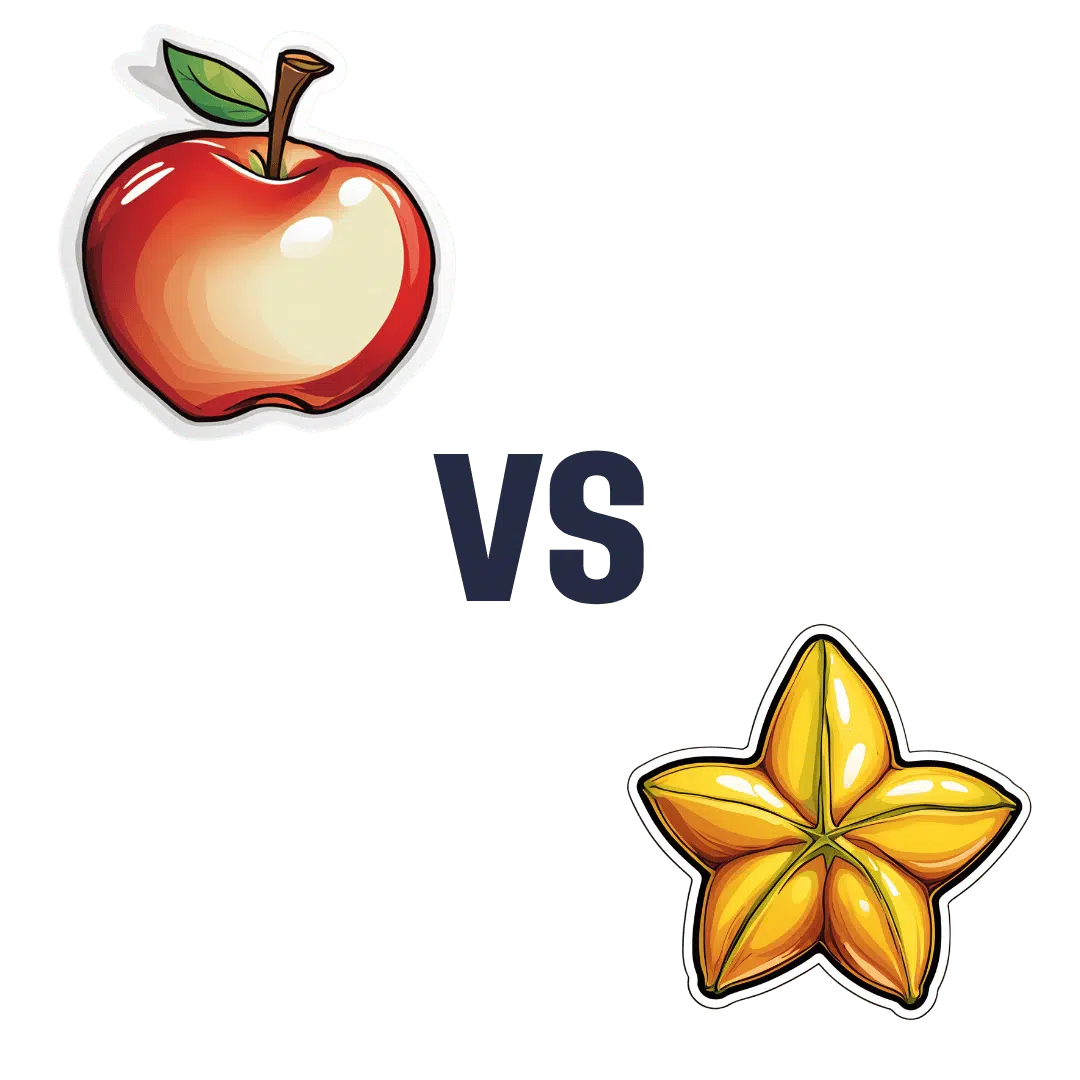
Apple vs Starfruit – Which is Healthier?
10almonds is reader-supported. We may, at no cost to you, receive a portion of sales if you purchase a product through a link in this article.
Our Verdict
When comparing apples to starfruit, we picked the starfruit.
Why?
In terms of macros, apples have 2x the carbs while starfruit have slightly more fiber and protein; by most people’s macro standards that’s a win for starfruit.
In the category of vitamins, apples have more of vitamins B2 and B6, while starfruit has more of vitamins B3, B5, B7, B9, and C, winning in this round.
Looking at minerals, apples have more calcium and iron, while starfruit has more copper, magnesium, manganese, phosphorus, potassium, selenium, and zinc, winning a third round in a row.
In other considerations, there are not really other considerations unless you have an allergy; both have comparably modest polyphenol profiles, and neither has any known exciting medicinal properties. So, a tie here.
Adding up the sections makes for a clear overall win for starfruit, but by all means enjoy either or both, as diversity is good!
Want to learn more?
You might like:
What’s Your Plant Diversity Score?
Enjoy!
Don’t Forget…
Did you arrive here from our newsletter? Don’t forget to return to the email to continue learning!
Recommended
Learn to Age Gracefully
Join the 98k+ American women taking control of their health & aging with our 100% free (and fun!) daily emails:
-
It’s Not A Diet – by Davinia Taylor
10almonds is reader-supported. We may, at no cost to you, receive a portion of sales if you purchase a product through a link in this article.
A lot of diet books claim “it’s not a diet”, even when the titles are things like “The Such-and-Such Diet”.
This time, we get to see the claim as the title itself, so, how does it measure up?
Honestly, we’ll agree it’s not a diet. Yes, there is nutritional advice, and nothing that will be too shocking to regular 10almonds readers. Avoid processed foods, get plenty of fruit and veg, skip the alcohol. She leans towards keto, but isn’t evangelical about it despite selling a line of keto products herself. All in all, it can be called dietary guidance, but not reasonably “a diet” in any meaningful sense of the word.
The only counterpoint is that there is, for those who like that sort of thing, a “two-week reset programme”, which we might consider a diet, given it is clearly prescriptive with its meal plan.
She also talks sleep, hydration, stress management, movement, and so forth. Again, nothing that will surprise the well-informed reader. So, what does this book have to offer that we’re not assuming knowledge of?
Informationally, very little. But inspirationally, rather more, and a lot is about integrating healthier changes into your life and making them actually stick—and that’s where the real value of the book lies.
The style is, as with her other book “Futureproof” that we reviewed all so recently, again very direct and personable, and/but has a normal British amount of casual swearing that might shock some American readers. There’s a lot less science in this book than her other one, so there’s no bibliography per se, just an “acknowledgements” section at the back.
Bottom line: if you know what you need to do but struggle more with actually doing it, this book can help with that.
Share This Post
-
What is frozen shoulder? And will I need surgery?
10almonds is reader-supported. We may, at no cost to you, receive a portion of sales if you purchase a product through a link in this article.
Frozen shoulder can make simple tasks – such as lifting your arm, sleeping on your side, getting out of bed, putting on a bra, driving or playing with your kids – painful and challenging.
This condition usually starts with pain suddenly developing in the shoulder and stiffness. Over time, the pain and stiffness get worse. It can drag on for months or even years.
So, what causes frozen shoulder? And can it be treated?
Mikolette/Getty What is frozen shoulder?
This shoulder condition, also known as “adhesive capsulitis”, affects around 8% of men and 10% of women aged 25–64. But it’s more common over 40, especially for people in their 60s.
We don’t fully understand what causes frozen shoulder.
The tissues around the joint become tight, swollen and stiff. But we don’t know exactly why these changes occur and lead to pain and limited movement.
There are usually three stages:
- freezing – pain gradually gets worse and the shoulder becomes stiff, limiting the range of movement
- frozen – stiffness and pain usually peak, but may begin to ease
- thawing – pain and stiffness slowly improve, and movement begins to return.
While health professionals commonly accept it, this staged description suggests frozen shoulder will follow a predictable pattern and always get better on its own. But research suggests this is not always the case.
For example, the “freezing” stage is usually expected to last at least ten weeks. But some people will start to notice improved movement sooner.
Recovery stages will vary from person to person and can take months to years. Some people may not fully recover, even with treatment.
One 2020 study followed up with 215 patients with frozen shoulder. While over 70% of participants said they were happy with improvements in their symptoms, around 40% still had some movement restriction two years after their symptoms began.
Another study from 2008 found over a third of people they surveyed (41%) had ongoing symptoms two to seven years later, including pain and difficulty sleeping.
Who is most at risk?
Certain groups are more likely to develop frozen shoulder:
- women, especially during menopause
- people with diabetes
- older adults
- those with high cholesterol or thyroid problems.
There is some evidence genetics also plays a role, as a family history increases your risk.
But we need more high-quality research to understand what’s behind these risk factors.
For example, people with diabetes are around five times more likely to develop frozen shoulder than those without diabetes – and also have worse pain. This may be linked to diabetes-related changes in the body, such as reduced blood flow to tissues and chemical changes from high blood sugar. But the exact mechanisms are unclear, and research is yet to determine whether controlling blood sugar better could help prevent or slow frozen shoulder.
Similarly, women are 40% more likely to develop frozen shoulder than men, with one theory suggesting hormone fluctuations during menopause are responsible. But there is no clear evidence yet to support this.
How is frozen shoulder treated?
There is mixed evidence about which treatments are effective, including whether over-the-counter pain medication such as Voltaren helps.
Oral steroids
A review of the evidence suggests oral steroids, such as prednisolone, can provide some short-term pain relief and improve shoulder movement, compared to doing nothing or a placebo. But these benefits don’t seem to last beyond six weeks, and the evidence comes from a few small studies. These require a prescription.
Injections
High-quality evidence shows corticosteroid injections can provide short-term relief, compared to doing nothing.
There is also some limited evidence that corticosteroid injections and platelet rich plasma injections can provide better short-term pain relief, compared with over-the-counter pain relief and physiotherapy. However, the studies are small or poorly designed and the effects are small, so the evidence needs to be interpreted with caution.
Physiotherapy
Moderate-quality evidence suggests physiotherapy can help improve shoulder movement. Benefits of physio are greater when combined with a steroid injection, and followed up by doing the exercises at home. More research is needed to understand how well these treatments work in the long term.
What about surgery?
There are two main procedures for frozen shoulder, both done while the patient is unconscious under anaesthetic.
1. Manipulation under anaesthetic
This is a less invasive procedure where the surgeon stretches the shoulder, without cutting into the joint, to help loosen tight tissue that may be causing stiffness.
2. Arthroscopic capsular release
In this type of keyhole surgery, the surgeon cuts tight tissues inside the shoulder joint to try to free up shoulder movement.
Improvements from these procedures are typically small, and evidence suggests the results are not better than non-surgical treatments. For example, one study showed that after one year, patients who’d had surgery had similar improvements to those who’d had physiotherapy and a steroid injection, but no surgery.
These procedures also have several downsides. It’s more expensive than other treatments, carries additional risks, and typically requires weeks (and up to three months) of rehabilitation.
The bottom line
Being physically active and doing exercises can help if you’re experiencing pain and limited movement. But you don’t have to work this out alone. It’s a good idea to get advice on managing pain and how to stay active.
If you suspect you have frozen shoulder, it’s important to see a doctor or physiotherapist so they can rule out other conditions, such as fracture and arthritis.
A health professional can also discuss management – the potential benefits, harms, costs, and how easy it is to access each treatment option.
Fernando Sousa, Research Fellow in Physiotherapy, Monash University; Joshua Zadro, NHMRC Emerging Leader Research Fellow, Sydney Musculoskeletal Health, University of Sydney, and Peter Malliaras, Professor in Physiotherapy, Monash University
This article is republished from The Conversation under a Creative Commons license. Read the original article.
Share This Post
-
Intuitive Eating – by Evelyn Tribole and Elyse Resch
10almonds is reader-supported. We may, at no cost to you, receive a portion of sales if you purchase a product through a link in this article.
You may be given to wonder: if this is about intuitive eating, and an anti-diet approach, why a whole book?
There’s a clue in the other part of the title: “4th Edition”.
The reason there’s a 4th edition (and before it, a 3rd and 2nd edition) is because this book is very much full of science, and science begets more science, and the evidence just keeps on rolling in.
While neither author is a doctor, each has a sizeable portion of the alphabet after their name (more than a lot of doctors), and this is an incredibly well-evidenced book.
The basic premise from many studies is that restrictive dieting does not work well long-term for most people, and instead, better is to make use of our bodies’ own interoceptive feedback.
You see, intuitive eating is not “eat randomly”. We do not call a person “intuitive” because they speak or act randomly, do we? Same with diet.
Instead, the authors give us ten guiding principles (yes, still following the science) to allow us a consistent “finger on the pulse” of what our body has to say about what we have been eating, and what we should be eating.
Bottom line: if you want to be a lot more in tune with your body and thus better able to nourish it the way it needs, this book is literally on the syllabus for many nutritional science classes, and will stand you in very good stead!
Share This Post
Related Posts
-
How light can shift your mood and mental health
10almonds is reader-supported. We may, at no cost to you, receive a portion of sales if you purchase a product through a link in this article.
This is the next article in our ‘Light and health’ series, where we look at how light affects our physical and mental health in sometimes surprising ways. Read other articles in the series.
It’s spring and you’ve probably noticed a change in when the Sun rises and sets. But have you also noticed a change in your mood?
We’ve known for a while that light plays a role in our wellbeing. Many of us tend to feel more positive when spring returns.
But for others, big changes in light, such as at the start of spring, can be tough. And for many, bright light at night can be a problem. Here’s what’s going on.
llaszlo/Shutterstock An ancient rhythm of light and mood
In an earlier article in our series, we learned that light shining on the back of the eye sends “timing signals” to the brain and the master clock of the circadian system. This clock coordinates our daily (circadian) rhythms.
“Clock genes” also regulate circadian rhythms. These genes control the timing of when many other genes turn on and off during the 24-hour, light-dark cycle.
But how is this all linked with our mood and mental health?
Circadian rhythms can be disrupted. This can happen if there are problems with how the body clock develops or functions, or if someone is routinely exposed to bright light at night.
When circadian disruption happens, it increases the risk of certain mental disorders. These include bipolar disorder and atypical depression (a type of depression when someone is extra sleepy and has problems with their energy and metabolism).
Light on the brain
Light may also affect circuits in the brain that control mood, as animal studies show.
There’s evidence this happens in humans. A brain-imaging study showed exposure to bright light in the daytime while inside the scanner changed the activity of a brain region involved in mood and alertness.
Another brain-imaging study found a link between daily exposure to sunlight and how the neurotransmitter (or chemical messenger) serotonin binds to receptors in the brain. We see alterations in serotonin binding in several mental disorders, including depression.
Our mood can lift in sunlight for a number of reasons, related to our genes, brain and hormones. New Africa/Shutterstock What happens when the seasons change?
Light can also affect mood and mental health as the seasons change. During autumn and winter, symptoms such as low mood and fatigue can develop. But often, once spring and summer come round, these symptoms go away. This is called “seasonality” or, when severe, “seasonal affective disorder”.
What is less well known is that for other people, the change to spring and summer (when there is more light) can also come with a change in mood and mental health. Some people experience increases in energy and the drive to be active. This is positive for some but can be seriously destabilising for others. This too is an example of seasonality.
Most people aren’t very seasonal. But for those who are, seasonality has a genetic component. Relatives of people with seasonal affective disorder are more likely to also experience seasonality.
Seasonality is also more common in conditions such as bipolar disorder. For many people with such conditions, the shift into shorter day-lengths during winter can trigger a depressive episode.
Counterintuitively, the longer day-lengths in spring and summer can also destabilise people with bipolar disorder into an “activated” state where energy and activity are in overdrive, and symptoms are harder to manage. So, seasonality can be serious.
Alexis Hutcheon, who experiences seasonality and helped write this article, told us:
[…] the season change is like preparing for battle – I never know what’s coming, and I rarely come out unscathed. I’ve experienced both hypomanic and depressive episodes triggered by the season change, but regardless of whether I’m on the ‘up’ or the ‘down’, the one constant is that I can’t sleep. To manage, I try to stick to a strict routine, tweak medication, maximise my exposure to light, and always stay tuned in to those subtle shifts in mood. It’s a time of heightened awareness and trying to stay one step ahead.
So what’s going on in the brain?
One explanation for what’s going on in the brain when mental health fluctuates with the change in seasons relates to the neurotransmitters serotonin and dopamine.
Serotonin helps regulate mood and is the target of many antidepressants. There is some evidence of seasonal changes in serotonin levels, potentially being lower in winter.
Dopamine is a neurotransmitter involved in reward, motivation and movement, and is also a target of some antidepressants. Levels of dopamine may also change with the seasons.
But the neuroscience of seasonality is a developing area and more research is needed to know what’s going on in the brain.
How about bright light at night?
We know exposure to bright light at night (for instance, if someone is up all night) can disturb someone’s circadian rhythms.
This type of circadian rhythm disturbance is associated with higher rates of symptoms including self-harm, depressive and anxiety symptoms, and lower wellbeing. It is also associated with higher rates of mental disorders, such as major depression, bipolar disorder, psychotic disorders and post-traumatic stress disorder (or PTSD).
Why is this? Bright light at night confuses and destabilises the body clock. It disrupts the rhythmic regulation of mood, cognition, appetite, metabolism and many other mental processes.
But people differ hugely in their sensitivity to light. While still a hypothesis, people who are most sensitive to light may be the most vulnerable to body clock disturbances caused by bright light at night, which then leads to a higher risk of mental health problems.
Bright light at night disrupts your body clock, putting you at greater risk of mental health issues. Ollyy/Shutterstock Where to from here?
Learning about light will help people better manage their mental health conditions.
By encouraging people to better align their lives to the light-dark cycle (to stabilise their body clock) we may also help prevent conditions such as depression and bipolar disorder emerging in the first place.
Healthy light behaviours – avoiding light at night and seeking light during the day – are good for everyone. But they might be especially helpful for people at risk of mental health problems. These include people with a family history of mental health problems or people who are night owls (late sleepers and late risers), who are more at risk of body clock disturbances.
Alexis Hutcheon has lived experience of a mental health condition and helped write this article.
If this article has raised issues for you, or if you’re concerned about someone you know, call Lifeline on 13 11 14.
Jacob Crouse, Research Fellow in Youth Mental Health, Brain and Mind Centre, University of Sydney; Emiliana Tonini, Postdoctoral Research Fellow, Brain and Mind Centre, University of Sydney, and Ian Hickie, Co-Director, Health and Policy, Brain and Mind Centre, University of Sydney
This article is republished from The Conversation under a Creative Commons license. Read the original article.
Don’t Forget…
Did you arrive here from our newsletter? Don’t forget to return to the email to continue learning!
Learn to Age Gracefully
Join the 98k+ American women taking control of their health & aging with our 100% free (and fun!) daily emails:
-
Dealing With Spider Veins & More
10almonds is reader-supported. We may, at no cost to you, receive a portion of sales if you purchase a product through a link in this article.
Aside from aesthetic considerations, this can lead to more serious problems, so it’s best to catch it early:
Chronic venous insufficiency
Chronic venous insufficiency (CVI) is a failure of the veins of the lower legs to push blood back towards the heart because the one-way valves weaken, leading to backward flow, pooling, increased pressure, swelling, and skin damage.
There are risk factors, some of which some are modifiable and some aren’t. Namely: older age, heavier weight, prolonged sitting or standing, limited mobility, family history (+50% risk if one parent affected, +80% if both), female hormonal changes, previous deep-vein thrombosis, and leg injuries that damage valves.
In terms of early warning signs, watch out for: heavy, aching, or tired legs (often worsening by day’s end and improving with elevation), ankle swelling that disappears overnight and returns daily, spider veins, varicose veins, and/or rust-brown ankle discoloration from iron deposition.
If it’s not caught early, then you can expect to also see: stasis eczema with itching, flaking, and dryness; tightening and fibrosis of the lower leg (lipodermatosclerosis); pale white patches (atrophie blanche); and there’s also a progressively increasing risk of leg ulcers, especially near the inner ankle.
Early diagnosis matters, because chronic inflammation, impaired wound healing, recurrent infections, skin breakdown, and long-lasting ulcers can take months or years to heal—if ever.
Upon diagnosis, there are lifestyle options and medical options:
- Lifestyle options:
- regular movement to activate your calf “muscle pump”
- taking frequent breaks from prolonged sitting or standing
- elevating your legs whenever possible
- wearing compression stockings
- maintaining a healthy weight
- reducing sodium intake
- Medical options:
- consistent compression therapy as the cornerstone
- medical-grade fitted stockings
- minimally invasive vein-closure procedures such as:
- sclerotherapy
- endovenous laser therapy
- radiofrequency ablation
If you’re still at the happy stage of prevention rather than cure, then Dr. Suarez recommends hourly movement breaks at a desk job, weight-shifting and calf flexing if standing all day, routine leg elevation (especially evenings), wearing compression if at high risk, protecting the skin, and paying attention to early signs like swelling or visible veins.
For more on all of this, enjoy:
Click Here If The Embedded Video Doesn’t Load Automatically!
Want to learn more?
You might also like:
Remedies To Reduce Varicose Veins (Or Avoid Them Entirely)
Take care!
Don’t Forget…
Did you arrive here from our newsletter? Don’t forget to return to the email to continue learning!
Learn to Age Gracefully
Join the 98k+ American women taking control of their health & aging with our 100% free (and fun!) daily emails:
- Lifestyle options:
-
Oats vs Rye – Which is Healthier?
10almonds is reader-supported. We may, at no cost to you, receive a portion of sales if you purchase a product through a link in this article.
Our Verdict
When comparing oats to rye, we picked the oats.
Why?
It was close!
In terms of macros, oats have a little more protein and rye has a little more fiber, and we’ll call this first round a tie on the strength of those.
In the category of vitamins, oats have more of vitamins B1, B7, and B9, while rye has more of vitamins B2, B3, and B6—another tie!
Looking at minerals, this time we have something to set one ahead of the other: oats have more calcium, copper, iron, magnesium, manganese, phosphorus, selenium, and zinc, while rye has just a little more potassium. An easy win for oats in this round.
Adding up the sections makes for an overall win for oats, but both are great, so by all means do enjoy either or both, as diversity is best!
Want to learn more?
You might like:
The Best Kind Of Fiber For Overall Health? ← it’s β-glucan, the kind find abundantly in oats!
Enjoy!
Don’t Forget…
Did you arrive here from our newsletter? Don’t forget to return to the email to continue learning!
Learn to Age Gracefully
Join the 98k+ American women taking control of their health & aging with our 100% free (and fun!) daily emails:


