
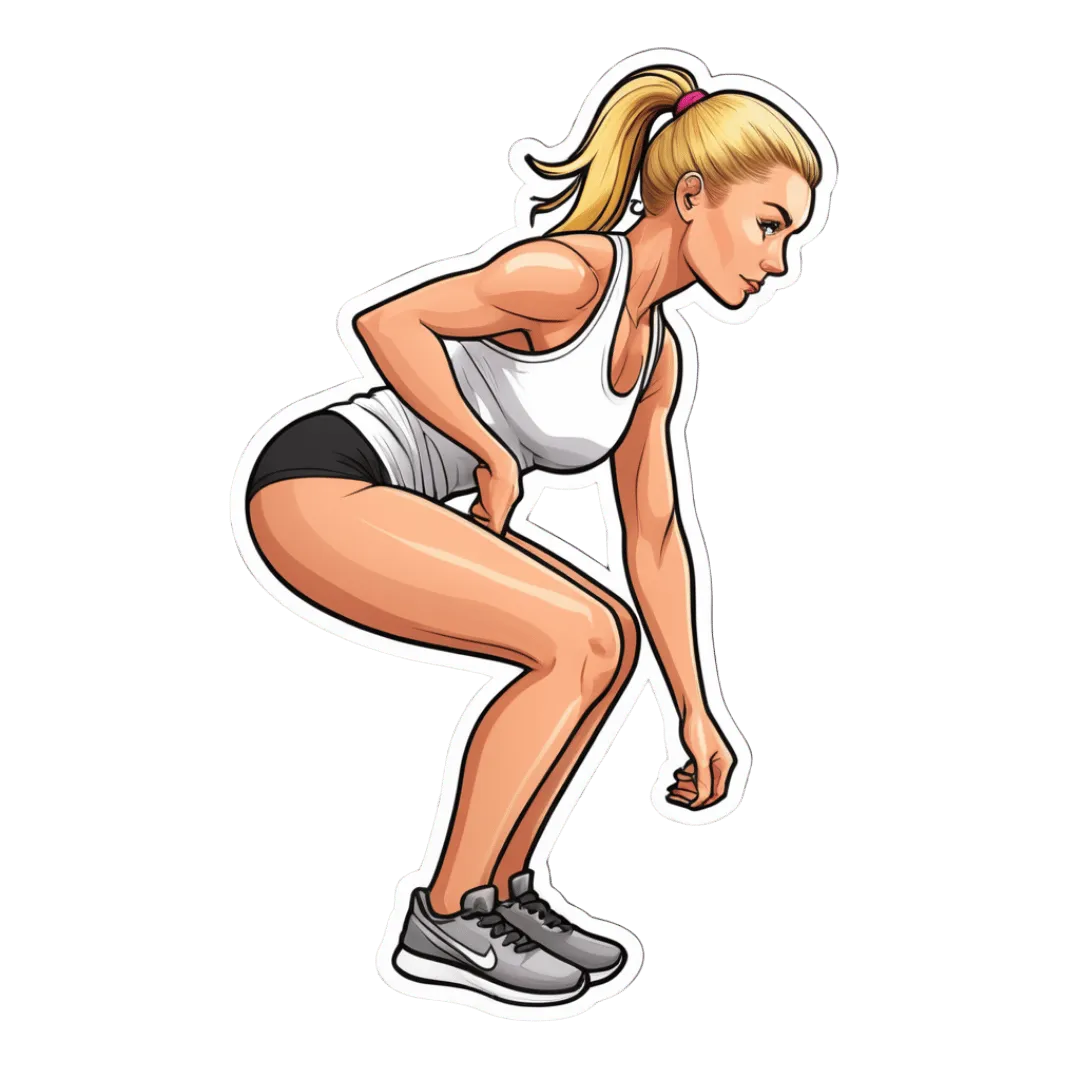
Your Knee Pain Isn’t Coming From Your Knee

10almonds is reader-supported. We may, at no cost to you, receive a portion of sales if you purchase a product through a link in this article.

Four things to fix it:

More than just a part

Knee pain usually isn’t just a knee problem, because your knee mainly handles flexion and extension and relies on your feet, ankles, hips, and even glutes to control force, rotation, and alignment. So problems can come from all those places.

With that in mind, here are four things to identify and (as applicable) fix:

  1. Foot arch collapse (overpronation)
    • What happens: when your arch drops, your foot rolls inward, your shin follows, and your knee tracks inward under load
    • Test for it: stand relaxed and see if your arches visibly collapse inward
    • Exercise to fix it: pull the ball of your foot toward your heel without curling your toes and hold briefly; repeat as necessary
  2. Limited ankle dorsiflexion
    • What happens: if your ankle can’t move forwards, your knee compensates during walking, squatting, and stairs
    • Test for it: knee-to-wall test (10–12 cm distance, heel flat, knee touches wall)
    • Exercise to fix it: slow heel raises off a step to improve ankle mobility and control
  3. Weak glutes (especially glute medius)
    • What happens: weak hip control lets your femur rotate inward, causing your knee to collapse inward under load
    • Test for it: single-leg squat—watch if your knee caves inward
    • Exercise to fix it: banded clamshells to strengthen hip stabilizers
  4. Tight quads and hip flexors
    • What happens: tightness here alters how your kneecap tracks, increasing pressure and irritation
    • Test for it: simply watch for symptoms like pain going upstairs, stiffness after sitting, or a “gravelly” feeling
    • Exercise to fix it: couch stretch or standing quad stretch with your glute engaged

For more on all of this plus visual demonstrations, enjoy:

Click Here If The Embedded Video Doesn’t Load Automatically!

Want to learn more?

You might also like:

For a much deeper understanding of treating knee pain, here’s a great book that we reviewed a little while back:

Treat Your Own Knee – by Robin McKenzie ← he’s a physiotherapist and not a doctor, and/but with 40 years of practice to his name and 33 letters after his name (CNZM OBE FCSP (Hon) FNZSP (Hon) Dip MDT Dip MT), he seems to know his stuff. His work is very well-respected, and almost any English-speaking physiotherapist will have read his books.

Take care!

Don’t Forget…

Did you arrive here from our newsletter? Don’t forget to return to the email to continue learning!
Learn to Age Gracefully

Join the 98k+ American women taking control of their health & aging with our 100% free (and fun!) daily emails:

  • Your Brain on Art – by Susan Magsamen & Ivy Ross

    10almonds is reader-supported. We may, at no cost to you, receive a portion of sales if you purchase a product through a link in this article.

    The notion of art therapy is popularly considered a little wishy-washy. As it turns out, however, there are thousands of studies showing its effectiveness.

    Nor is this just a matter of self-expression. As authors Magsamen and Ross explore, different kinds of engagement with art can convey different benefits.

    That’s one of the greatest strengths of this book: “this form of engagement with art will give these benefits, according to these studies”

    With benefits ranging from reducing stress and anxiety, to overcoming psychological trauma or physical pain, there’s a lot to be said for art!

    And because the book covers many kinds of art, if you can’t imagine yourself taking paintbrush to canvas, that’s fine too. We learn of the very specific cognitive benefits of coloring in mandalas (yes, really), of sculpting something terrible in clay, or even just of repainting the kitchen, and more. Each thing has its set of benefits.

    The book’s main goal is to encourage the reader to cultivate what the authors call an aesthetic mindset, which involves four key attributes:

    • a high level of curiosity
    • a love of playful, open-ended exploration
    • a keen sensory awareness
    • a drive to engage in creative activities

    And, that latter? It’s as a maker and/or a beholder. We learn about what we can gain just by engaging with art that someone else made, too.

    Bottom line: come for the evidence-based cognitive benefits; stay for the childlike wonder of the universe. If you already love art, or have thought it’s just “not for you”, then this book is for you.

    Click here to check out Your Brain On Art, and open up whole new worlds of experience!

    Share This Post

  • How Too Much Salt May Lead To Organ Failure

    10almonds is reader-supported. We may, at no cost to you, receive a portion of sales if you purchase a product through a link in this article.

    Salt’s Health Risks… More Than Just Heart Disease!

    It’s been well-established for a long time that too much salt is bad for cardiovascular health. It can lead to high blood pressure, which in turn can lead to many problems, including heart attacks.

    A team of researchers has found that in addition to this, it may be damaging your organs themselves.

    This is because high salt levels peel away the surfaces of blood vessels. How does this harm your organs? Because it’s through those walls that nutrients are selectively passed to where they need to be—mostly your organs. So, too much salt can indirectly starve your organs of the nutrients they need to survive. And you absolutely do not want your organs to fail!

    ❝We’ve identified new biomarkers for diagnosing blood vessel damage, identifying patients at risk of heart attack and stroke, and developing new drug targets for therapy for a range of blood vessel diseases, including heart, kidney and lung diseases as well as dementia❞

    ~ Newman Sze, Canada Research Chair in Mechanisms of Health and Disease, and lead researcher on this study.

    See the evidence for yourself: Endothelial Damage Arising From High Salt Hypertension Is Elucidated by Vascular Bed Systematic Profiling

    Diets high in salt are a huge problem in Canada, North America as a whole, and around the world. According to a World Health Organization (WHO) report released March 9, Canadians consume 9.1 grams of salt per day.

    Read: WHO global report on sodium intake reduction

    You may be wondering: who is eating over 9g of salt per day?

    And the answer is: mostly, people who don’t notice how much salt is already in processed foods… don’t see it, and don’t think about it.

    Meanwhile, the WHO recommends the average person to consume no more than five grams, or one teaspoon, of salt per day.

    Read more: Massive efforts needed to reduce salt intake and protect lives

    The American Heart Association, tasked with improving public health with respect to the #1 killer of Americans (it’s also the #1 killer worldwide—but that’s not the AHA’s problem), goes further! It recommends no more than 2.3g per day, and ideally, no more than 1.5g per day.

    Some handy rules-of-thumb

    Here are sodium-related terms you may see on food packages:

    • Salt/Sodium-Free = Less than 5mg of sodium per serving
    • Very Low Sodium = 35mg or less per serving
    • Low Sodium = 140mg or less per serving
    • Reduced Sodium = At least 25% less sodium per serving than the usual sodium level
    • Light in Sodium or Lightly Salted = At least 50% less sodium than the regular product

    Confused by milligrams? Instead of remembering how many places to move the decimal point (and potentially getting an “out by an order of magnitude error—we’ve all been there!), think of the 1.5g total allowance as being 1500mg.

    See also: How much sodium should I eat per day? ← from the American Heart Association

    Share This Post

  • How Science News Outlets Can Lie To You (Yes, Even If They Cite Studies!)

    10almonds is reader-supported. We may, at no cost to you, receive a portion of sales if you purchase a product through a link in this article.

    Today, in this special edition, we want to lay out plain and simple how to see through a lot of the tricks used not just by popular news outlets, but even sometimes the research publications themselves.

    That way, when we give you health-related science news, you won’t have to take our word for it, because you’ll be able to see whether the studies we cite really support the claims we make.

    Of course, we’ll always give you the best, most honest information we have… But the point is that you shouldn’t have to trust us! So, buckle in for today’s special edition, and never have to blindly believe sci-hub (or Snopes!) again.

    The above now-famous Tumblr post that became a meme is a popular and obvious example of how statistics can be misleading, either by error or by deliberate spin.

    But what sort of mistakes and misrepresentations are we most likely to find in real research?

    Spin Bias

    Perhaps most common in popular media reporting of science, the Spin Bias hinges on the fact that most people perceive numbers in a very “fuzzy logic” sort of way.

    Consider, for example:

    • A million seconds is 11.5 days
    • A billion seconds is not weeks, but 13.2 months!

    Or not; it’s actually nearly thirty-two years. Did the months figure seem reasonable to you, though? If so, this is the same kind of “human brains don’t do large numbers” problem that occurs when looking at statistics.

    Let’s have a look at reporting on statistically unlikely side effects for vaccines, as an example:

    • “966 people in the US died after receiving this vaccine!” (So many! So risky!)
    • “Fewer than 3 people per million died after receiving this vaccine!” (Hmm, I wonder if it is worth it?)
    • “Half of unvaccinated people with this disease die of it” (Oh)

    How to check for this: ask yourself “is what’s being described as very common really very common?”. To keep with the spiders theme, there are many (usually outright made-up) stats thrown around on social media about how near the nearest spider is at any given time. Apply this kind of thinking to medical conditions.. If something affects only 1% of the population (So few! What a tiny number!), how far would you have to go to find someone with that condition? The end of your street, perhaps?

    Selection/Sampling Bias

    Diabetes disproportionately affects black people, but diabetes research disproportionately focuses on white people with diabetes. There are many possible reasons for this, the most obvious being systemic/institutional racism. For example, advertisements for clinical trial volunteer opportunities might appear more frequently amongst a convenient, nearby, mostly-white student body. The selection bias, therefore, made the study much less reliable.

    Alternatively: a researcher is conducting a study on depression, and advertises for research subjects. He struggles to get a large enough sample size, because depressed people are less likely to respond, but eventually gets enough. Little does he know, even the most depressed of his subjects are relatively happy and healthy compared with the silent majority of depressed people who didn’t respond.

    See This And Many More Educational Cartoons At Sketchplanations.com!

    How to check for this: Does the “method” section of the scientific article describe how they took pains to make sure their sample was representative of the relevant population, and how did they decide what the relevant population was?

    Publication Bias

    Scientific publications will tend to prioritise statistical significance. Which seems great, right? We want statistically significant studies… don’t we?

    We do, but: usually, in science, we consider something “statistically significant” when it hits the magical marker of p=0.05 (in other words, the probability of getting that result is 1/20, and the results are reliably coming back on the right side of that marker).

    However, this can result in the clinic stopping testing once p=0.05 is reached, because they want to have their paper published. (“Yay, we’ve reached out magical marker and now our paper will be published”)

    So, you can think of publication bias as the tendency for researchers to publish ‘positive’ results.

    If it weren’t for publication bias, we would have a lot more studies that say “we tested this, and here are our results, which didn’t help answer our question at all”—which would be bad for the publication, but good for science, because data is data.

    To put it in non-numerical terms: this is the same misrepresentation as the technically true phrase “when I misplace something, it’s always in the last place I look for it”—obviously it is, because that’s when you stop looking.

    There’s not a good way to check for this, but be sure to check out sample sizes and see that they’re reassuringly large.

    Reporting/Detection/Survivorship Bias

    There’s a famous example of the rise in “popularity” of left-handedness. Whilst Americans born in ~1910 had a bit under a 3.5% chance of being left handed, those born in ~1950 had a bit under a 12% change.

    Why did left-handedness become so much more prevalent all of a sudden, and then plateau at 12%?

    Simple, that’s when schools stopped forcing left-handed children to use their right hands instead.

    In a similar fashion, countries have generally found that homosexuality became a lot more common once decriminalized. Of course the real incidence almost certainly did not change—it just became more visible to research.

    So, these biases are caused when the method of data collection and/or measurement leads to a systematic error in results.

    How to check for this: you’ll need to think this through logically, on a case by case basis. Is there a reason that we might not be seeing or hearing from a certain demographic?

    And perhaps most common of all…

    Confounding Bias

    This is the bias that relates to the well-known idea “correlation ≠ causation”.

    Everyone has heard the funny examples, such as “ice cream sales cause shark attacks” (in reality, both are more likely to happen in similar places and times; when many people are at the beach, for instance).

    How can any research paper possibly screw this one up?

    Often they don’t and it’s a case of Spin Bias (see above), but examples that are not so obviously wrong “by common sense” often fly under the radar:

    “Horse-riding found to be the sport that most extends longevity”

    Should we all take up horse-riding to increase our lifespans? Probably not; the reality is that people who can afford horses can probably afford better than average healthcare, and lead easier, less stressful lives overall. The fact that people with horses typically have wealthier lifestyles than those without, is the confounding variable here.

    See This And Many More Educational Cartoons on XKCD.com!

    In short, when you look at the scientific research papers cited in the articles you read (you do look at the studies, yes?), watch out for these biases that found their way into the research, and you’ll be able to draw your own conclusions, with well-informed confidence, about what the study actually tells us.

    Science shouldn’t be gatekept, and definitely shouldn’t be abused, so the more people who know about these things, the better!

    So…would one of your friends benefit from this knowledge? Forward it to them!

    Share This Post

  • Resistance band Training – by James Atkinson

    10almonds is reader-supported. We may, at no cost to you, receive a portion of sales if you purchase a product through a link in this article.

    For those who’d like a full gym workout at home, without splashing out thousands on a home gym, resistance bands provide a lot of value. But how much value, really?

    As James Atkinson demonstrates, there’s more exercise available than one might think.

    Did you know that you can use the same band to strengthen your triceps as well as your biceps, for instance? and the same goes for your quadriceps and biceps femoris. And core strength? You bet.

    The style here is not a sales pitch (though he does, at the end, offer extra resources if desired), but rather, instructional, and this book is in and of itself already a complete guide. With clear instructions and equally clear illustrations, you don’t need to spend a dime more (unless you don’t own a resistance band, in which case then yes, you will need one of those).

    Bottom line: if you’d like to give your body the workout it deserves, this book is a potent resource.

    Click here to check out Resistance Band Training, and get training!

    Don’t Forget…

    Did you arrive here from our newsletter? Don’t forget to return to the email to continue learning!

    Learn to Age Gracefully

    Join the 98k+ American women taking control of their health & aging with our 100% free (and fun!) daily emails:

  • Which nut butter is healthiest – peanut, almond or cashew?

    10almonds is reader-supported. We may, at no cost to you, receive a portion of sales if you purchase a product through a link in this article.

    Once, the only nut butter on the supermarket shelf was peanut butter. Now you can also buy almond, cashew, hazelnut and macadamia nut butters, or blends.

    So which is the healthiest nut butter to spread on your toast?

    As we’ll see, the healthiest is not just about the actual nut. It’s also about what else goes in the jar.

    Robert Owen-Wahl/Pexels

    What do they all have in common?

    All nut butters are made from ground nuts that provide healthy monounsaturated and polyunsaturated fats, plant-based protein, fibre. They also provide essential minerals, such as magnesium, potassium, zinc and iron.

    Across decades of research, regularly eating nuts is associated with a lower risk of heart disease and premature death. That benefit appears whether the nut is peanut, almond or cashew or any other type of nut.

    But many commercial products contain vegetable oils, palm oil, salt, sugar, or stabilisers to improve texture and shelf life. These added ingredients dilute the nutritional quality and increase salt or kilojoules without providing any health benefits.

    Choosing a nut butter made only from nuts (or nuts with minimal salt) means you get the full nutritional value.

    How do I choose a nut butter?

    Check the ingredients list. The healthiest options contain just one ingredient – nuts. Some added salt is fine, if minimal. But avoid products with seed oils (such as canola oil), palm oil, fillers or added sugars.

    Looking at the nutrients in each nut butter per serve (a tablespoon, about 16 grams) can highlight how they differ. The numbers vary slightly by brand. But when the product contains 100% nuts, the numbers don’t generally change dramatically between nuts.

    To keep things simple, we’ve focused on peanut, almond and cashew butters:

    • protein: peanut butter wins slightly for protein content, at 3.84g per tablespoon, making it a solid choice for post-workout snacks or adding extra protein to your day. However, almond (3.36g) and cashew butters (2.82g) aren’t far behind. So they still contribute meaningful protein to your diet
    • fat: almond butter takes the top spot for healthy fats (8.88g per tablespoon), followed closely by peanut (7.98g) and cashew butter (7.9g). The fats in nuts are mainly heart-healthy monounsaturated and polyunsaturated fats, which have been associated with improved cholesterol levels and reduced inflammation
    • carbohydrates: cashew butter contains the most carbohydrates (4.42g per tablespoon), which might be important if you’re looking for quick energy before a workout or if you have type 1 diabetes and are adjusting your medication based on your carbohydrate intake. Then comes peanut butter (3.49g), followed by almond butter (3.01g)
    • fibre: almond butter takes the lead for fibre (1.65g per tablespoon) followed by peanut butter (1.06g). Cashew butter lags significantly behind (0.32g), about one-fifth of the almond butter’s content. This makes cashew butter the weakest option if you’re relying on nut butter to contribute to your daily fibre intake
    • calcium: almond butter dramatically outperforms the others for calcium, with 55.5 milligrams per tablespoon. This offers about eight times more than peanut butter (6.56mg) and cashew butter (6.88mg). This makes almond butter an excellent choice for bone health, especially if you avoid dairy
    • potassium: both peanut and almond butter tie for potassium content (120mg per tablespoon). This makes them useful for supporting healthy blood pressure and muscle function. Cashew butter contains 87.4mg
    • iron: cashew butter leads the pack for iron (0.805mg for tablespoon), followed by almond butter (0.558mg) and peanut butter (0.304mg). This is particularly relevant for people with higher iron needs, such as those menstruating, pregnant or breastfeeding, or people following plant-based diets. But overall, nut butters are not a meaningful source of iron
    • zinc: cashew butter (0.826mg per tablespoon) offers nearly twice the zinc of peanut butter (0.445mg). Almond butter’s zinc content is in the middle (0.526mg). This makes cashew butter valuable for immune function and wound healing
    • selenium: cashew butter provides the most selenium (1.84 micrograms per tablespoon), an important antioxidant mineral that supports thyroid function. Peanut butter comes in second (1.2µg), while almond butter contains notably less (0.384µg)
    • magnesium: almond butter leads for magnesium (44.6mg per tablespoon). Close behind is cashew butter (41.3mg), then peanut butter (25.4mg). This mineral is crucial for muscle relaxation, sleep quality and energy production.

    In a nutshell

    Each nut butter has distinct nutritional advantages:

    • peanut butter leads in protein and ties with almond butter for potassium, making it ideal for muscle support and feeling full
    • almond butter is the standout for calcium, and is also higher in fibre, magnesium and heart-healthy fats. This makes it an excellent choice for bone health, digestion and cardiovascular support
    • cashew butter is naturally sweet and is the strongest source of minerals such as iron, zinc and selenium. These are essential for immune function, energy production and thyroid health. However, it is the lowest in both protein and fibre. So while it contributes valuable micronutrients, it’s better suited as an occasional option rather than a primary protein source.

    Any concerns?

    Often, almond and cashew butters are processed on equipment that’s been used to process peanuts or other nuts. So traces of one nut may appear in another nut butter, which is stated on the label. So if you have a specific nut allergy, check labels carefully.

    The cost also varies. Almond and cashew butters are usually slightly more expensive (at around A$2.40 per 100g) compared with about $1.82 per 100g for peanut butter.

    What now?

    No single nut butter reigns supreme as each brings different nutritional strengths.

    The smartest approach would be to keep more than one on hand, choose versions made from 100% nuts, and let your taste preferences and nutritional goals guide you.

    Lauren Ball, Professor of Community Health and Wellbeing, The University of Queensland and Emily Burch, Accredited Practising Dietitian and Lecturer, Southern Cross University

    This article is republished from The Conversation under a Creative Commons license. Read the original article.

    Don’t Forget…

    Did you arrive here from our newsletter? Don’t forget to return to the email to continue learning!

    Learn to Age Gracefully

    Join the 98k+ American women taking control of their health & aging with our 100% free (and fun!) daily emails:

  • Stop Pain Spreading

    10almonds is reader-supported. We may, at no cost to you, receive a portion of sales if you purchase a product through a link in this article.

    Put Your Back Into It (Or Don’t)!

    We’ve written before about Managing Chronic Pain (Realistically!), and today we’re going to tackle a particular aspect of chronic pain management.

    • It’s a thing where the advice is going to be “don’t do this”
    • And if you have chronic pain, you will probably respond “yep, I do that”

    However, it’s definitely a case of “when knowing isn’t the problem”, or at the very least, it’s not the whole problem.

    Stop overcompensating and address the thing directly

    We all do it, whether in chronic pain, or just a transient injury. But we all need to do less of it, because it causes a lot of harm.

    Example: you have pain in your right knee, so you sit, stand, walk slightly differently to try to ease that pain. It works, albeit marginally, at least for a while, but now you also have pain in your left hip and your lumbar vertebrae, because of how you leaned a certain way. You adjust how you sit, stand, walk, to try to ease both sets of pain, and before you know it, now your neck also hurts, you have a headache, and you’re sure your digestion isn’t doing what it should and you feel dizzy when you stand. The process continues, and before long, what started off as a pain in one knee has now turned your whole body into a twisted aching wreck.

    What has happened: the overcompensation due to the original pain has unduly stressed a connected part of the body, which we then overcompensate for somewhere else, bringing down the whole body like a set of dominoes.

    For more on this: Understanding How Pain Can Spread

    “Ok, but how? I can’t walk normally on that knee!”

    We’re keeping the knee as an example here, but please bear in mind it could be any chronic pain and resultant disability.

    Note: if you found the word “disability” offputting, please remember: if it adversely affects your abilities, it is a disability. Disabilities are not something that only happen to other people! They will happen to most of us at some point!

    Ask yourself: what can you do, and what can’t you do?

    For example:

    • maybe you can walk, but not normally
    • maybe you can walk normally, but not without great pain
    • maybe you can walk normally, but not at your usual walking pace

    First challenge: accept your limitations. If you can’t walk at your usual walking pace without great pain and/or throwing your posture to the dogs, then walk more slowly. To Hell with societal expectations that it shouldn’t take so long to walk from A to B. Take the time you need.

    Second challenge: accept help. It doesn’t have to be help from another person (although it could be). It might be accepting the help of a cane, or maybe even a wheelchair for “flare-up” days. Society, especially American society which is built on ideas of self-sufficiency, has framed a lot of such options as “giving up”, but if they help you get about your day while minimizing doing further harm to your body, then they can be good and even health-preserving things. Same goes for painkillers if they help you from doing more harm to your body by balling up tension in a part of your body in a way that ends up spreading out and laying ruin to your whole body.

    Speaking of which:

    How Much Does It Hurt? Get The Right Help For Your Pain

    After which, you might want to check out:

    The 7 Approaches To Pain Management

    and

    Science-Based Alternative Pain Relief

    Third challenge: deserves its own section, so…

    Do what you can

    If you have chronic pain (or any chronic illness, really), you are probably fed up of hearing how this latest diet will fix you, or yoga will fix you, and so on. But, while these things may not be miracle cures…

    • A generally better diet really will lessen symptoms and avoid flare-ups (a low-inflammation diet is a great start for lessening the symptoms of a lot of chronic illnesses)
    • Doing what exercise you can, being mindful of your limitations yes but still keeping moving as much as possible, will also prevent (or at least slow) deterioration. Consider consulting a physiotherapist for guidance (a doctor will more likely just say “rest, take it easy”, whereas a physiotherapist will be able to give more practical advice).
    • Getting good sleep may be a nightmare in the case of chronic pain (or other chronic illnesses! Here’s to those late night hyperglycemia incidents for Type 1 Diabetics that then need monitoring for the next few hours while taking insulin and hoping it goes back down) but whatever you can do to prioritize it, do it.

    Want to read more?

    We reviewed a little while ago a great book about this; the title sounds like a lot of woo, but we promise the content is extremely well-referenced science:

    The Pain Relief Secret: How to Retrain Your Nervous System, Heal Your Body, and Overcome Chronic Pain – by Sarah Warren

    …and if your issue is back pain specifically, we highly recommend:

    Healing Back Pain: The Mind-Body Connection – by Dr. John Sarno

    Take care!

    Don’t Forget…

    Did you arrive here from our newsletter? Don’t forget to return to the email to continue learning!

    Learn to Age Gracefully

    Join the 98k+ American women taking control of their health & aging with our 100% free (and fun!) daily emails: