
Yes, adults can develop food allergies. Here are 4 types you need to know about
10almonds is reader-supported. We may, at no cost to you, receive a portion of sales if you purchase a product through a link in this article.
If you didn’t have food allergies as a child, is it possible to develop them as an adult? The short answer is yes. But the reasons why are much more complicated.
Preschoolers are about four times more likely to have a food allergy than adults and are more likely to grow out of it as they get older.
It’s hard to get accurate figures on adult food allergy prevalence. The Australian National Allergy Council reports one in 50 adults have food allergies. But a US survey suggested as many as one in ten adults were allergic to at least one food, with some developing allergies in adulthood.
What is a food allergy
Food allergies are immune reactions involving immunoglobulin E (IgE) – an antibody that’s central to triggering allergic responses. These are known as “IgE-mediated food allergies”.
Food allergy symptoms that are not mediated by IgE are usually delayed reactions and called food intolerances or hypersensitivity.
Food allergy symptoms can include hives, swelling, difficulty swallowing, vomiting, throat or chest tightening, trouble breathing, chest pain, rapid heart rate, dizziness, low blood pressure or anaphylaxis.
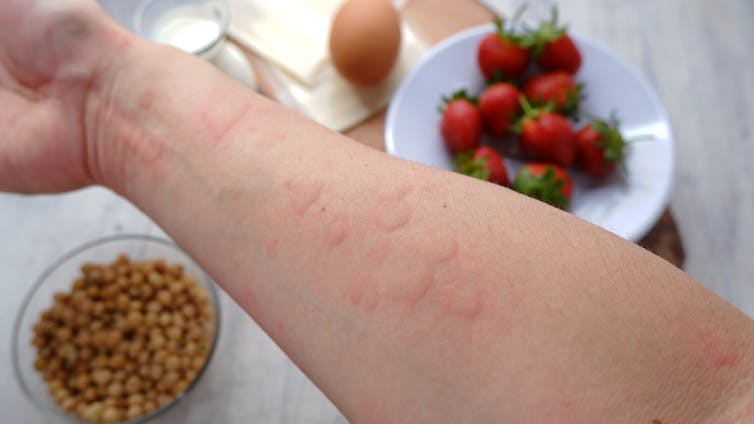
IgE-mediated food allergies can be life threatening, so all adults need an action management plan developed in consultation with their medical team.
Here are four IgE-mediated food allergies that can occur in adults – from relatively common ones to rare allergies you’ve probably never heard of.
1. Single food allergies
The most common IgE-mediated food allergies in adults in a US survey were to:
- shellfish (2.9%)
- cow’s milk (1.9%)
- peanut (1.8%)
- tree nuts (1.2%)
- fin fish (0.9%) like barramundi, snapper, salmon, cod and perch.
In these adults, about 45% reported reacting to multiple foods.
This compares to most common childhood food allergies: cow’s milk, egg, peanut and soy.
Overall, adult food allergy prevalence appears to be increasing. Compared to older surveys published in 2003 and 2004, peanut allergy prevalence has increased about three-fold (from 0.6%), while tree nuts and fin fish roughly doubled (from 0.5% each), with shellfish similar (2.5%).
While new adult-onset food allergies are increasing, childhood-onset food allergies are also more likely to be retained into adulthood. Possible reasons for both include low vitamin D status, lack of immune system challenges due to being overly “clean”, heightened sensitisation due to allergen avoidance, and more frequent antibiotic use.

2. Tick-meat allergy
Tick-meat allergy, also called α-Gal syndrome or mammalian meat allergy, is an allergic reaction to galactose-alpha-1,3-galactose, or α-Gal for short.
Australian immunologists first reported links between α-Gal syndrome and tick bites in 2009, with cases also reported in the United States, Japan, Europe and South Africa. The US Centers for Disease Control estimates about 450,000 Americans could be affected.
The α-Gal contains a carbohydrate molecule that is bound to a protein molecule in mammals.
The IgE-mediated allergy is triggered after repeated bites from ticks or chigger mites that have bitten those mammals. When tick saliva crosses into your body through the bite, antibodies to α-Gal are produced.
When you subsequently eat foods that contain α-Gal, the allergy is triggered. These triggering foods include meat (lamb, beef, pork, rabbit, kangaroo), dairy products (yoghurt, cheese, ice-cream, cream), animal-origin gelatin added to gummy foods (jelly, lollies, marshmallow), prescription medications and over-the counter supplements containing gelatin (some antibiotics, vitamins and other supplements).
Tick-meat allergy reactions can be hard to recognise because they’re usually delayed, and they can be severe and include anaphylaxis. Allergy organisations produce management guidelines, so always discuss management with your doctor.
3. Fruit-pollen allergy
Fruit-pollen allergy, called pollen food allergy syndrome, is an IgE-mediated allergic reaction.
In susceptible adults, pollen in the air provokes the production of IgE antibodies to antigens in the pollen, but these antigens are similar to ones found in some fruits, vegetables and herbs. The problem is that eating those plants triggers an allergic reaction.
The most allergenic tree pollens are from birch, cypress, Japanese cedar, latex, grass, and ragweed. Their pollen can cross-react with fruit and vegetables, including kiwi, banana, mango, avocado, grapes, celery, carrot and potato, and some herbs such as caraway, coriander, fennel, pepper and paprika.
Fruit-pollen allergy is not common. Prevalence estimates are between 0.03% and 8% depending on the country, but it can be life-threatening. Reactions range from itching or tingling of lips, mouth, tongue and throat, called oral allergy syndrome, to mild hives, to anaphylaxis.
4. Food-dependent, exercise-induced food allergy
During heavy exercise, the stomach produces less acid than usual and gut permeability increases, meaning that small molecules in your gut are more likely to escape across the membrane into your blood. These include food molecules that trigger an IgE reaction.
If the person already has IgE antibodies to the foods eaten before exercise, then the risk of triggering food allergy reactions is increased. This allergy is called food-dependent exercise-induced allergy, with symptoms ranging from hives and swelling, to difficulty breathing and anaphylaxis.

Common trigger foods include wheat, seafood, meat, poultry, egg, milk, nuts, grapes, celery and other foods, which could have been eaten many hours before exercising.
To complicate things even further, allergic reactions can occur at lower levels of trigger-food exposure, and be more severe if the person is simultaneously taking non-steroidal inflammatory medications like aspirin, drinking alcohol or is sleep-deprived.
Food-dependent exercise-induced allergy is extremely rare. Surveys have estimated prevalence as between one to 17 cases per 1,000 people worldwide with the highest prevalence between the teenage years to age 35. Those affected often have other allergic conditions such as hay fever, asthma, allergic conjunctivitis and dermatitis.
Allergies are a growing burden
The burden on physical health, psychological health and health costs due to food allergy is increasing. In the US, this financial burden was estimated as $24 billion per year.
Adult food allergy needs to be taken seriously and those with severe symptoms should wear a medical information bracelet or chain and carry an adrenaline auto-injector pen. Concerningly, surveys suggest only about one in four adults with food allergy have an adrenaline pen.
If you have an IgE-mediated food allergy, discuss your management plan with your doctor. You can also find more information at Allergy and Anaphylaxis Australia.
Clare Collins, Laureate Professor in Nutrition and Dietetics, University of Newcastle
This article is republished from The Conversation under a Creative Commons license. Read the original article.
Don’t Forget…
Did you arrive here from our newsletter? Don’t forget to return to the email to continue learning!
Recommended
Learn to Age Gracefully
Join the 98k+ American women taking control of their health & aging with our 100% free (and fun!) daily emails:
-
Eat Better, Feel Better – by Giada de Laurentis
10almonds is reader-supported. We may, at no cost to you, receive a portion of sales if you purchase a product through a link in this article.
In yesterday’s edition of 10almonds, we reviewed Dr. Aujla’s “The Doctor’s Kitchen“; today we’re reviewing a different book about healing through food—in this case, with a special focus on maintaining energy and good health as we get older.
De Laurentis may not be a medical doctor, but she is a TV chef, and not only holds a lot of influence, but also has access to a lot of celebrity doctors and such; that’s reflected a lot in her style and approach here.
The recipes are clear and easy to follow; well-illustrated and nicely laid-out.
This cookbook’s style is less “enjoy this hearty dish of rice and beans with these herbs and spices” and more “you can serve your steak salad with white beans and sweet shallot dressing on a bed of organic quinoa if you haven’t already had your day’s serving of grains, of course”.
It’s a little fancier, in short, and more focused on what to cut out, than what to include. On account of that, this could make it a good contrast to yesterday’s book, which had the opposite focus.
She also recommends assorted adjuvant practices; some that are evidence-based, like intermittent fasting and meditation, and some that are not, like extreme detox-dieting, and acupuncture (which has no bearing on gut health).
Bottom line: if you like the idea of eating for good health, and prefer a touch of celebrity lifestyle to your meals, this one’s a good book for you.
Share This Post
-
Plant Milk vs Dairy: His & Hers?
10almonds is reader-supported. We may, at no cost to you, receive a portion of sales if you purchase a product through a link in this article.
When it comes to osteoporosis risk, common wisdom says “get plenty of dairy”. However, there are several things to bear in mind:
- Milk is a great source of calcium, which is useless to the body if you don’t also have good levels of vitamin D and magnesium.
- People’s vitamin D levels tend to directly correlate to the level of sun where they live, if supplementation isn’t undertaken.
- Plant-based milks are usually fortified with vitamin D (and calcium), by the way.
- Most people are deficient in magnesium, because green leafy things don’t form as big a part of most people’s diets as they should.
See also: An update on magnesium and bone health
And of course, dairy has its own health risks, the relatively most well-known of which (sadly still not that well-known) is inflammation; see: How to Prevent (or Reduce) Inflammation
His & Hers
It’s interesting that some of the other health benefits/risks of dairy are contentious (i.e. mixed evidence), because in vitro modelling of sex differences in digestion of different kinds of milk (plant and animal) have found:
❝In the case of dairy milk, male gut conditions liberated various known bioactive peptides with antimicrobial, Dipeptidyl peptidase-4 inhibitor and cholesterol regulating activities.
Contrary, female gastric conditions led to the liberation of an osteoanabolic peptide. Moreover, female gut conditions were able to liberate more free amino acids from oat milk rather than from dairy milk while male conditions yielded an inverse trend.❞
Translating from sciencese:
- in the male model, cow-derived dairy milk proteins were broken down more efficiently, producing more antimicrobial peptides (that’s good, contextually)
- in the female model, oat-based plant milk proteins digested more efficiently, generating osteoanabolic peptides that are important for bone formation (that’s good in almost any context)
This becomes super-important when we note that women have, other things being equal, a much higher risk of osteoporosis than men.
You can read the paper in full here: Sex-based differences in in vitro digestibility of milk and oat drink, and powder counterparts
What about estrogen in soy milk?
That study used oat milk (which is very healthful).
However, since we’re talking plant milks and sex: many people cite the phytoestrogens in soy milk as a reason that women should drink it, and men should not. That’s half-correct:
- For women, the phytoestrogens in soy milk cannot be used as estrogen directly (not compatible with human estrogen), but it can be broken down and the parts used to make new, compatible, human estrogen (assuming you have working ovaries, to produce that estrogen).
- For men, the phytoestrogens in soy milk cannot be used as estrogen directly (not compatible with human estrogen), but it can be broken down and the parts used to make new, compatible, human testosterone (assuming you have working testes, to produce that testosterone).
This means, gentlemen-readers, that no, soy milk will not have any feminizing effect on you (unless you have ovaries instead of testes, in which case yes, it’ll boost your natural estrogen production).
See for example this research review with 439 sources of its own: Soy and Health Update: Evaluation of the Clinical and Epidemiologic Literature
You may be wondering why the “ingredients” of estrogen can be used to make testosterone. It’s because on a molecular level, they’re almost identical:
❝Both estradiol and testosterone have the “steroid nucleus” and a hydroxyl group in their structures.
Apart from estradiol, testosterone has a double bond and a ketone.❞
estradiol = the main kind of estrogen that we humans use
For the more visually-inclined, you can see the molecules diagrammed next to each other here, and play spot-the-difference!
If you’d like to explore different kinds of plant milk, we examine 6 of the best, here: Which Plant Milk?
Want to learn more?
You might want to check out this well-sourced LiveStrong article:
Bone Health: Best and Worst Foods
(Teaser: leafy greens are in 2nd place, topped by sardines at #1—where do you think dairy milk ranks?)
And if you want to dive much deeper into it than we have room to here, you’ll like this book that we reviewed a little while back; it covers today’s nutritional considerations comprehensively:
Take care!
Share This Post
-
Dr. Stacy Sims’ Guide to Fitness and Nutrition after 40
10almonds is reader-supported. We may, at no cost to you, receive a portion of sales if you purchase a product through a link in this article.
It’s worth noting that Dr. Sims has directed research programs at Stanford University focusing on female athlete health and performance, and she also has 94 peer-reviewed papers on the topic to her name.
Here’s what she has to say for those of us in the “women over 40” bracket:
What most people miss
Some notes on daily rhythm: Dr. Sims recommends to eat within an hour of waking, because cortisol spikes about 30 minutes afterwards, so, we can counter it with breakfast. She also advises we bookend our workouts with food, especially 30–40g of protein afterwards. Eat regularly through the day, have an adequate dinner, and avoid eating after dinner, to work with normal hormonal fluctuations.
You may be thinking “but I have long since menopaused; I do not have hormonal fluctuations”; in such a case, then do remember that “hormonal” doesn’t just mean sex hormones, it also means cortisol, serotonin, dopamine, leptin, ghrelin, insulin, and many others!
About heavy lifting after 40: declining estrogen changes muscle signalling, so women must rely more on central-nervous-system stimulation. Heavy loads create this stimulus, improving strength, power, lean mass, and nerve firing when hormonal signalling is reduced. So, lift heavy! But, also safely, please.
Some specific notes on high-intensity interval training (HIIT) of various kinds:
- SIT (sprint interval training): very short maximal bursts of 30 seconds or less at perceived exertion 9–10, followed by long recovery. effective for metabolic control and for signalling between skeletal muscle, the liver, and visceral fat. two intervals are usually the maximum for beginners if the effort is truly maximal.
- High-intensity training in general: true high intensity (e.g. 1–4 minute efforts at 80–90% of maximum heartrate with equal recovery) generates hormones that help lower cortisol afterwards. Moderate intensity does not create the same adaptive hormonal response.
On bone density, she recommends:
- Don’t bother with weighted vests for walking: wearing a weighted vest while walking can maintain existing bone but does not stimulate new growth. Basically, it doesn’t improve bone density because it lacks multi-directional stress, which is what’s needed per Wolff’s Law.
- Do use multi-directional jumps: for example, flat-footed pogo stick jumps or jumping rope, for about 10 minutes, three times per week. The “bone jump” app (developed from a 5-year study in 35–45-year-old women with low-normal bone density) provides structured jump progressions.
Two biggest things she wants us all to take into account, if we remember nothing else:
- Address sleep before fine-tuning training. Better sleep improves cravings, gut health, training response, and stress regulation.
- Ignore diet fads and instead focus on meal timing, consistent intake, and sufficient protein. Match your nutrition to your stress levels and training.
For more on all of this, enjoy:
Click Here If The Embedded Video Doesn’t Load Automatically!
Want to learn more?
You might also like:
Next Level – by Dr. Stacy Sims ← this is her book specifically about going from strength to strength through menopause and beyond 😎
Take care!
Share This Post
Related Posts
-
How to safely store and dispose of medication
10almonds is reader-supported. We may, at no cost to you, receive a portion of sales if you purchase a product through a link in this article.
What you need to know:
- Prescription and over-the-counter medications can be dangerous for kids and teens, especially opioids.
- Keep medication in a locked box or cabinet out of reach and sight of children, and return it there after each use.
- You can dispose of unused or expired prescription or over-the-counter medications at a drug take-back location.
Any prescription or over-the-counter medications can be dangerous when they’re not taken as prescribed or directed, especially for kids and teens. Opioids pose a particularly high risk since they can slow down or stop breathing and are very addictive.
A 2024 study found that while reported opioid exposures among young children declined between 2016 and 2023, there was a 300 percent absolute increase in the number of deaths and serious effects from opioids.
Correctly storing and disposing of medication, including opioids, is an important way to keep your family safe. Read on to learn how.
How can I safely store medication at home?
Keep medication in a locked box or cabinet out of reach and sight of children, and return it there after each use. If you need to carry medication with you, keep it in its original packaging and ensure that it has a childproof lid.
“Kids are coming to the ER because of ingestion issues every nine minutes right now. That’s how prevalent it is,” said Shannon Moody, the chief policy and strategy officer of Kentucky Youth Advocates, in a Spectrum News article. Moody explained that large doses of medication could damage children’s organs, including the liver, lungs, and heart.
If you spill pills or liquid medication, clean it up immediately. For some medications like opioids, even a small amount can be life-threatening for children.
How do I dispose of unused medication?
You can dispose of unused or expired prescription or over-the-counter medications at a drug take-back location. Find local, authorized drug take-back locations using this search tool. Not every location accepts all types of medications, so it’s a good idea to ask about your specific medications. Don’t forget to remove personal information from medication bottles before disposal.
Medication can also be mailed using a prepaid drug mail-back envelope, which may be available for free at some pharmacies.
“If you don’t have a take-back location nearby, you can dispose of your medication in your household garbage. But you should remove it from the bottle and mix it with coffee grounds or kitty litter,” said pharmacist Stacia Woodcock in a CBS News article.
Some medications can also be flushed down a toilet. However, flushing should be a backup plan after exhausting other options. Learn which medications can be flushed by reviewing the Food and Drug Administration’s flush list.
What should I tell children and teens about medication safety?
Always supervise young children when you’re giving them any medication, and make sure that they know to never take someone else’s medication.
Educate preteens and teens on how to read medication labels. If they’re independently taking their daily medication, check in to ensure that they are taking the appropriate dose, and reiterate the risks of not taking medication as prescribed or sharing it with others.
Sudden changes in mood, behavior, hygiene, or health or missing medication could be signs that your child or teen is using medication recreationally. Their pediatrician can connect you to providers who can help.
What should I do if my child ingested medication they weren’t prescribed?
If you believe your child ingested medication they weren’t prescribed or an unknown amount of any medication, contact Poison Control immediately at 1-800-222-1222, and watch for unusual behavior.
“You should bring your child to the hospital anytime there is a change in mental status, slurred speech or a child is not acting appropriately,” said Dr. Meghan Martin, a pediatric emergency medicine physician, in a Johns Hopkins article.
If your child is unconscious, having a seizure, or having trouble breathing, call 911.
Since opioids are very dangerous for kids, it’s important to know the signs of an opioid overdose, such as unconsciousness, slow or shallow breathing, gurgling sounds, blue or purple lips or nails, and very small (pinpoint) pupils that don’t react to light. Keep naloxone, a medication that can reverse an opioid overdose, on hand, especially if you or someone else in your household is prescribed opioids.
You can get naloxone (also sold as Narcan) for free at many harm reduction programs, or you can purchase it without a prescription at pharmacies, at some convenience stores, and online. It’s safe for people of all ages, including infants.
“It is such an important lifesaving medication, with really no side effects and no danger from using it, that everyone should just consider having it as a part of their first aid kit,” said Dr. Erin McKnight, medical director of the Substance Use Treatment and Recovery Program at Nationwide Children’s Hospital, in a 2023 Washington Post article. “It’s one of those things that you don’t realize you need until the moment arises.”
Ask your pediatrician about using naloxone for overdoses in children. Always call 911 if you believe someone in your household is experiencing an overdose, even if you’ve administered naloxone.
For more information, talk to your health care provider.
This article first appeared on Public Good News and is republished here under a Creative Commons Attribution-NoDerivatives 4.0 International License.
Don’t Forget…
Did you arrive here from our newsletter? Don’t forget to return to the email to continue learning!
Learn to Age Gracefully
Join the 98k+ American women taking control of their health & aging with our 100% free (and fun!) daily emails:
-
Which gut drugs might end up in a lawsuit? Are there really links with cancer and kidney disease? Should I stop taking them?
10almonds is reader-supported. We may, at no cost to you, receive a portion of sales if you purchase a product through a link in this article.
Common medicines used to treat conditions including heartburn, reflux, indigestion and stomach ulcers may be the subject of a class action lawsuit in Australia.
Lawyers are exploring whether long-term use of these over-the-counter and prescription drugs are linked to stomach cancer or kidney disease.
The potential class action follows the settlement of a related multi-million dollar lawsuit in the United States. Last year, international pharmaceutical company AstraZeneca settled for US$425 million (A$637 million) after patients made the case that two of its drugs caused significant and potentially life-threatening side effects.
Specifically, patients claimed the company’s drugs Nexium (esomeprazole) and Prilosec (omeprazole) increased the risk of kidney damage.
Doucefleur/Shutterstock Which drugs are involved in Australia?
The class of drugs we’re talking about are “proton pump inhibitors” (sometimes called PPIs). In the case of the Australian potential class action, lawyers are investigating:
- Nexium (esomeprazole)
- Losec, Asimax (omeprazole)
- Somac (pantoprazole)
- Pariet (rabeprazole)
- Zoton (lansoprazole).
Depending on their strength and quantity, these medicines are available over-the-counter in pharmacies or by prescription.
They have been available in Australia for more than 20 years and are in the top ten medicines dispensed through the Pharmaceutical Benefits Scheme.
They are used to treat conditions exacerbated by stomach acid. These include heartburn, gastric reflux and indigestion. They work by blocking the protein responsible for pumping acid into the stomach.
These drugs are also prescribed with antibiotics to treat the bacterium Helicobacter pylori, which causes stomach ulcers and stomach cancer.
This class of drugs is also used with antibiotics to treat Helicobacter pylori infections. nobeastsofierce/Shutterstock What do we know about the risks?
Appropriate use of proton pump inhibitors plays an important role in treating several serious digestive problems. Like all medicines, there are risks associated with their use depending on how much and how long they are used.
When proton pump inhibitors are used appropriately for the short-term treatment of stomach problems, they are generally well tolerated, safe and effective.
Their risks are mostly associated with long-term use (using them for more than a year) due to the negative effects from having reduced levels of stomach acid. In elderly people, these include an increased risk of gut and respiratory tract infections, nutrient deficiencies and fractures. Long-term use of these drugs in elderly people has also been associated with an increased risk of dementia.
In children, there is an increased risk of serious infection associated with using these drugs, regardless of how long they are used.
How about the cancer and kidney risk?
Currently, the Australian consumer medicine information sheets that come with the medicines, like this one for esomeprazole, do not list stomach cancer or kidney injury as a risk associated with using proton pump inhibitors.
So what does the evidence say about the risk?
Over the past few years, there have been large studies based on observing people in the general population who have used proton pump inhibitors. These studies have found people who take them are almost two times more likely to develop stomach cancer and 1.7 times more likely to develop chronic kidney disease when compared with people who are not taking them.
In particular, these studies report that users of the drugs lansoprazole and pantoprazole have about a three to four times higher risk than non-users of developing chronic kidney disease.
While these observational studies show a link between using the drugs and these outcomes, we cannot say from this evidence that one causes the other.
Researchers have not yet shown these drugs cause kidney disease. crystal light/Shutterstock What can I do if I’m worried?
Several digestive conditions, especially reflux and heartburn, may benefit from simple dietary and lifestyle changes. But the overall evidence for these is not strong and how well they work varies between individuals.
But it may help to avoid large meals within two to three hours before bed, and reduce your intake of fatty food, alcohol and coffee. Eating slowly and getting your weight down if you are overweight may also help your symptoms.
There are also medications other than proton pump inhibitors that can be used for heartburn, reflux and stomach ulcers.
These include over-the-counter antacids (such as Gaviscon and Mylanta), which work by neutralising the acidic environment of the stomach.
Alternatives for prescription drugs include nizatidine and famotidine. These work by blocking histamine receptors in the stomach, which decreases stomach acid production.
If you are concerned about your use of proton pump inhibitors it is important to speak with your doctor or pharmacist before you stop using them. That’s because when you have been using them for a while, stopping them may result in increased or “rebound” acid production.
Nial Wheate, Professor and Director – Academic Excellence, Macquarie University; Joanna Harnett, Senior Lecturer – Sydney Pharmacy School, Faculty of Medicine and Health, University of Sydney, and Wai-Jo Jocelin Chan, Pharmacist and Associate Lecturer, University of Sydney
This article is republished from The Conversation under a Creative Commons license. Read the original article.
Don’t Forget…
Did you arrive here from our newsletter? Don’t forget to return to the email to continue learning!
Learn to Age Gracefully
Join the 98k+ American women taking control of their health & aging with our 100% free (and fun!) daily emails:
-
Pineapple vs Passion fruit – Which is Healthier?
10almonds is reader-supported. We may, at no cost to you, receive a portion of sales if you purchase a product through a link in this article.
Our Verdict
When comparing pineapple to passion fruit, we picked the passion fruit.
Why?
Both certainly have their strong points, and this one was very close!
In terms of macros, passion fruit has about 4x the protein, nearly 2x the carbs, and more than 7x the fiber. So, this one’s a clear and overwhelming win for passion fruit.
Vitamins are quite close; pineapple has more of vitamins B1, B5, B6, B9, and C, while passion fruit has more of vitamins A, B2, and B3. So, a modest 5:3 win for pineapple.
When it comes to minerals, pineapple has more calcium, copper, manganese, and zinc, while passion fruit has more iron, manganese, phosphorus, potassium, and selenium. Superficially, this would be a 5:5 tie, but looking at the numbers, passion fruit’s margins of difference are much greater, which means it gives the better overall mineral coverage, and thus wins the category on tiebreakers.
In other considerations, pineapple has more polyphenols with its variety of lignans, while passion fruit has just secoisolariciresinol, of which pineapple has more anyway. Plus, not a polyphenol but doing much of the same job, pineapple has bromelain, which is unique to it. So pineapple wins this category easily.
Adding up the sections and weighting them for importance (e.g. what a difference it makes to health) and statistical relevance (e.g. greater or smaller margins of difference) makes for a nominal passion fruit win, but like we say, both of these fruits are great, so do enjoy both!
Want to learn more?
You might like to read:
Bromelain vs Inflammation & Much More
Take care!
Don’t Forget…
Did you arrive here from our newsletter? Don’t forget to return to the email to continue learning!
Learn to Age Gracefully
Join the 98k+ American women taking control of their health & aging with our 100% free (and fun!) daily emails:


