

Why do disinfectants only kill 99.9% of germs? Here’s the science
10almonds is reader-supported. We may, at no cost to you, receive a portion of sales if you purchase a product through a link in this article.
Have you ever wondered why most disinfectants indicate they kill 99.9% or 99.99% of germs, but never promise to wipe out all of them? Perhaps the thought has crossed your mind mid-way through cleaning your kitchen or bathroom.
Surely, in a world where science is able to do all sorts of amazing things, someone would have invented a disinfectant that is 100% effective?
The answer to this conundrum requires understanding a bit of microbiology and a bit of mathematics.
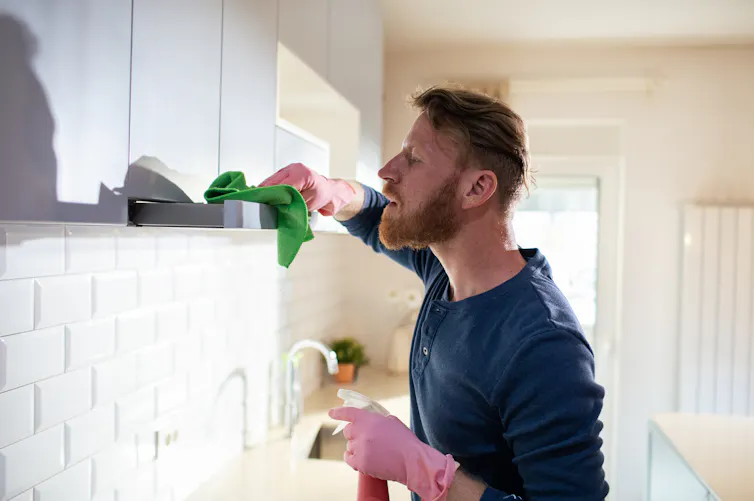
What is a disinfectant?
A disinfectant is a substance used to kill or inactivate bacteria, viruses and other microbes on inanimate objects.
There are literally millions of microbes on surfaces and objects in our domestic environment. While most microbes are not harmful (and some are even good for us) a small proportion can make us sick.
Although disinfection can include physical interventions such as heat treatment or the use of UV light, typically when we think of disinfectants we are referring to the use of chemicals to kill microbes on surfaces or objects.
Chemical disinfectants often contain active ingredients such as alcohols, chlorine compounds and hydrogen peroxide which can target vital components of different microbes to kill them.

The maths of microbial elimination
In the past few years we’ve all become familiar with the concept of exponential growth in the context of the spread of COVID cases.
This is where numbers grow at an ever-accelerating rate, which can lead to an explosion in the size of something very quickly. For example, if a colony of 100 bacteria doubles every hour, in 24 hours’ time the population of bacteria would be more than 1.5 billion.
Conversely, the killing or inactivating of microbes follows a logarithmic decay pattern, which is essentially the opposite of exponential growth. Here, while the number of microbes decreases over time, the rate of death becomes slower as the number of microbes becomes smaller.
For example, if a particular disinfectant kills 90% of bacteria every minute, after one minute, only 10% of the original bacteria will remain. After the next minute, 10% of that remaining 10% (or 1% of the original amount) will remain, and so on.
Because of this logarithmic decay pattern, it’s not possible to ever claim you can kill 100% of any microbial population. You can only ever scientifically say that you are able to reduce the microbial load by a proportion of the initial population. This is why most disinfectants sold for domestic use indicate they kill 99.9% of germs.
Other products such as hand sanitisers and disinfectant wipes, which also often purport to kill 99.9% of germs, follow the same principle.

Real-world implications
As with a lot of science, things get a bit more complicated in the real world than they are in the laboratory. There are a number of other factors to consider when assessing how well a disinfectant is likely to remove microbes from a surface.
One of these factors is the size of the initial microbial population that you’re trying to get rid of. That is, the more contaminated a surface is, the harder the disinfectant needs to work to eliminate the microbes.
If for example you were to start off with only 100 microbes on a surface or object, and you removed 99.9% of these using a disinfectant, you could have a lot of confidence that you have effectively removed all the microbes from that surface or object (called sterilisation).
In contrast, if you have a large initial microbial population of hundreds of millions or billions of microbes contaminating a surface, even reducing the microbial load by 99.9% may still mean there are potentially millions of microbes remaining on the surface.
Time is is a key factor that determines how effectively microbes are killed. So exposing a highly contaminated surface to disinfectant for a longer period is one way to ensure you kill more of the microbial population.
This is why if you look closely at the labels of many common household disinfectants, they will often suggest that to disinfect you should apply the product then wait a specified time before wiping clean. So always consult the label on the product you’re using.
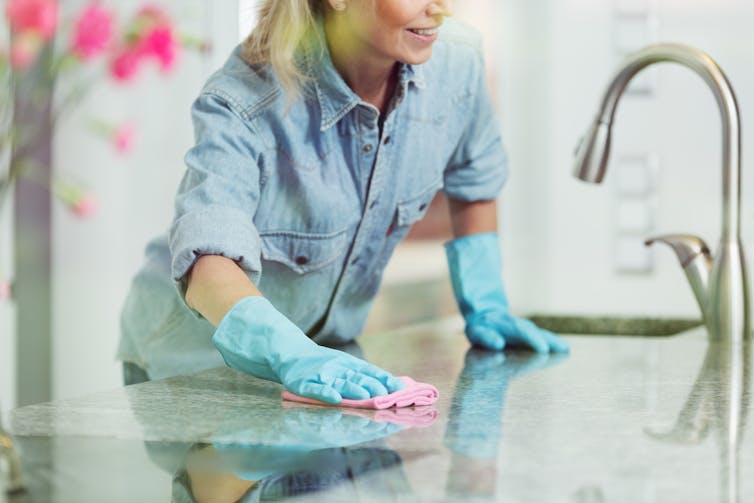
Other factors such as temperature, humidity and the type of surface also influence how well a disinfectant works outside the lab.
Similarly, microbes in the real world may be either more or less sensitive to disinfection than those used for testing in the lab.
Disinfectants are one part infection control
The sensible use of disinfectants plays an important role in our daily lives in reducing our exposure to pathogens (microbes that cause illness). They can therefore reduce our chances of getting sick.
The fact disinfectants can’t be shown to be 100% effective from a scientific perspective in no way detracts from their importance in infection control. But their use should always be complemented by other infection control practices, such as hand washing, to reduce the risk of infection.
Hassan Vally, Associate Professor, Epidemiology, Deakin University
This article is republished from The Conversation under a Creative Commons license. Read the original article.
Don’t Forget…
Did you arrive here from our newsletter? Don’t forget to return to the email to continue learning!
Recommended
Learn to Age Gracefully
Join the 98k+ American women taking control of their health & aging with our 100% free (and fun!) daily emails:
-
Lime vs Mango – Which is Healthier?
10almonds is reader-supported. We may, at no cost to you, receive a portion of sales if you purchase a product through a link in this article.
Our Verdict
When comparing limes to mangos, we picked the mangos.
Why?
In terms of macros, limes get off to a good start with more fiber, while mangos have more carbs, making this a first round win for limes.
However, in the category of vitamins, limes are not higher in any vitamins (no, not even vitamin C), while mangos are higher in vitamins A, B2, B3, B6, B9, C, E, and K, winning easily.
Looking at minerals, limes have more calcium, iron, phosphorus, and zinc, while mangos have more copper, magnesium, manganese, potassium, and selenium, scoring a marginal win for mangos here.
Adding up the sections makes for an overall win for mangos, but by all means enjoy either or both, and after all, their culinary uses are often quite different in any case, but their relative nutritional densities are always good to know, and…
If you love getting enough vitamin C but don’t love sour tastes, then the fact that mangos have more vitamin C than limes is a very good thing to remember!
Want to learn more?
You might like:
Eat Your Vitamins – by Mascha Davis, RDN ← the how and why of getting good amounts of vitamins from food rather than from supplements
Enjoy!
Share This Post
-
Does Your Butt…Wink?
10almonds is reader-supported. We may, at no cost to you, receive a portion of sales if you purchase a product through a link in this article.
What is a Butt Wink?
A “butt wink” is a common issue that occurs during squatting exercises.
Now, we’ve talked about the benefits of squatting countless times (see here or here for just a few examples). As with all exercises, using the correct technique is imperative, helping to both reduce injury and maximize gain.
Given butt winks are a common issue when squatting, we thought it natural to devote an article to it.
So, a butt wink happens when, at the bottom of your squat position, your pelvis tucks rotates backward (otherwise known as a “posterior pelvic tilt”) and the lower back rounds. This motion looks like a slight ‘wink’, hence the name.
How to Avoid Butt Winking
When the pelvis tucks under and the spine rounds, it can put undue pressure on the lumbar discs. This is especially risky when squatting with weights, as it can exacerbate the stress on the spine.
To avoid a butt wink, it’s important to maintain a neutral spine throughout the squat and to work on flexibility and strength in the hips, glutes, and hamstrings. Adjusting the stance width or foot angle during squats can also help in maintaining proper form.
A visual representation would likely work better than our attempt at describing what to do, so without further ado, here’s today’s video:
How was the video? If you’ve discovered any great videos yourself that you’d like to share with fellow 10almonds readers, then please do email them to us!
Share This Post
-
The Polyvagal Theory – by Dr. Stephen Porges
10almonds is reader-supported. We may, at no cost to you, receive a portion of sales if you purchase a product through a link in this article.
Do you ever find that your feelings (or occasionally: lack thereof) sometimes can seem mismatched with the observed facts of your situation? This book unravels that mystery—or rather, that stack of mysteries.
Dr. Porges’ work on this topic is, by the way, the culmination of 40 years of research. While he’s not exactly a household name to the layperson, he’s very respected in his field, and this book is his magnum opus.
Here he explains the disparate roles of the two branches of the vagus nerve (hence: polyvagal theory). At least, the two branches that we mammals have; non-mammalian vertebrates have only one. This makes a big difference, because of the cascade of inhibitions that this allows.
The answer to the very general question “What stops you from…?” is usually found somewhere down this line of cascade of inhibitions.
These range from “what stops you from quitting your job/relationship/etc” to “what stops you from freaking out” to “what stops you from relaxing” to “what stops you from reacting quickly” to “what stop you from giving up” to “what stops you from gnawing your arm off” and many many more.
And because sometimes we wish we could do something that we can’t, or wish we wouldn’t do something that we do, understanding this process can be something of a cheat code to life.
A quick note on style: the book is quite dense and can be quite technical, but should be comprehensible to any layperson who is content to take their time, because everything is explained as we go along.
Bottom line: if you’d like to better understand the mysteries of how you feel vs how you actually are, and what that means for what you can or cannot wilfully do, this is a top-tier book
Click here to check out Polyvagal Theory, and take control of your responses!
Share This Post
Related Posts
-
Dietary Changes for Artery Health
10almonds is reader-supported. We may, at no cost to you, receive a portion of sales if you purchase a product through a link in this article.
It’s Q&A Day at 10almonds!
Have a question or a request? You can always hit “reply” to any of our emails, or use the feedback widget at the bottom!
In cases where we’ve already covered something, we might link to what we wrote before, but will always be happy to revisit any of our topics again in the future too—there’s always more to say!
As ever: if the question/request can be answered briefly, we’ll do it here in our Q&A Thursday edition. If not, we’ll make a main feature of it shortly afterwards!
So, no question/request too big or small
❝How does your diet change clean out your arteries of the bad cholesterol?❞
There’s good news and bad news here, and they can both be delivered with a one-word reply:
Slowly.
Or rather: what’s being cleaned out is mostly not the LDL (bad) cholesterol, but rather, the result of that.
When our diet is bad for cardiovascular health, our arteries get fatty deposits on their walls. Cholesterol gets stuck here too, but that’s not the main physical problem.
Our body’s natural defenses come into action and try to clean it up, but they (for example macrophages, a kind of white blood cell that consumes invaders and then dies, before being recycled by the next part of the system) often get stuck and become part of the buildup (called atheroma), which can lead to atherosclerosis and (if calcium levels are high) hardening of the arteries, which is the worst end of this.
This can then require medical attention, precisely because the body can’t remove it very well—especially if you are still maintaining a heart-unhealthy diet, thus continuing to add to the mess.
However, if it is not too bad yet, yes, a dietary change alone will reverse this process. Without new material being added to the arterial walls, the body’s continual process of rejuvenation will eventually fix it, given time (free from things making it worse) and resources.
In fact, your arteries can be one of the quickest places for your body to make something better or worse, because the blood is the means by which the body moves most things (good or bad) around the body.
All the more reason to take extra care of it, since everything else depends on it!
You might also like our previous main feature:
Don’t Forget…
Did you arrive here from our newsletter? Don’t forget to return to the email to continue learning!
Learn to Age Gracefully
Join the 98k+ American women taking control of their health & aging with our 100% free (and fun!) daily emails:
-
Wholewheat Bread vs Seeded White – Which is Healthier?
10almonds is reader-supported. We may, at no cost to you, receive a portion of sales if you purchase a product through a link in this article.
Our Verdict
When comparing wholewheat bread to seeded bread, we picked the wholewheat.
Why?
First, we will acknowledge that this is a false dichotomy; it is possible to have seeded wholewheat bread. However, it is very common to have wholewheat bread that isn’t seeded, and white bread that is seeded. So, it’s important to be able to decide which is the healthier option, since very often, this false dichotomy is what’s on offer.
We will also advise checking labels (or the baker, if getting from a bakery) to ensure that visibly brown bread is actually wholewheat, and not just dyed brown with caramel coloring or such (yes, that is a thing that some companies do).
Now, as for why we chose the wholewheat over the seeded white…
In terms of macronutrients, wholewheat bread has (on average; individual breads may vary of course) has 2x the protein and a lot more fiber.
Those seeds in seeded bread? They just aren’t enough to make a big impact on the overall nutritional value of the bread in those regards. Per slice, you are getting, what, 10 seeds maybe? This is not a meaningful dietary source of much.
Seeded bread does have proportionally more healthy fats, but the doses are still so low as to make it not worth the while; it just looks like a lot of expressed as a percentage of comparison, because of the wholewheat bread has trace amounts, and the seeded bread has several times those trace amounts, it’s still a tiny amount. So, we’d recommend looking to other sources for those healthy fats.
Maybe dip your bread, of whatever kind, into extra virgin olive oil, for example.
Wholewheat bread of course also has a lower glycemic index. Those seeds in seeded white bread don’t really slow it down at all, because they’re not digested until later.
Want to learn more?
You might like to read:
- Carb-Strong or Carb-Wrong?
- Level-Up Your Fiber Intake! (Without Difficulty Or Discomfort)
- Gluten: What’s The Truth?
Enjoy!
Don’t Forget…
Did you arrive here from our newsletter? Don’t forget to return to the email to continue learning!
Learn to Age Gracefully
Join the 98k+ American women taking control of their health & aging with our 100% free (and fun!) daily emails:
-
JoyFull – by Radhi Devlukia-Shetty
10almonds is reader-supported. We may, at no cost to you, receive a portion of sales if you purchase a product through a link in this article.
We haven’t done a recipe book in a little while, so here’s a good one!
The focus of this book is getting more plants and spices into your diet, and doing it deliciously.
Healthwise, there is nothing controversial here: the recipes are all plant-based, mostly whole-foods, and the items that aren’t whole foods are things like “vanilla extract”.
The recipes themselves (of which there are 125) are presented clearly and simply, one to a double-page (although sometimes there will be a suggested variation on the same double-page), ideal for use in a kitchen bookstand. For each recipe, there’s a clear photo of the end result, so you know what you’re working towards.
The ingredients are not too obscure, and can be acquired from more or less any large supermarket.
Bottom line: if you’re looking to expand your plant-based cooking repertoire in a way that’s not just substitutions, then this book provides an excellent variety.
Click here to check out JoyFull, and get a taste of Ayurvedic cooking!
Don’t Forget…
Did you arrive here from our newsletter? Don’t forget to return to the email to continue learning!
Learn to Age Gracefully
Join the 98k+ American women taking control of their health & aging with our 100% free (and fun!) daily emails:


