
What’s the difference between freckles, sunspots and moles?
10almonds is reader-supported. We may, at no cost to you, receive a portion of sales if you purchase a product through a link in this article.
You’ve got a new brown spot on your face, but is it a freckle or a sunspot? Or perhaps you’ve found a spot on your back that looks like a mole but is flatter than your other ones – is it a mole or a dark freckle?
Here’s how to tell the difference between freckles, sunspots and moles – and when you need to get a spot checked to see if it’s skin cancer.
Freckles
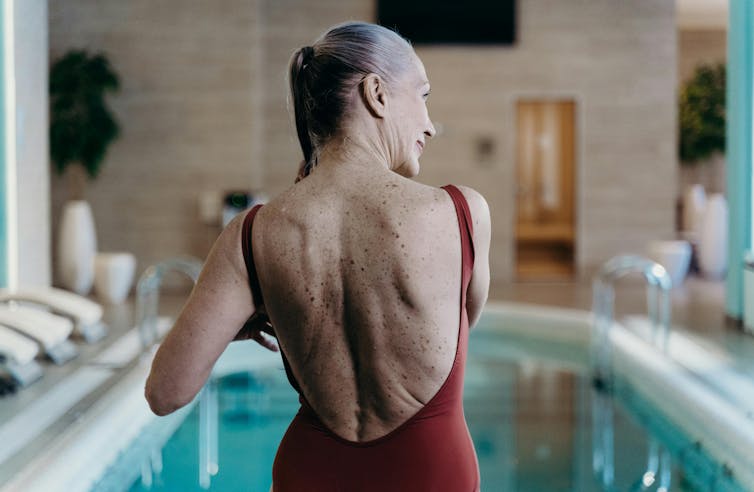
Freckles, known as ephelides, are small, flat, light brown spots that appear on people with fair skin, or red or light-coloured hair.
These people are more likely to have the MC1R gene, which leads to freckles forming.
Freckles are caused by sun exposure and are more noticeable in summer. When sunlight hits the skin, cells called melanocytes produce melanin, the pigment that gives skin its colour.
In people prone to freckles, the melanin doesn’t spread evenly. Instead, it clumps together, creating freckles.
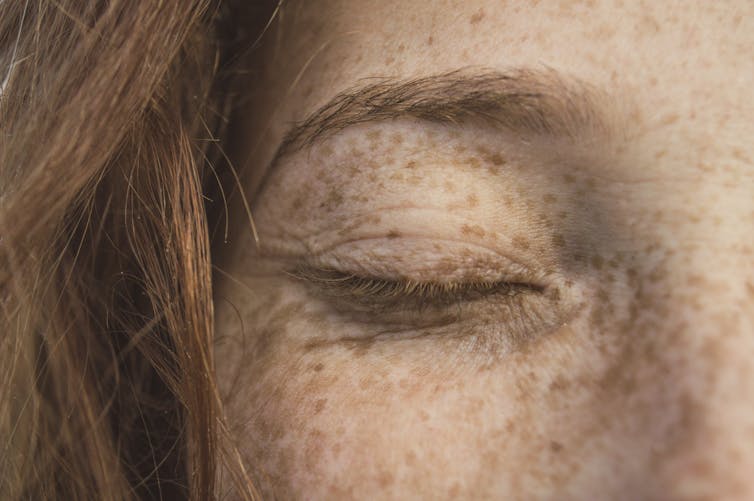
Freckles generally appear in childhood and may fade with age, especially if sun exposure reduces. As we age we produce less melanin, or it can break down or disperse, resulting in lighter or fewer freckles.
Using sunscreen and wearing protective clothing can help prevent new freckles from developing, especially on the face and arms.
While freckles are completely harmless, they are a sign that someone is genetically at higher risk of developing skin cancer.
Sunspots
Sunspots are also called age spots or solar lentigos (or liver spots, but they have nothing to do with the liver). They are larger than freckles: sometimes the size of a small coin, and appear as flat brown spots.
Sunspots develop over time due to long-term sun exposure, which leads to excessive melanin production. They tend to appear on skin with greater sun exposure, such as the face, hands, shoulders and arms.
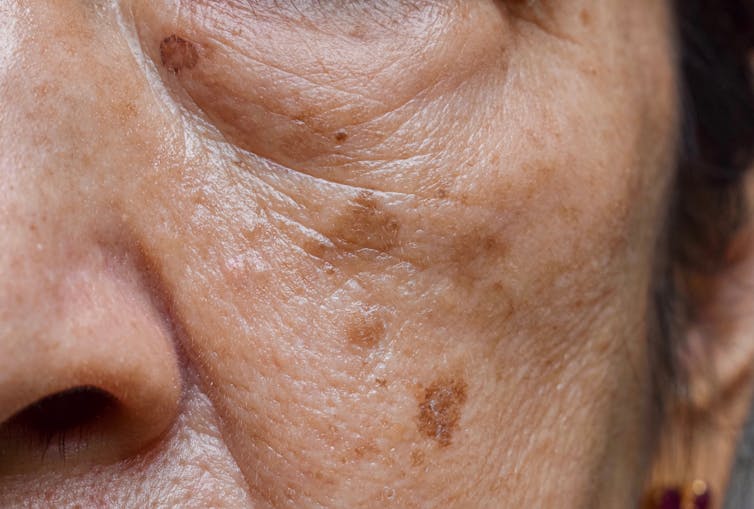
Unlike freckles, which tend to get lighter with less sun exposure, sunspots will not fade with time, and may further darken with continued sun exposure.
However, some people try to remove their sunspots for cosmetic reasons using either a laser, chemical peel or a prescription topical cream.
While sunspots are not dangerous, they do increase your risk of other skin cancers in that area.
It’s also important to monitor them, as slow-growing melanomas may initially look like sunspots. If you see the spot changes in size, shape or colour, see your doctor to rule out skin cancer.
Moles
Moles are often dark, raised or flat skin growths that can appear anywhere on your body.
Although moles can exist from birth, they typically grow during childhood, adolescence and early adulthood (including during pregnancy, when hormones are changing), until around the age of around 40. Moles can increase in size, and new ones can also appear.
Most adults have between ten and 40 moles on their body. A person with a high mole count has 50 or more, while someone with a very high mole count has 100 or more.
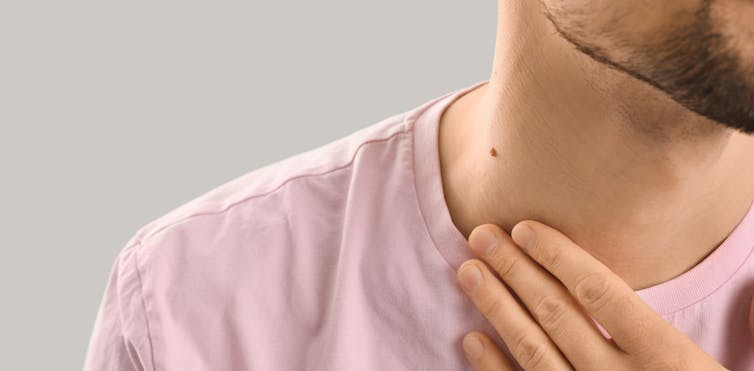
Moles form when melanocytes grow in clusters instead of spreading evenly throughout the skin.
Moles can either be raised or flat, depending upon their type, depth and age.
Raised moles, referred to as compound nevi, have both flat and raised portions and typically have pigment that is deeper in the skin.
Dermal nevi are skin-coloured or light brown moles that are also raised.
Most moles are harmless. Some may have hair growing from them and some may disappear, whereas other moles may darken or alter with age or hormonal changes.
However, some moles can develop into melanoma, a dangerous form of skin cancer.
When to see your doctor
While freckles and sunspots are completely harmless, moles do require more attention, especially if they change in size, shape, colour or texture.
If a mole shows any of the following warning signs, see your doctor, who will use the ABCDE rule to detect if a lesion is a skin cancer:
- asymmetry: if one half of the mole looks different from the other half
- border: if your mole is shaped irregularly, jagged or has poorly defined edges
- colour: varied shades or sudden changes in colour of the mole
- diameter: if it is larger than 6 millimeters (about the size of a pencil eraser)
- evolving: if your mole has any changes in its size, shape, colour, or sensation such as itching or bleeding for more than a few weeks.
Our research shows only 21.7% of people can correctly identify melanoma on their own, so professional checks are essential.
How to prevent skin damage
Since freckles, sunspots and some moles are influenced by exposure to the sun, you can protect your skin by:
- avoiding the sun when ultraviolet rays are strongest
- wearing sunscreen with SPF 50 every day, even when it’s cloudy. Apply it 20 minutes before going outside and reapply every two hours
- wearing protective clothing, including a wide-brimmed hat to cover your face, neck and ears, and long-sleeved shirts and pants to protect your arms and legs.
Correction: this article originally referred to sun sports as actinic keratoses rather than solar lentigos.
Mike Climstein, Associate Professor, Faculty of Health, Southern Cross University; Jeremy Hudson, Adjunct Associate Professor, Faculty of Health, Southern Cross University; Michael Stapelberg, Adjunct Associate Professor, Faculty of Health, Southern Cross University, and Nedeljka Rosic, Senior Lecturer, Faculty of Health, Southern Cross University
This article is republished from The Conversation under a Creative Commons license. Read the original article.
Don’t Forget…
Did you arrive here from our newsletter? Don’t forget to return to the email to continue learning!

Recommended
Learn to Age Gracefully
Join the 98k+ American women taking control of their health & aging with our 100% free (and fun!) daily emails:
-
7 Days Of Celery Juice: What’s The Verdict?
10almonds is reader-supported. We may, at no cost to you, receive a portion of sales if you purchase a product through a link in this article.
Laura “Try” tries many popular trends, and reports on the benefits (or problems, or both). In this case, it’s 7 days of celery juice… Not as a fast, though, i.e. she doesn’t just have celery juice for 7 days, but rather, it’s how she kicks off each morning, with half a liter (16oz) on an empty stomach.
What she found
First, she bought a masticating juicer and organic celery. So, those are expenses to consider, especially the one-off expense of the juicer, and the ongoing expense of organic celery—estimated $90/month).
In terms of taste, she was surprised it wasn’t as bitter as expected, but from the second day onwards, she did use the juicer’s filter to remove the frothy sludge, and she also switched to juicing only the stalks, not the leaves—which are more bitter.
10almonds note: the leaves are more bitter because that’s where the polyphenols are more densely concentrated. The leaves are better for you than the stalks. Enjoy the leaves. Really: if you chop them finely you can use them as herbs in your cooking, and if you’re making a salad, just chop them into that too.
The reason she picked the quantity of half a liter is because this is what she found recommended to coat the stomach lining—on the promise of increased stomach acid production, reduced bacteria overgrowth, as well as antiviral, antifungal, and anti-inflammatory properties. As she’s just one woman without a personal lab, she couldn’t test and thus verify any of these though—but she did still have benefits to report:
She did experience clearer skin, more energy, and better sleep after a few days.
Ultimately, she decided to continue to do it just at the weekends, due to its positive effects, despite the cost and time consumption.
For more personal insights, enjoy:
Click Here If The Embedded Video Doesn’t Load Automatically!
Want to learn more?
You might also like to read:
Enjoy Bitter Foods For Your Heart & Brain
Take care!
Share This Post
-
How To Get Unstuck
10almonds is reader-supported. We may, at no cost to you, receive a portion of sales if you purchase a product through a link in this article.
At 10almonds we sometimes say “mental health is also simply health”, and in this video, we get an examination of how one’s state of mind affects physical health and life in general—for better or for worse—and how to shift out of the wrong mental gear and into a better one:
Inside out
Zuzka notes that feeling stuck is often a result of fear and limited perspective, not an actual lack of options. Now, this does not mean that external circumstances don’t exist, or that we go through life without limitations. But it does mean we must start by asking ourselves the right questions, such as in this case, “Am I being resourceful right now?”
For her, she considers that being resourceful means seeking solutions and seeing possibilities, even in difficult situations—and that it’s a skill that can be trained like a muscle.
To that end, she champions trying things even if we think we may fail (indeed, she acknowledges that experiencing failure is inevitable and/but ultimately, however, learning from short-term failure increases chances of long-term success).
In the case of being afraid (of failure, or more specifically, trying hard and failing anyway, which can feel worse than not trying at all), she recommends that small actions (which she calls actions of “micro-bravery”) can break the cycle and reduce fear—which is important, because otherwise, fear only grows over time if we avoid taking actions to challenge it.
For more on all of this, enjoy:
Click Here If The Embedded Video Doesn’t Load Automatically!
Want to learn more?
You might also like:
The Most Anti-Aging Exercise ← this same YouTuber’s most well-known video (and our discussion of it). She is, by the way, in her early 40s at time of writing. So, rather younger than the average 10almonds reader, but also rather older than the average fitness influencer!
Take care!
Share This Post
-
The Anti-Viral Gut – by Dr. Robynne Chutkan
10almonds is reader-supported. We may, at no cost to you, receive a portion of sales if you purchase a product through a link in this article.
Some people get a virus and feel terrible for a few days; other people get the same virus and die. Then there are some who never even get it at all despite being in close proximity with the other two. So, what’s the difference?
Dr. Robynne Chutkan outlines the case for the difference not being in the virus, but in the people. And nor is it a matter of mysterious fate, but rather, a matter of the different levels of defenses (or lack thereof) that we each have.
The key, she explains, is in our microbiome, and the specific steps to make sure that ours is optimized and ready to protect us. The book goes beyond “eat prebiotics and probiotics”, though, and goes through other modifiable factors, based on data from this pandemic and the last one a hundred years ago. We also learn about the many different kinds of bacteria that live in our various body parts (internal and external), because as it turns out, our gut microbiome (however important; hence the title) isn’t the only relevant microbiome when it comes to whether or not a given disease will take hold or be eaten alive on the way in.
The style is very polished—Dr. Chutkan is an excellent educator who makes her points clearly and comprehensibly without skimping on scientific detail.
Bottom line: if you’d like your chances of surviving any given virus season to not be left to chance, then this is a must-read book.
Click here to check out The Anti-Viral Gut, and make your body a fortress!
Share This Post
Related Posts
-
A Surprising New Weapon Against Alzheimer’s
10almonds is reader-supported. We may, at no cost to you, receive a portion of sales if you purchase a product through a link in this article.
One of the putative causal factors potentially mediating Alzheimer’s pathogenesis is the aggregation of tau proteins in the brain.
Translated from sciencese: tau proteins getting stuck in the brain may be at least partly responsible for Alzheimer’s disease.
So, what to do about it?
Get tau’t of the way
Researchers (Dr. Sofia Bali et al.) may have a novel solution: replace sticky tau proteins with modified tau proteins that are able to slip-and-slide as necessary, while still doing the job they’re supposed to (because yes, there are supposed to be tau proteins in the brain; they’re just not supposed to clump together and get stuck).
You may be wondering what tau’s job is supposed to be: tau stabilizes microtubules, which act as intracellular transport highways for vesicles, organelles, and other cellular components. This is important, because loss of this function contributes to neurodegenerative disease just as badly as toxic aggregation of tau does.
Diseases that come about as a result of tau dysfunction (in one way or another) or called tauopathies. Most tauopathies, including Alzheimer’s disease, frontotemporal dementia, chronic traumatic encephalopathy, and progressive supranuclear palsy, are driven primarily by aggregation of the 4R isoform of tau, but preventing this without disrupting the microtubule binding that we talked about has been a major challenge, to say the least.
So, Dr. Bali and her team altered some of the amino acids in the region that normally the potentially pathogenic 4R isoform to an amyloid-forming motif, borrowing sequence features from the non-pathogenic 3R isoform.
That might be hard to visualize, so think of it this way: these substitutions caused the modified tau fragments to fold into a rigid, hairpin-like shape, physically blocking interactions and preventing clump formation.
Does it work? Per the team’s experimentations… Yes, it works, in vitro at least. Whether it works in a living human brain has yet to be tested, and doubtlessly non-human animal tests will be done first.
You can find the paper itself, here: Amyloid-motif-dependent tau self-assembly is modulated by isoform sequence context
What to do about it meanwhile?
Since that won’t be hitting the prescription pads for a while yet, it’s worth staying ahead of the game with such strategies as:
And to get those tau proteins moving like they should, you might consider:
Spermine vs Alzheimer’s & Parkinson’s!
And if you’re wondering to what extent you’re at risk, then do check out:
Want to learn more?
For a much more in-depth coverage of the topic of Alzheimer’s treatment on the level of the personal rather than the molecular, you might like this excellent book we reviewed a while back:
Take care!
Don’t Forget…
Did you arrive here from our newsletter? Don’t forget to return to the email to continue learning!
Learn to Age Gracefully
Join the 98k+ American women taking control of their health & aging with our 100% free (and fun!) daily emails:
-
Beetroot vs Carrot – Which is Healthier?
10almonds is reader-supported. We may, at no cost to you, receive a portion of sales if you purchase a product through a link in this article.
Our Verdict
When comparing beetroot to carrots, we picked the carrots.
Why?
It was close! And beetroot does have its advantages, but we say carrots win on balance.
In terms of macros, these two root vegetables are close to identical, down to both having 9.57g carbs per 100g, and 2.8g fiber per 100g. Technically, beetroot has a smidgen more protein, but nobody’s eating these for their tiny protein content. So, a tie in this category.
In the category of vitamins, it’s not close and the margins are mostly huge: beetroot has a little more vitamin B9, while carrots have a lot more of vitamins A, B1, B2, B3, B5, B6, C, E, and K. Thus, a clear win for carrots in this round.
Looking at minerals next, superficially it swings the other way, but the margins this time are small. Nevertheless, beetroot has more copper, iron, magnesium, manganese, phosphorus, potassium, selenium, and zinc, while carrots have more calcium. The margins of difference being small, this means a modest victory for beetroot here.
In other considerations, beetroot has a generous betalain content and especially betanin, while carrots have more carotenoids (who’d have guessed?). So, we’re calling this round a tie.
Adding up the sections gives an even result, but the tie-breaker is the huge margins in the vitamins category, so carrots take the overall win today. But by all means do enjoy either or both, as diversity is best!
Want to learn more?
You might like to read:
Beetroot For More Than Just Your Blood Pressure
Take care!
Don’t Forget…
Did you arrive here from our newsletter? Don’t forget to return to the email to continue learning!
Learn to Age Gracefully
Join the 98k+ American women taking control of their health & aging with our 100% free (and fun!) daily emails:
-
Once-A-Week Strategy to Stop Procrastination – by Brad Meir
10almonds is reader-supported. We may, at no cost to you, receive a portion of sales if you purchase a product through a link in this article.
Procrastination is perhaps the most frustrating bad habit to kick!
We know we should do the things. We know why we should do the things. We want to do the things. We’re afraid of what will happen if we don’t do the things. And then we… don’t do the things? What is going on?!
Brad Meir has answers, and—what a relief—solutions. But enough about him, because first he wants to focus a little on you:
Why do you procrastinate? No, you’re probably not “just lazy”, and he’ll guide you through figuring out what it is that makes you procrastinate. There’s an exploration of various emotions here, as well as working out: what type of procrastinator are you?
Then, per what you figured out with his guidance, exercises, and tests, it’s time for an action plan.
But, importantly: one you can actually do, because it won’t fall foul of the problems you’ve been encountering so far. The exact mechanism you’ll use may vary a bit based on you, but some tools here are good for everyone—as well as an outline of the mistakes you could easily make, and how to avoid falling into those traps. And, last but very definitely not least, his “once a week plan”, per the title.
All in all, a highly recommendable and potentially life-changing book.
Grab Your Copy of “Once-A-Week Strategy to Stop Procrastination” NOW (don’t put it off!)
Don’t Forget…
Did you arrive here from our newsletter? Don’t forget to return to the email to continue learning!
Learn to Age Gracefully
Join the 98k+ American women taking control of their health & aging with our 100% free (and fun!) daily emails:


