What’s Missing from Medicine – by Dr. Saray Stancic

10almonds is reader-supported. We may, at no cost to you, receive a portion of sales if you purchase a product through a link in this article.

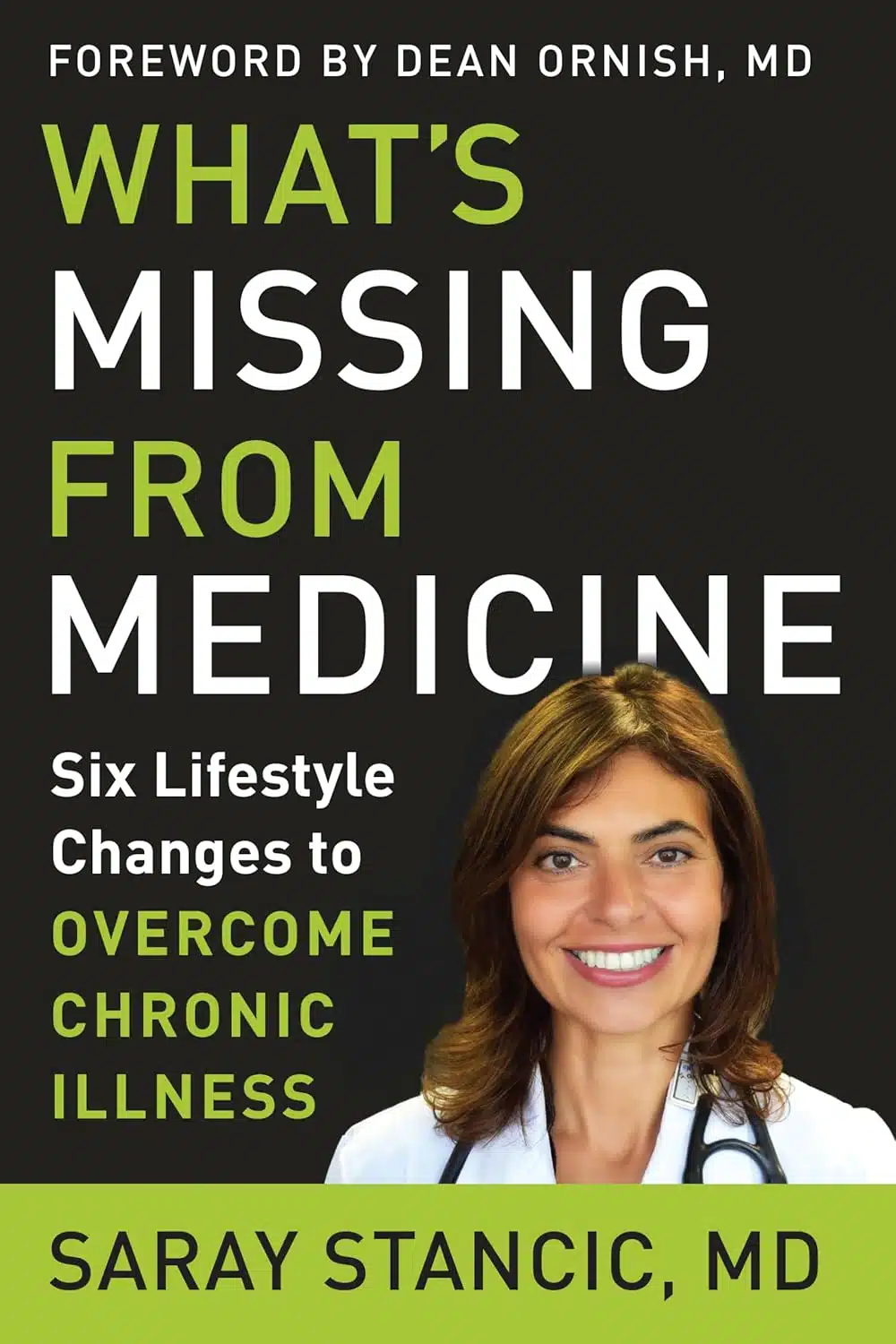
Another from the ranks of “doctors who got a serious illness and it completely changed how they view the treatment of serious illness”, Dr. Stancic was diagnosed with multiple sclerosis, and wasn’t impressed with the treatments presented.

Taking an evidence-based lifestyle medicine approach, she was able to not only manage her illness sufficiently to resume her normal activities, but even when so far as to run a marathon, and today boasts a symptom-free, active life.

The subtitular six lifestyle changes are not too shocking, and include a plants-centric diet, good exercise, good sleep, stress management, avoidance of substance abuses, and a fostering of social connections, but the value here is in what she has to say about each, especially the ones that aren’t so self-explanatory and/or can even cause harm if done incorrectly (such as exercise, for example).

The style is on the academic end of pop-science, of the kind that has frequent data tables, lots of statistics, and an extensive bibliography, but is still very readable.

Bottom line: if you are faced with a chronic disease, or even just an increased risk of some chronic disease, or simply like to not take chances, then this is a high-value book for you.

Click here to check out What’s Missing From Medicine, and enjoy chronic good health!

Don’t Forget…

Did you arrive here from our newsletter? Don’t forget to return to the email to continue learning!

Learn to Age Gracefully

Join the 98k+ American women taking control of their health & aging with our 100% free (and fun!) daily emails:

  • Melasma Dark Spots, & What To Do About Them

    10almonds is reader-supported. We may, at no cost to you, receive a portion of sales if you purchase a product through a link in this article.

    Discoloration (including melasma, sunspots, freckles) accounts for 90% of visible skin aging, and is a risk factor for cancer.

    Dr. Shereene Idris, dermatologist, advises:

    Beyond sunscreen

    Melasma is a chronic inflammatory skin condition that causes darkened patches especially on the cheeks, forehead, and upper lip; it’s worsened not just by UV rays as you probably guessed, but also by heat (including hot baths, hot showers, facial steaming, saunas, etc), stress, and hormonal imbalances.

    So, with that in mind,

    • Protect from UV and heat: use daily high-SPF sunscreen, UV visors, wide-brim hats (straw is, sadly, inadequate for this, as a lot of UV passes through), UPF clothing, and sunglasses; heat alone can trigger melasma, so stay cool and avoid saunas, steam, and hot yoga.
    • Reapply sunscreen properly: she recommends dabbing sunscreen with a beauty blender over makeup for best coverage, saying that sprays are quick fixes but less protective.
    • Maintain a strong skincare routine: use brightening ingredients (she suggests: tranexamic acid, kojic acid, licorice root, niacinamide, vitamin C, retinol) to manage discoloration long term; hydroquinone is effective short term.
    • Avoid unnecessary triggers: check medications, skip waxing in affected areas, and reduce stress where possible.
    • Layer your protection: combine multiple methods—e.g. shade, cooling tools, sun-blocking clothing—for the best prevention and maintenance.

    For more on all of this, enjoy:

    Click Here If The Embedded Video Doesn’t Load Automatically!

    Want to learn more?

    You might also like:

    Skin Care Down There (Incl. Butt Acne, Hyperpigmentation, & More) ← for related concerns in places that typically get less sun

    Take care!

    Share This Post

  • The Exercise That Can Fix A Very Common Knee Pain, Permanently

    10almonds is reader-supported. We may, at no cost to you, receive a portion of sales if you purchase a product through a link in this article.

    Notwithstanding the thumbnail, whether or not you do squats is actually not particularly important for this one.

    Will Harlow, the over-50s specialist physio, explains:

    It’s in your hips

    This isn’t the only possible reason for knee pain, of course, but it is one of the three most common causes. Usually, if there’s a knee problem, the problem is actually rooted in one of the following:

    • Hip rotators
    • Glutes
    • Tibialis anterior

    Even in the case of osteoarthritis of the knee, the underlying problem (i.e. before the OA set in) usually started in one of those places and then messed up the knee by referral (i.e., undue stress being put on the knee because of the problem in the other place, then causes the joint wear-and-tear that’s characteristic of OA). In contrast, rheumatoid arthritis is an autoimmune issue from the start, but that only affects 0.5% of the population, so statistically the other things are much more common.

    So, today we’ll be looking at the hips: weak hip muscles can let your thigh move uncontrollably, sending twisting and side-to-side forces into your knee, which is mainly built for forwards and backwards motion.

    And the remedy for this: the “double clam” exercise, which targets your hip rotators to improve control of your thigh and thus reduce stress on your knee:

    • setup and position: lie on your side with the affected leg on top, support your head, place your top hand in front, roll slightly forwards, and keep your knees bent with your heels and knees together.
    • double clam movement: lift your top knee without rolling your hips, then keep your knee still and lift your heel by rotating your thigh inwards, before lowering your heel and then your knee with good, steady control.
    • progressions: add a resistance band above your knees to increase difficulty, then add a second band around your ankles to make both parts of the movement harder; for each progression, only progress when you can do 15 good-form reps of the easier version.

    For more on all of this plus visual demonstrations, enjoy:

    Click Here If The Embedded Video Doesn’t Load Automatically!

    Want to learn more?

    For a much deeper understanding of treating knee pain, here’s a great book that we reviewed a little while back:

    Treat Your Own Knee – by Robin McKenzie ← he’s a physiotherapist and not a doctor, and/but with 40 years of practice to his name and 33 letters after his name (CNZM OBE FCSP (Hon) FNZSP (Hon) Dip MDT Dip MT), he seems to know his stuff. His work is very well-respected, and almost any English-speaking physiotherapist will have read his books.

    Take care!

    Share This Post

  • The Beetroot Benefits That Depend On Your Age

    10almonds is reader-supported. We may, at no cost to you, receive a portion of sales if you purchase a product through a link in this article.

    We’ve written before about beetroot’s considerable health benefits: Beetroot For More Than Just Your Blood Pressure

    We even covered how to make it better in a surprising way: Beetroot Juice & Caffeine Work Better Than Either Alone

    But what’s this about age differences?

    Different for younger and older people

    Researchers (Dr. Anni Vanhatalo et al.) investigated this, and wondered how much of beetroot’s beneficial effect is due to boosting nitric oxide (NO) production, something that aging typically reduces, but that nitrate-rich beetroot improves.

    To test this, they did a randomized, placebo-controlled, double-blind crossover trial with young adults (18–30) and older adults (67–79). They excluded participants with cardiovascular, metabolic, pulmonary, or oral disease; smokers; anyone with high blood pressure (here defined as >140/90, notwithstanding that the usual standard is >130/90), and anyone who had recently used antibiotics.

    The interventions were:

    • nitrate-rich beetroot juice (2 × 70 ml/day, ~595 mg nitrate each)
    • nitrate-depleted beetroot juice (same quantity of juice, no nitrate, functioning as placebo)
    • antiseptic mouthwash (because they suspected that oral bacteria played a role)

    These they tested with two-week treatment phases, with washout periods between (since the groups switched roles, being as it was a crossover trial, it was important to ensure that each group was not still being affected by the previous intervention).

    What they measured: they did tongue swabs for microbiome sequencing, they checked plasma nitrate/nitrite for NO bioavailability, they also recorded blood pressure (brachial and central), endothelial function (flow-mediated dilation), and arterial stiffness.

    What they found:

    • Endothelial function and arterial stiffness remained unchanged in all groups. It seems this is simply not something that beetroot juice affects.
    • The older adults had higher baseline blood pressure, and/but nitrate-rich beetroot juice lowered brachial mean arterial pressure in older adults while it had no significant effect in younger adults.
    • In the category of oral microbiome changes, they found that in older adults, beetroot juice reduced Prevotella-dominated bacterial linked with DNRA (which diverts nitrite away from NO production), and that reduction in Prevotella correlated with higher plasma nitrite and lower blood pressure; nitrate-rich beetroot juice increased nitrate-reducing genera Neisseria and Rothia, especially in older adults, having only modest benefits for younger adults. Antiseptic mouthwash reduced microbial diversity (shocking nobody) and impaired vascular function.
    • Nitrate-depleted juice still raised plasma nitrate/nitrite modestly and had a small lowering effect on blood pressure in older adults. This may have been because of:
      • placebo effect doing its thing
      • imperfect depletion of nitrates
      • other unknown factors
      • a combination of the above

    In summary: in older adults, beetroot juice improves the oral microbiome and, partly because of that, lowers blood pressure. Younger adults get only marginal benefits at best, and use of antiseptic mouthwash completely wipes out the benefits.

    You can read the paper itself, here: Ageing modifies the oral microbiome, nitric oxide bioavailability and vascular responses to dietary nitrate supplementation

    Before you get juicing, there are some things you should be aware of: 3 Day Juice Fasting? Not So Fast! ← this isn’t even just about the glycemic index issue (juices being stripped of fiber), and is rather mostly about the microbiome problems juices can cause without sufficient dietary fiber (so, not so much a problem if, for example, you have a juice after a fibrous meal).

    Not a fan of juices? This writer doesn’t love juices most of the time either, but we can enjoy: Hearty Healthy Ukrainian Borscht ← from our recipes archive!

    Remember when…

    …we talked about Dr. Ellie Phillips’ advices with regard to oral health?

    In few words, Dr. Phillips promotes protecting oral microbial diversity by avoiding antibacterial mouthwashes; the study we talked about today also validated that, showing how antiseptic mouthwash (unsurprisingly) reduced microbial diversity and (importantly and relevantly) impaired vascular function.

    Now, she often points to imbalances where certain bacteria overgrow; this study showed Prevotella dominance (i.e., harmful bacteria being too plentiful) diverts nitrite away from NO production, worsening cardiovascular function—a good example of how oral imbalances have systemic effects.

    So, how to kill the bad bacteria without harming the good ones? Critically, diet can feed the protective oral bacteria; here, nitrate-rich beetroot juice improved blood pressure by shifting the oral microbiome towards beneficial nitrate-reducing genera (e.g. the Neisseria and Rothia in this study). As for the rest, Dr. Phillips advocates simple, natural methods (xylitol, remineralizing foods, protective rinses) instead of harsh chemicals. As we’ve learned today, dietary strategies (like beetroot juice) can also play their part as a natural, safe way to help your oral microbiome to help you.

    For research on this by a third source, see: Make Your Saliva Better For Your Health

    Want to learn more?

    With regard to nitrates and health, you might like:

    The Nitric Oxide (NO) Solution – by Dr. Nathan Bryan & Janet Zand

    …and, with a focus on beets (roots and leaves):

    Beet The Odds – by Dr. Nathan Bryan & Carolyn Pierini

    Enjoy!

    Share This Post

  • ADHD 2.0 – by Dr. Edward Hallowell & Dr. John Ratey

    10almonds is reader-supported. We may, at no cost to you, receive a portion of sales if you purchase a product through a link in this article.

    A lot of ADHD literature is based on the assumption that the reader is a 30-something parent of a child with ADHD. This book, on the other hand, addresses all ages, and includes just as readily the likelihood that the person with ADHD is the reader, and/or the reader’s partner.

    The authors cover such topics as:

    • ADHD mythbusting, before moving on to…
    • The problems of ADHD, and the benefits that those exact same traits can bring too
    • How to leverage those traits to get fewer of the problems and more of the benefits
    • The role of diet beyond the obvious, including supplementation
    • The role of specific exercises (especially HIIT, and balance exercises) in benefiting the ADHD brain
    • The role of medications—and arguments for and gainst such

    The writing style is… Thematic, let’s say. The authors have ADHD and it shows. So, expect comprehensive deep-dives from whenever their hyperfocus mode kicked in, and expect no stones left unturned. That said, it is very readable, and well-indexed too, for ease of finding specific sub-topics.

    Bottom line: if you are already very familiar with ADHD, you may not learn much, and might reasonably skip this one. However, if you’re new to the topic, this book is a great—and practical—primer.

    Click here to check out ADHD 2.0, and make things better!

    Don’t Forget…

    Did you arrive here from our newsletter? Don’t forget to return to the email to continue learning!

    Learn to Age Gracefully

    Join the 98k+ American women taking control of their health & aging with our 100% free (and fun!) daily emails:

  • What is wabi-sabi? Will this Japanese philosophy make me happy?

    10almonds is reader-supported. We may, at no cost to you, receive a portion of sales if you purchase a product through a link in this article.

    The ceramic bowl with an uneven glaze. The teacup mended with gold lacquer.

    The images are calming and attractive.

    They are said to reflect wabi-sabi – a Japanese aesthetic often summarised in the West as valuing imperfection, impermanence and incompleteness.

    And wabi-sabi is having a moment on social media. It’s linked to everything from interior design to makeup trends and happiness.

    So can wabi-sabi improve your wellbeing? Here’s what the psychological evidence says.

    Marco Montalti/Getty

    What is wabi-sabi?

    At its core, wabi-sabi, as it is commonly understood in the West, rests on three simple ideas: things are flawed, things change, and things are never fully finished.

    There isn’t much scientific research on wabi-sabi itself. You won’t find clinical trials testing the effects of “becoming wabi-sabi”.

    But the ideas behind wabi-sabi reflect several well-established principles in psychology – responding kindly to imperfection, accepting change, and loosening rigid perfectionism.

    Imperfection and self-compassion

    Wabi-sabi begins with imperfection. Instead of disguising cracks, it incorporates them. The flaw becomes part of the object’s character, not proof it is worthless.

    In psychological terms, this resembles self-compassion – responding to your own mistakes or shortcomings with warmth and care, rather than harsh self-criticism.

    Self-compassion does not pretend errors do not exist. It changes how we relate to them.

    Research consistently shows people who are more self-compassionate report lower anxiety and depression and greater wellbeing.

    When interventions help people develop this skill, their mental health often improves.

    Like the repaired bowl, the person is not defined by the crack. The crack is acknowledged and becomes part of their story.

    Impermanence and acceptance

    Wabi-sabi also reminds us nothing lasts. Everything changes.

    Some of our distress comes not only from change itself, but from insisting things should not change. We want relationships to stay the same. We want our bodies not to age. We want plans to unfold exactly as expected.

    When reality shifts and we resist it, the struggle intensifies.

    In psychology, acceptance means allowing thoughts, emotions and changes to occur without constantly trying to push them away or control them.

    Modern therapies, such as “acceptance and commitment therapy”, teach this skill because resisting unavoidable experiences often intensifies distress.

    Mindfulness – paying attention to what is happening right now without immediately judging or trying to fix it – is one way people practise acceptance.

    Seen this way, wabi-sabi’s focus on impermanence is not passive resignation. It reflects a practical insight. When change is unavoidable, reducing the fight against it can reduce suffering.

    Incompleteness and perfectionism

    The third idea in wabi-sabi is incompleteness. Nothing is ever fully finished.

    This runs counter to a form of perfectionism psychologists call clinical perfectionism. This is not simply wanting to do well. It occurs when people base their self-worth on meeting extremely high standards and respond to falling short with harsh self-criticism.

    Research links this form of perfectionism with anxiety and depression.

    Self-compassion may offer a similar shift in perspective. When people respond to setbacks with understanding rather than harsh self-criticism, the psychological cost of imperfection is reduced.

    Wabi-sabi does not reject effort or aspiration. It questions the belief that you must be flawless before you are acceptable.

    Imperfection and meaning

    I recently wrote that meaning does not emerge from perfectly executed life plans. It grows from repeated, worthwhile action, often messy, unfinished and imperfect. Wabi-sabi echoes this.

    If we wait for flawless conditions before acting, we may wait indefinitely. The project will never feel polished enough. The timing will never seem quite right.

    But wellbeing is strongly shaped by what we do repeatedly, especially when those actions align with our values. From this perspective, imperfection is not an obstacle to meaning. It is often the setting in which meaning develops.

    The repaired bowl is still used.

    The musician keeps playing after a broken string.

    The parent apologises and tries again.

    Imperfection and connection

    There is also a social dimension.

    Research shows vulnerability can strengthen relationships. In other words, when people acknowledge mistakes or limitations, they are often seen as more relatable and trustworthy.

    Presenting as flawless can create distance. Allowing cracks to be visible can create connection.

    Wabi-sabi offers a simple image for this. The crack is not hidden. It becomes part of the story.

    Wabi-sabi has its limits

    It is important not to overstate what wabi-sabi offers.

    There is no evidence adopting it as a named philosophy guarantees happiness. It is not a treatment for depression. And acceptance does not mean tolerating injustice or giving up on improvement.

    But at its heart, wabi-sabi questions whether our expectations have become too polished.

    It asks whether some of our expectations – of our bodies, our productivity, our relationships – have become so polished they leave no room for being human.

    How can I use it?

    Wabi-sabi may not offer something entirely new. But it captures, in a single image, several psychological skills research suggests can help people live well.

    It invites us to:

    • respond to our flaws with kindness
    • accept that change is normal
    • loosen rigid standards
    • act in line with our values despite imperfection
    • connect with others by showing our humanity.

    Wabi-sabi is not a shortcut to happiness. But as both an image and a practice, it reflects a grounded psychological idea.

    Wellbeing is less about erasing the cracks, and more about continuing to live, act and connect with them visible.

    Trevor Mazzucchelli, Associate Professor of Clinical Psychology, Curtin University

    This article is republished from The Conversation under a Creative Commons license. Read the original article.

    Don’t Forget…

    Did you arrive here from our newsletter? Don’t forget to return to the email to continue learning!

    Learn to Age Gracefully

    Join the 98k+ American women taking control of their health & aging with our 100% free (and fun!) daily emails:

  • Yoga for Better Sleep – by Mark Stephens

    10almonds is reader-supported. We may, at no cost to you, receive a portion of sales if you purchase a product through a link in this article.

    The book has, as you might expect:

    • postural exercises
    • breathing exercises
    • meditation exercises

    Instructions given in all of the above categories are clear and easy to follow, and there are photographic illustrations too where appropriate.

    What sets it apart from many books of this kind is that it also has chapters dedicated to various specific circumstances; the many actual reasons people seriously struggle to sleep; not just “screentime too late”, but for example deprepression, sleep apnea, hyperarousal, or even just aging.

    As well as the comprehensive exercises, there are also many tips, tricks, hacks, and workarounds—it’s a practical guidebook with practical advice.

    While the book is about yogic practices, the author also does tackle this holistically, acknowledging that there are many factors going on, and that yogic practices should be one more string to our sleep-improving bow—as we continue with other general good advice for good sleep too, have medical tests if it seems appropriate, that kind of thing. Basically, to have one’s assorted approaches work together with synergistic effect.

    Bottom line: this book will quite possibly put you to sleep! But only in the best possible way.

    Click here to check out Yoga for Better Sleep, and get those valuable Zs in, healthily!

    Don’t Forget…

    Did you arrive here from our newsletter? Don’t forget to return to the email to continue learning!

    Learn to Age Gracefully

    Join the 98k+ American women taking control of their health & aging with our 100% free (and fun!) daily emails: