
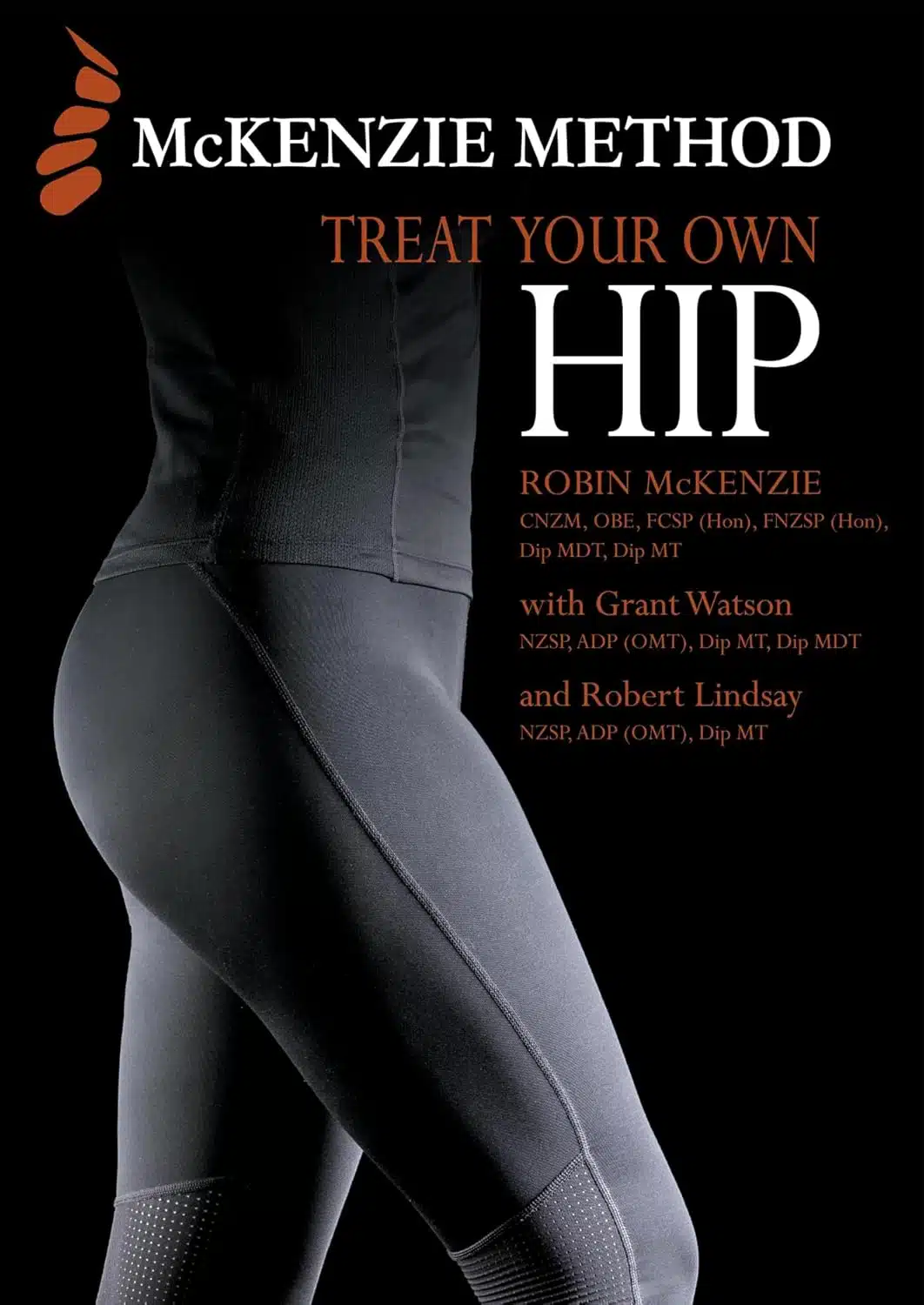
Treat Your Own Hip – by Robin McKenzie

10almonds is reader-supported. We may, at no cost to you, receive a portion of sales if you purchase a product through a link in this article.

We previously reviewed another book by this author in this series, “Treat Your Own Knee”, and today it’s the same deal, but for the hip.

A quick note about the author first: a physiotherapist and not a doctor, but with over 40 years of practice to his name and 33 letters after his name (CNZM OBE FCSP (Hon) FNZSP (Hon) Dip MDT Dip MT), he seems to know his stuff.

He takes the reader through first diagnosing the nature of the pain (and how to rule out, for example, a back problem manifesting as hip pain, rather than a hip problem per se—and points to his own “Treat Your Own Back” manual if it turns out that that’s your problem instead), and then treating it. A bold claim, the kind that many people’s lawyers don’t let them make, but once again, this guy is pretty much the expert when it comes to this. Ask any other physiotherapist, and they probably have several of his books on their shelf.

The treatments recommend are tailored to the results of various diagnostic flowcharts; essentially troubleshooting your hip. However, they mainly consist of exercises (perhaps the greatest value of the book), and lifestyle adjustments (these ones, 10almonds readers probably know already, but a reminder never hurts).

The explanations are thorough while still being comprehensible, and there is zero sensationalization or fluff. It is straight to the point, and clearly illustrated too with diagrams and photographs.

Bottom line: if you’re looking for a “one-stop shop” for diagnosing and treating your bad hip, then this is it.

Click here to check out Treat Your Own Hip, and indeed Treat Your Own Hip!

PS: if you have musculoskeletal problems elsewhere in your body, you might want to check out the rest of his body parts series (neck, back, shoulder, wrist, knee, ankle) for the one that’s tailored to your specific problem.

Don’t Forget…

Did you arrive here from our newsletter? Don’t forget to return to the email to continue learning!
  • How To Feel 10 Years Younger
    Revitalize your mobility with over-50s specialist physio Will Harlow’s 5 essential exercises for youthful flexibility and strength. Watch now for a step-by-step guide!

Learn to Age Gracefully

Join the 98k+ American women taking control of their health & aging with our 100% free (and fun!) daily emails:

  • Tiramisu Crunch Bites

    10almonds is reader-supported. We may, at no cost to you, receive a portion of sales if you purchase a product through a link in this article.

    It’s coffee, it’s creamy, it’s nutty, it’s chocolatey, what’s not to love? It has all the well-loved flavors of tiramisu, but this recipe is a simple one, and it’s essentially stuffed dates in a way you’ve never had them before. They’re delectable, decadent, and decidedly good for your health. These things are little nutrient-bombs that’ll keep you reaching for more.

    You will need

    • Coffee (we will discuss this)
    • 150g (5.5oz) mascarpone (if vegan or lactose-intolerant, can be substituted with vegan varieties, or at a pinch, pressed silken tofu)
    • 500g (1lb) dates (Medjool are ideal)
    • Twice as many almonds as you have dates
    • 50g (2oz) dark chocolate (the darkest, bitterest, you can find)
    • Edible flower petals if you can source them (some shops sell dried rose petals for this purpose)

    Method

    (we suggest you read everything at least once before doing anything)

    1) Take the mascarpone and whisk (or blend) it with the coffee. What kind of coffee, you ask? Many will use instant coffee (1tbsp granules mixed with enough boiling water to dissolve it), and that is actually healthiest (counterintuitive but true) but if you care for flavor over health, and have the means to make espresso, make it ristretto (so, stop it halfway through filling up an espresso cup), let it cool, and use that. Absolute bonus for flavor (not for health): if you have the means to make Turkish coffee, use an equivalent amount of that (again, cooled).

    You will now have coffee-flavoured mascarpone. It’s great for your gut and full of antioxidant polyphenols. Set it aside for the moment.

    2) Take the dark chocolate and melt it. Please don’t microwave it or try to do it in a pan directly over the hob; instead, you will need to use a Bain-Marie. If you don’t have one made-for-purpose, you can place a metal or heatproof glass bowl in a saucepan, with something to stop it from touching the floor of the pan. Then boil water in the pan (without letting the water get into the bowl), and melt the chocolate in the bowl—this will allow you to melt it evenly without burning the chocolate.

    You will now have melted dark chocolate. It has its own set of polyphenols, and is great for everything from the brain to the gut microbiome.

    3) Cut the dates lengthways on one side and remove the stone. Stuff them carefully with the coffee-flavored mascarpone (you can use a teaspoon, or use a piping kit if you have one). Add a couple of almonds to each one. Place them all on a big plate, and drizzle the melted chocolate over them. Add the petals if you have them.

    The dates and almonds deliver extra vitamins and minerals in abundance (not to mention, lots of fiber), and also are an amazing combination even just by themselves. With the mascarpone and chocolate added, this winning on new levels. We’re not done yet, though…

    4) Chill them in the fridge for about 30 minutes.

    Serve!

    Learn more

    For those interested in some of the science of what we have going on today:

    Enjoy!

    Share This Post

  • Cherries vs Elderberries – Which is Healthier?

    10almonds is reader-supported. We may, at no cost to you, receive a portion of sales if you purchase a product through a link in this article.

    Our Verdict

    When comparing cherries to elderberries, we picked the elderberries.

    Why?

    Both are great! But putting them head-to-head…

    In terms of macros, cherries have slightly more protein (but we are talking miniscule numbers here, 0.34mg/100g), while elderberries have moderately more carbs and more than 4x the fiber. This carbs:fiber ratio difference means that elderberries have the lower glycemic index by far, as well as simply more grams/100g fiber, making this an easy win for elderberries.

    In the category of vitamins, cherries have more of vitamins A, B9, E, K, and choline, while elderberries have more of vitamins B1, B2, B3, B6, and C. The margins of difference mean that elderberries have the very slightly better overall vitamin coverage, but it’s so slight that we’ll call this a 5:5 tie.

    When it comes to minerals, cherries have more copper, magnesium, and manganese, while elderberries have more calcium, iron, phosphorus, potassium, selenium, and zinc. A nice easy win to top it off for elderberries.

    On the polyphenols (and other phytochemicals) front, both are great in different ways, nothing that’d we’d consider truly sets one ahead of the other.

    All in all, adding up the sections, an overall win for elderberries, but by all means enjoy either or both!

    Want to learn more?

    You might like to read:

    Take care!

    Share This Post

  • Protein Immune Support Salad

    10almonds is reader-supported. We may, at no cost to you, receive a portion of sales if you purchase a product through a link in this article.

    How to get enough protein from a salad, without adding meat? Cashews and chickpeas have you more than covered! Along with the leafy greens and an impressive array of minor ingredients full of healthy phytochemicals, this one’s good for your muscles, bones, skin, immune health, and more.

    You will need

    • 1½ cups raw cashews (if allergic, omit; the chickpeas and coconut will still carry the dish for protein and healthy fats)
    • 2 cans (2x 14oz) chickpeas, drained
    • 1½ lbs baby spinach leaves
    • 2 large onions, finely chopped
    • 3 oz goji berries
    • ½ bulb garlic, finely chopped
    • 2 tbsp dessicated coconut
    • 1 tbsp dried cumin
    • 1 tbsp nutritional yeast
    • 2 tsp chili flakes
    • 1 tsp black pepper, coarse ground
    • ½ tsp MSG, or 1 tsp low-sodium salt
    • Extra virgin olive oil, for cooking

    Method

    (we suggest you read everything at least once before doing anything)

    1) Heat a little oil in a pan; add the onions and cook for about 3 minutes.

    2) Add the garlic and cook for a further 2 minutes.

    3) Add the spinach, and cook until it wilts.

    4) Add the remaining ingredients except the coconut, and cook for another three minutes.

    5) Heat another pan (dry); add the coconut and toast for 1–2 minutes, until lightly golden. Add it to the main pan.

    6) Serve hot as a main, or an attention-grabbing side:

    Enjoy!

    Want to learn more?

    For those interested in some of the science of what we have going on today:

    Take care!

    Share This Post

  • Mental illness, psychiatric disorder or psychological problem. What should we call mental distress?

    10almonds is reader-supported. We may, at no cost to you, receive a portion of sales if you purchase a product through a link in this article.

    We talk about mental health more than ever, but the language we should use remains a vexed issue.

    Should we call people who seek help patients, clients or consumers? Should we use “person-first” expressions such as person with autism or “identity-first” expressions like autistic person? Should we apply or avoid diagnostic labels?

    These questions often stir up strong feelings. Some people feel that patient implies being passive and subordinate. Others think consumer is too transactional, as if seeking help is like buying a new refrigerator.

    Advocates of person-first language argue people shouldn’t be defined by their conditions. Proponents of identity-first language counter that these conditions can be sources of meaning and belonging.

    Avid users of diagnostic terms see them as useful descriptors. Critics worry that diagnostic labels can box people in and misrepresent their problems as pathologies.

    Underlying many of these disagreements are concerns about stigma and the medicalisation of suffering. Ideally the language we use should not cast people who experience distress as defective or shameful, or frame everyday problems of living in psychiatric terms.

    Our new research, published in the journal PLOS Mental Health, examines how the language of distress has evolved over nearly 80 years. Here’s what we found.

    Engin Akyurt/Pexels

    Generic terms for the class of conditions

    Generic terms – such as mental illness, psychiatric disorder or psychological problem – have largely escaped attention in debates about the language of mental ill health. These terms refer to mental health conditions as a class.

    Many terms are currently in circulation, each an adjective followed by a noun. Popular adjectives include mental, mental health, psychiatric and psychological, and common nouns include condition, disease, disorder, disturbance, illness, and problem. Readers can encounter every combination.

    These terms and their components differ in their connotations. Disease and illness sound the most medical, whereas condition, disturbance and problem need not relate to health. Mental implies a direct contrast with physical, whereas psychiatric implicates a medical specialty.

    Mental health problem, a recently emerging term, is arguably the least pathologising. It implies that something is to be solved rather than treated, makes no direct reference to medicine, and carries the positive connotations of health rather than the negative connotation of illness or disease.

    Therapist talks to young man
    Is ‘mental health problem’ actually less pathologising? Monkey Business Images/Shutterstock

    Arguably, this development points to what cognitive scientist Steven Pinker calls the “euphemism treadmill”, the tendency for language to evolve new terms to escape (at least temporarily) the offensive connotations of those they replace.

    English linguist Hazel Price argues that mental health has increasingly come to replace mental illness to avoid the stigma associated with that term.

    How has usage changed over time?

    In the PLOS Mental Health paper, we examine historical changes in the popularity of 24 generic terms: every combination of the nouns and adjectives listed above.

    We explore the frequency with which each term appears from 1940 to 2019 in two massive text data sets representing books in English and diverse American English sources, respectively. The findings are very similar in both data sets.

    The figure presents the relative popularity of the top ten terms in the larger data set (Google Books). The 14 least popular terms are combined into the remainder.

    Relative popularity of alternative generic terms in the Google Books corpus. Haslam et al., 2024, PLOS Mental Health.

    Several trends appear. Mental has consistently been the most popular adjective component of the generic terms. Mental health has become more popular in recent years but is still rarely used.

    Among nouns, disease has become less widely used while illness has become dominant. Although disorder is the official term in psychiatric classifications, it has not been broadly adopted in public discourse.

    Since 1940, mental illness has clearly become the preferred generic term. Although an assortment of alternatives have emerged, it has steadily risen in popularity.

    Does it matter?

    Our study documents striking shifts in the popularity of generic terms, but do these changes matter? The answer may be: not much.

    One study found people think mental disorder, mental illness and mental health problem refer to essentially identical phenomena.

    Other studies indicate that labelling a person as having a mental disease, mental disorder, mental health problem, mental illness or psychological disorder makes no difference to people’s attitudes toward them.

    We don’t yet know if there are other implications of using different generic terms, but the evidence to date suggests they are minimal.

    Dark field
    The labels we use may not have a big impact on levels of stigma. Pixabay/Pexels

    Is ‘distress’ any better?

    Recently, some writers have promoted distress as an alternative to traditional generic terms. It lacks medical connotations and emphasises the person’s subjective experience rather than whether they fit an official diagnosis.

    Distress appears 65 times in the 2022 Victorian Mental Health and Wellbeing Act, usually in the expression “mental illness or psychological distress”. By implication, distress is a broad concept akin to but not synonymous with mental ill health.

    But is distress destigmatising, as it was intended to be? Apparently not. According to one study, it was more stigmatising than its alternatives. The term may turn us away from other people’s suffering by amplifying it.

    So what should we call it?

    Mental illness is easily the most popular generic term and its popularity has been rising. Research indicates different terms have little or no effect on stigma and some terms intended to destigmatise may backfire.

    We suggest that mental illness should be embraced and the proliferation of alternative terms such as mental health problem, which breed confusion, should end.

    Critics might argue mental illness imposes a medical frame. Philosopher Zsuzsanna Chappell disagrees. Illness, she argues, refers to subjective first-person experience, not to an objective, third-person pathology, like disease.

    Properly understood, the concept of illness centres the individual and their connections. “When I identify my suffering as illness-like,” Chappell writes, “I wish to lay claim to a caring interpersonal relationship.”

    As generic terms go, mental illness is a healthy option.

    Nick Haslam, Professor of Psychology, The University of Melbourne and Naomi Baes, Researcher – Social Psychology/ Natural Language Processing, The University of Melbourne

    This article is republished from The Conversation under a Creative Commons license. Read the original article.

    Don’t Forget…

    Did you arrive here from our newsletter? Don’t forget to return to the email to continue learning!

    Learn to Age Gracefully

    Join the 98k+ American women taking control of their health & aging with our 100% free (and fun!) daily emails:

  • Fall Asleep In 2 Minutes (Doctor Explains)

    10almonds is reader-supported. We may, at no cost to you, receive a portion of sales if you purchase a product through a link in this article.

    Beyond “sleep hygiene”, Dr. Siobhan Deshauer has insights to share:

    Rest for your body and mind

    First, do still do the basics. That means dimming/filtering lights for an hour before bed, lowering the room temperature a little, ensuring you have nice fresh sheets, not having alcohol or caffeine before bed, and getting out of bed if you’re not asleep within half an hour, to avoid associating being in bed with wakefulness.

    Next, the extra tips:

    • Progressive relaxation: tense and relax each muscle group from toes to head
    • Box breathing: inhale, hold, exhale, and hold for 4 seconds each; helps calm the nervous system (it’s called “box breathing” because of the 4:4:4:4 setup)
    • Diaphragmatic breathing: focus on belly breathing, with longer exhalation to activate the parasympathetic nervous system (note that this can, and even ideally should, be done at the same time as the previous)
    • Cognitive shuffling: think of words starting with each letter of a chosen word while visualizing them (this is like “counting sheep”, but does the job better—the job in question being preventing your brain from moving to anything more strenuous or stressful)

    For more on all of these plus some extra side-along advice, enjoy:

    Click Here If The Embedded Video Doesn’t Load Automatically!

    Want to learn more?

    You might also like to read:

    Non-Sleep Deep Rest: A Neurobiologist’s Take ← a way to get many of the benefits of sleep, while awake

    Take care!

    Don’t Forget…

    Did you arrive here from our newsletter? Don’t forget to return to the email to continue learning!

    Learn to Age Gracefully

    Join the 98k+ American women taking control of their health & aging with our 100% free (and fun!) daily emails:

  • Think you’re good at multi-tasking? Here’s how your brain compensates – and how this changes with age

    10almonds is reader-supported. We may, at no cost to you, receive a portion of sales if you purchase a product through a link in this article.

    We’re all time-poor, so multi-tasking is seen as a necessity of modern living. We answer work emails while watching TV, make shopping lists in meetings and listen to podcasts when doing the dishes. We attempt to split our attention countless times a day when juggling both mundane and important tasks.

    But doing two things at the same time isn’t always as productive or safe as focusing on one thing at a time.

    The dilemma with multi-tasking is that when tasks become complex or energy-demanding, like driving a car while talking on the phone, our performance often drops on one or both.

    Here’s why – and how our ability to multi-task changes as we age.

    Doing more things, but less effectively

    The issue with multi-tasking at a brain level, is that two tasks performed at the same time often compete for common neural pathways – like two intersecting streams of traffic on a road.

    In particular, the brain’s planning centres in the frontal cortex (and connections to parieto-cerebellar system, among others) are needed for both motor and cognitive tasks. The more tasks rely on the same sensory system, like vision, the greater the interference.

    This is why multi-tasking, such as talking on the phone, while driving can be risky. It takes longer to react to critical events, such as a car braking suddenly, and you have a higher risk of missing critical signals, such as a red light.

    The more involved the phone conversation, the higher the accident risk, even when talking “hands-free”.

    Generally, the more skilled you are on a primary motor task, the better able you are to juggle another task at the same time. Skilled surgeons, for example, can multitask more effectively than residents, which is reassuring in a busy operating suite.

    Highly automated skills and efficient brain processes mean greater flexibility when multi-tasking.

    Adults are better at multi-tasking than kids

    Both brain capacity and experience endow adults with a greater capacity for multi-tasking compared with children.

    You may have noticed that when you start thinking about a problem, you walk more slowly, and sometimes to a standstill if deep in thought. The ability to walk and think at the same time gets better over childhood and adolescence, as do other types of multi-tasking.

    When children do these two things at once, their walking speed and smoothness both wane, particularly when also doing a memory task (like recalling a sequence of numbers), verbal fluency task (like naming animals) or a fine-motor task (like buttoning up a shirt). Alternately, outside the lab, the cognitive task might fall by wayside as the motor goal takes precedence.

    Brain maturation has a lot to do with these age differences. A larger prefrontal cortex helps share cognitive resources between tasks, thereby reducing the costs. This means better capacity to maintain performance at or near single-task levels.

    The white matter tract that connects our two hemispheres (the corpus callosum) also takes a long time to fully mature, placing limits on how well children can walk around and do manual tasks (like texting on a phone) together.

    For a child or adult with motor skill difficulties, or developmental coordination disorder, multi-tastking errors are more common. Simply standing still while solving a visual task (like judging which of two lines is longer) is hard. When walking, it takes much longer to complete a path if it also involves cognitive effort along the way. So you can imagine how difficult walking to school could be.

    What about as we approach older age?

    Older adults are more prone to multi-tasking errors. When walking, for example, adding another task generally means older adults walk much slower and with less fluid movement than younger adults.

    These age differences are even more pronounced when obstacles must be avoided or the path is winding or uneven.

    Older adults tend to enlist more of their prefrontal cortex when walking and, especially, when multi-tasking. This creates more interference when the same brain networks are also enlisted to perform a cognitive task.

    These age differences in performance of multi-tasking might be more “compensatory” than anything else, allowing older adults more time and safety when negotiating events around them.

    Older people can practise and improve

    Testing multi-tasking capabilities can tell clinicians about an older patient’s risk of future falls better than an assessment of walking alone, even for healthy people living in the community.

    Testing can be as simple as asking someone to walk a path while either mentally subtracting by sevens, carrying a cup and saucer, or balancing a ball on a tray.

    Patients can then practise and improve these abilities by, for example, pedalling an exercise bike or walking on a treadmill while composing a poem, making a shopping list, or playing a word game.

    The goal is for patients to be able to divide their attention more efficiently across two tasks and to ignore distractions, improving speed and balance.

    There are times when we do think better when moving

    Let’s not forget that a good walk can help unclutter our mind and promote creative thought. And, some research shows walking can improve our ability to search and respond to visual events in the environment.

    But often, it’s better to focus on one thing at a time

    We often overlook the emotional and energy costs of multi-tasking when time-pressured. In many areas of life – home, work and school – we think it will save us time and energy. But the reality can be different.

    Multi-tasking can sometimes sap our reserves and create stress, raising our cortisol levels, especially when we’re time-pressured. If such performance is sustained over long periods, it can leave you feeling fatigued or just plain empty.

    Deep thinking is energy demanding by itself and so caution is sometimes warranted when acting at the same time – such as being immersed in deep thought while crossing a busy road, descending steep stairs, using power tools, or climbing a ladder.

    So, pick a good time to ask someone a vexed question – perhaps not while they’re cutting vegetables with a sharp knife. Sometimes, it’s better to focus on one thing at a time.The Conversation

    Peter Wilson, Professor of Developmental Psychology, Australian Catholic University

    This article is republished from The Conversation under a Creative Commons license. Read the original article.

    Don’t Forget…

    Did you arrive here from our newsletter? Don’t forget to return to the email to continue learning!

    Learn to Age Gracefully

    Join the 98k+ American women taking control of their health & aging with our 100% free (and fun!) daily emails: