
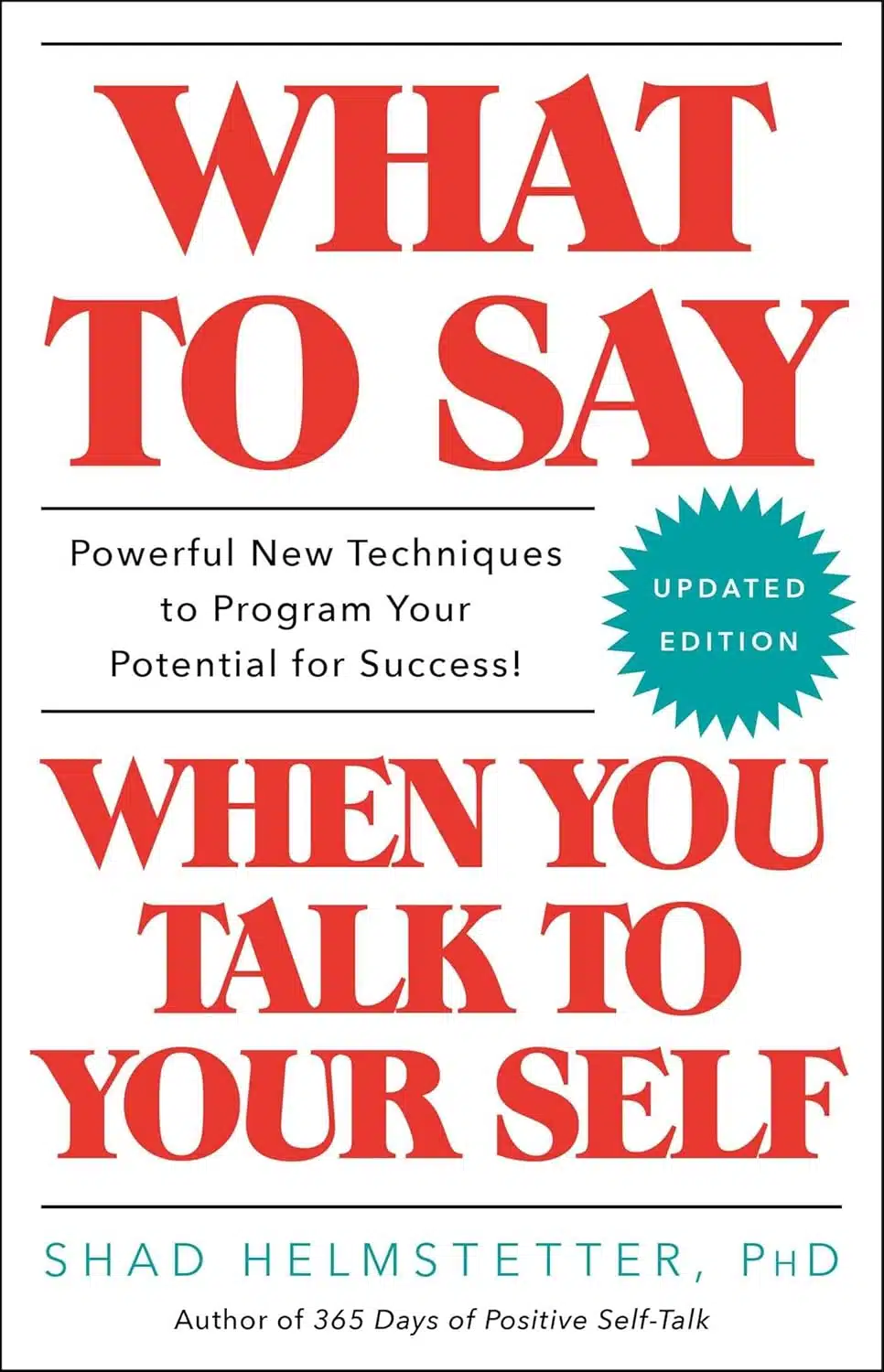
What To Say When You Talk To Your Self – by Dr. Shad Helmstetter
10almonds is reader-supported. We may, at no cost to you, receive a portion of sales if you purchase a product through a link in this article.
It’s sometimes said that your brain, and by extension the rest of your body, is listening to everything you say—including, of course, what you say just in your head.
So, how can we best make use of that? Dr. Helmstetter covers a lot more than just “be nice to yourself”, and discusses how to change habits and rewire attitude, solve problems and overcome personal growth stasis, and also how to navigate the nuances of situational self-talk, while keeping to the principle that “if it isn’t simple, it won’t work”.
The style is a little more personal than one might expect; notwithstanding the title being about what to say when you talk to yourself, the pronoun “I” is the one the author uses rather more than “you”, giving many examples of how he has done things, and telling stories involving himself. This is all illustrative and helpful, so it’s not a problem, just an interesting choice that may alienate some readers.
In the category of subjective criticism, the book is quite repetitive; it seems Dr. Helmstetter goes for the P. T. Barnum approach of “tell them what you’re going to tell them, tell them, and then tell them what you’ve told them”, and repeats a few extra times to be sure. So, for those who find that repetition indeed helps learning, this book will very much fulfil that preference.
Bottom line: if you’d like to improve your self-talk to re-write your brain for the better, then this book will walk you through the processes very thoroughly indeed.
Click here to check out What To Say When You Talk To Your Self, and rewire yourself!
Don’t Forget…
Did you arrive here from our newsletter? Don’t forget to return to the email to continue learning!
Recommended
Learn to Age Gracefully
Join the 98k+ American women taking control of their health & aging with our 100% free (and fun!) daily emails:
-
Morning Routine To Feel Like You’re in Your 20s Again
10almonds is reader-supported. We may, at no cost to you, receive a portion of sales if you purchase a product through a link in this article.
Spoiler: it’s not “sleep until midday and eat cold pizza” (for those for whom that was their routine in their student years).
Rather, it’s about getting the body to behave a certain way:
A good start, every day
Mobility coach Marina Sarenac makes the observation that stiffness in the morning makes your posture, energy, and overall movement feel older, whereas a short routine wakes up your muscles, improves circulation, and prepares your body for the day.
First, she advises to breathe correctly. Deep belly breathing calms your nervous system, lowers morning stress, and prepares your body for smoother movement. So, place one hand on your chest and one on your belly, keep your chest still, inhale through your nose, and let your belly rise (and repeat).
Then move onto some mobility drills. Here’s her advice on how to do that:
- Ankle mobility movements: move your ankles slowly through dorsiflexion, plantarflexion, and controlled circles to wake up your lower body and support healthier knees, hips, and posture.
- Alternating spinal twist: lying on your back with your knees bent, let your knees fall gently side to side so gravity loosens your lower back and releases your hips.
- Modified cobra with hip opener: lying on your stomach, place your hands under your shoulders and bring one leg out to the side at 90°; lift your chest gently to open your hips and reduce tension in your lower back.
- Thoracic rotation: in a kneeling position, place one hand on the floor and the other behind your head; rotate your upper body upwards to loosen your middle spine and help your posture and breathing.
- Neck mobility movements: with a tall spine and relaxed shoulders, move your neck gently through flexion, extension, rotations, and a light side stretch to ease any stress-related stiffness and reduce tension.
For more on all of this plus visual demonstrations, enjoy:
Click Here If The Embedded Video Doesn’t Load Automatically!
Want to learn more?
You might also like:
10 Tips To Reduce Morning Pain & Stiffness With Arthritis
Take care!
Share This Post
-
What’s Lurking In Your Household Air?
10almonds is reader-supported. We may, at no cost to you, receive a portion of sales if you purchase a product through a link in this article.
As individuals, we can’t do much about the outside air. We can try to spend more time in green spaces* and away from traffic, and we can wear face-masks—as was popular in Tokyo and other such large cities long before the pandemic struck.
*The well-known mental health benefits aside (and contrary to British politician Amber Rudd’s famous assertion in a televised political debate that “clean air doesn’t grow on trees”), clean air comes mostly from trees—their natural process of respiration scrubs not only carbon dioxide, but also pollutants, from the air before releasing oxygen without the pollutants. Neat!
See also this study: Site new care homes near trees and away from busy roads to protect residents’ lungs
We are fortunate to be living in a world where most of us in industrialized countries can exercise a great degree of control over our home’s climate. But, what to do with all that power?
Temperature
Let’s start with the basics. Outside temperature may vary, but you probably have heating and air conditioning. There’s a simple answer here; the optimal temperature for human comfort and wellbeing is 20℃ / 68℉:
Scientists Identify a Universal Optimal Temperature For Life on Earth
Note: this does not mean that that is the ideal global average temperature, because that would mean the polar caps are completely gone, the methane stored there released, many large cities underwater, currently hot places will be too hot for human life (e.g. outside temperatures above human body temperature), there will be mass extinctions of many kinds of animals and plants, including those we humans require for survival, and a great proliferation of many bugs that will kill us. Basically we need diversity for the planet to survive, arctic through to tropical and yes, even deserts (deserts are important carbon sinks!). The ideal global average temperature is about 14℃ (we currently have about 15℃ and rising).
But, for setting the thermostat in your home, 20℃ / 68℉ is perfect for most people, though down as far as 17℃ / 61℉ is fine too, provided other things such as humidity are in order. In fact, for sleeping, 18℃ / 62℉ is ideal. This is because the cooler temperature is one of the several things that tell our brain it is nighttime now, and thus trigger secretion of melatonin.
If you’re wondering about temperatures and respiratory viruses, by the way, check out:
The Cold Truth About Respiratory Infections: The Pathogens That Came In From The Cold
Humidity
Most people pay more attention to the temperature in their home than the humidity, and the latter is just as important:
❝Conditions that fall outside of the optimal range of 40–60% can have significant impacts on health, including facilitating infectious transmission and exacerbating respiratory diseases.
When humidity is too low, it can cause dryness and irritation of the respiratory tract and skin, making individuals more susceptible to infections.
When humidity is too high, it can create a damp environment that encourages the growth of harmful microorganisms like mould, bacteria, and viruses.❞
~ Dr. Gabriella Guarnieri et al.
So, if your average indoor humidity falls outside of that range, consider getting a humidifier or dehumidifier, to correct it. Example items on Amazon, for your convenience:
Humidity monitor | Humidifier | Dehumidifier
See also, about a seriously underestimated killer:
Pneumonia: Prevention Is Better Than Cure
Now, one last component to deal with, for perfect indoor air:
Pollution
We tend to think of pollution as an outdoors thing, and indeed, the pollution in your home will (hopefully!) be lower than that of a busy traffic intersection. However…
- The air you have inside comes from outside, and that matters if you’re in an urban area
- Even in suburban and rural areas, general atmospheric pollutants will reach you, and if you’ve ever been subject to wildfire smoke, you’ll know that’s no fun either.
- Gas appliances in the home cause indoor pollution, even when carbon monoxide is within levels considered acceptable. This polluting effect is much stronger for open gas flames (such as on gas cookers/stoves, or gas fires), than for closed gas heating systems (such as a gas-powered boiler for central heating).
- Wood stoves/fireplaces are not an improvement, in fact they are worse, and don’t get us started on coal. You should not be breathing these things, and definitely should not be burning them in an enclosed space.
- That air conditioning, humidifier, dehumidifier? They may be great for temperature and humidity, but please clean/change the filter more often than you think is necessary, or things will grow there and then your device will be adding pathogens to the air as it goes.
- Plug-in air-freshening devices? They may smell clean, but they are effectively spraying cleaning fluids into your lungs. So please don’t.
So, what of air purifiers? They can definitely be of benefit. for example:
But watch out! Because if you don’t clean/change the filter regularly, guess what happens! That’s right, it’ll be colonized with bacteria/fungus and then be blowing those at you.
And no, not all of them will be visible to the naked eye:
Is Unnoticed Environmental Mold Harming Your Health?
Taking a holistic approach
The air is a very important factor for the health of your lungs (and thus, for the health of everything that’s fed oxygen by your lungs), but there are more things we can do as well:
Seven Things To Do For Good Lung Health!
Take care!
Share This Post
-
“Recovery is possible when we replace judgment with compassion”: How this mother turned pain into service for others
10almonds is reader-supported. We may, at no cost to you, receive a portion of sales if you purchase a product through a link in this article.
This is the second installment in a series about Pennsylvanians in recovery from substance use disorder and how stigma affected their recovery. The series is a collaboration between Public Good News, Centro Integral de la Mujer Madre Tierra, and Life Unites Us. If you’d like to share your story, contact us at mailto:[email protected].
[Editor’s note: The contents of this interview have been edited for length and clarity. This interview was originally conducted in Spanish.]
Carmen Albrecht, 58
Outreach bilingual coordinator at Peace and Harmony House in Berks County
Reading, PennsylvaniaI am a mother of five children. I have 22 grandchildren, six great-grandchildren, and I have been married for 16 years. I came to the United States from Puerto Rico in 1979, when my parents separated. My father struggled a lot with alcohol and was abusive toward my mother.
I stayed in the United States with my father, and during that time, I decided to start a family at a very young age. By the age of 21, I already had five children. Very shortly after having my children, I was introduced to cocaine. Less than a year later, I was completely addicted.
By 1996, I had lost my five children to social services because I had become consumed by my addiction.
It controlled me completely—not only mentally, but also physically and emotionally. It numbed so much of the sadness, pain, and loneliness I had back then as a single mother.
There were many times I tried to leave it behind because people wanted me to change so I could get my children back and move forward. I was a young person, only 27 years old. With addiction, I didn’t just lose my dignity—I lost my pride and my faith.
There were many blows along the way because my own people looked at me differently and no one respected me anymore. The stigma crushed me completely, and I kept going with that pain.
I was treated badly. People called me “drug addict,” “dirty,” and told me I was worthless. They said, “They took your children away because you deserved it,” and, “Your family will never accept you like that.” There was a time in 2002 when I sought help, and my children were returned to me—but about a year and a half later, or less, I lost them again.
This is something I wrote:
“During the struggle with addiction for more than 10 years, one of the deepest wounds did not come only from the drugs, but from the stigma that surrounded me. People who called me an ‘addict’ looked at me with contempt, as if I were less than human. Over time, those words began to feel like the truth. I felt useless. I felt worthless, convinced that this was the only future waiting for me. Stigma doesn’t just hurt—it completely crushes you. It makes you believe you don’t deserve help. It makes you hide from people, hide like a worm all tangled up, making you think there is no way out. And when you are already at your lowest point, that judgment can push you even deeper—and it does. It wasn’t until I went through many jails and institutions that I was able to slow down enough to see what I could do and realize that there was hope for me. There, I received structure and support and the opportunity to begin to rebuild myself.”
When I left prison, I had already met someone—and that person did not judge me for who I was. That person supported me. I remember thinking, “That can’t be real because nobody loves me.” But he was the only one who stayed there, standing strong with me. That’s how my recovery began.
Carmen with her husband. Courtesy of Carmen Albrecht. I had to go to court, see the judge, report to parole, deal with social services, take care of my mental health, keep a job, and maintain a home—and for me, that was overwhelming. But with the support of the person who is now my husband, and the support of the job I had, I was able to complete all those programs in 18 months.
Then I said to myself, “I have to make a change in my life. I have to help those who are where I once was.” If I don’t help them, they won’t find a way out because this is incredibly hard.
So I set aside all the things that hurt me so much. Those names people called me and the ways they hurt me, that was the addiction, that wasn’t who I truly was. I am different. I am a strong person, and I can do this. Little by little, I kept going. I started studying and went back to school. I earned my GED. I completed an 18-month program in drug and alcohol counseling and got my first job serving people with mental health needs. By 2008, I was working as an assistant to social workers in a halfway house.
I had a deep hunger to keep moving forward and to keep learning more about what drugs do to people, about the damage I had done to myself, and how I was able to overcome the stigma of how people treated me and how they saw me. I had to learn to walk with my head held high, not look back, and give myself the pride of knowing that I am not that person anymore. I had to look at myself in the mirror every morning and say, “Wow, I am beautiful.”
So I kept studying. I also graduated as a Certified Recovery Specialist. I have a diploma in drug and alcohol counseling, and I also have more than 200 certificates related to working with addiction, alcohol, mental health, and homelessness because I went through all of that myself.
Until recently, I worked at the Hope Rescue Mission with people struggling with addiction, homelessness, and mental health. And now I am working as a bilingual community outreach coordinator at Peace and Harmony House in Berks County.
Even at the age I am now, I want to keep going forward. I want to help in every way I can. I have been able to help thousands and thousands of people, and I have helped send many people to rehabilitation centers who trust me deeply. I have a family that loves me unconditionally. My grandchildren love me. And by the grace of God, today I have been sober for 21 years.
I have spent 18 years working in the field of addiction, walking alongside people who are living what I once lived. Every day I see how stigma continues to be a huge barrier for those seeking help. That’s why I speak about this because no one should be defined by their worst moments. Recovery is possible when we replace judgment with compassion.
If you or anyone you know is considering suicide or self-harm or is anxious, depressed, upset, or needs to talk, call the Suicide & Crisis Lifeline at 988 or text the Crisis Text Line at 741-741. For international resources, here is a good place to begin.
If you’re looking for substance use disorder or mental health help in Pennsylvania, find a list of resources here.
This article first appeared on Public Good News and is republished here under a Creative Commons Attribution-NoDerivatives 4.0 International License.
Share This Post
Related Posts
-
Unfuck Your Brain – by Dr. Faith Harper
10almonds is reader-supported. We may, at no cost to you, receive a portion of sales if you purchase a product through a link in this article.
This book takes a trauma-informed care approach, which is relatively novel in the mental health field and it’s quickly becoming the industry standard because of its effectiveness.
The basic premise of trauma-informed care is that you had a bad experience (possibly even more than one—what a thought!) and that things that remind you of that will tend to prompt reactivity from you in a way that probably isn’t healthy. By identifying each part of that process, we can then interrupt it, much like we might with CBT (the main difference being that CBT, for all its effectiveness, tends to assume that the things that are bothering you are not true, while TIC acknowledges that they might well be, and that especially historically, they probably were).
A word of warning: if something that triggers a trauma-based reactivity response in you is people swearing, then this book will either cure you by exposure therapy or leave you a nervous wreck, because it’s not just the title; Dr. Harper barely gets through a sentence without swearing. It’s a lot, even by this (European) reviewer’s standards (we’re a lot more relaxed about swearing over here, than people tend to be in America).
On the other hand, something that Dr. Harper excels at is actually explaining stuff very well. So while it sometimes seems like she’s “trying too hard” style-wise in terms of being “not like other therapists”, in her defence she’s nevertheless a very good writer; she knows her stuff, and knows how to communicate it clearly.
Bottom line: if you don’t mind a writer who swears more than 99% of soldiers, then this book is an excellent how-to guide for self-administered trauma-informed care.
Click here to check out Unfuck Your Brain, and indeed unfuck it!
Don’t Forget…
Did you arrive here from our newsletter? Don’t forget to return to the email to continue learning!
Learn to Age Gracefully
Join the 98k+ American women taking control of their health & aging with our 100% free (and fun!) daily emails:
-
Are berries safe to eat? How worried should I be about the pesticide dimethoate?
10almonds is reader-supported. We may, at no cost to you, receive a portion of sales if you purchase a product through a link in this article.
Australia’s regulator has suspended use of a common pesticide used on blueberries, raspberries and blackberries known as dimethoate.
But this year-long suspension isn’t due to any new information about the pesticide itself. Rather, the Australian Pesticides and Veterinary Medicines Authority (APVMA) says it’s because we’re eating more berries so our potential exposure has increased.
In particular, it says children aged two to six years may be at increased risk of exceeding maximum limits.
Here’s what we know about dimethoate and whether berries are still safe to eat. https://www.youtube.com/embed/dds_-BiSng4?wmode=transparent&start=0
Alexander Sinn/Unsplash What is dimethoate?
Dimethoate is a pesticide that has been used in Australia since 1956. It belongs to a class of pesticides that inhibits the enzyme acetylcholinesterase. This prevents the breakdown of a key neurotransmitter (chemical messenger) and so paralyses an insect’s nervous system, killing it.
Mammals, including humans, also have the enzyme acetylcholinesterase, and can be poisoned by this class of pesticide.
So careful regulation of both application of dimethoate and levels of dimethoate residues on food are required so we are not exposed to harmful levels.
The amount of maximum permissible residues depends, in turn, on how much someone is exposed to from their food.
To do this, you need to have estimates of how much residue is on food and how much food we eat.
How much is too much?
The APVMA has a maximum limit for how much dimethoate we should be exposed to from our food. This is known as the acute reference dose (or ARfD), which is 0.02 milligrams per kilogram of body weight.
This maximum dose includes a safety factor of ten. In other words, the maximum dose allowed is ten times lower than the lowest dose that has no effect.
This dose was set in 2017. But it is consistent with current World Health Organization limits and Canadian regulations. Australia’s maximum dose is lower than limits from the United States Environmental Protection Agency.
So, what’s changed?
But our dietary habits have changed. Australian consumption of blueberries, blackberries and raspberries has increased substantially since the APVMA last assessed dimethoate. Consumption is up 285–962% compared to levels considered for its 2017 assessment.
Eating more berries is a good thing. But this means that current trace levels of dimethoate on berries (0.0033 micrograms per kilogram of body weight per day for a toddler) might potentially exceed the maximum limit for children aged two to six years.
The APVMA states:
The level of residues detected are unlikely to pose a serious risk to human health, but has proposed suspension of these specific dimethoate products as a precautionary measure.
What can you do?
Don’t give up on berries. Eating berries is an important part of a balanced diet. And the APVMA is at pains to emphasise the risk of harm is low.
The simplest approach is to wash your berries. You should be washing fruit and vegetables anyway. Washing helps get rid of soil, and potentially harmful microorganisms.
Washing berries will not remove all dimethoate, but can substantially reduce the levels so you can continue to enjoy them and their benefits.
Ian Musgrave, Senior Lecturer in Pharmacology, University of Adelaide
This article is republished from The Conversation under a Creative Commons license. Read the original article.
Don’t Forget…
Did you arrive here from our newsletter? Don’t forget to return to the email to continue learning!
Learn to Age Gracefully
Join the 98k+ American women taking control of their health & aging with our 100% free (and fun!) daily emails:
-
Kiwi vs Grapefruit – Which is Healthier?
10almonds is reader-supported. We may, at no cost to you, receive a portion of sales if you purchase a product through a link in this article.
Our Verdict
When comparing kiwi to grapefruit, we picked the kiwi.
Why?
In terms of macros, kiwi has nearly 2x the protein, slightly more carbs, and 2x the fiber, making this an easy first-round win.
In the category of vitamins, kiwi has more of vitamins B3, B6, B7, B9, C, E, and K, while grapefruit has more of vitamins A, B1, B2, and B5, yielding a 7:4 win for kiwi.
Looking at minerals, kiwi is higher in calcium, copper, iron, magnesium, manganese, phosphorus, potassium, selenium, and zinc, while grapefruit is not higher in any minerals. So, no surprises for guessing which wins this category.
In other consdierations, we’ll mention:
- kiwi has some cancer-killing properties that are special to it (see the “learn more” below for details)
- one thing that grapefruit is a rich source of: furanocoumarin, which can inhibit cytochrome P-450 3A4 isoenzyme and P-glycoptrotein transporters in the intestine and liver—slowing down their drug metabolism capabilities, thus effectively increasing the bioavailability of many drugs manifold.
This latter may sound superficially like a good thing (improving bioavailability of things we want), but in practice it means that in the case of many drugs, if you take them with (or near in time to) grapefruit or grapefruit juice, then congratulations, you just took an overdose. This happens with a lot of meds for blood pressure, cholesterol (including statins), calcium channel-blockers, anti-depressants, benzo-family drugs, beta-blockers, and more. Oh, and Viagra, too. Which latter might sound funny, but remember, Viagra’s mechanism of action is blood pressure modulation, and that is not something you want to mess around with unduly. So, do check with your pharmacist to know if you’re on any meds that would be affected by grapefruit or grapefruit juice!
All in all, adding up the sections makes for a clear overall win for kiwis, but by all means do enjoy either or both, unless any of the grapefruit contraindications apply!
Want to learn more?
You might like to read:
- Top 8 Fruits That Prevent & Kill Cancer ← kiwi is top of the list!
- Watch Out For Furanocoumarins! ← for more effects than those discussed above
Take care!
Don’t Forget…
Did you arrive here from our newsletter? Don’t forget to return to the email to continue learning!
Learn to Age Gracefully
Join the 98k+ American women taking control of their health & aging with our 100% free (and fun!) daily emails:


