
The Easy Way To Fix Shoulder Pain For Good
10almonds is reader-supported. We may, at no cost to you, receive a portion of sales if you purchase a product through a link in this article.
Will Harlow, over-50s specialist physio, shows us how.
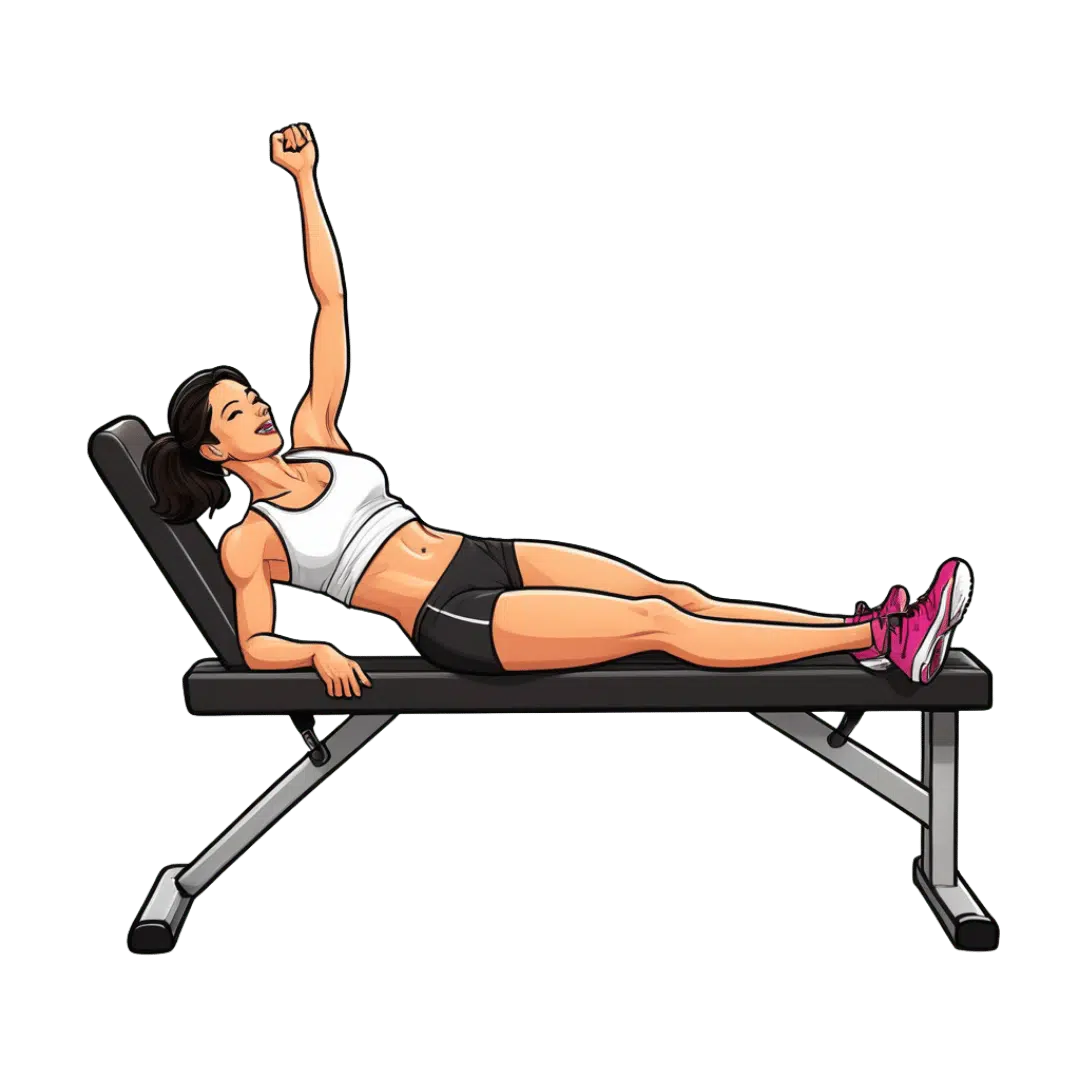
And the good news is, you don’t even have to get out of bed:
On the fly
This looks like an astonishingly lazy exercise, but in fact, it trains your posterior deltoid, your middle and lower trapezius, your rhomboids, and at least three rotator-cuff muscles that keep your shoulder centred in its socket.
The resultant stability, i.e. your shoulder’s ability to to essentially hold itself together and move freely, will mean (unless there is something else going on) a considerable reduction in pain. And if there is something else going on, then well, it will in most cases still help, but we cannot cover all eventualities and nor did this video.
Here’s the exercise, with all the details you need to know:
- How to set up: lie on your side on a bed with your painful side on top, rest your head on a pillow, extend your top arm slightly forwards
- How to do it: raise your arm upwards without rolling your torso backwards, then slowly lower it for about five seconds, allowing your hand to drop slightly below bed height if comfortable to lengthen and strengthen your shoulder muscles.
- How to modify: if lowering past neutral causes pain in your shoulder, stop at neutral and lift again rather than forcing the range—but do increase again when your body allows you to do so without pain.
- What you should feel: expect strong work in your posterior deltoid and your deep rotator-cuff muscles, as they stabilize and control your shoulder during the slow lowering phase.
- How to structure practice: do a short set, rest, and repeat for about three total sets, adding weight only when the movement becomes easy.
For more on all of this plus a visual demonstration, enjoy:
Click Here If The Embedded Video Doesn’t Load Automatically!
Want to learn more?
You might also like:
Shoulders Range – by Elia Bartolini
Take care!
Don’t Forget…
Did you arrive here from our newsletter? Don’t forget to return to the email to continue learning!
Recommended
Learn to Age Gracefully
Join the 98k+ American women taking control of their health & aging with our 100% free (and fun!) daily emails:
-
Grapefruit vs Guava – Which is Healthier?
10almonds is reader-supported. We may, at no cost to you, receive a portion of sales if you purchase a product through a link in this article.
Our Verdict
When comparing grapefruit to guava, we picked the guava.
Why?
It’s not close:
In terms of macros, guava has 3x the fiber, slightly more carbs, and 3x the protein, winning easily in this category.
In the category of vitamins, grapefruit has more vitamin A, while guava has more of vitamins A, B1, B2, B3, B5, B6, B7, B9, C, E, and K, sweeping its second round in a row.
Looking at minerals, grapefruit has a tiny touch more calcium, while guava has a lot more copper, iron, magnesium, manganese, phosphorus, potassium, selenium, and zinc, winning its third round by a long way.
One more consideration that’s not shown in the nutritional values, is that grapefruit contains high levels of furanocoumarins, which can inhibit cytochrome P-450 3A4 isoenzyme and P-glycoptrotein transporters in the intestine and liver—slowing down their drug metabolism capabilities, thus effectively increasing the bioavailability of many drugs manifold.
This may sound superficially like a good thing (improving bioavailability of things we want), but in practice it means that in the case of many drugs, if you take them with (or near in time to) grapefruit or grapefruit juice, then congratulations, you just took an overdose. This happens with a lot of meds for blood pressure, cholesterol (including statins), calcium channel-blockers, anti-depressants, benzo-family drugs, beta-blockers, and more. Oh, and Viagra, too. Which latter might sound funny, but remember, Viagra’s mechanism of action is blood pressure modulation, and that is not something you want to mess around with unduly. So, do check with your pharmacist to know if you’re on any meds that would be affected by grapefruit or grapefruit juice!
PS: the same substance is quite available in pummelos and sour oranges (but not meaningfully in sweet oranges); you can see a chart here showing the relative furanocoumarin contents of many citrus fruits, or lack thereof as the case may be, as it is for lemons and most limes).
Adding up the sections makes for an overwhelming overall win for guava, but by all means do enjoy either or both, unless any of the furanocoumarin contraindications apply!
Want to learn more?
You might like:
Watch Out For Furanocoumarins!
Enjoy!
Share This Post
-
The Mindful Body – by Dr. Ellen Langer
10almonds is reader-supported. We may, at no cost to you, receive a portion of sales if you purchase a product through a link in this article.
Fear not, this is not a “think healing thoughts” New Age sort of book. In fact, it’s quite the contrary.
The most common negative reviews for this on Amazon are that it is too densely packed with scientific studies, and some readers found it hard to get through since they didn’t find it “light reading”.
Counterpoint: this reviewer found it very readable. A lot of it is as accessible as 10almonds content, and a lot is perhaps halfway between 10almonds content in readability, and the studies we cite. So if you’re at least somewhat comfortable reading academic literature, you should be fine.
The author, a professor of psychology (tenured at Harvard since 1981), examines a lot of psychosomatic effect. Psychosomatic effect is often dismissed as “it’s all in your head”, but it means: what’s in your head has an effect on your body, because your brain talks to the rest of the body and directs bodily responses and actions/reactions.
An obvious presentation of this in medicine is the placebo/nocebo effect, but Dr. Langer’s studies (indeed, many of the studies she cites are her own, from over the course of her 40-year career) take it further and deeper, including her famous “Counterclockwise” study in which many physiological markers of aging were changed (made younger) by changing the environment that people spent time in, to resemble their youth, and giving them instructions to act accordingly while there.
In the category of subjective criticism: the book is not exceptionally well-organized, but if you read for example a chapter a day, you’ll get all the ideas just fine.
Bottom line: if you want a straightforward hand-holding “how-to” guide, this isn’t it. But it is very much information-packed with a lot of ideas and high-quality science that’s easily applicable to any of us.
Click here to check out The Mindful Body, and indeed grow your chronic good health!
Share This Post
-
Restorative Yoga for Beginners – by Julia Clarke
10almonds is reader-supported. We may, at no cost to you, receive a portion of sales if you purchase a product through a link in this article.
If your goals with yoga are less “Instagram influencer doing the vertical splits” and more “I would like my body to not ache so often”, then this is the book for you.
The focus here is on opening and relaxation, and involves poses that are simple and gentle, and each routine consists of only a few poses per session, so there’s no need to memorize a long arcane list of asanas, nor any need to refer constantly to a manual while in the perambulatory pretzel position. In short, it’s stress-free, which surely is something that yoga in general should be.
The poses themselves (of which there are 36) are illustrated clearly; the cover art is indicative of the style of drawings inside, and there are clear text-based instructions and explanations too.
Since there are props used throughout to give support in positions that will be held for a period of time (think less “holding a plank position while shaking” and more “this cushion under this body part eliminates the need for tension”), you will need to have/get those things to do the exercises as indicated. If you have some cushions/pillows and a rolled towel, you probably don’t need anything else, though a foam roller and a yoga block can be helpful if you have them.
Bottom line: if you’ve been thinking of yoga, and want to ease yourself in gently, then this is an excellent choice, and in this reviewer’s opinion, a lot better than other “yoga lite” options such as chair yoga.
Click here to check out Restorative Yoga For Beginners, and restore your body!
Share This Post
Related Posts
-
How To Build Strong Ankles
10almonds is reader-supported. We may, at no cost to you, receive a portion of sales if you purchase a product through a link in this article.
You can step up those calf raises to great effect:
Give your calves a raise
Weak ankles are a big liability, as you never know when one will just send you crashing to the floor.
Strengthening your calves helps a lot, but how, besides just stepping up and down?
Here are three ways, depending on your ability level:
- Beginner split-stance calf raises: set up in a split stance with your toes elevated on a small wedge or step, lift one heel at a time as high as you can and tap it back down, then pedal between sides to add balance while moving at a speed that feels comfortable.
- Intermediate ninja-stance calf raises: bring your feet together with your toes elevated, start already lifted through your heels, then tap your heels down and lift them back up while staying higher and controlling your balance.
- Advanced single-leg calf raises: balance on one foot with your toes elevated and tap your heel down before lifting it back up, or perform the movement on the ground if needed while aiming to stay steady without losing your balance.
For more on each of these plus visual demonstrations, enjoy:
Click Here If The Embedded Video Doesn’t Load Automatically!
Want to learn more?
You might also like:
Knee Pain? The Problem Might Be Your Ankles
Take care!
Don’t Forget…
Did you arrive here from our newsletter? Don’t forget to return to the email to continue learning!
Learn to Age Gracefully
Join the 98k+ American women taking control of their health & aging with our 100% free (and fun!) daily emails:
-
The Breathing Cure – by Patrick McKeown
10almonds is reader-supported. We may, at no cost to you, receive a portion of sales if you purchase a product through a link in this article.
We’ve previously reviewed this author’s “The Oxygen Advantage”, which as you might guess from the title, was also about breathing. So, what’s different here?
While The Oxygen Advantage was mostly about improving good health with optimized breathing, and with an emphasis on sports too, The Breathing Cure is more about the two-way relationship between ill health and disordered breathing (and how to fix it).
Many kinds of illnesses can affect our breathing, and our breathing can affect many types of illness; McKeown covers a lot of these, including the obvious things like respiratory diseases (including COVID and Long COVID, as well as non-infectious respiratory conditions like asthma), but also things like diabetes and heart disease, as well as peri-disease things like chronic pain, and demi-disease things like periods and menopause.
In each case (and more), he examines what things make matters better or worse, and how to improve them.
While the style itself is just as pop-science as The Oxygen Advantage, this time it relies less on anecdote (though there are plenty of anecdotes too), and leans more heavily on a generous chapter-by-chapter scientific bibliography, with plenty of citations to back up claims.
Bottom line: if you’d like to breathe better, this book can help in very many ways.
Click here to check out The Breathing Cure, and breathe easy!
Don’t Forget…
Did you arrive here from our newsletter? Don’t forget to return to the email to continue learning!
Learn to Age Gracefully
Join the 98k+ American women taking control of their health & aging with our 100% free (and fun!) daily emails:
-
Focusing on how and why you eat, not just what, may be the key to healthy eating
10almonds is reader-supported. We may, at no cost to you, receive a portion of sales if you purchase a product through a link in this article.
When most people think about “healthy eating”, they usually focus on what they eat. That might mean trying to eat more fruit and vegetables or less fast food, or counting calories.
But there’s a lot more to healthy eating than just dietary intake. Behaviours and attitudes around food are also important.
Take, for example, orthorexia nervosa, which is an obsessive preoccupation with consuming only “healthy” foods. If healthy eating only means ingesting healthy foods, then people with orthorexia are super healthy.
But people who live with this eating disorder often struggle with relationships and report poor quality of life, among other issues.
Research suggests that shifting the focus from food itself to our experience of eating can have a range of health benefits. Let’s take a look.
Hinterhaus Productions/Getty Why are we so obsessed with diet?
Equating “healthy eating” with “healthy diet” may have taken off in the early 1980s with panic over the “obesity epidemic” in Western countries – defined as a rapid rise in the prevalence of people in the population with a body mass index (BMI) of 30 or greater.
But causes of obesity are complex and poorly understood, with numerous possible explanations beyond simply what a person eats. And admonishing overweight people to eat “healthier” has done nothing to reduce population rates of obesity.
There is some evidence that this fixation on weight has resulted in increased rates of disordered eating and eating disorders – both of which involve problematic eating behaviours and distorted attitudes towards food, weight, shape and appearance.
Clearly, something needs to change in how we think about healthy eating.
Listening to your body
A growing body of research on intuitive eating has found this approach has an array of health benefits.
Intuitive eating means trusting internal body cues that tell us when, what and how much to eat. For example, tuning into your stomach growling telling you it’s time to eat, or noticing feeling full or satisfied, or that you may crave certain foods because your body wants specific nutrients (such as protein after exercising).
Studies have shown this approach can lead to better physical and mental health as well as better diet quality, and is associated with lower BMIs.
Research also shows eating at regular intervals and eating with other people also lead to better overall health and diet.
But if you find it hard, you’re not alone
Most of us are surrounded by food environments that make healthy eating difficult.
Unhealthy food environments promote overeating and encourage us to override our innate signals of hunger and fullness.
When we’re surrounded by cheap and accessible sugary snacks, fast foods and large portions – and lots of marketing – it can be hard to develop a positive relationship with food.
The issue is particularly acute for people in more disadvantaged communities.
For example, in our research with rural Australians about food and eating, most told us they wanted to eat more healthily, but found it difficult for many reasons, These included busy schedules and the cost of healthier food.
Habits and emotional eating can also make healthy eating difficult.
So, what works?
For most people, healthy behaviours and attitudes to eating mean a balanced, flexible and non-judgmental approach, without fear of “bad” foods. It means paying attention to hunger and fullness cues.
But it also means recognising that food is a source of social and cultural connection. A healthy attitude to food doesn’t ignore nutritional information – it incorporates this knowledge into a broader and more joyous approach to eating.
Here are three suggestions to get you started.
1. Recognising signs of hunger and fullness
These may differ from person to person. Can you hear your stomach start to growl or your energy begin to dip? Is it a while since you ate? And while eating, is there a point where the hunger has gone away and you no longer feel a strong desire to continue eating? Some people find using hunger and fullness scales useful.
2. Reframing “bad” foods
Is there a food you really like but don’t eat because you consider it “bad” or “forbidden”? Try incorporating a small amount into your next meal or snack. You may find that doing so brings greater joy to your eating while simultaneously taking away its power.
3. Eating with people
If you normally eat by yourself or “grab and go”, see if there’s a way to plan more time for meals and include other people – whether this is more family meals or group lunches with coworkers.
But some people have to follow a specific diet
People with medical conditions that require a particular type of diet – such as those with diabetes or coeliac disease – need to follow that advice. But they may still be able to have healthy behaviours and attitudes towards food even within these constraints.
For example, one 2020 study of people with type 2 diabetes found that more intuitive eaters had better control of their blood sugar levels.
The bottom line
So – if you don’t have a medical condition that prevents it – go ahead and have some of that birthday cake. And then listen to your body when it tells you you’ve had enough.
If you feel that you have an unhealthy relationship with food that is interfering with your life, please contact your GP to discuss your options. You may also want to contact the Butterfly Foundation for support.
Nina Van Dyke, Associate Professor and Associate Director, Mitchell Institute, Victoria University and Rosemary V. Calder, Professor, Health Policy, Victoria University
This article is republished from The Conversation under a Creative Commons license. Read the original article.
Don’t Forget…
Did you arrive here from our newsletter? Don’t forget to return to the email to continue learning!
Learn to Age Gracefully
Join the 98k+ American women taking control of their health & aging with our 100% free (and fun!) daily emails:


