
Should I take a magnesium supplement? Will it help me sleep or prevent muscle cramps?
10almonds is reader-supported. We may, at no cost to you, receive a portion of sales if you purchase a product through a link in this article.
Magnesium supplements are everywhere – lined up on pharmacy shelves and promoted on wellness blogs and social media.
Maybe you have a friend or family member who swears a daily tablet will help everything, from better sleep to alleviating muscle cramps.
But do you really need one? Or it is just marketing hype?
What is magnesium and why do we need it?
Magnesium is an essential metal the body needs to make and operate more than 300 different enzymes.
These enzymes build protein, and regulate muscle and nerve function, help in the release of energy from our food, and help to maintain blood function. The body doesn’t produce magnesium so we need to get it from external sources.
The government recommends a daily magnesium dose of 310–420 mg a day for adults and 30–410 mg for children, depending on age and sex.
This is easily met through a good diet. Foods rich in magnesium include nuts and seeds, whole grains, seafood, meat, legumes and green leafy vegetables.
You can even get some of your magnesium needs met through dark chocolate. It has 146 mg per 100 g of chocolate.
How do I know if I’m deficient?
People at risk of experiencing magnesium deficiency include people with restricted diets, gastrointestinal problems such as Crohn’s and coeliac diseases, type 2 diabetes, and alcohol dependence. Older adults are also more likely to be deficient.
You will only need a magnesium supplement if you show signs of low magnesium. One of the most common signs is muscle spasms and twitches. Other symptoms to look out for include low appetite, nausea and vomiting, or your heart beating abnormally.
Magnesium deficiency can be properly diagnosed by a blood test ordered by your doctor. If you need this test, it’s covered by Medicare.
What conditions can it help?
Commercially available magnesium supplements have been promoted to prevent muscle cramps, manage insomnia and help with migraines.
While magnesium deficiency is linked to muscle cramps, the cause of most muscle cramps is unknown.
And the current evidence does not demonstrate that magnesium supplements can prevent muscle cramps in older adults.
There is conflicting data as to whether the use of magnesium helps with sleep. One study reported magnesium was able to reduce the time for a person to fall asleep by 17.4 minutes while others didn’t show an effect.
For migraines, the most recent research suggests taking 122-600 mg of magnesium supplements daily for 4–24 weeks may decrease their frequency and severity.
Are magnesium supplements safe?
Magnesium supplements are generally well tolerated.
However, they can cause gastrointestinal discomfort such as nausea, abdominal cramping and diarrhoea. Magnesium causes diarrhoea by drawing water into the intestine and stimulating movement in the gut.
It is possible to take too much magnesium and you can overdose on it. Very large doses, around 5,000 mg per day, can lead to magnesium toxicity.
Most of the research investigating the clinical use of magnesium focuses on magnesium in oral formulations.
What other formulations are available?
As magnesium is a small metal ion, it can pass through skin – but not easily.
Magnesium bath salts, patches and topical cream-based formulations may be able to raise your blood magnesium levels to some extent.
But due to the amount needed each day, tablets and foods are a better source.
Things to watch out for when taking magnesium
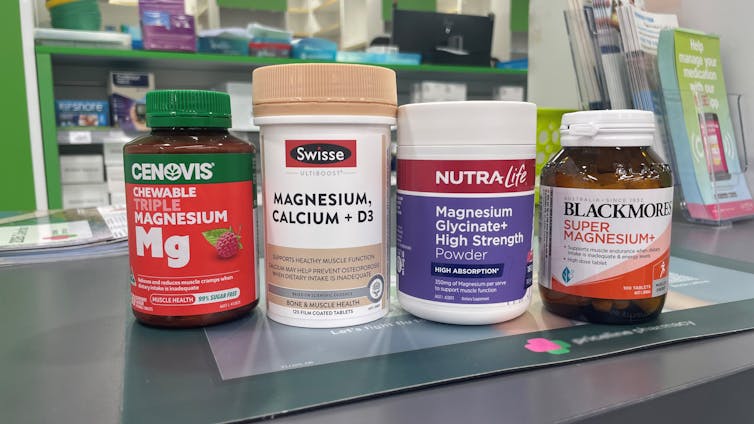
Commercially available magnesium products can vary widely in dose, formulation and cost. Magnesium supplements have between 150 to 350 mg of the metal per tablet. Your required dose will depend on your age and sex, and whether you have any underlying health problems.
Magnesium supplements sometimes contain other vitamins and minerals, such as vitamins C and D, and the metals calcium, chromium and manganese. So it’s important to consider the total quantities if you’re taking other vitamins and supplements.
Many magnesium supplements also include vitamin B6. While this vitamin is important for supporting the immune system, high intakes can it can cause serious health issues. If you’re already taking a B6 supplement, a magnesium supplement that also includes it can put you at risk.
What if you’re considering supplements?
If you think you might be deficient in magnesium, speak to your doctor who can order a blood test.
If you suffer from migraines, cramps, or poor sleep, talk to your doctor or pharmacist who can advise on and monitor the underlying cause. It may be that a change in lifestyle or an alternative treatment may be more appropriate for you.
If you do decide to take a magnesium supplement, check you won’t be taking too much of any other vitamin or mineral. A pharmacist can help select a supplement that suits you best.
Nial Wheate, Professor, School of Natural Sciences, Macquarie University and Wai-Jo Jocelin Chan, Pharmacist and Lecturer, UNSW Sydney; University of Sydney
This article is republished from The Conversation under a Creative Commons license. Read the original article.
Don’t Forget…
Did you arrive here from our newsletter? Don’t forget to return to the email to continue learning!
Recommended
Learn to Age Gracefully
Join the 98k+ American women taking control of their health & aging with our 100% free (and fun!) daily emails:
-
Red Light Therapy Every Day For 5 Years (Plus New Research)!
10almonds is reader-supported. We may, at no cost to you, receive a portion of sales if you purchase a product through a link in this article.
And how to get the most out of the correct kind of device:
There’s no stopping this red light
Over the past 5 years, the use of red light therapy (RLT) has moved from being a fringe “biohack” to a more mainstream, research-backed tool.
It’s not new, though! RLT originated in the 1960s when a Hungarian scientist observed improved wound healing and hair growth in rodents exposed to low-level red light.
Now here in the modern era, strong evidence supports red light therapy for wound healing, collagen production, skin health, and treating hair loss, nerve damage in extremities, and age-related macular degeneration.
Going down the list, less certain but promising applications include muscle recovery, ameliorating depression symptoms, managing the pain of conditions ranging from osteoarthritis to fibromyalgia, and improving metabolic and cardiovascular health.
How it works: it’s not magic; red and near-infrared light stimulate mitochondria by interacting with cytochrome c oxidase, increasing ATP production and thus cellular energy. Other mechanisms include reactive oxygen species signaling for tissue repair and nitric oxide release to improve oxygen availability.
What kind of device is best: simpler devices with red (around 660nm) and near-infrared (around 830nm) wavelengths are more effective than more complex devices with additional wavelengths (including multicolored lights).
This is particularly important as wavelengths above 1000nm or below 500nm can irritate sensitive skin and (ironically) cause redness rather than calming effects.
As with many things, consistent use—ideally daily or at least 5 times per week—is necessary to see noticeable benefits.
And of course, results are best supported by a broader routine including skincare (e.g. tretinoin), diet, exercise, and sleep, rather than relying on RLT to do all the work alone. Your body is, after all, a system of systems, and works best when treated holistically!
For more on all of this, enjoy:
Click Here If The Embedded Video Doesn’t Load Automatically!
Want to learn more?
You might also like:
Casting Yourself In A Healthier Light ← our main feature about RLT
Take care!
Share This Post
-
Collard Greens vs Watercress – Which is Healthier?
10almonds is reader-supported. We may, at no cost to you, receive a portion of sales if you purchase a product through a link in this article.
Our Verdict
When comparing collard greens to watercress, we picked the collards.
Why?
Both are definitely superfoods! But…
In terms of macros, collards have 7x the fiber for 5x the carbs and slightly more protein, winning this category easily.
In the category of vitamins, collards have more of vitamins A, B3, and B9, while watercress has more of vitamins B1, B5, and B6 (the two plants are equal in other vitamins they both contain, making this round a 3:3 tie.
Looking at minerals next, collards have more calcium, iron, magnesium, manganese, selenium, and zinc, while watercress has more copper, phosphorus, and potassium, yielding to collard greens a 6:3 win here.
In other considerations, they’re approximately equal on polyphenols, while collard greens have more carotenoids, including a good lutein content, so that’s a win for them in this round.
Adding up the sections makes for a clear overall win for collard greens, but by all means do enjoy either or both, as diversity is good!
Want to learn more?
You might like:
Brain Food? The Eyes Have It! ← this is about leafy greens, and their lutein in particular
Enjoy!
Share This Post
-
The BAT-pause!
10almonds is reader-supported. We may, at no cost to you, receive a portion of sales if you purchase a product through a link in this article.
When Cold Weather & The Menopause Battle It Out
You may know that (moderate, safe) exposure to the cold allows our body to convert our white and yellow fat into the much healthier brown fat—also called brown adipose tissue, or “BAT” to its friends.
If you didn’t already know that, then well, neither did scientists until about 15 years ago:
The Changed Metabolic World with Human Brown Adipose Tissue: Therapeutic Visions
You can read more about it here:
Cool Temperature Alters Human Fat and Metabolism
This is important, especially because the white fat that gets converted is the kind that makes up most visceral fat—the kind most associated with all-cause mortality:
Visceral Belly Fat & How To Lose It ← this is not the same as your subcutaneous fat, the kind that sits directly under your skin and keeps you warm; this is the fat that goes between your organs and of which we should only have a small amount!
The BAT-pause
It’s been known (since before the above discovery) that BAT production slows considerably as we get older. Not too shocking—after all, many metabolic functions slow as we get older, so why should fat regulation be any different?
But! Rodent studies found that this was tied less to age, but to ovarian function: rats who underwent ovariectomies suffered reduced BAT production, regardless of their age.
Naturally, it’s been difficult to recreate such studies in humans, because it’s difficult to find a large sample of young adults willing to have their ovaries whipped out (or even suppressed chemically) to see how badly their metabolism suffers as a result.
Nor can an observational study (for example, of people who incidentally have ovaries removed due to ovarian cancer) usefully be undertaken, because then the cancer itself and any additional cancer treatments would be confounding factors.
Perimenopausal study to the rescue!
A recent (published last month, at time of writing!) study looked at women around the age of menopause, but specifically in cohorts before and after, measuring BAT metabolism.
By dividing the participants into groups based on age and menopausal status, and dividing the post-menopausal group into “takes HRT” and “no HRT” groups, and dividing the pre-menopausal group into “normal ovarian function” and “ovarian production of estrogen suppressed to mimic slightly early menopause” groups (there’s a drug for that), and then having groups exposed to warm and cold temperatures, and measuring BAT metabolism in all cases, they were able to find…
It is about estrogen, not age!
You can read more about the study here:
“Good” fat metabolism changes tied to estrogen loss, not necessarily to aging, shows study
…and the study itself, here:
Brown adipose tissue metabolism in women is dependent on ovarian status
What does this mean for men?
This means nothing directly for (cis) men, sorry.
But to satisfy your likely curiosity: yes, testosterone does at least moderately suppress BAT metabolism—based on rodent studies, anyway, because again it’s difficult to find enough human volunteers willing to have their testicles removed for science (without there being other confounding variables in play, anyway):
Testosterone reduces metabolic brown fat activity in male mice
So, that’s bad per se, but there isn’t much to be done about it, since the rest of your (addressing our male readers here) metabolism runs on testosterone, as do many of your bodily functions, and you would suffer many unwanted effects without it.
However, as men do typically have notably less body fat in general than women (this is regulated by hormones), the effects of changes in BAT metabolism are rather less pronounced in men (per testosterone level changes) than in women (per estrogen level changes), because there’s less overall fat to convert.
In summary…
While menopausal HRT is not necessarily a silver bullet to all metabolic problems, its BAT-maintaining ability is certainly one more thing in its favor.
See also:
Dr. Jen Gunter | What You Should Have Been Told About The Menopause Beforehand
Take care!
Share This Post
Related Posts
-
Take This Two-Minute Executive Dysfunction Test
10almonds is reader-supported. We may, at no cost to you, receive a portion of sales if you purchase a product through a link in this article.
Roll For Initiative
Some of us struggle with executive dysfunction a lot; others, a little.
What Is Executive Dysfunction?
• Executive function is a broad group of mental skills that enable people to complete tasks and interact with others.
• Executive dysfunction can impair a person’s ability to organize and manage behavior
• Executive dysfunction is not a specific stand-alone diagnosis or condition.
• Instead, conditions such as depression and ADHD (amongst others) can affect a person’s executive function.
Take This Two-Minute Executive Dysfunction Test
How did you score? (8/16 here!)
Did you do it? (it honestly is really two minutes and is quite informative)
If not, here’s your cue to go back up and do it
For almost all of us, we sometimes find ourselves torn between several competing tasks, and end up doing… none of them.
For such times, compile yourself a “productivity buffet”, print it, and pin it above your desk or similar space.
What’s a productivity buffet?
It’s a numbered list of 6, 8, 10, 12 or 20 common tasks that pretty much always need doing (to at least some extent!). Doesn’t matter how important they are, just that they are frequently recurring tasks. For example:
- Tidy desk (including that drawer!)
- Reply to emails/messages
- Drink water
- Collect stray one-off to-dos into a list
- Stretch (or at least correct your posture!)
- Extend that Duolingo streak
- Read one chapter of a book
- Etc
Why 6, 8, 10, 12, or 20?
Because those are common denominations of polyhedral dice that are very cheap to buy!
Keep the relevant die to hand (perhaps in your pocket or on your desk), and when you know you should be doing something but can’t decide what exactly, roll the die and do the item corresponding to the number you roll.
And if you find yourself thinking “damn, I got 12, I wanted 7!” then go ahead and do item 7—the dice aren’t the boss of you, they’re just there to break the ice between you and your to-do list!
The Housekeeper In Your Pocket?
If you found the tidying tips (up top) helpful, but don’t like cleaning schedules because you just can’t stick to them, this one’s for you.
It’s easy to slip into just doing the same few easy tasks while neglecting others for far too long.
The answer? Outsource!
Not “get a cleaner” (though if you want to and can, great, go for it, this one won’t be for you after all), but rather, try this nifty little app that helps you keep on top of daily cleaning—which we all know is better than binge-cleaning every few months.
Sweepy keeps track of:
- What jobs there are that might need doing in each room (or type of room) in the house
- How often those jobs generally need doing
- How much of your energy (a finite resource, which it also takes into account!) those jobs will take
- How much energy you are prepared to spend per day (you can “lighter/heavier” days, or even “off-days”, too)
…and then it populates a small daily task list according to what needs cleaning and how much energy it’ll take.
For example, today Sweepy gives me (your trusty writer, hi! ) the tasks:
- Bathroom: clean sink (every 3 days, 1pt of energy)
- Dining room: clean and tidy table (every day, 1pt of energy)
- Bedroom: vacuum floor (every 7 days, 2pts of energy)
- Kitchen: clean coffee machine (every 30 days, 2pts of energy)
And that’s my 6pts of energy I’ve told Sweepy I’m happy to spend per day cleaning. There are “3 pts” tasks too—cleaning the oven, for example—but none came up today.
Importantly: it does not bother me about any other tasks today (even if something’s overdue), and I don’t have to worry my pretty head about it.
I don’t have to feel guilty for not doing other cleaning tasks; if they need doing, Sweepy will tell me tomorrow, and it will make sure I don’t get behind or leave anything neglected for too long.
Check it out (available for both iOS and Android)
PS: to premium or not to premium? We think the premium is worth it (unlocks some extra customization features) but the free version is sufficient to get your house in order, so don’t be afraid to give it a try first.
Don’t Forget…
Did you arrive here from our newsletter? Don’t forget to return to the email to continue learning!
Learn to Age Gracefully
Join the 98k+ American women taking control of their health & aging with our 100% free (and fun!) daily emails:
-
Protein Immune Support Salad
10almonds is reader-supported. We may, at no cost to you, receive a portion of sales if you purchase a product through a link in this article.
How to get enough protein from a salad, without adding meat? Cashews and chickpeas have you more than covered! Along with the leafy greens and an impressive array of minor ingredients full of healthy phytochemicals, this one’s good for your muscles, bones, skin, immune health, and more.
You will need
- 1½ cups raw cashews (if allergic, omit; the chickpeas and coconut will still carry the dish for protein and healthy fats)
- 2 cans (2x 14oz) chickpeas, drained
- 1½ lbs baby spinach leaves
- 2 large onions, finely chopped
- 3 oz goji berries
- ½ bulb garlic, finely chopped
- 2 tbsp dessicated coconut
- 1 tbsp dried cumin
- 1 tbsp nutritional yeast
- 2 tsp chili flakes
- 1 tsp black pepper, coarse ground
- ½ tsp MSG, or 1 tsp low-sodium salt
- Extra virgin olive oil, for cooking
Method
(we suggest you read everything at least once before doing anything)
1) Heat a little oil in a pan; add the onions and cook for about 3 minutes.
2) Add the garlic and cook for a further 2 minutes.
3) Add the spinach, and cook until it wilts.
4) Add the remaining ingredients except the coconut, and cook for another three minutes.
5) Heat another pan (dry); add the coconut and toast for 1–2 minutes, until lightly golden. Add it to the main pan.
6) Serve hot as a main, or an attention-grabbing side:
Enjoy!
Want to learn more?
For those interested in some of the science of what we have going on today:
- Cashew Nuts vs Coconut – Which is Healthier?
- What Matters Most For Your Heart?
- Beyond Supplements: The Real Immune-Boosters!
- Goji Berries: Which Benefits Do They Really Have?
- Our Top 5 Spices: How Much Is Enough For Benefits?
Take care!
Don’t Forget…
Did you arrive here from our newsletter? Don’t forget to return to the email to continue learning!
Learn to Age Gracefully
Join the 98k+ American women taking control of their health & aging with our 100% free (and fun!) daily emails:
-
Menopause can bring increased cholesterol levels and other heart risks. Here’s why and what to do about it
10almonds is reader-supported. We may, at no cost to you, receive a portion of sales if you purchase a product through a link in this article.
Menopause is a natural biological process that marks the end of a woman’s reproductive years, typically between 45 and 55. As women approach or experience menopause, common “change of life” concerns include hot flushes, sweats and mood swings, brain fog and fatigue.
But many women may not be aware of the long-term effects of menopause on the heart and blood vessels that make up the cardiovascular system. Heart disease accounts for 35% of deaths in women each year – more than all cancers combined.
What should women – and their doctors – know about these risks?
Hormones protect hearts – until they don’t
As early as 1976, the Framingham Heart Study reported more than twice the rates of cardiovascular events in postmenopausal than pre-menopausal women of the same age. Early menopause (younger than age 40) also increases heart risk.
Before menopause, women tend to be protected by their circulating hormones: oestrogen, to a lesser extent progesterone and low levels of testosterone.
These sex hormones help to relax and dilate blood vessels, reduce inflammation and improve lipid (cholesterol) levels. From the mid-40s, a decline in these hormone levels can contribute to unfavourable changes in cholesterol levels, blood pressure and weight gain – all risk factors for heart disease.
Speedkingz/Shutterstock 4 ways hormone changes impact heart risk
1. Dyslipidaemia– Menopause often involves atherogenic changes – an unhealthy imbalance of lipids in the blood, with higher levels of total cholesterol, triglycerides, and low-density lipoprotein (LDL-C), dubbed the “bad” cholesterol. There are also reduced levels of high-density lipoprotein (HDL-C) – the “good” cholesterol that helps remove LDL-C from blood. These changes are a major risk factor for heart attack or stroke.
2. Hypertension – Declines in oestrogen and progesterone levels during menopause contribute to narrowing of the large blood vessels on the heart’s surface, arterial stiffness and raise blood pressure.
3. Weight gain – Females are born with one to two million eggs, which develop in follicles. By the time they stop ovulating in midlife, fewer than 1,000 remain. This depletion progressively changes fat distribution and storage, from the hips to the waist and abdomen. Increased waist circumference (greater than 80–88 cm) has been reported to contribute to heart risk – though it is not the only factor to consider.
4. Comorbidities – Changes in body composition, sex hormone decline, increased food consumption, weight gain and sedentary lifestyles impair the body’s ability to effectively use insulin. This increases the risk of developing metabolic syndromes such as type 2 diabetes.
While risk factors apply to both genders, hypertension, smoking, obesity and type 2 diabetes confer a greater relative risk for heart disease in women.
So, what can women do?
Every woman has a different level of baseline cardiovascular and metabolic risk pre-menopause. This is based on their genetics and family history, diet, and lifestyle. But all women can reduce their post-menopause heart risk with:
- regular moderate intensity exercise such as brisk walking, pushing a lawn mower, riding a bike or water aerobics for 30 minutes, four or five times every week
- a healthy heart diet with smaller portion sizes (try using a smaller plate or bowl) and more low-calorie, nutrient-rich foods such as vegetables, fruit and whole grains
- plant sterols (unrefined vegetable oil spreads, nuts, seeds and grains) each day. A review of 14 clinical trials found plant sterols, at doses of at least 2 grams a day, produced an average reduction in serum LDL-C (bad cholesterol) of about 9–14%. This could reduce the risk of heart disease by 25% in two years
- less unhealthy (saturated or trans) fats and more low-fat protein sources (lean meat, poultry, fish – especially oily fish high in omega-3 fatty acids), legumes and low-fat dairy
- less high-calorie, high-sodium foods such as processed or fast foods
- a reduction or cessation of smoking (nicotine or cannabis) and alcohol
- weight-gain management or prevention.
Exercise can reduce post-menopause heart disease risk. Monkey Business Images/Shutterstock What about hormone therapy medications?
Hormone therapy remains the most effective means of managing hot flushes and night sweats and is beneficial for slowing the loss of bone mineral density.
The decision to recommend oestrogen alone or a combination of oestrogen plus progesterone hormone therapy depends on whether a woman has had a hysterectomy or not. The choice also depends on whether the hormone therapy benefit outweighs the woman’s disease risks. Where symptoms are bothersome, hormone therapy has favourable or neutral effects on coronary heart disease risk and medication risks are low for healthy women younger than 60 or within ten years of menopause.
Depending on the level of stroke or heart risk and the response to lifestyle strategies, some women may also require medication management to control high blood pressure or elevated cholesterol levels. Up until the early 2000s, women were underrepresented in most outcome trials with lipid-lowering medicines.
The Cholesterol Treatment Trialists’ Collaboration analysed 27 clinical trials of statins (medications commonly prescribed to lower cholesterol) with a total of 174,000 participants, of whom 27% were women. Statins were about as effective in women and men who had similar risk of heart disease in preventing events such as stroke and heart attack.
Every woman approaching menopause should ask their GP for a 20-minute Heart Health Check to help better understand their risk of a heart attack or stroke and get tailored strategies to reduce it.
Treasure McGuire, Assistant Director of Pharmacy, Mater Health SEQ in conjoint appointment as Associate Professor of Pharmacology, Bond University and as Associate Professor (Clinical), The University of Queensland
This article is republished from The Conversation under a Creative Commons license. Read the original article.
Don’t Forget…
Did you arrive here from our newsletter? Don’t forget to return to the email to continue learning!
Learn to Age Gracefully
Join the 98k+ American women taking control of their health & aging with our 100% free (and fun!) daily emails:


