
Pregnant women can now get a free RSV shot. What other vaccines do you need when you’re expecting?
10almonds is reader-supported. We may, at no cost to you, receive a portion of sales if you purchase a product through a link in this article.
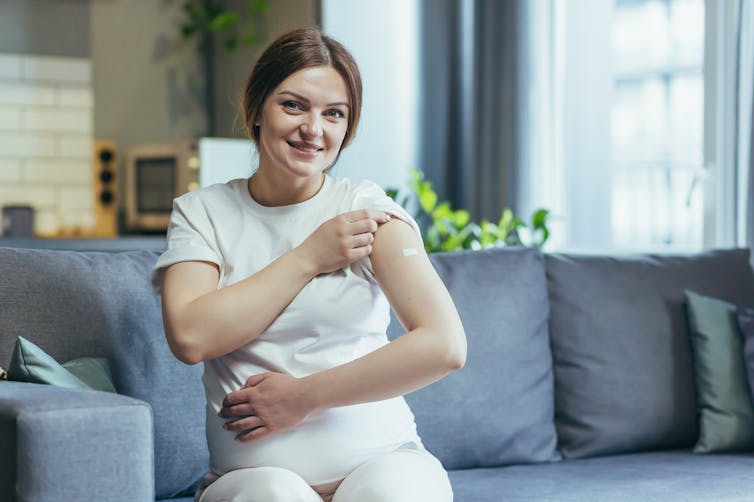
From today, February 3, pregnant women in Australia will be eligible for a free RSV vaccine under the National Immunisation Program.
This vaccine is designed to protect young infants from severe RSV (respiratory syncytial virus). It does so by generating the production of antibodies against RSV in the mother, which then travel across the placenta to the baby.
While the RSV vaccine is a new addition to the National Immunisation Program, it’s one of three vaccines provided free for pregnant women under the program, alongside ones for influenza and whooping cough. Each offers important protection for newborn babies.
The RSV vaccine
RSV is the most common cause of lower respiratory infections (bronchiolitis and pneumonia) in infants. It’s estimated that of every 100 infants born in Australia each year, at least two will be hospitalised with RSV by six months of age.
RSV infection is most common roughly between March and August in the southern hemisphere, but infection can occur year-round, especially in tropical areas.
The vaccine works by conferring passive immunity (from the mother) as opposed to active immunity (the baby’s own immune response). By the time the baby is born, their antibodies are sufficient to protect them during the first months of life when they are most vulnerable to severe RSV disease.
The RSV vaccine registered for use in pregnant women in Australia, Abrysvo, has been used since 2023 in the Americas and Europe. Real-world experience there shows it’s working well.
For example, over the 2024 RSV season in Argentina, it was found to prevent 72.7% of lower respiratory tract infections caused by RSV and requiring hospitalisation in infants aged 0–3 months, and 68% among those aged 0–6 months. This research noted three deaths from RSV, all in infants whose mothers did not receive the RSV vaccine during pregnancy.
This was similar to protection seen in a large multinational clinical trial that compared babies born to mothers who received this RSV vaccine with babies born to mothers who received a placebo. This study found the vaccine prevented 82.4% of severe cases of RSV in infants aged under three months, and 70% under six months, and that the vaccine was safe.

In addition to the maternal vaccine, nirsevimab, a long-acting monoclonal antibody, provides effective protection against severe RSV disease. It’s delivered to the baby by an intramuscular injection, usually in the thigh.
Nirsevimab is recommended for babies born to women who did not receive an RSV vaccine during pregnancy, or who are born within two weeks of their mother having received the shot (most likely if they’re born prematurely). It may also be recommended for babies who are at higher risk of RSV due to a medical condition, even if their mother was vaccinated.
Nirsevimab is not funded under the National Immunisation Program, but is covered under various state and territory-based programs for infants of mothers who fall into the above categories.
But now we have a safe and effective RSV vaccine for pregnancy, all pregnant women should be encouraged to receive it as the first line of prevention. This will maximise the number of babies protected during their first months of life.
Flu and whooping cough
It’s also important pregnant women continue to receive flu and whooping cough vaccines in 2025. Like the RSV vaccine, these protect infants by passing antibodies from mother to baby.
There has been a large whooping cough outbreak in Australia in recent months, including a death of a two-month-old infant in Queensland in November 2024.
The whooping cough vaccine, given in combination with diphtheria and tetanus, prevents more than 90% of whooping cough cases in babies too young to receive their first whooping cough vaccine dose.
Similarly, influenza can be deadly in young babies, and maternal flu vaccination substantially reduces hospital visits associated with influenza for babies under six months. Flu can also be serious for pregnant women, so the vaccine offers important protection for the mother as well.
COVID vaccines are safe in pregnancy, but unless a woman is otherwise eligible, they’re not routinely recommended. You can discuss this with your health-care provider.
When and where can you get vaccinated?
Pregnant women can receive these vaccines during antenatal visits through their GP or in a specialised antenatal clinic.
The flu vaccine is recommended at any time during pregnancy, the whooping cough vaccine from 20 weeks (ideally before 32 weeks), and the RSV vaccine from 28 weeks (before 36 weeks).
It’s safe to receive multiple vaccinations at the same clinic visit.

We know vaccination rates have declined in a variety of groups since the pandemic, and there’s evidence emerging that suggests this trend has occurred in pregnant women too.
A recent preprint (a study yet to be peer-reviewed) found a decrease of nearly ten percentage points in flu vaccine coverage among pregnant women in New South Wales, from 58.8% in 2020 to 49.1% in 2022. The research showed a smaller drop of 1.4 percentage points for whooping cough, from 79% in 2020 to 77.6% in 2022.
It’s important to work to improve vaccination rates during pregnancy to give babies the best protection in their first months of life.
We know pregnant women would like to receive information about new and routine maternal vaccines early in pregnancy. In particular, many pregnant women want to understand how vaccines are tested for safety, and their effectiveness, which was evident during COVID.
GPs and midwives are trusted sources of information on vaccines in pregnancy. There’s also information available online on Sharing Knowledge About Immunisation, a collaboration led by the National Centre for Immunisation Research and Surveillance.
Archana Koirala, Paediatrician and Infectious Diseases Specialist, University of Sydney; Bianca Middleton, Senior Research Fellow, Menzies School of Health Research; Margie Danchin, Professor of Paediatrics and vaccinologist, Royal Childrens Hospital, University of Melbourne and Murdoch Childrens Research Institute (MCRI); Associate Dean International, University of Melbourne, Murdoch Children’s Research Institute; Peter McIntyre, Professor in Women’s and Children’s Health, University of Otago, and Rebecca Doyle, Adjunct Research Fellow, School of Nursing, Midwifery and Social Work, The University of Queensland
This article is republished from The Conversation under a Creative Commons license. Read the original article.
Don’t Forget…
Did you arrive here from our newsletter? Don’t forget to return to the email to continue learning!
Recommended
Learn to Age Gracefully
Join the 98k+ American women taking control of their health & aging with our 100% free (and fun!) daily emails:
-
The Skincare Bible − by Dr. Anjali Mahto
10almonds is reader-supported. We may, at no cost to you, receive a portion of sales if you purchase a product through a link in this article.
The subtitle claims this to be a “no-nonsense guide to great skin”, and while subtitle claims can often wildly overstate what’s being delivered, in this case, the book really is a no-nonsense guide to great skin.
The author is a dermatologist, and as such she speaks from her professional knowledge and experience, which is a lot more reliable than someone’s latest hack on TikTok.
She gives a quick crash course on what skin actually is and how it works, giving time to genetic considerations, cellular matters, and the grander-scale physical issues at hand, as well as what things affect it and how, ranging from diet to UV light to hormones and more.
We also get a clear explanation of regular skincare as well as specific skin concerns, ranging from minor inconveniences to skin cancer.
You may wonder if she covers anti-aging treatments, and yes, she does.
The style is (as indeed promised by the subtitle) no-nonsense, insofar as it’s straight to the point, no hype, and no padding, just plenty of information-dense content while still being very readable.
Bottom line: if you’d like to seriously look after your skin but aren’t a fan of every latest trend, this book will be a welcome guide.
Click here to check out The Skincare Bible, and enjoy great skin!
Share This Post
-
More Things Dopamine Does For Us
10almonds is reader-supported. We may, at no cost to you, receive a portion of sales if you purchase a product through a link in this article.
In this week’s news roundup, we have two dopamine items and one other for variety:
The real “dopamine switch”
Dopamine is well-known as “the reward chemical”, and indeed it is that, but it also plays a central role in many neurological processes, including:
- Linear task processing
- Motivation
- Learning and memory
- Motor functions
- Language faculties
Recent research has now shown its importance in cognitive flexibility, i.e. the ability to adapt to circumstances, and switch approaches appropriately to such, and generally not get stuck in a cognitive rut:
Read in full: Scientists confirm neurobiochemical link between dopamine and cognitive flexibility
Related: The Dopamine Myth
You may like the sound of this
It’s been known for a while that dopamine is involved in learning and memory (as mentioned above), but this has been established largely by associative studies, e.g. “people with lower dopamine levels learn less easily”. But scientists have now mapped out more of how it actually does that.
One more reason to ensure we have and maintain healthy dopamine levels!
Read in full: Songbirds highlight dopamine’s role in learning
Related: 10 Ways To Naturally Boost Dopamine
Resist Or Run!
When it comes to protecting against bone loss, resistance exercise remains key, but impact-laden activities such as running (but not lower-level everyday activity) can help too. There have been studies on the extent to which walking (a load-bearing activity) may be protective against bone loss, and the results of those studies have mostly been inconclusive.
This study looked into the incidence (or not, as the case may be) of bone-loading impacts in everyday movements, using accelerometers, and measured bone mineral density before and after testing periods. Those that had higher-intensity bone-loading movements (so, resistance training or running, for example) retained the best measures of bone density through menopause into postmenopause:
Read in full: Everyday physical activity does not slow bone loss during menopause, finds study
Related: The Bare-Bones Truth About Osteoporosis
Take care!
Share This Post
-
Healthy Skin At 50… With Sensitive Eyes & No Retinol
10almonds is reader-supported. We may, at no cost to you, receive a portion of sales if you purchase a product through a link in this article.
Dr. Ruth Machin advises:
Gently does it
As she herself has a tendency to dry skin and easily irritated eyes, she recommends:
- Use a mild, moisturizing cleanser (like Emma Hardy’s Moringa Balm) morning and night; avoid scrubbing and consider water-only washing in the morning if your skin tends towards dryness.
- Skip harsh chemicals if you have sensitive or dry eyes; use gentle physical tools (she recommends Fio Luna 4) to aid skin turnover without irritation of the kind that often occurs with retinol.
- Enjoy formulas with ceramides, squalane, or hyaluronic acid; apply daily, especially after cleansing, and use separate gentle products for the eye area.
- Apply a high-SPF sunscreen that doesn’t irritate your eyes (she recommends Arven SPF 50), even on cloudy days.
- Prioritize sleep, hydration, and a nutrient-dense diet; on the flipside, do of course avoid alcohol and smoking.
For more on all of this as well as some more brand-specific recommendations, enjoy:
Click Here If The Embedded Video Doesn’t Load Automatically!
Want to learn more?
You might also like:
The Evidence-Based Skincare That Beats Product-Specific Hype
Take care!
Share This Post
Related Posts
-
Just One Thing – by Dr. Michael Mosley
10almonds is reader-supported. We may, at no cost to you, receive a portion of sales if you purchase a product through a link in this article.
This is a collection of easy-to-implement changes that have good science behind them to show how they can benefit us. Some things are obvious (e.g: drink water); others, less so (e.g: sing, to reduce inflammation).
The book is divided thematically into times of the day, though in many cases it’s not a hard rule that a thing needs to be done at a certain time. Others are, like a cold shower in the morning and hot bath before bed—you might not want to switch those around!
The style is very pop-science, and does not have in-line citations for claims, but it does have a bibliography in the bag organized by each “one thing”, e.g. it might say “get some houseplants” and then list a number of references supporting that, with links to the studies showing how that helps. For those with the paper version, don’t worry, you can copy the URL from the book into your browser and see it that way. In any case, there are 2–6 scientific references for each claim, which is very respectable for a pop-sci book.
Bottom line: if you’re looking for evidence-based “one little thing” changes that can make a big difference, this book has lots!
Click here to check out Just One Thing, and improve your life!
Don’t Forget…
Did you arrive here from our newsletter? Don’t forget to return to the email to continue learning!
Learn to Age Gracefully
Join the 98k+ American women taking control of their health & aging with our 100% free (and fun!) daily emails:
-
Brain Wash – by Dr. David Perlmutter, Dr. Austin Perlmutter, and Kristen Loberg
10almonds is reader-supported. We may, at no cost to you, receive a portion of sales if you purchase a product through a link in this article.
You may be familiar with the lead author of this book, Dr. David Perlmutter, as a big name in the world of preventative healthcare. A lot of his work has focused specifically on carbohydrate metabolism, and he is as associated with grains and he is with brains. This book focuses on the latter.
Dr. Perlmutter et al. take a methodical look at all that is ailing our brains in this modern world, and systematically lay out a plan for improving each aspect.
The advice is far from just dietary, though the chapter on diet takes a clear stance:
❝The food you eat and the beverages you drink change your emotions, your thoughts, and the way you perceive the world❞
The style is explanatory, and the book can be read comfortably as a “sit down and read it cover to cover” book; it’s an enjoyable, informative, and useful read.
Bottom line: if you’d like to give your brain a gentle overhaul, this is the one-stop-shop book to give you the tools to do just that.
Don’t Forget…
Did you arrive here from our newsletter? Don’t forget to return to the email to continue learning!
Learn to Age Gracefully
Join the 98k+ American women taking control of their health & aging with our 100% free (and fun!) daily emails:
-
Starfruit vs Strawberries – Which is Healthier?
10almonds is reader-supported. We may, at no cost to you, receive a portion of sales if you purchase a product through a link in this article.
Our Verdict
When comparing starfruit to strawberries, we picked the strawberries.
Why?
In terms of macros, starfruit has slightly more fiber while strawberries have slightly more carbs; the differences are very small (less than 1g/100g in each direction in each case) so this can be called either a tie, or the slenderest of nominal wins to starfruit in this category.
In the category of vitamins, starfruit has more of vitamins A and B5 (so, the vitamins it’s hardest to be deficient in while not starving to death), while strawberries have more of vitamins B1, B2, B3, B6, B7, B9, C, E, and K, winning easily by a long way.
Looking at minerals, starfruit has more copper and selenium, while strawberries have more calcium, iron, magnesium, manganese, phosphorus, potassium, and zinc, winning convincingly again.
In other considerations, strawberries are also higher in polyphenols (greater total and greater diversity) so that’s another round in strawberries’ favor.
Adding up the sections makes for a clear overall win for strawberries, but by all means do enjoy either or both, as diversity is best!
Want to learn more?
You might like:
Are You Getting The Right Kinds Of Flavonoids?
Enjoy!
Don’t Forget…
Did you arrive here from our newsletter? Don’t forget to return to the email to continue learning!
Learn to Age Gracefully
Join the 98k+ American women taking control of their health & aging with our 100% free (and fun!) daily emails:


