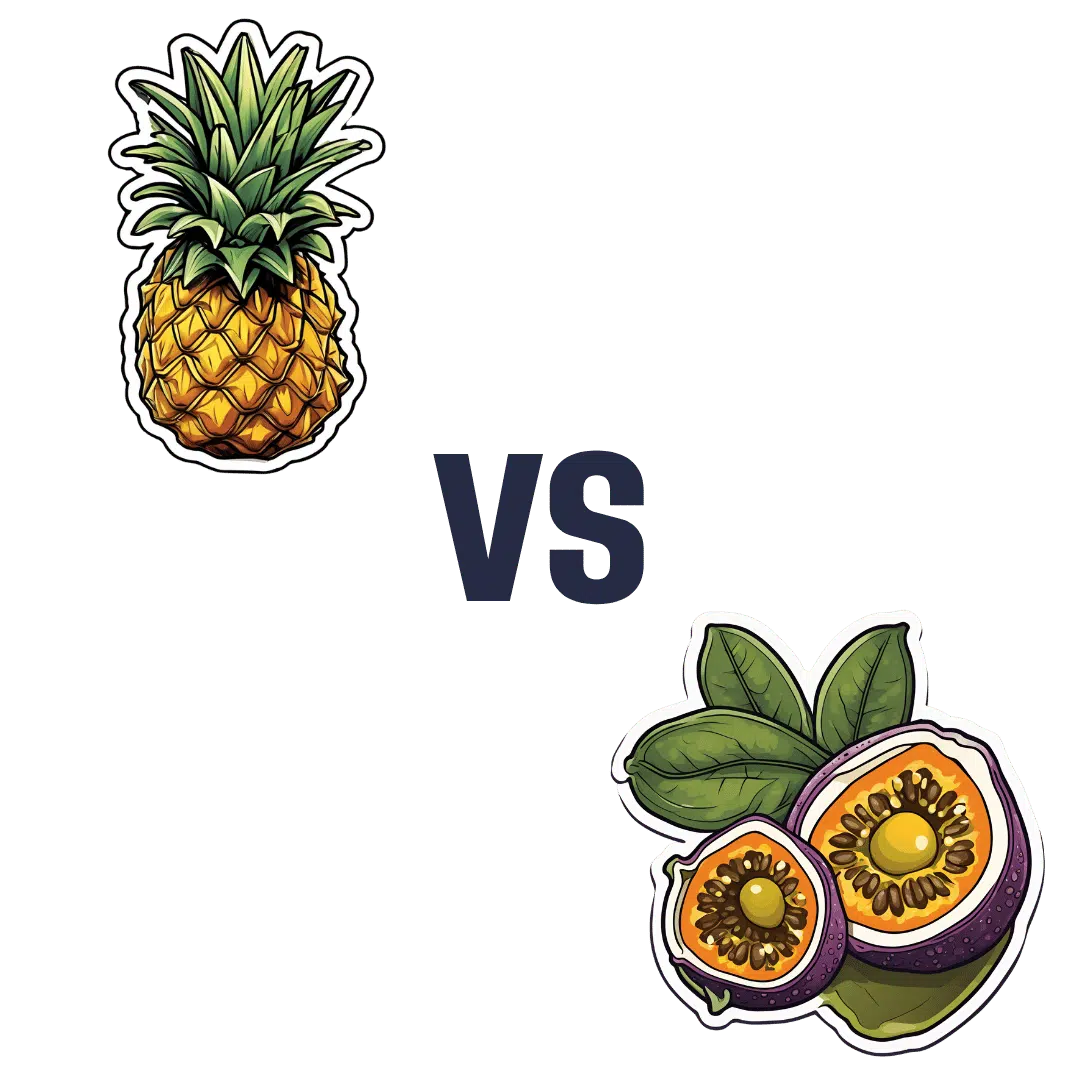
Pineapple vs Passion fruit – Which is Healthier?

10almonds is reader-supported. We may, at no cost to you, receive a portion of sales if you purchase a product through a link in this article.

Our Verdict

When comparing pineapple to passion fruit, we picked the passion fruit.

Why?

Both certainly have their strong points, and this one was very close!

In terms of macros, passion fruit has about 4x the protein, nearly 2x the carbs, and more than 7x the fiber. So, this one’s a clear and overwhelming win for passion fruit.

Vitamins are quite close; pineapple has more of vitamins B1, B5, B6, B9, and C, while passion fruit has more of vitamins A, B2, and B3. So, a modest 5:3 win for pineapple.

When it comes to minerals, pineapple has more calcium, copper, manganese, and zinc, while passion fruit has more iron, manganese, phosphorus, potassium, and selenium. Superficially, this would be a 5:5 tie, but looking at the numbers, passion fruit’s margins of difference are much greater, which means it gives the better overall mineral coverage, and thus wins the category on tiebreakers.

In other considerations, pineapple has more polyphenols with its variety of lignans, while passion fruit has just secoisolariciresinol, of which pineapple has more anyway. Plus, not a polyphenol but doing much of the same job, pineapple has bromelain, which is unique to it. So pineapple wins this category easily.

Adding up the sections and weighting them for importance (e.g. what a difference it makes to health) and statistical relevance (e.g. greater or smaller margins of difference) makes for a nominal passion fruit win, but like we say, both of these fruits are great, so do enjoy both!

Want to learn more?

You might like to read:

Bromelain vs Inflammation & Much More

Take care!

Don’t Forget…

Did you arrive here from our newsletter? Don’t forget to return to the email to continue learning!

Learn to Age Gracefully

Join the 98k+ American women taking control of their health & aging with our 100% free (and fun!) daily emails:

  • How To Stop Ingrown Hair & Razor Bumps From Waxing & Shaving

    10almonds is reader-supported. We may, at no cost to you, receive a portion of sales if you purchase a product through a link in this article.

    Dr. Simi Adedeji shares her expertise:

    Staying smooth

    Ingrown hairs (pseudofolliculitis) are inflamed hair follicles caused by hairs growing back into the skin—common in coarse, curly hair areas such as the underarms, pubic region, legs, and face.

    It can be caused by shaving, waxing, plucking, tweezing, and more—in fact, almost anything aside from “trim it or leave it be”. This is because most methods cause irritation by cutting or pulling hair in ways that make it more likely to re-enter the skin.

    Normally, it’s just a case of rash or itchy red bumps appearing a few days after hair removal. However, it can also get more pronounced, in cases of bacterial infection (true folliculitis), hyperpigmentation, or scarring (keloid or hypertrophic).

    There are two main kinds of ingrown hair to be aware of:

    1. extra-follicular penetration: occurs after shaving—sharply cut hairs re-enter the skin beside the follicle, causing inflammation.
    2. trans-follicular penetration: occurs after plucking, waxing, or tweezing—trapped hair grows through the follicle wall into the skin, creating lumps.

    Treatment options include:

    • Hydrocortisone: reduces inflammation and redness.
    • Benzoyl peroxide: antibacterial effect for inflamed areas.
    • Chemical exfoliants: help stop hair from getting trapped

    How to stop it from happening in the future:

    • First, reset things and let it all calm down—stop shaving, waxing, or plucking for about a month—when hairs grow 10 mm or more, irritation usually resolves.
    • Next, consider alternatives, such as depilatory creams, which dissolve hair, leaving a blunt or feathered tip that can still ingrow, but is less likely to than the other methods we talked about above. However, this comes with the tradeoff that the cream itself may irritate the skin.
    • Then, consider long-term hair removal methods, such as laser or IPL, if you have dark hair on light skin—this is because laser/IPL superheats melanin in the hair to destroy the follicle, which means it won’t work on light hair (no melanin to superheat), and can harm dark skin (superheats the wrong melanin)—or electrolysis otherwise, which doesn’t depend on pigment. Removing the hair permanently means stopping ingrown hairs permanently, because a hair can’t ingrow if it’s not growing back at all.

    If you are going to shave or wax, though, then:

    • Shaving tips: shave after a warm bath or shower (or pre-soak the area with a warm towel); use shaving cream or a gentle cleanser for slip; avoid stretching your skin; use a bland, fragrance-free moisturizer afterwards; wait 3–4 days before applying glycolic acid.
    • Waxing tips: wax before showering and avoid moisturizers beforehand; taking acetaminophen and antihistamines 30–45 minutes before can reduce pain and inflammation, respectively. Ibuprofen will also reduce both things (pain and inflammation).

    For more on all of this, enjoy:

    Click Here If The Embedded Video Doesn’t Load Automatically!

    Want to learn more?

    You might also like:

    Skin Care Down There (Incl. Butt Acne, Hyperpigmentation, & More)

    Take care!

    Share This Post

  • Syringe Exchange Fears Hobble Fight Against West Virginia HIV Outbreak

    10almonds is reader-supported. We may, at no cost to you, receive a portion of sales if you purchase a product through a link in this article.

    CHARLESTON, http://w.va/. — More than three years have passed since federal health officials arrived in central Appalachia to assess an alarming outbreak of HIV spread mostly between people who inject opioids or methamphetamine.

    Infectious disease experts from the Centers for Disease Control and Prevention made a list of recommendations following their visit, including one to launch syringe service programs to stop the spread at its source. But those who’ve spent years striving to protect people who use drugs from overdose and illness say the situation likely hasn’t improved, in part because of politicians who contend that such programs encourage illegal drug use.

    Joe Solomon is a Charleston City Council member and co-director of SOAR WV, a group that works to address the health needs of people who use drugs. He’s proud of how his close-knit community has risen to this challenge but frustrated with the restraints on its efforts.

    “You see a city and a county willing to get to work at a scale that’s bigger than ever before,” Solomon said, “but we still have one hand tied behind our back.”

    The hand he references is easier access to clean syringes.

    In April 2021, the CDC came to Charleston — the seat of Kanawha County and the state capital, tucked into the confluence of the Kanawha and Elk rivers — to investigate dozens of newly detected HIV infections. The CDC’s HIV intervention chief called it “the most concerning HIV outbreak in the United States” and warned that the number of reported diagnoses could be just “the tip of the iceberg.”

    Now, despite attention and resources directed toward the outbreak, researchers and health workers say HIV continues to spread. In large part, they say, the outbreak lingers because of restrictions state and local policymakers have placed on syringe exchange efforts.

    Research indicates that syringe service programs are associated with an estimated 50% reduction in HIV and hepatitis C, and the CDC issued recommendations to steer a response to the outbreak that emphasized the need for improved access to those services.

    That advice has thus far gone unheeded by local officials.

    In late 2015, the Kanawha-Charleston Health Department launched a syringe service program but shuttered it in 2018 under pressure, with then-Mayor Danny Jones calling it a “mini-mall for junkies and drug dealers.”

    SOAR stepped in, hosting health fairs at which it distributed naloxone, an opioid overdose reversal drug; offered treatment and referrals; provided HIV testing; and exchanged clean syringes for used ones.

    But in April 2021, the state legislature passed a bill limiting the number of syringes people could exchange and made it mandatory to present a West Virginia ID. The Charleston City Council subsequently added guidelines of its own, including requiring individual labeling of syringes.

    As a result of these restrictions, SOAR ceased exchanging syringes. West Virginia Health Right now operates an exchange program in the city under the restrictions.

    Robin Pollini is a West Virginia University epidemiologist who conducts community-based research on injection drug use. “Anyone I’ve talked to who’s used that program only used it once,” she said. “And the numbers they report to the state bear that out.”

    A syringe exchange run by the health department in nearby Cabell County — home to Huntington, the state’s largest city after Charleston — isn’t so constrained. As Solomon notes, that program exchanges more than 200 syringes for every one exchanged in Kanawha.

    A common complaint about syringe programs is that they result in discarded syringes in public spaces. Jan Rader, director of Huntington’s Mayor’s Office of Public Health and Drug Control Policy, is regularly out on the streets and said she seldom encounters discarded syringes, pointing out that it’s necessary to exchange a used syringe for a new one.

    In August 2023, the Charleston City Council voted down a proposal from the Women’s Health Center of West Virginia to operate a syringe exchange in the city’s West Side community, with opponents expressing fears of an increase in drug use and crime.

    Pollini said it’s difficult to estimate the number of people in West Virginia with HIV because there’s no coordinated strategy for testing; all efforts are localized.

    “You would think that in a state that had the worst HIV outbreak in the country,” she said, “by this time we would have a statewide testing strategy.”

    In addition to the testing SOAR conducted in 2021 at its health fairs, there was extensive testing during the CDC’s investigation. Since then, the reported number of HIV cases in Kanawha County has dropped, Pollini said, but it’s difficult to know if that’s the result of getting the problem under control or the result of limited testing in high-risk groups.

    “My inclination is the latter,” she said, “because never in history has there been an outbreak of injection-related HIV among people who use drugs that was solved without expanding syringe services programs.”

    “If you go out and look for infections,” Pollini said, “you will find them.”

    Solomon and Pollini praised the ongoing outreach efforts — through riverside encampments, in abandoned houses, down county roads — of the Ryan White HIV/AIDS Program to test those at highest risk: people known to be injecting drugs.

    “It’s miracle-level work,” Solomon said.

    But Christine Teague, Ryan White Program director at the Charleston Area Medical Center, acknowledged it hasn’t been enough. In addition to HIV, her concerns include the high incidence of hepatitis C and endocarditis, a life-threatening inflammation of the lining of the heart’s chambers and valves, and the cost of hospital resources needed to address them.

    “We’ve presented that data to the legislature,” she said, “that it’s not just HIV, it’s all these other lengthy hospital admissions that, essentially, Medicaid is paying for. And nothing seems to penetrate.”

    Frank Annie is a researcher at CAMC specializing in cardiovascular diseases, a member of the Charleston City Council, and a proponent of syringe service programs. Research he co-authored found 462 cases of endocarditis in southern West Virginia associated with injection drug use, at a cost to federal, state, and private insurers of more than $17 million, of which less than $4 million was recovered.

    Teague is further concerned for West Virginia’s rural counties, most of which don’t have a syringe service program.

    Tasha Withrow, a harm reduction advocate in bordering rural Putnam County, said her sense is that HIV numbers aren’t alarmingly high there but said that, with little testing and heightened stigma in a rural community, it’s difficult to know.

    In a January 2022 follow-up report, the CDC recommended increasing access to harm reduction services such as syringe service programs through expansion of mobile services, street outreach, and telehealth, using “patient-trusted” individuals, to improve the delivery of essential services to people who use drugs.

    Teague would like every rural county to have a mobile unit, like the one operated by her organization, offering harm reduction supplies, medication, behavioral health care, counseling, referrals, and more. That’s an expensive undertaking. She suggested opioid settlement money through the West Virginia First Foundation could pay for it.

    Pollini said she hopes state and local officials allow the experts to do their jobs.

    “I would like to see them allow us to follow the science and operate these programs the way they’re supposed to be run, and in a broader geography,” she said. “Which means that it shouldn’t be a political decision; it should be a public health decision.”

    KFF Health News is a national newsroom that produces in-depth journalism about health issues and is one of the core operating programs at KFF—an independent source of health policy research, polling, and journalism. Learn more about KFF.

    Subscribe to KFF Health News’ free Morning Briefing.

    This article first appeared on KFF Health News and is republished here under a Creative Commons license.

    Share This Post

  • Will my boobs sag if I don’t wear a bra? And 5 other common questions about breasts and bras

    10almonds is reader-supported. We may, at no cost to you, receive a portion of sales if you purchase a product through a link in this article.

    We’re all born with mammary glands – better known as breasts. These are made of glandular tissue, fat and the ligaments that attach them to our chest wall.

    For roughly half of us – those born biologically female – our breasts will change dramatically in size and shape at puberty. Size is largely genetic: genes explain 56% of the differences in breast size between people. But breasts may also change during pregnancy and breastfeeding, and can be affected by age, diet and exercise.

    So, what about bras?

    There are a lot of popular beliefs about when, how and what kind of bra to wear to stop your boobs sagging or make them grow. But is there any evidence behind these?

    Before we myth bust, let’s get one thing straight: breasts are sisters, not twins. So, while your bra is symmetrical, it’s normal your breasts aren’t.

    Pixel-Shot/Shutterstock

    1. Do bras give you cancer?

    No, there is no evidence to show wearing a bra is linked to developing breast cancer.

    This myth seems to come from the idea bras can block lymphatic drainage, but there is no evidence to support this or any other cancer-causing mechanism.

    One study, involving more than 1,000 women aged 55 to 74, compared those diagnosed with breast cancer to those without. Researchers found no aspect of bra-wearing – including how many hours per day and whether it had an underwire – was linked to breast cancer risk in post-menopausal women.

    Risk factors for breast cancer are well established and include being female, over 50 years old, having a family history of breast cancer, and lifestyle factors such as inactivity and drinking a lot of alcohol.

    2. Does sleeping in a bra stop your boobs growing?

    No. Wearing a bra – day or night – won’t affect their size.

    Breasts grow thanks to hormones, which are regulated by your brain. Nutrition and overall health can also play a role; for example, if you lose body fat, your breasts may also shrink.

    There is no evidence to suggest sleeping with a bra has a negative effect on their growth.

    So, it comes down to comfort. Women with larger breasts may find a bra reduces how much their breasts move during sleep, while others may find it uncomfortable.

    Woman sitting in bed with green eiderdown wearing black crop top stretches arms above head.
    If sleeping in a bra is comfortable for you, don’t worry – it doesn’t affect boob size. Willie B. Thomas/Getty

    3. Will wearing a bra stop my breasts sagging?

    No.

    Gravity affects everyone, meaning breasts will sag as we age. But larger breasts are affected more by gravitational forces pulling them towards the ground. This may stretch the skin and ligaments over time, making them sag more.

    Being pregnant also usually makes your breasts grow bigger and this – along with milk production affecting their composition – can increase strain, potentially stretching skin and ligaments.

    Some other factors can also increase this effect, including being older, having a higher body mass index, having multiple pregnancies and smoking. Even surgically reduced breasts sag more with smoking.

    However, breastfeeding does not appear to make breasts saggy.

    So, while we don’t have evidence to show bras can prevent natural sagging, a well-fitted one may offer support and comfort.

    4. Should you only exercise in a sports bra?

    Yes. Breasts and bras move with your body. The pull of gravity on your breasts has the potential to cause damage by straining the skin and breaking collagen fibres which support the structure of the breast.

    Again, this is more likely to affect women with larger breasts. Researchers found when women with D-cups exercised without a sports bra, their breasts moved up and down about 4 centimetres when walking. When they ran, their breasts bounced about 15cm – the height of your smartphone.

    High-impact sports bras are the most effective at reducing breast movement and discomfort, compared to crop tops and everyday bras.

    So exercising in a bandeau or “boob tube” bra – like these Roman women in a 4th century mosaic – is not recommended.

    Roman mosaic of a woman with dumbbells and a woman lifting a ball exercising in bandeau bras.
    These strips of fabric pulled across the chest don’t offer support against gravity and bounce. izanbar/Getty

    5. Can underwire bras injure your boobs?

    Yes. It’s possible for underwires from bras to escape their casing and scratch or dig into your breast skin, but this has not been studied.

    However, one 2023 study found women who wear underwire bras after breast implants are 2.7 more times likely to have them rupture. This suggests underwire bras can put more pressure on breasts.

    One case study in 2014 suggested a tight underwire bra was responsible for blocking and inflaming breast veins, causing pain and breast tissue to harden.

    However we don’t have evidence this condition is common, and it can be avoided by wearing correctly fitted bras. If you have breast pain or notice unusual lumps or changes, speak to a doctor.

    6. Should I get fitted if I have small breasts?

    Yes. Wearing a poorly fitting bra can cause unnecessary discomfort, even if you have small breasts.

    One study of 309 Australian women, with bra cup sizes ranging from A to K, found only one in ten were wearing a bra that fitted correctly. This affected women with small, medium, large and extremely large breasts equally.

    Most had an incorrectly fitting backband (either too loose or too tight) and the wrong cup size. However women with smaller breasts were more likely to have badly fitting bra straps while women with medium or larger breasts were more likely to have ill-fitting front bands and underwire.

    A 2018 review of evidence about women with benign but unidentified breast pain (mastalgia) also found most experienced relief when offered bra-fitting advice and reassurance from their GP.

    Amanda Meyer, Senior Lecturer, Anatomy and Pathology in the College of Medicine and Dentistry, James Cook University and Monika Zimanyi, Associate Professor in Anatomy, James Cook University

    This article is republished from The Conversation under a Creative Commons license. Read the original article.

    Share This Post

  • Brown Rice vs Oats – Which is Healthier?

    10almonds is reader-supported. We may, at no cost to you, receive a portion of sales if you purchase a product through a link in this article.

    Our Verdict

    When comparing brown rice to oats, we picked the oats.

    Why?

    Both are great, but ultimately, rice cannot compete with the nutritional heavyweight that is oats:

    In terms of macros, brown rice has more carbs, while oats have nearly 3x the fiber nearly 2x the protein; an easy first-round win for oats.

    In the category of vitamins, brown rice has more of vitamins B3 and B6, while oats have more of vitamins B1, B2, B5, B7, and B9, winning another round.

    Looking at minerals next, brown rice is not higher in any minerals, while oats have more calcium, copper, iron, magnesium, manganese, phosphorus, potassium, and zinc, winning their third round in a row.

    Adding up the sections makes for a clear overall win for oats, but by all means do enjoy either or both, as diversity is best!

    Want to learn more?

    You might like:

    The Best Kind Of Fiber For Overall Health? ← it’s β-glucan, the kind find abundantly in oats!

    Enjoy!

    Don’t Forget…

    Did you arrive here from our newsletter? Don’t forget to return to the email to continue learning!

    Learn to Age Gracefully

    Join the 98k+ American women taking control of their health & aging with our 100% free (and fun!) daily emails:

  • Age Less – by Sandra Parsons

    10almonds is reader-supported. We may, at no cost to you, receive a portion of sales if you purchase a product through a link in this article.

    Depending on which edition of the book you’re looking at, you might see “Daily Mail Wellness Book of the Year!”, which we must assume has nothing to do with fact that the author is the Daily Mail’s literary editor.

    However, we’re here to review the book, not the marketing, so let’s have at it:

    You may be wondering how well backed-up the claim in the subtitle (“I reduced my biological age from 60 to 20”) is.

    • On the one hand, the source for this claim is: she says so.
    • On the other hand, when it comes to talking about what kind of test this was: she does not say.

    All she tells us is that it was “one of the most accurate tests available” and that the results were “I was 60 on the outside and 20 on the inside”.

    We then read about how she smoked and drank and ate junk food for most of her life, but that now she doesn’t smoke anymore (she still drinks and eats junk food).

    Her 3-step “reset plan” is:

    1. Eat 10% less
    2. Move more
    3. Rest more

    With regard to how to achieve that 10% less eating, she suggests to do as she does, for example choosing a smaller portion of McDonald’s fries, or three chocolate chip cookies.

    In terms of scientific rigor, for the most part this book lives up to the standards that might reasonably be expected from the Daily Mail (a tabloid newspaper), and while beyond that there are some studies cited, more often we have an argument-from-authority presentation, more often than not referencing Dr. David Sinclair, mostly about caloric restriction.

    Bottom line: this book does contain some good advice in broad terms (move more, rest more, reduce inflammation), some terrible advice in specific terms, and all in all, it might be better to just read a book by Dr. Sinclair instead*.

    In the unlikely event this review has inspired you to want this book, you can find it here!

    *For example, see our review of this book that we strongly prefer: Lifespan: Why We Age―and Why We Don’t Have To – by Dr. David Sinclair

    Don’t Forget…

    Did you arrive here from our newsletter? Don’t forget to return to the email to continue learning!

    Learn to Age Gracefully

    Join the 98k+ American women taking control of their health & aging with our 100% free (and fun!) daily emails:

  • Your Brain On (And Off) Estrogen

    10almonds is reader-supported. We may, at no cost to you, receive a portion of sales if you purchase a product through a link in this article.

    This is Dr. Lisa Mosconi. She’s a professor of Neuroscience in Neurology and Radiology, and is one of the 1% most influential scientists of the 21st century. That’s not a random number or an exaggeration; it has to do with citation metrics collated over 20 years:

    A standardized citation metrics author database annotated for scientific field

    What does she want us to know?

    Women’s brains age differently from men’s

    This is largely, of course, due to menopause, and as such is a generalization, but it’s a statistically safe generalization, because:

    • Most women go through menopause—and most women who don’t, avoid it by dying pre-menopause, so the aging also does not occur in those cases
    • Menopause is very rarely treated immediately—not least of all because menopause is diagnosed officially when it has been one year since one’s last period, so there’s almost always a year of “probably” first, and often numerous years, in the case of periods slowing down before stopping
    • Menopausal HRT is great, but doesn’t completely negate that menopause occurred—because of the delay in starting HRT, some damage can be done already and can take years to reverse.

    Medicated and unmedicated menopause proceed very differently from each other, and this fact has historically caused obfuscation of a lot of research into age-related neurodegeneration.

    For example, it is well-established that women get Alzheimer’s at nearly twice the rate than men do, and deteriorate more rapidly after onset, too.

    Superficially, one might conclude “estrogen is to blame” or maybe “the xx-chromosomal karyotype is to blame”.

    The opposite, however, is true with regard to estrogen—estrogen appears to be a protective factor in women’s neurological health, which is why increased neurodegeneration occurs when estrogen levels decline (for example, in menopause).

    For a full rundown on this, see:

    Alzheimer’s Sex Differences May Not Be What They Appear

    It’s not about the extra X

    Dr. Mosconi examines this in detail in her book “The XX Brain”. To summarize and oversimplify a little: the XX karyotype by itself makes no difference, or more accurately, the XY karyotype by itself makes no difference (because biologically speaking, female physiological attributes are more “default” than male ones; it is only 12,000ish* years of culture that has flipped the social script on this).

    *Why 12,000ish years? It’s because patriarchalism largely began with settled agriculture, for reasons that are fascinating but beyond the scope of this article, which is about health science, not archeology.

    The topic of “which is biologically default” is relevant, because the XY karyotype (usually) informs the body “ignore previous instructions about ovaries, and adjust slightly to make them into testes instead”, which in turn (usually) results in a testosterone-driven system instead of an estrogen-driven system. And that is what makes the difference to the brain.

    One way we can see that it’s about the hormones not the chromosomes, is in cases of androgen insensitivity syndrome, in which the natal “congratulations, it’s a girl” pronouncement may later result in a surprise if it turns out she had XY chromosomes all along, but the androgenic instructions never got delivered successfully, so she popped out with fairly typical female organs. And, relevantly for Dr. Mosconi, a typically female brain that will age in a typically female fashion, because it’s driven by estrogen, regardless of the Y-chromosome.

    The good news

    The good news from all of this is that while we can’t (with current science, anyway) do much about our chromosomes, we can do plenty about our hormones, and also, the results of changes in same.

    Remember, Dr. Mosconi is not an endocrinologist, nor a gynecologist, but a neurologist. As such, she makes the case for how a true interdisciplinary team for treating menopause should not confined to the narrow fields usually associated with “bikini medicine”, but should take into account that a lot of menopause-related changes are neurological in nature.

    We recently reviewed another book by Dr. Mosconi:

    The Menopause Brain – by Dr. Lisa Mosconi

    …and as we noted there, many sources will mention “brain fog” as a symptom of menopause, Dr. Mosconi can (and will) point to a shadowy patch on a brain scan and say “that’s the brain fog, there”.

    And so on, for other symptoms that are often dismissed as “all in your head”, as though that’s a perfectly acceptable place for problems to be.

    This is critical, because it’s treating real neurological things as the real things they are.

    Dr. Mosconi’s advice, beyond HRT

    Dr. Mosconi notes that brain health tends to dip during perimenopause but often recovers, showing the brain’s resilience to hormonal shifts. As such, all is not lost if for whatever reason, hormone replacement therapy isn’t a viable option for you.

    Estrogen plays a crucial role in brain energy, and women’s declining estrogen levels during menopause increase the need for antioxidants to protect brain health—something not often talked about.

    Specifically, Dr. Mosconi tells us, women need more antioxidants and have different metabolic responses to diets compared to men.*

    *Yes, even though men usually have negligible estrogen, because their body (and thus brain, being also part of their body) is running on testosterone instead, which is something that will only happen if either you are producing normal male amounts of testosterone (requires normal male testes) or you are taking normal male amounts of testosterone (requires big bottles of testosterone; this isn’t the kind of thing you can get from a low dose of testogel as sometimes prescribed as part of menopausal HRT to perk your metabolism up).

    Note: despite women being a slight majority on Earth, and despite an aging population in wealthy nations, meaning “a perimenopausal woman” is thus the statistically average person in, for example, the US, and despite the biological primacy of femaleness… Medicine still mostly looks to men as the “default person”, which in this case can result in seriously low-balled estimates of what antioxidants are needed.

    In terms of supplements, therefore, she recommends:

    • Antioxidants: key for brain health, especially in women. Rich sources include fruits (especially berries) and vegetables. Then there’s the world’s most-consumed antioxidant, which is…
    • Coffee: Italian-style espresso has the highest antioxidant power. Adding a bit of fat (e.g. oat milk) helps release caffeine more slowly, reducing jitters. Taking it alongside l-theanine also “flattens the curve” and thus improves its overall benefits.
    • Flavonoids: important for both men and women but particularly essential for women. Found in many fruits and vegetables.
    • Chocolate: dark chocolate is an excellent source of antioxidants and flavonoids!
    • Turmeric: a natural neuroprotectant with anti-inflammatory properties, best boosted by taking with black pepper, which improves absorption as well as having many great qualities of its own.
    • B Vitamins: B6, B9, and B12 are essential for anti-aging and brain health; deficiency in B6 is rare, while deficiency in B9 (folate) and especially B12 is very common later in life.
    • Vitamins C & E: important antioxidants, but caution is needed with fat-soluble vitamins to avoid toxicity.
    • Omega-3s: important for brain health; can be consumed in the diet, but supplements may be necessary.
    • Caution with zinc: zinc can support immunity and endocrine health (and thus, indirectly, brain health) but may be harmful in excess, particularly for brain health.
    • Probiotics & Prebiotics: beneficial for gut health, and in Dr. Mosconi’s opinion, hard to get sufficient amounts from diet alone.

    For more pointers, you might want to check out the MIND diet, that is to say, the “Mediterranean-DASH Intervention for Neurodegenerative Delay” upgrade to make the Mediterranean diet even brain-healthier than it is by default:

    Four Ways To Upgrade The Mediterranean Diet

    Want to know more from Dr. Mosconi?

    Here’s her TED talk:

    Click Here If The Embedded Video Doesn’t Load Automatically!

    Enjoy!

    Don’t Forget…

    Did you arrive here from our newsletter? Don’t forget to return to the email to continue learning!

    Learn to Age Gracefully

    Join the 98k+ American women taking control of their health & aging with our 100% free (and fun!) daily emails: