
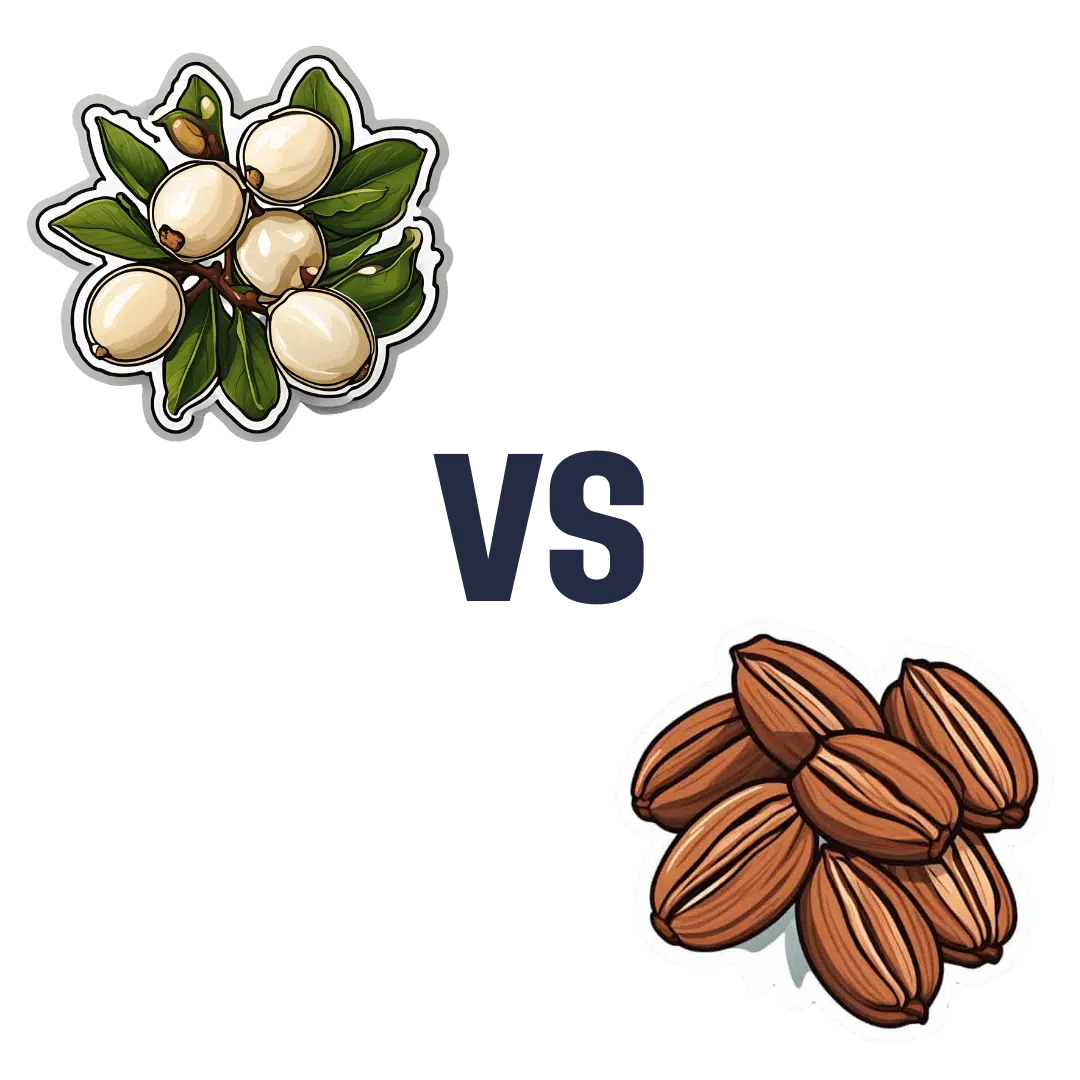
Macadamias vs Pecans – Which is Healthier?
10almonds is reader-supported. We may, at no cost to you, receive a portion of sales if you purchase a product through a link in this article.
Our Verdict
When comparing macadamias to pecans, we picked the pecans.
Why?
It’s close!
In terms of macros, they’re very close, though pecans have slightly more fiber, carbs, and protein, and while the total fat figure is comparable (very slightly more for macadamias), the lipids profile is in pecans’ favor, as while they’re both rich in monounsaturated fat, macadamias have more saturated fat and pecans have more polyunsaturated fat. All in all a win for pecans here, though honestly, it’s marginal.
In the category of vitamins, macadamias have more of vitamins B1, B2, B3, and B6, while pecans have more of vitamins A, B5, B9, and E. The margins of difference are comparable too, so it’s a clear tie in this round.
When it comes to minerals, macadamias have more calcium, iron, and magnesium, while pecans have more copper, manganese, phosphorus, potassium, selenium, and zinc. An easy win for pecans here.
Adding up the sections makes for an overall win for pecans, but macadamias are great too, so by all means enjoy either or both; diversity is good!
Want to learn more?
You might like:
Why You Should Diversify Your Nuts
Enjoy!
Don’t Forget…
Did you arrive here from our newsletter? Don’t forget to return to the email to continue learning!
Recommended
Learn to Age Gracefully
Join the 98k+ American women taking control of their health & aging with our 100% free (and fun!) daily emails:
-
Is Flour As Bad As Sugar?
10almonds is reader-supported. We may, at no cost to you, receive a portion of sales if you purchase a product through a link in this article.
It’s Q&A Day at 10almonds!
Have a question or a request? We love to hear from you!
In cases where we’ve already covered something, we might link to what we wrote before, but will always be happy to revisit any of our topics again in the future too—there’s always more to say!
As ever: if the question/request can be answered briefly, we’ll do it here in our Q&A Thursday edition. If not, we’ll make a main feature of it shortly afterwards!
So, no question/request too big or small 😎
❝Is flour as bad as sugar, and if so, is it just white flour? What about other flours like rice flour?❞
Short answer: the problem with flour is essentially the same as the problem with sugar, and by applying the knowledge of what the problem actually is, we can healthily enjoy either or both if we want to—with some important caveats.
The problem: for both of these foods (flour and sugar) the glycemic index is very high, and so is the glycemic load.
For more on what those things are and why they matter: Glycemic Index vs Glycemic Load vs Insulin Index
Now, in this case:
- white sugar has a glycemic index of 65 and a glycemic load of 65
- white flour has a glycemic index of 70–85, and a glycemic load of 53–65
You may be wondering: what happens, in each case if you make it brown? i.e. brown sugar and wholewheat flour?
- brown sugar: is now brown in color; that’s it; that’s the difference (didn’t make it any healthier)
- wholewheat flour: now has a slightly lower glycemic index, which will also lower the glycemic load (made it healthier)
For why it made it healthier in the latter case, it has to do with the fiber content, and that’s what makes all the difference.
For how, see: Which Sugars Are Healthier, And Which Are Just The Same?
This is also why, as we say, there’s no pressing need to “go against the grain” for most* people, if you do enjoy wheat-based foods, you can indeed indulge.
For more on this, see: Grains: Bread Of Life, Or Cereal Killer?
If you are going to, we’d simply recommend:
- go for wholewheat / whole grain bread, pasta, etc
- use the most fiberful flour you can find if you’re going to use flour directly in your cooking
- enjoy it with some kind of healthy fats (e.g. olive oil; see: All About Olive Oil, and, for that matter, Is “Extra Virgin” Worth It?), and also, ideally, other fiber-containing foods (see: What Do The Different Kinds Of Fiber Do? 30 Foods That Rank Highest)
As for why we want to add those latter things into the dish, specifically in the context of eating a food with a lot of an ingredient that has a high glycemic index, is because of this:
10 Ways To Balance Blood Sugars ← see #10, “put some clothes on your carbs”
*You may be wondering: why “most” people?
And the answer is, if you have a relevant allergy, intolerance, or sensitivity, you might want to skip the wheat, or skip any grain that contains gluten specifically, for example.
See: Gluten: What’s The Truth?
However, if you don’t, then you might want to not trouble yourself in that regard; see: Why Going Gluten-Free Could Be A Bad Idea
Now, as for “what about other flours like rice flour?”, there are of course many options, but here are some things you should be aware of:
- Rice flour has an incredibly high glycemic index (varies, but ranges up to 95), making it often about the worst choice healthwise for most people
- …unless it is brown rice flour (which it usually isn’t), in which case it’s a more “middling” option
- Potato flour is a little better, but still has a higher glycemic index than white flour
- Cornflour (cornstarch) and cassava or tapioca flour are about the same as white flour, GI-wise
- Sorghum flour isn’t much better
- Quinoa, rye, and teff flour are all rather lower in GI, making them great options
- Nut flours (e.g. almond) and pea flour are even lower in GI and higher in protein, but have strong flavors that might not suit all dishes, and the high fat content of most nut flours will make them unsuitable for certain kinds of baking (can’t make a light fluffy bread with almond flour that’s 50% fat, for example)
For more details and numbers, see: What is the glycemic index of different flours?
Want to make your own healthy bread?
Check out our recipes section, including:
Delicious Quinoa Avocado Bread | Healthy Homemade Flatbreads
Enjoy!
Share This Post
-
Can kids overdose on melatonin gummies? Yes, and an online store has suspended sales
10almonds is reader-supported. We may, at no cost to you, receive a portion of sales if you purchase a product through a link in this article.
US-based online store iHerb has suspended sales of melatonin gummies to Australia. This comes after a rise in reports of non-fatal overdoses in Western Australia in children who took these popular supplements.
This latest move raises fresh concerns about the safety of these non-prescription sleep aids.
I have been a sleep researcher and a psychologist treating children with behavioural sleep problems for more than 20 years.
Here’s what’s great and not so great about using melatonin to help children sleep.
Vitaliia Hryshchenko/Getty What is melatonin? Who uses it?
Melatonin is a naturally occurring hormone secreted in our brains. Its main function is to make us feel sleepy. A synthetic version is used in prescription and non-prescription products, for adults and for children who have trouble sleeping.
Melatonin prescriptions for children and adolescents with sleep difficulties have increased substantially around the world in recent years.
Melatonin available on prescription is an effective and relatively safe drug in children, particularly those with attention deficit hyperactivity disorder (ADHD) and autism spectrum disorder. It is now the most commonly prescribed drug to treat insomnia in children and adolescents with neurodevelopmental disorders.
These children commonly have considerable difficulties getting to sleep, or getting back to sleep when they wake in the night. This can be distressing for the child and the whole family.
Guidelines for melatonin for these children suggest a low dose and only using it for a maximum two years. Melatonin does not appear to be addictive. So it seems like a good option for these families.
A rise in wider use
Up to one in four children have behavioural sleep problems, including children who are not neurodivergent, or who are developing typically.
So parents have turned to sourcing non-prescription melatonin, including melatonin gummies.
However, unlike for neurodivergent children, there are no scientific studies and therefore no evidence to demonstrate whether melatonin would work or pose a risk in typically developing children. There’s certainly no indication of how much children should take and for how long.
So melatonin is not usually recommended for children who are not neurodivergent.
Yet, it is widely available
In many countries including Australia, melatonin is classified as a pharmaceutical product. In Australia, the Therapeutic Goods Administration approves paediatric use for children with ADHD, autism and Smith-Magenis syndrome, and only on prescription.
In other countries, notably the United States, melatonin is categorised as a dietary supplement and is thought to be natural and safe. As such it is less tightly regulated than a pharmaceutical product.
As it’s available online, parents in countries with tighter restrictions, including Australia, can buy child-friendly melatonin gummies from the US, for example, and have it shipped. They can do this without a prescription or medical guidance.
Are melatonin gummies safe?
Accessing these gummies online for children without a prescription is at best concerning and at worst dangerous.
We don’t know how much melatonin is in these gummies. Studies show levels vary between brands of melatonin supplements and within the same brand. Melatonin levels range from practically zero to four times more than the amount stated on the label.
Some products also contained serotonin, which is concerning as this can interact with melatonin, and also affect a child’s mood.
There are also few studies on the long-term effects of taking melatonin, or what is a safe dose. So the risk of overdose is a real concern. Symptoms depend on many factors, including the age of the child. Symptoms include significant nausea, excessive sleepiness and migraine. The potential effects on other body systems and hormones have not been studied.
There have been deaths and hospital visits associated with the use of melatonin gummies in the US. There have been seven deaths in young children where the link to gummies has been suspected but not substantiated.
In Australia, there has been reports of a rise in queries about gummie overdoses to a poisons hotline.
There’s also the risk of toxicity with melatonin use. But there’s much we don’t know about how this happens, over what time frame, or its effects. Labels don’t always reflect what’s in the product so we don’t know if toxicity in children relates to those who have taken what’s recommended on the packet, or who have taken too many gummies by accident.
Melatonin gummies look like lollies. What child would not love to eat as many lollies as they can?
If you think your child has eaten too many gummies, they need emergency care.
So what are parents to do?
Sleep difficulties can be extremely distressing for the child and the whole family. But we need to treat melatonin with care. Buying melatonin gummies online is not the answer, despite many parents thinking they are safe and natural.
A medical professional can assess if a melatonin prescription is right for your child. They will also support you by recommending behavioural sleep strategies we know work, are sustainable and safe.
If you’d like support for your child’s sleep problems you can visit your GP and/or search for a trained sleep psychologist via the Australasian Sleep Association.
Sarah Blunden, Professor and Head of Paediatric Sleep Research, CQUniversity Australia
This article is republished from The Conversation under a Creative Commons license. Read the original article.
Share This Post
-
Anti-Inflammatory Brownies
10almonds is reader-supported. We may, at no cost to you, receive a portion of sales if you purchase a product through a link in this article.
Brownies are usually full of sugar, butter, and flour. These ones aren’t! Instead, they’re full of fiber (good against inflammation), healthy fats, and anti-inflammatory polyphenols:
You will need
- 1 can chickpeas (keep half the chickpea water, also called aquafaba, as we’ll be using it)
- 4 oz of your favorite nut butter (substitute with tahini if you’re allergic to nuts)
- 3 oz rolled oats
- 2 oz dark chocolate chips (or if you want the best quality: dark chocolate, chopped into very small pieces)
- 3 tbsp of your preferred plant milk (this is an anti-inflammatory recipe and unfermented dairy is inflammatory)
- 2 tbsp cocoa powder (pure cacao is best)
- 1 tbsp glycine (if unavailable, use 2 tbsp maple syrup, and skip the aquafaba)
- 2 tsp vanilla extract
- ½ tsp baking powder
- ¼ tsp low-sodium salt
Method
(we suggest you read everything at least once before doing anything)
1) Preheat the oven to 350℉ / 180℃, and line a 7″ cake tin with baking paper.
2) Blend the oats in a food processor, until you have oat flour.
3) Add all the remaining ingredients except the dark chocolate chips, and process until the mixture resembles cookie dough.
3) Transfer to a bowl, and fold in the dark chocolate chips, distributing evenly.
4) Add the mixture to the cake tin, and smooth the surface down so that it’s flat and even. Bake for about 25 minutes, and let them cool in the tin for at least 10 minutes, but longer is better, as they will firm up while they cool. Cut into cubes when ready to serve:
Enjoy!
Want to learn more?
For those interested in some of the science of what we have going on today:
- Level-Up Your Fiber Intake! (Without Difficulty Or Discomfort)
- Cacao vs Carob – Which is Healthier?
- Keep Inflammation At Bay
- The Sweet Truth About Glycine
- The Best Kind Of Fiber For Overall Health?
Take care!
Share This Post
Related Posts
-
Apple vs Pear – Which is Healthier?
10almonds is reader-supported. We may, at no cost to you, receive a portion of sales if you purchase a product through a link in this article.
Our Verdict
When comparing apple to pear, we picked the pear.
Why?
Both are great! But there’s a category that puts pears ahead of apples…
Looking at their macros first, pears contain more carbs but also more fiber. Both are low glycemic index foods, though.
In the category of vitamins, things are moderately even: apples contain more of vitamins A, B1, B6, and E, while pears contain more of vitamins B3, B9, K, and choline. That’s a 4:4 split, and the two fruits are about equal in the other vitamins they both contain.
When it comes to minerals, pears contain more calcium, copper, iron, magnesium, manganese, phosphorus, potassium, selenium, and zinc. A resounding victory for pears, as apples are not higher in any mineral.
In short, if an apple a day keeps the doctor away, a pear should keep the doctor away for about a day and a half, based on the extra nutrients ← this is slightly facetious as medicine doesn’t work like that, but you get the idea: pears simply have more to offer. Apples are still great though! Enjoy both! Diversity is good.
Want to learn more?
You might like to read:
From Apples To Bees, And High-Fructose Cs: Which Sugars Are Healthier, And Which Are Just The Same?
Take care!
Don’t Forget…
Did you arrive here from our newsletter? Don’t forget to return to the email to continue learning!
Learn to Age Gracefully
Join the 98k+ American women taking control of their health & aging with our 100% free (and fun!) daily emails:
-
Do You Do This During Ab Workouts? 5 Mistakes You Might Be Making
10almonds is reader-supported. We may, at no cost to you, receive a portion of sales if you purchase a product through a link in this article.
Sometimes people will decide to “get abs” and do a lot of whatever their preferred ab exercise might be, but get discouraged when it doesn’t seem to be yielding results.
So, here’s some troubleshooting:
What not to do
Common mistakes include:
- Doing ab exercises you haven’t worked up to: trying advanced moves without the strength or control leads to compensating with hips or back instead of engaging abs.
- Avoiding spinal flexion exercises: while they are indeed an incomplete exercise, completely dismissing crunches or sit-ups robs you of a key movement pattern that effectively trains the abs.
- Not focusing on the correct muscles: performing exercises with poor form (e.g. using hip flexors instead of abs) prevents proper ab activation and may cause pain.
- Training to fatigue instead of focusing on quality: rushing through workouts or overtraining in a single session leads to poor form and reduced results; spread volume throughout the week.
- Prioritizing duration over intensity: holding long planks or doing more reps with low effort doesn’t challenge the abs effectively; shorter, more intense efforts with full engagement are better.
For more on each of these, plus visual demonstrations, enjoy:
Click Here If The Embedded Video Doesn’t Load Automatically!
Want to learn more?
You might also like:
Is A Visible Six-Pack Obtainable Regardless Of Genetic Predisposition?
Take care!
Don’t Forget…
Did you arrive here from our newsletter? Don’t forget to return to the email to continue learning!
Learn to Age Gracefully
Join the 98k+ American women taking control of their health & aging with our 100% free (and fun!) daily emails:
-
The Red Meat Dilemma
10almonds is reader-supported. We may, at no cost to you, receive a portion of sales if you purchase a product through a link in this article.
When it comes to red meat…
- Good news: it’s very nutrient-dense insofar as it has high-quality protein, and many vitamins and minerals, especially B12 and iron.
- Bad news: it’s a group 2 carcinogen (group 1 carcinogen if processed), and dramatically increases many other disease risks, especially metabolic syndrome diseases such as diabetes, heart disease, stroke, and more.
How much risk increase is enough for us to describe it as “dramatically”? The numbers vary a lot from risk to risk and depending what else is taken into account, but a 11–16% risk increase for unprocessed red meat is a range that comes up in a lot of studies, and bear in mind, these risks stack, i.e. it’s not 11–16% increase of getting any of the above, it’s a risk increase for diabetes, plus a risk increase for heart disease, plus a risk increase for stroke, plus a risk increase for cancer, plus plus plus.
Fun mathematical quirk: if you roll a fair 6-sided die, you have an approximately 16% chance of rolling a 1 (because 1/6 = 0.16). But if you roll two such dice (to illustrate the chances for two disease risks in the same range), you have more like a 32% chance of rolling at least one 1. Add in a third die for a third disease risk, and you’re at 48% chance of rolling at least one 1. Throw six such dice to illustrate 6 disease risks, and you’re at 96% chance. You see the problem.
For processed red meat, it’s the same deal mathematically but the numbers are higher, and each risk increase is more like 18–35%, which by the time you add in each of the disease risks is really pretty damning.
As usual, we’re not just making up numbers, this is based on quite large datasets, for example:
❝Forty-three observational studies (N = 4 462 810, 61.7% women) for CVD and 27 observational studies (N = 1 760 774, 64.4% women) for diabetes were included. Red meat consumption was positively associated with CVD [hazard ratio (HR) 1.11, 95% confidence interval (CI) 1.05 to 1.16 for unprocessed red meat (per 100 g/day increment); 1.26, 95% CI 1.18 to 1.35 for processed red meat (per 50 g/day increment)], CVD subtypes, T2DM, and GDM. The associations with stroke and T2DM were higher in western settings, with no difference by sex.❞
Source: Red meat consumption, cardiovascular diseases, and diabetes: a systematic review and meta-analysis
If you’d like to not just rely on one source (as well you shouldn’t), here are a bunch more:
- Health Risks Associated with Meat Consumption: A Review of Epidemiological Studies
- Meat Consumption and the Risk of Cancer: A Critical Evaluation of the Constraints of Current Evidence from Epidemiological Studies
- Red Meat Consumption (Heme Iron Intake) and Risk for Diabetes and Comorbidities
- Associations of Processed Meat, Unprocessed Red Meat, Poultry, or Fish Intake With Incident Cardiovascular Disease and All-Cause Mortality
- Meat consumption: Which are the current global risks? A review of recent (2010-2020) evidences
But I need it because of a nutritional deficiency!
It can be so!
And in fact, for example, if you’re 70 with anemia and sarcopenia and non-critical CVD risk and struggling to eat enough food to cover the iron/protein nutritional shortfall, then actually eating red meat may be playing the odds in your case, because you might consider it better to sacrifice your 10-year cancer risk odds in order to avoid, say, falling down the stairs this week and not seeing next year.
That’s obviously not a decision we can make for you either way, and we’d only counsel that it’s the kind of health decision that (whatever you choose) should ideally be made consciously, with objective knowledge of the various risks at hand, and taking your own personal circumstances into account.
While we’re here, if anemia is a challenge you’re facing, by the way, you might want to also swing by: Avoiding Anemia (More Than Just “Get More Iron”)
…for some very helpful tips!
Is moderation the answer?
When it comes to red meat, for most people most of the time, it is certainly true that less is better than more.
And for most people in most situations, sustainable moderation is better than unsustainable abstinence.
That said, remember that paper we quoted up top? Those risk increases were for 100g/day increments of unprocessed red meat, or 50g/day increments of processed red meat.
For the non-metric preferrers, that’s about 3 oz of unprocessed red meat or about 1½ oz of processed red meat.
That’s the amount that’s needed to increase your health risks for various diseases by 11–35% each.
So, moderation is definitely a lot better than immoderation in this regard, but for example a single beefburger made with two quarter-pound beef patties is already increasing each of those health risks by several multiples of the numbers we gave you, and that’s from the beef alone, let alone anything else in there (not just contaminants, but for example the fat for frying, the kind of bread used, anything else being added like cheese, bacon, etc).
So, by these numbers, the kind of moderation that avoids the increases we described looks less like “well I’m not consuming cartoonishly large amounts of meat” and more like “there are some shavings of prosciutto at the side of my salad”
On which note…
This is again something that the Mediterranean diet does well, as it doesn’t expect or require outright abstention from any food, including red or processed meat (and remember, cured meats are processed, no matter how healthy they look in a salad), and/but simply keep the amounts of meat very small:
Want to make the Mediterranean diet even better?
Here are 4 ways to do it, with 4 different health focuses:
Four Ways To Upgrade The Mediterranean Diet
Enjoy!
Don’t Forget…
Did you arrive here from our newsletter? Don’t forget to return to the email to continue learning!
Learn to Age Gracefully
Join the 98k+ American women taking control of their health & aging with our 100% free (and fun!) daily emails:


