
I have a stuffy nose, how can I tell if it’s hay fever, COVID or something else?
10almonds is reader-supported. We may, at no cost to you, receive a portion of sales if you purchase a product through a link in this article.
Hay fever (also called allergic rhinitis) affects 24% of Australians. Symptoms include sneezing, a runny nose (which may feel blocked or stuffy) and itchy eyes. People can also experience an itchy nose, throat or ears.
But COVID is still spreading, and other viruses can cause cold-like symptoms. So how do you know which one you’ve got?

Remind me, how does hay fever cause symptoms?
Hay fever happens when a person has become “sensitised” to an allergen trigger. This means a person’s body is always primed to react to this trigger.
Triggers can include allergens in the air (such as pollen from trees, grasses and flowers), mould spores, animals or house dust mites which mostly live in people’s mattresses and bedding, and feed on shed skin.
When the body is exposed to the trigger, it produces IgE (immunoglobulin E) antibodies. These cause the release of many of the body’s own chemicals, including histamine, which result in hay fever symptoms.
People who have asthma may find their asthma symptoms (cough, wheeze, tight chest or trouble breathing) worsen when exposed to airborne allergens. Spring and sometimes into summer can be the worst time for people with grass, tree or flower allergies.
However, animal and house dust mite symptoms usually happen year-round.

What else might be causing my symptoms?
Hay fever does not cause a fever, sore throat, muscle aches and pains, weakness, loss of taste or smell, nor does it cause you to cough up mucus.
These symptoms are likely to be caused by a virus, such as COVID, influenza, respiratory syncytial virus (RSV) or a “cold” (often caused by rhinoviruses). These conditions can occur all year round, with some overlap of symptoms:
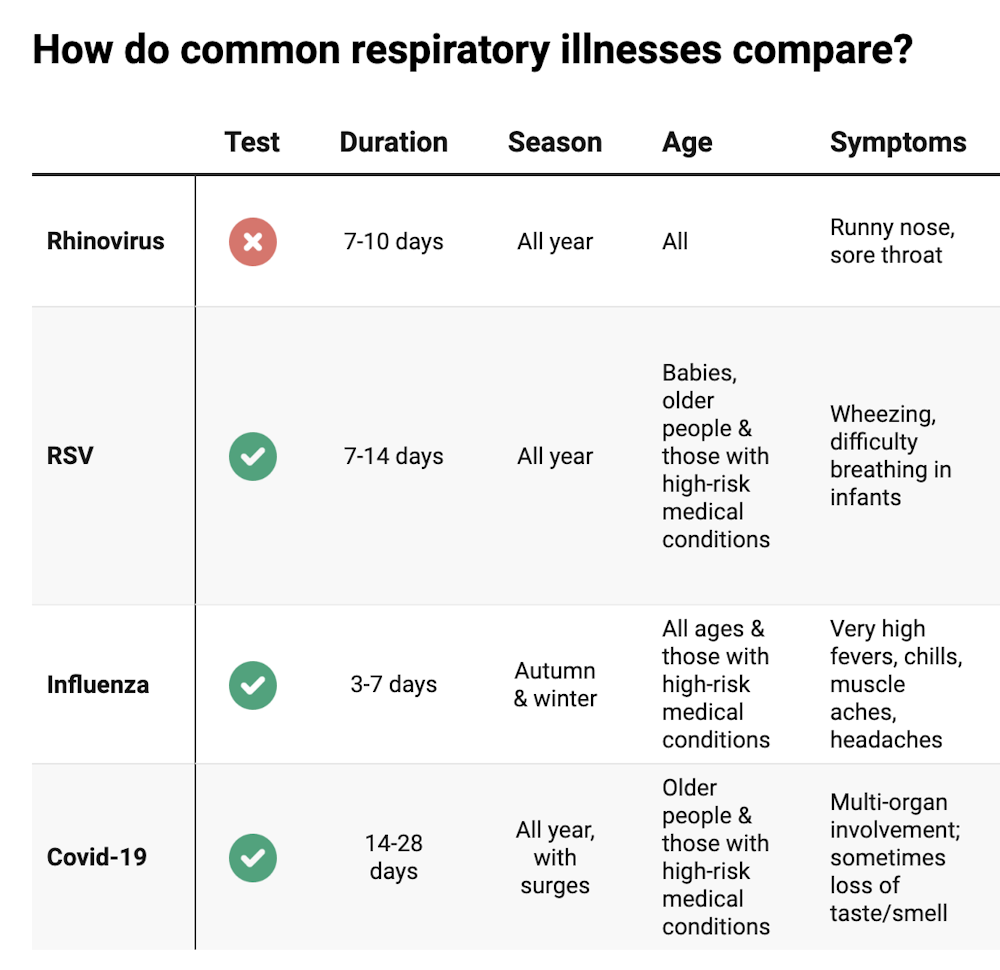
COVID still surrounds us. RSV and influenza rates appear higher than before the COVID pandemic, but it may be due to more testing.
So if you have a fever, sore throat, muscle aches/pains, weakness, fatigue, or are coughing up mucus, stay home and avoid mixing with others to limit transmission.
People with COVID symptoms can take a rapid antigen test (RAT), ideally when symptoms start, then isolate until symptoms disappear. One negative RAT alone can’t rule out COVID if symptoms are still present, so test again 24–48 hours after your initial test if symptoms persist.
You can now test yourself for COVID, RSV and influenza in a combined RAT. But again, a negative test doesn’t rule out the virus. If your symptoms continue, test again 24–48 hours after the previous test.
If it’s hay fever, how do I treat it?
Treatment involves blocking the body’s histamine release, by taking antihistamine medication which helps reduce the symptoms.
Doctors, nurse practitioners and pharmacists can develop a hay fever care plan. This may include using a nasal spray containing a topical corticosteroid to help reduce the swelling inside the nose, which causes stuffiness or blockage.
Nasal sprays need to delivered using correct technique and used over several weeks to work properly. Often these sprays can also help lessen the itchy eyes of hay fever.
Drying bed linen and pyjamas inside during spring can lessen symptoms, as can putting a smear of Vaseline in the nostrils when going outside. Pollen sticks to the Vaseline, and gently blowing your nose later removes it.
People with asthma should also have an asthma plan, created by their doctor or nurse practitioner, explaining how to adjust their asthma reliever and preventer medications in hay fever seasons or on allergen exposure.
People with asthma also need to be alert for thunderstorms, where pollens can burst into tinier particles, be inhaled deeper in the lungs and cause a severe asthma attack, and even death.
What if it’s COVID, RSV or the flu?
Australians aged 70 and over and others with underlying health conditions who test positive for COVID are eligible for antivirals to reduce their chance of severe illness.
Most other people with COVID, RSV and influenza will recover at home with rest, fluids and paracetamol to relieve symptoms. However some groups are at greater risk of serious illness and may require additional treatment or hospitalisation.
For RSV, this includes premature infants, babies 12 months and younger, children under two who have other medical conditions, adults over 75, people with heart and lung conditions, or health conditions that lessens the immune system response.
For influenza, people at higher risk of severe illness are pregnant women, Aboriginal people, people under five or over 65 years, or people with long-term medical conditions, such as kidney, heart, lung or liver disease, diabetes and decreased immunity.
If you’re concerned about severe symptoms of COVID, RSV or influenza, consult your doctor or call 000 in an emergency.
If your symptoms are mild but persist, and you’re not sure what’s causing them, book an appointment with your doctor or nurse practitioner. Although hay fever season is here, we need to avoid spreading other serious infectious.
For more information, you can call the healthdirect helpline on 1800 022 222 (known as NURSE-ON-CALL in Victoria); use the online Symptom Checker; or visit healthdirect.gov.au or the Australian Society of Clinical Immunology and Allergy.
Deryn Thompson, Eczema and Allergy Nurse; Lecturer, University of South Australia
This article is republished from The Conversation under a Creative Commons license. Read the original article.
Don’t Forget…
Did you arrive here from our newsletter? Don’t forget to return to the email to continue learning!
Recommended
Learn to Age Gracefully
Join the 98k+ American women taking control of their health & aging with our 100% free (and fun!) daily emails:
-
Is there anything good about menopause? Yep, here are 4 things to look forward to
10almonds is reader-supported. We may, at no cost to you, receive a portion of sales if you purchase a product through a link in this article.
Menopause is having a bit of a moment, with less stigma and more awareness about the changes it can bring.
A recent senate inquiry recommended public education about perimenopause and menopause, more affordable treatments and flexible work arrangements.
But like many things in life the experiences of menopause are on a continuum. While some women find it challenging and require support, others experience some physical and emotional benefits. These are rarely reported – but we can learn from the research available and, importantly, from people’s lived experiences.
Here are four changes to look forward to once you reach menopause.
Insta_Photos/Shutterstock 1. No more periods or related issues
Menopause is considered “complete” 12 months after the final period of a woman (or person assigned female at birth) who previously menstruated.
Perhaps unsurprisingly, the benefit at the top of the list is no more periods (unless you are taking hormone therapy and still have your womb). This can be particularly beneficial for women who have had to manage erratic, unpredictable and heavy bleeding.
At last, you don’t need to keep sanitary protection in every bag “just in case”. No more planning where the bathroom is or having to take extra clothes. And you’ll save money by not purchasing sanitary products.
There is also good news for women who have had heavy bleeding due to uterine fibroids – common benign gynaecological tumours that affect up to 80% of women. The evidence suggests hormonal changes (for women not taking hormone therapy) can lead to a reduction in the size of fibroids and relieve symptoms.
Women who suffer from menstrual migraine may experience an improvement in migraines post-menopause as their hormonal fluctuations begin to settle – but the timeframe for this remains unclear.
For some women, no more periods also means more participation in social activities from which they may have been excluded due to periods. For example, religious activities or food preparation in some cultures.
2. Getting your body and your groove back
Throughout their reproductive lives, women in heterosexual relationships are usually the ones expected to be proactive about preventing pregnancy.
Some post-menopausal women describe a re-emergence of their sexuality and a sense of sexual freedom that they had not previously experienced (despite contraceptive availability) as there is no longer a risk of pregnancy.
A participant in my research into women’s experiences of menopause described the joy of no longer being child-bearing age:
I’ve got a body back for me, you know, coz I can’t get pregnant, not that I haven’t enjoyed having [children] and things like that and it was a decision to get pregnant but I feel like, ooh my body isn’t for anybody now but me, people, you know?
For women who have chosen to be child-free there may also be a sense of freedom from social expectations. People will likely stop asking them when they are planning to have children.
3. A new chapter and a time to focus on yourself
Another participant described menopause as an unexpected “acceleration point” for change.
Women told us they were more accepting of themselves and their needs rather than being focused on the needs of other people. Researchers have previously tracked this shift from “living for others” to “a life of one’s own”.
Some women find the strength of emotions at this time a challenge, whereas others find their potency can facilitate liberation – enabling them to speak their minds or be more assertive than at any other time in their lives.
4. Increased self-confidence
A new sense of liberation can fuel increased self-confidence at menopause. This has been reported in studies based on in-depth interviews with women.
Confidence boosts can coincide with changes in career and sometimes in relationships as priorities and self-advocacy transform.
Life on the other side
It can be hard to think about what is good about menopause, particularly if you are having challenges during perimenopause – but these can get better with time.
In cultures where women are valued as they become older, women describe themselves as positively contributing to the community. They find they gain power and respect as they age.
We need to work towards more positive societal attitudes on this front. Our bodies change across the lifespan and are remarkable at every stage, including menopause.
Yvonne Middlewick, Nurse, Lecturer & Director of Post-graduate Studies in the School of Nursing and Midwifery, Edith Cowan University
This article is republished from The Conversation under a Creative Commons license. Read the original article.
Share This Post
-
Celeriac vs Eggplant – Which is Healthier?
10almonds is reader-supported. We may, at no cost to you, receive a portion of sales if you purchase a product through a link in this article.
Our Verdict
When comparing celeriac to eggplant, we picked the celeriac.
Why?
In terms of macros, celeriac has very slightly more protein and eggplant has very slightly more fiber, and/but it’s all close enough that we consider this round a tie.
In the category of vitamins, celeriac has more of vitamins B1, B2, B3, B5, B6, C, E, K, and choline, while eggplant has more vitamin B9. An easy win for celeriac.
When it comes to minerals, celeriac has more calcium, iron, magnesium, potassium, phosphorus, selenium, and zinc, while eggplant has more copper and manganese. Another win for celeriac.
Adding up the sections makes for an overall win for celeriac, but by all means enjoy either or both; diversity is good!
Want to learn more?
You might like:
What’s Your Plant Diversity Score?
Enjoy!
Share This Post
-
Celeriac vs Onion – Which is Healthier?
10almonds is reader-supported. We may, at no cost to you, receive a portion of sales if you purchase a product through a link in this article.
Our Verdict
When comparing celeriac to onion, we picked the celeriac.
Why?
In terms of macros, celeriac has slightly more fiber and protein, while onions have slightly more carbs, so this category is a nominal win for celeriac, but really it’s very close, so can just as easily be called a tie in this first round.
In the category of vitamins, celeriac has more of vitamins B1, B2, B3, B5, B6, B7, C, E, and K (in fact, 100x more vitamin K), while onions have more vitamin B9; an easy win for celeriac in this round.
Looking at minerals, celeriac has more calcium, copper, iron, magnesium, manganese, phosphorus, potassium, selenium, and zinc, while onions are not higher in any minerals. Another overwhelming win for celeriac here.
Adding up the sections makes for a very clear overall win for celeriac, but by all means do enjoy either or both, as diversity is best!
Want to learn more?
You might like:
What’s Your Plant Diversity Score?
Enjoy!
Share This Post
Related Posts
-
More than just being well: teens and Gen Z are redefining what it means to be healthy
10almonds is reader-supported. We may, at no cost to you, receive a portion of sales if you purchase a product through a link in this article.
Health isn’t what it used to be – namely the absence of being sick.
Ask any teenager today what it means to them to be healthy, and you’re likely to hear about the vast array of areas in their lives they are “working on”.
This can include emotional health, aesthetic health, fitness, nutrition, social health, financial health, social media health, mental health, spiritual health … the list goes on.
When I was a teenager in the 1980s, health wasn’t something I or my friends thought about much. We took it for granted it was either something you had, or were unfortunate to have lost.
In contrast, today’s young people view health as something they can “grow” and should already be working on. Health has become an investment. And, through a process of expansion I call “healthization”, it has become an increasingly diverse one.
Getty Images Beyond Dr Google
In my recent research, I asked 235 young New Zealanders aged 14–24 to talk about how they use digital technology as part of understanding their health. The results inform my recent book, Healthization: Turning Life into Health.
Some of the results were not unexpected: young people discussed googling their symptoms and self-diagnosing anything from a sore throat to a miscarriage.
They also talked about using online quizzes and a variety of websites and forums to ascertain their mental wellbeing, including self-diagnosing themselves with anxiety, post-traumatic stress disorder and depression.
But at the same time as invoking the value of using “Dr Google”, they also talked about sophisticated strategies they use for determining what forms of online and offline knowledge are trustworthy.
They described how they triangulate online results, determine when to check with medical professionals, and frequently compare their understanding of health information with friends, siblings or parents.
Perhaps more unexpectedly, their definitions of what it means to be healthy were all-encompassing. So much so that for some there appeared to be almost no limit to the role that striving to be healthy plays in their lives.
Things that a generation ago were thought to be important but not necessarily part of being healthy – such as friendship, beauty, having a sense of community, dating, doing well in school, creating “down time” or moments of relaxation – are now rolled into this expansive concept of health.
Not having these things is no longer seen as sad or due to misfortune, but as being actively detrimental to one’s health.
Health’s moral dimension
In a country often stereotyped for its rugged but sometimes cavalier “she’ll be right” ethos, young people openly worry about their own and other people’s physical health in ways strikingly at odds with previous generations.
There has been a lot written about the 21st-century focus on self-improvement. But young people also describe eagerly helping others in their health projects or “journeys”, spending time googling mental health issues so they can help diagnose friends, or even taking their parents along on a run.
Indeed, mental and emotional health in particular are singled out as areas where young people see a generational role to promote greater transparency and social acceptance.
Health takes on a moral dimension as young people describe investing in their own and others’ health as a means to achieve “a good life”. In fact, not to work on one’s health was often depicted as morally wrong.
Through the process of healthization, health has come to cover a much broader terrain than it did a generation or so ago. So, is it even achievable?
Or, given so many different components to health – from minding one’s time on social media to drinking enough water, from working on establishing meaningful friendships to logging in with MapMyRun – is it an illusion that no one can possibly fulfil?
While this might initially appear to be the case, the young people I interviewed suggest differently.
While some did indeed seem overwhelmed by the amount of necessary “work” on health that faces them, others noted the need for “balance” and pathways (sometimes multiple ones) toward enacting those aspects of health that appear most meaningful and achievable.
Finding real balance
In my book I suggest the turn towards such holistic views of health not only helps us acknowledge the wide variety of things that affect our wellbeing, but highlights how the mind and body are interrelated – how our mental wellbeing can influence our physical health and vice versa.
The downside is that it can feel overwhelming and also draw attention away from other things we value and which we need or want to do. These may not necessarily be good for our health but are nonetheless socially meaningful.
That might include devoting time to caring for family members, for example, rather than working on our physical fitness. Or sacrificing our time or wellbeing to promote or protect a greater cause.
The trick, the book concludes, might be to adopt a point of view that embraces the merits of a broad view of health while also encouraging ourselves to look beyond it.
Just as young people are recognising the importance of working on the self while also emphasising the importance of their relationships with others, maybe we can all discover a better kind of “balance”.
Susanna Trnka, Professor of Anthropolgy, University of Auckland, Waipapa Taumata Rau
This article is republished from The Conversation under a Creative Commons license. Read the original article.
Don’t Forget…
Did you arrive here from our newsletter? Don’t forget to return to the email to continue learning!
Learn to Age Gracefully
Join the 98k+ American women taking control of their health & aging with our 100% free (and fun!) daily emails:
-
Why won’t my cough go away?
10almonds is reader-supported. We may, at no cost to you, receive a portion of sales if you purchase a product through a link in this article.
A persistent cough can be embarrassing, especially if people think you have COVID.
Coughing frequently can also make you physically tired, interfere with sleep and trigger urinary incontinence. As a GP, I have even treated patients whose repetitive forceful coughing has caused stress fractures in their ribs.
So, why do some coughs linger so long? Here are some of the most common causes – and signs you should get checked for something more serious.
Mladen Zivkovic/Shutterstock Why do we cough?
The cough reflex is an important protective mechanism. Forcefully expelling air helps clear our lungs and keep them safe from irritants, infections and the risk of choking.
Some people who have long-term conditions, such as chronic bronchitis or bronchiectasis, have to cough frequently. This is because the lung’s cilia – tiny hair-like structures that move mucus, debris and germs – no longer work to clear the lungs.
A wet or “productive” cough means coughing up a lot of mucus.
A cough can also be dry or “unproductive”. This happens when the cough receptors in the airways, throat and upper oesophagus have become overly sensitised, triggering a cough even when there’s no mucus to clear.
Causes of a chronic cough
A cough is considered chronic when it lasts longer than eight weeks in adults, or four weeks in children.
The three most common causes are:
- post-nasal drip (where mucus drips from the back of the nose into the throat)
- asthma
- acid reflux from the stomach.
These often go together. One study found 23% of people with chronic cough had two of these conditions, and 3% had all three.
This makes sense – people prone to airway allergies are more likely to develop both asthma and hayfever (allergic rhinitis). Hayfever is probably the main cause of persistent post-nasal drip.
Meanwhile, prolonged, vigorous coughing can also cause reflux, possibly triggering further coughing.
Chronic cough is the primary symptom of two other conditions, although these can be more challenging to diagnose: cough-variant asthma and eosinophilic bronchitis. Both conditions inflame the airways. However, they don’t rapidly improve with ventolin (the standard clinic test to diagnose asthma).
Allergies can cause inflammation that triggers a chronic cough. Kmpzzz/Shutterstock Coughs after respiratory infections
Coughs can also persist long after a viral or bacterial infection. In children with colds, one systematic review found it took 25 days for more than 90% to be free of their cough.
After an infection, cough hypersensitivity may develop thanks to inflamed airways and over-responsive cough receptors. Even minor irritants will then trigger the coughing reflex.
The body’s response to infection makes the mucus more sticky – and more difficult for the overworked, recovering cilia to clear. Allergens in the air can also more easily penetrate the upper airway’s damaged lining.
This can trigger an unhelpful feedback loop that slows the body’s recovery after an infection. Excessive and unhelpful coughing tends to further fatigue the recovering cilia and irritate the airway lining.
Could I still have an infection?
When a cough persists, a common concern is whether a secondary bacterial infection has followed the first viral infection, requiring antibiotics.
Simply coughing up yellow or green phlegm is not enough to tell.
To diagnose a serious chest infection, your doctor will consider the whole picture of your symptoms. For example, whether you also have shortness of breath, worsening fever or your lungs make abnormal sounds through a stethoscope.
The possibility you have undiagnosed asthma or allergies should also be considered.
What treats a persistent cough?
People with a persistent cough who are otherwise healthy may request and be prescribed antibiotics. But these rarely shorten how long your cough lasts, as irritation – not infection – is the primary cause of cough.
The most effective treatments for shifting sticky mucus from the airways are simple ones: saline nose sprays and washes, steam inhalation and medicated sore throat sprays.
Honey has also been shown to reduce throat irritation and the need to cough.
The effectiveness of cough syrup is less clear. As these mixtures have potential side effects, they should be used with care.
The most effective treatments are simple ones, including steam inhalation. New Africa/Shutterstock Signs of something more serious
Sometimes, a cough that won’t go away could be the sign of a serious condition, including lung cancer or unusual infections. Fortunately, these aren’t common.
To rule them out, Australia’s chronic cough guidelines recommend a chest x-ray and spirometry (which tests lung volume and flow) for anyone presenting to their doctor with a chronic cough.
You should seek prompt medical attention if, in addition to your cough, you:
- cough up blood
- produce a lot of phlegm
- are very short of breath, especially when resting or at night
- have difficulty swallowing
- lose weight or have a fever
- have recurring pneumonia
- are a smoker older than 45, with a new or changed cough.
What if there’s no clear cause?
Very occasionally, despite thorough testing and treatment, a cough persists. This is called refractory chronic cough.
When no cause can be identified, it’s known as unexplained chronic cough. In the past, unexplained cough may have been diagnosed as a “psychogenic” or “habit” cough, a term which has fallen from favour.
We now understand that cough hypersensitivity makes a person cough out of proportion to the trigger, and that both the peripheral and central nervous systems play a role in this. But our understanding of the relationship between hypersensitivity and chronic cough remains incomplete.
These are disabling conditions and should be referred to a respiratory clinic or a chronic cough specialist. Speech pathology treatments may also be effective for refractory and unexplained coughs.
There are a class of new medications in the pipeline that block cough receptors, and seem promising for persisting, troublesome coughs.
David King, Senior Lecturer in General Practice, The University of Queensland
This article is republished from The Conversation under a Creative Commons license. Read the original article.
Don’t Forget…
Did you arrive here from our newsletter? Don’t forget to return to the email to continue learning!
Learn to Age Gracefully
Join the 98k+ American women taking control of their health & aging with our 100% free (and fun!) daily emails:
-
Cherries vs Elderberries – Which is Healthier?
10almonds is reader-supported. We may, at no cost to you, receive a portion of sales if you purchase a product through a link in this article.
Our Verdict
When comparing cherries to elderberries, we picked the elderberries.
Why?
Both are great! But putting them head-to-head…
In terms of macros, cherries have slightly more protein (but we are talking miniscule numbers here, 0.34mg/100g), while elderberries have moderately more carbs and more than 4x the fiber. This carbs:fiber ratio difference means that elderberries have the lower glycemic index by far, as well as simply more grams/100g fiber, making this an easy win for elderberries.
In the category of vitamins, cherries have more of vitamins A, B9, E, K, and choline, while elderberries have more of vitamins B1, B2, B3, B6, and C. The margins of difference mean that elderberries have the very slightly better overall vitamin coverage, but it’s so slight that we’ll call this a 5:5 tie.
When it comes to minerals, cherries have more copper, magnesium, and manganese, while elderberries have more calcium, iron, phosphorus, potassium, selenium, and zinc. A nice easy win to top it off for elderberries.
On the polyphenols (and other phytochemicals) front, both are great in different ways, nothing that’d we’d consider truly sets one ahead of the other.
All in all, adding up the sections, an overall win for elderberries, but by all means enjoy either or both!
Want to learn more?
You might like to read:
- Cherries’ Very Healthy Wealth Of Benefits!
- Herbs for Evidence-Based Health & Healing ← one of them is elderberry, which hastens recovery from upper respiratory viral infections 😎
Take care!
Don’t Forget…
Did you arrive here from our newsletter? Don’t forget to return to the email to continue learning!
Learn to Age Gracefully
Join the 98k+ American women taking control of their health & aging with our 100% free (and fun!) daily emails:


