
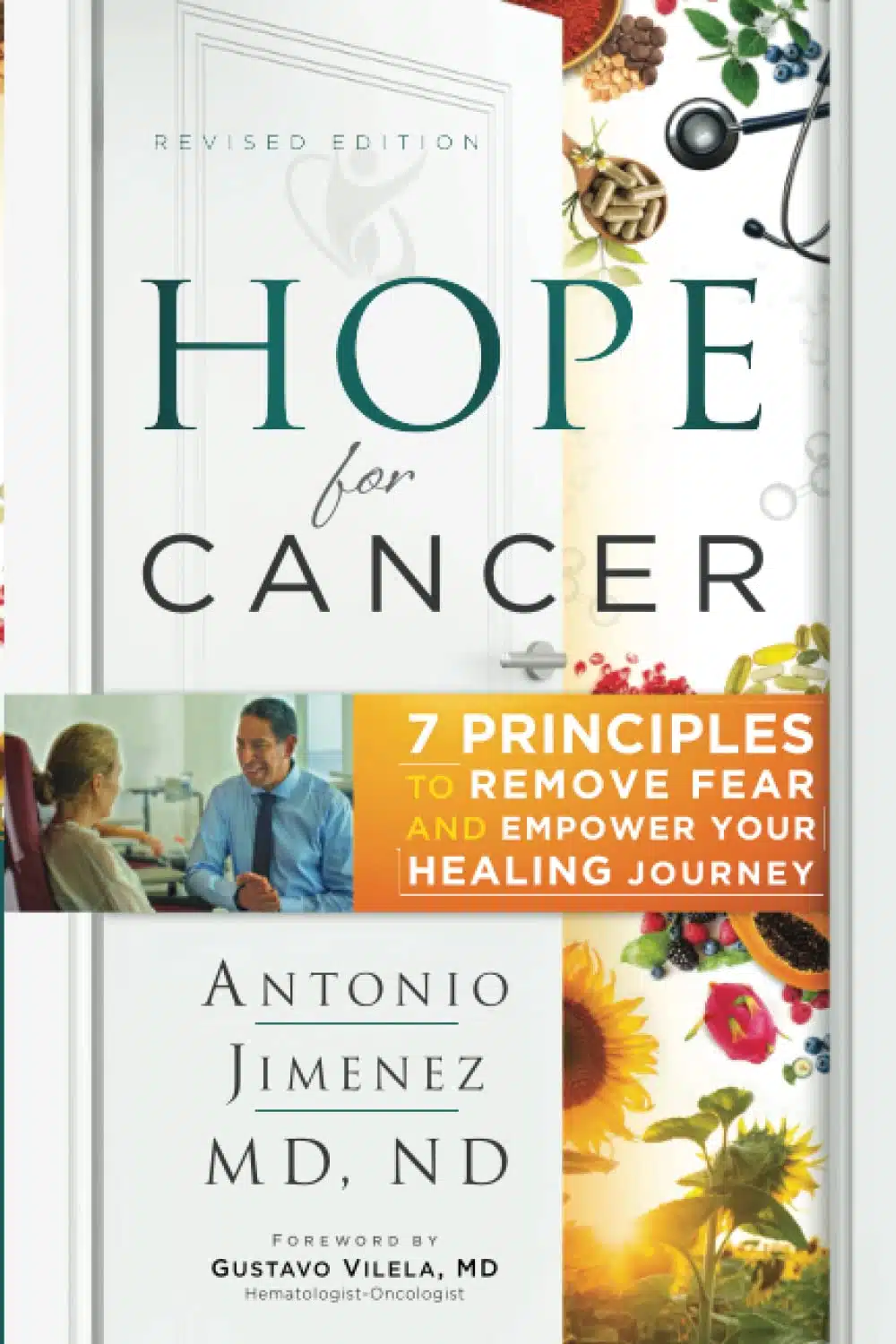
Hope For Cancer – by Dr. Antonio Jimenez
10almonds is reader-supported. We may, at no cost to you, receive a portion of sales if you purchase a product through a link in this article.
We’ll not keep the 7 principles a mystery; they are:
- Non-toxic cancer therapies
- Immunomodulation
- Full spectrum nutrition
- Detoxification
- Oxygenation
- Restore the microbiome
- Spiritual and emotional healing
When it comes to how these are covered in the book, they are often spread over chapters, often with testimonials, and you may notice that some chapters are not like others, for example:
- The chapter “Tools that empower your immune system” is followed by a chapter on “Nutrition based on the Garden of Eden”
- The chapter “Lifestyle tools for healing” is followed by a chapter on “Jesus, the Resurrection, the Life, and the Great Physician”
…and so forth.
Indeed, the first chapter alone, “Healing the whole person”, has many more Bible references than it has scientific references. So, all this to say, there is a lot of science in here, but there is also a remarkable amount of Christianity considering the lack of mentioning such (or even so much as hinting at it) in the title or subtitle or even anywhere in the current blurb on Amazon.
As such, if you are a Christian, you’ll probably get a lot more out of this book than otherwise. For non-Christians, the book could have been half the size without losing any scientifically relevant content.
As for the science side of things, most of the lifestyle advice is good, integrative cancer therapies are great, the detoxification angle is perhaps a little overemphasized, and the oxygenation chapter is on shaky ground.
Bottom line: this book wasn’t quite what we signed up for. Now, we have nothing against books about Christianity (this reviewer can recommend some excellent ones), but when we pick up a book about cancer, we ideally want to hear more from doctors and less from apostles. Nevertheless! If you are a Christian, you might find more value in this one.
Click here to check out Hope For Cancer, and do not, of course, hope for cancer!
Don’t Forget…
Did you arrive here from our newsletter? Don’t forget to return to the email to continue learning!
Recommended
Learn to Age Gracefully
Join the 98k+ American women taking control of their health & aging with our 100% free (and fun!) daily emails:
-
How To Leverage Placebo Effect For Yourself
10almonds is reader-supported. We may, at no cost to you, receive a portion of sales if you purchase a product through a link in this article.
Placebo Effect: Making Things Work Since… Well, A Very Long Time Ago
The placebo effect is a well-known, well-evidenced factor that is very relevant when it comes to the testing and implementation of medical treatments:
NIH | National Center for Biotechnology Information | Placebo Effect
Some things that make placebo effect stronger include:
- Larger pills instead of small ones: because there’s got to be more going on in there, right?
- Thematically-colored pills: e.g. red for stimulant effects, blue for relaxing effects
- Things that seem expensive: e.g. a well-made large heavy machine, over a cheap-looking flimsy plastic device. Similarly, medication from a small glass jar with a childproof lock, rather than popped out from a cheap blister-pack.
- Things that seem rational: if there’s an explanation for how it works that you understand and find rational, or at least you believe you understand and find rational ← this works in advertising, too; if there’s a “because”, it lands better almost regardless of what follows the word “because”
- Things delivered confidently by a professional: this is similar to the “argument from authority” fallacy (whereby a proposed authority will be more likely trusted, even if this is not their area of expertise at all, e.g. celebrity endorsements), but in the case of placebo trials, this often looks like a well-dressed middle-aged or older man with an expensive haircut calling for a young confident-looking aide in a lab coat to administer the medicine, and is received better than a slightly frazzled academic saying “and, uh, this one’s yours” while handing you a pill.
- Things with ritual attached: this can be related to the above (the more pomp and circumstance is given to the administration of the treatment, the better), but it can also be as simple as an instruction on an at-home-trial medication saying “take 20 minutes before bed”. Because, if it weren’t important, they wouldn’t bother to specify that, right? So it must be important!
And now for a quick personality test
Did you see the above as a list of dastardly tricks to watch out for, or did you see the above as a list of things that can make your actual medication more effective?
It’s arguably both, of course, but the latter more optimistic view is a lot more useful than the former more pessimistic one.
Since placebo effect works at least somewhat even when you know about it, there is nothing to stop you from leveraging it for your own benefit when taking medication or doing health-related things.
Next time you take your meds or supplements or similar, pause for a moment for each one to remember what it is and what it will be doing for you. This is a lot like the principles (which are physiological as well as psychological) of mindful eating, by the way:
How To Get More Nutrition From The Same Food
Placebo makes some surprising things evidence-based
We’ve addressed placebo effect sometimes as part of an assessment of a given alternative therapy, often in our “Mythbusting Friday” edition of 10almonds.
- In some cases, placebo is adjuvant to the therapy, i.e. it is one of multiple mechanisms of action (example: chiropractic or acupuncture)
- In some cases, placebo is the only known mechanism of action (example: homeopathy)
- In some cases, even placebo can’t help (example: ear candling)
One other fascinating and far-reaching (in a potentially good way) thing that placebo makes evidence-based is: prayer
…which is particularly interesting for something that is fundamentally faith-based, i.e. the opposite of evidence-based.
Now, we’re a health science publication, not a theological publication, so we’ll consider actual divine intervention to be beyond the scope of mechanisms of action we can examine, but there’s been a lot of research done into the extent to which prayer is beneficial as a therapy, what things it may be beneficial for, and what factors affect whether it helps:
Prayer and healing: A medical and scientific perspective on randomized controlled trials
👆 full paper here, and it is very worthwhile reading if you have time, whether or not you are religious personally
Placebo works best when there’s a clear possibility for psychosomatic effect
We’ve mentioned before, and we’ll mention again:
- psychosomatic effect does not mean: “imagining it”
- psychosomatic effect means: “your brain regulates almost everything else in your body, directly or indirectly, including your autonomic functions, and especially notably when it comes to illness, your immune responses”
So, a placebo might well heal your rash or even shrink a tumor, but it probably won’t regrow a missing limb, for instance.
And, this is important: it’s not about how credible/miraculous the outcome will be!
Rather, it is because we have existing pre-programmed internal bodily processes for healing rashes and shrinking tumors, that just need to be activated—whereas we don’t have existing pre-programmed internal bodily processes for regrowing a missing limb, so that’s not something our brain can just tell our body to do.
So for this reason, in terms of what placebo can and can’t do:
- Get rid of cancer? Yes, sometimes—because the body has a process for doing that; enjoy your remission
- Fix a broken nail? No—because the body has no process for doing that; you’ll just have to cut it and wait for it to grow again
With that in mind, what will you use the not-so-mystical powers of placebo for? What ever you go for… Enjoy, and take care!
Share This Post
-
Is Covid During Pregnancy Linked to Autism? What a New Study Shows, and What It Doesn’t
10almonds is reader-supported. We may, at no cost to you, receive a portion of sales if you purchase a product through a link in this article.
A large study from Massachusetts has found that babies whose mothers had covid-19 while pregnant were slightly more likely to have a range of neurodevelopmental diagnoses by age 3. Most of these children had speech or motor delays, and the link was strongest in boys and when the mother was infected late in pregnancy.
The increase in risk was small for any one child, but because millions of women were pregnant during the pandemic, even a small increase matters. The study doesn’t prove that covid infection during pregnancy causes autism or other brain conditions in the fetus, but it suggests that infections and inflammation during pregnancy can affect how a baby’s brain grows, something scientists have seen before with other illnesses. It’s a reason to help pregnant women avoid covid and to keep a close eye on children who were exposed in the womb.
(E+/Getty Images) What the Study Found
Researchers at Massachusetts General Hospital examined medical records from more than 18,000 mothers and their children born from March 2020 through May 2021, before vaccines were widely available to pregnant women. Because everyone giving birth during that period was tested for covid, the team could clearly see which pregnancies were exposed to the virus causing it.
About 5% of those mothers had covid while pregnant. Their children were modestly more likely to be diagnosed with a neurodevelopmental condition by age 3 than those whose mothers weren’t infected, even after accounting for differences in maternal age, race, insurance status, and preterm birth.
The link appeared strongest among boys and when infection occurred in their mother’s third trimester. Still, most children in both groups showed typical development.
“This was a very clean group to follow,” said Andrea Edlow, a maternal-fetal medicine specialist at Mass General and one of the study’s authors. “Because of universal testing early in the pandemic, we knew who had covid and who didn’t.”
Independent authorities say covid, which causes a powerful immune response in some people, fits the biological pattern seen with other infections in pregnancy. Alan Brown, a professor of psychiatry and epidemiology at Columbia University who studies maternal infection and brain development and was not involved in this research, explained, “Covid would be a very strong candidate for it to happen because the amount of inflammation is very extreme.”
How Might Infection Affect Brain Development?
Scientists are still piecing together how various infections during pregnancy can affect fetal development. Severe illness can cause inflammation that disrupts brain growth or can trigger preterm birth, which carries its own risks.
“There’s a long history of evidence showing that maternal infection can slightly raise the risk for many neurodevelopmental disorders,” said Roy Perlis, the vice chair for research in psychiatry at Massachusetts General Hospital and co-author of the new study.
Edlow’s lab is investigating how infection and inflammation may interfere with brain development. In a healthy brain, immune cells help shape developing neural circuits by trimming away extra or unnecessary connections, a process known as “synaptic pruning,” which sculpts the brain’s wiring. When a mother’s immune system is activated by infection, inflammatory molecules can reach the fetal brain and alter the pruning process.
Animal studies support Edlow’s hypothesis. When scientists trigger inflammation in pregnant mice, their offspring often show changes in how brain cells grow and connect, changes that can alter learning and behavior.
Why Late Pregnancy and Why Boys?
In Edlow and Perlis’ study, the link between covid and developmental delays was strongest when infection occurred late in pregnancy, during the third trimester. That’s also when the fetal brain is growing most rapidly, forming and refining millions of neural connections.
“When we think of organ development, we think earlier in pregnancy, but the brain is an exception in this regard, where there’s a massive amount of brain development in the third trimester. And that continues after birth,” Perlis said. “It is entirely plausible that the third trimester is a period of vulnerability specifically for brain development.”
But not all researchers agree that the third trimester is uniquely vulnerable. Brian Lee, a professor of epidemiology at Drexel University, cautioned that because most mothers in the study were tested at delivery, there were simply more late-pregnancy infections to analyze. “That gives the study more power to find a difference in the third trimester,” he said. “It doesn’t prove earlier infections aren’t important.”
The study also found stronger effects in boys. That pattern is familiar: Boys are generally more likely than girls to have speech or motor delays and to be diagnosed with autism. Researchers suspect that male fetuses may be more susceptible to stress and inflammation, though the biology isn’t fully understood.
What the Study Can and Can’t Show
Edlow and Perlis are careful to say the study shows an association, not proof that covid infection in pregnancy causes developmental problems. Many other factors could explain the correlation.
Mothers who get sick with covid may have other health issues, such as obesity, diabetes, or mental health conditions, that increase the risk of developmental delays in children. “Persons with mental disorders are much more likely to get covid. Women with mental disorders are much more likely to have kids with neurodevelopmental problems,” Lee said. “Mothers with worse physical health are also at higher risk of having children with neurodevelopmental problems.”
Lee’s research has shown that even infections before or after pregnancy can be linked to autism, suggesting that shared genetics or environment, rather than the infection itself, could be at play. That’s why experts say much larger, longer studies are needed to understand the extent of any risk from the infection.
Edlow, Perlis, and their team plan to follow the children in their study as they grow older to see whether early differences persist or fade. They’re also studying how inflammation during pregnancy affects the placenta and fetal brain, and how to counteract these effects.
What About Vaccination?
Because this study followed pregnancies from early in the pandemic, it doesn’t answer whether vaccination changes the risk. But other research offers reassurance.
A large national study in Scotland found no difference in early developmental outcomes between children whose mothers were vaccinated and those who weren’t. Another study in the U.S. found the same: no link between prenatal covid vaccination and developmental delays through 18 months. Both align with decades of data showing that vaccination during pregnancy is safe for both the mother and the baby.
“Vaccination is a short spike … your immune system revs up, then it goes back to normal,” Edlow said. “Covid [infection] is much more prolonged, unpredictable, and people can get … a dysregulated immune phenomenon that really doesn’t exist in vaccine responses.”
What This Means for Parents and Clinicians
Since late 2020, there’s been widespread confusion and misinformation about the safety of covid vaccination during pregnancy. Some women have hesitated to get vaccinated out of fear it might harm their baby. But the evidence since then has been clear: Covid vaccines are safe in pregnancy. The American College of Obstetricians and Gynecologists strongly recommends covid vaccination to protect both mother and child.
Experts say the broader lesson is that pregnancy is a period of vulnerability, and prevention matters, not only for covid, but other infections as well.
Janet Currie, a professor of economics at Yale University, said these risks remain “underappreciated,” despite decades of evidence. “Even though the flu vaccine is recommended for pregnant women, very few pregnant women get it,” she said. “Physicians seem to be reluctant to vaccinate pregnant women.”
As Gil Mor, scientific director of the C.S. Mott Center for Human Growth and Development at Wayne State University in Detroit, put it, “Protecting the mother is protecting the long-term health of the offspring. … The best intervention is vaccination.”
A Century-Old Echo
The idea that what happens in the womb can shape life after birth took root with studies of famine, like the Dutch “Hunger Winter” in the final months of World War II. In 1944 and 1945, as German forces blockaded the western Netherlands, rations fell to just a few hundred calories a day. Thousands died of starvation, and women pregnant during that period gave birth to babies who later faced higher risks of heart disease, diabetes, and schizophrenia. The episode became a cornerstone of the “fetal origins” idea, that deprivation or stress in pregnancy can have lifelong effects.
The 1918 flu pandemic broadened that idea to infection. Babies exposed to influenza in utero later showed small but lasting differences in education and earnings, a sign that illness during pregnancy could affect brain development. Researchers in Taiwan, Sweden, Switzerland, Brazil, and Japan found similar consequences. Some argued that those findings reflected the disruptions of World War I, not the flu itself. But later studies, including those from the United Kingdom and Finland, have strengthened the case for a biological effect, reinforcing that the infection itself, not wartime upheaval, was the key driver.
“It isn’t simply influenza that can alter fetal neurodevelopment,” Kristina Adams Waldorf, a professor of obstetrics and gynecology at the University of Washington, explained. “Many types of infections … in the mother can be transmitted as a signal to the fetus, which can alter its brain development.”
A century later, the same question has returned with covid: Could infection during pregnancy subtly shape how children grow and learn? The new Massachusetts General Hospital study offers an early look at an answer.
KFF Health News is a national newsroom that produces in-depth journalism about health issues and is one of the core operating programs at KFF—an independent source of health policy research, polling, and journalism. Learn more about KFF.
This article first appeared on KFF Health News and is republished here under a Creative Commons Attribution-NonCommercial-NoDerivatives 4.0 International License.
Share This Post
-
3 Mobility Mistakes That Ruin Your Progress
10almonds is reader-supported. We may, at no cost to you, receive a portion of sales if you purchase a product through a link in this article.
Don’t sabotage yourself:
As easy as 1, 2, 3
We’ll get straight into it:
- The first mistake is lack of time in the stretch: relying only on dynamic drills keeps mobility at a maintenance level because brief end-range exposure is not enough to drive adaptation.
- How to fix it: combine dynamic mobility with static stretching, holding stretches for up to two minutes, longer if you’re older, to meaningfully increase your range of motion.
- The second mistake is lack of consistency: constantly changing exercises prioritizes novelty over volume and prevents your body from adapting to any single movement.
- How to fix it: commit to a small selection of effective mobility drills or follow a structured program so you repeat the same movements often enough to improve.
- The third mistake is no progression: repeating a drill with the same range and difficulty each doesn’t challenge your body, which stalls mobility gains, as your body sees no reason to adapt.
- How to fix it: apply progressive overload to mobility by increasing your range of motion, adding a weight, or using props so the drill gradually becomes harder.
In other words: repeat the same mobility drills consistently, but do not repeat them at the same difficulty week after week without progression.
For more on all of this, enjoy:
Click Here If The Embedded Video Doesn’t Load Automatically!
Want to learn more?
You might also like:
Why Stretching Doesn’t Work After 50 (Unless You Fix These 3 Mistakes) ← for a physiotherapist’s insights on the same topic
Take care!
Share This Post
- The first mistake is lack of time in the stretch: relying only on dynamic drills keeps mobility at a maintenance level because brief end-range exposure is not enough to drive adaptation.
Related Posts
-
A new COVID variant is on the rise. Here’s what to know about LP.8.1
10almonds is reader-supported. We may, at no cost to you, receive a portion of sales if you purchase a product through a link in this article.
More than five years since COVID was declared a pandemic, we’re still facing the regular emergence of new variants of the virus, SARS-CoV-2.
The latest variant on the rise is LP.8.1. It’s increasing in Australia, making up close to one in five COVID cases in New South Wales.
Elsewhere it’s become even more dominant, comprising at least three in five cases in the United Kingdom, for example.
So what is LP.8.1? And is it cause for concern? Let’s look at what we know so far.
NicoElNino/Shutterstock An offshoot of Omicron
LP.8.1 was first detected in July 2024. It’s a descendant of Omicron, specifically of KP.1.1.3, which is descended from JN.1, a subvariant that caused large waves of COVID infections around the world in late 2023 and early 2024.
The World Health Organization (WHO) designated LP.8.1 as a variant under monitoring in January. This was in response to its significant growth globally, and reflects that it has genetic changes which may allow the virus to spread more easily and pose a greater risk to human health.
Specifically, LP.8.1 has mutations at six locations in its spike protein, the protein which allows SARS-CoV-2 to attach to our cells. One of these mutations, V445R, is thought to allow this variant to spread more easily relative to other circulating variants. V445R has been shown to increase binding to human lung cells in laboratory studies.
The proportion of COVID cases caused by LP.8.1 has been rising in New South Wales. NSW Health Notably, the symptoms of LP.8.1 don’t appear to be any more severe than other circulating strains. And the WHO has evaluated the additional public health risk LP.8.1 poses at a global level to be low. What’s more, LP.8.1 remains a variant under monitoring, rather than a variant of interest or a variant of concern.
In other words, these changes to the virus with LP.8.1 are small, and not likely to make a big difference to the trajectory of the pandemic.
That doesn’t mean cases won’t rise
COVID as a whole is still a major national and international health concern. So far this year there have been close to 45,000 new cases recorded in Australia, while around 260 people are currently in hospital with the virus.
Because many people are no longer testing or reporting their infections, the real number of cases is probably far higher.
COVID is still around. Hananeko_Studio/Shutterstock In Australia, LP.8.1 has become the third most dominant strain in NSW (behind XEC and KP.3).
It has been growing over the past couple of months and this trend looks set to continue.
This is not to say it’s not growing similarly in other states and territories, however NSW Health publishes weekly respiratory surveillance with a breakdown of different COVID variants in the state.
Sequences of LP.8.1 in the GISAID database, used to track the prevalence of variants around the world, increased from around 3% at the end of 2024 to 38% of global sequences as of mid March.
In some countries it’s climbed particularly high. In the United States LP.8.1 is responsible for 55% of cases. In the UK, where LP.8.1 is making up at least 60% of cases, scientists fear it may be driving a new wave.
Will COVID vaccines work against LP.8.1?
Current COVID vaccines, including the most recently available JN.1 shots, are still expected to offer good protection against symptomatic and severe disease with LP.8.1.
Nonetheless, due to its designation as a variant under monitoring, WHO member countries will continue to study the behaviour of the LP.8.1 variant, including any potential capacity to evade our immunity.
While there’s no cause for panic due to LP.8.1 variant at this stage, COVID can still be a severe disease for some. Continued vigilance and vaccination, particularly for medically vulnerable groups, is essential in minimising the impact of the disease.
Thomas Jeffries, Senior Lecturer in Microbiology, Western Sydney University
This article is republished from The Conversation under a Creative Commons license. Read the original article.
Don’t Forget…
Did you arrive here from our newsletter? Don’t forget to return to the email to continue learning!
Learn to Age Gracefully
Join the 98k+ American women taking control of their health & aging with our 100% free (and fun!) daily emails:
-
Don’t Shrink Your Brain With This Habit
10almonds is reader-supported. We may, at no cost to you, receive a portion of sales if you purchase a product through a link in this article.
We (hopefully) take a lot of care with our brains. We nourish then, hydrate them, make sure they have a good blood supply, let them get adequate rest (they will use it for tidying up, which is a restful activity if you’re a brain), and maybe even buy them brain-boosting nootropic supplements as a treat.
But a lot of people sabotage their brains, and here’s one of the most surefire ways to do so:
Smoking shrinks the brain, a lot
Ok, so “smoking is bad for the health” is not exactly breaking news, but often its ill effects are put largely down to things such as:
- tar buildup in the lungs
- strain on the cardiovascular system
- carcinogenic effect on cells
Also, the simple fact that it is addictive is often considered somehow responsible for harm to the health. In reality, the addictiveness of nicotine adds to the problem only because it is already bad (as are many of the things that come with it) and people then use more.
It’s not the addiction itself that’s the problem—a substance can be addictive without being deleterious to the health; see caffeine for example.
The difference is, smoking itself is astonishingly bad for the health, while enjoying a little coffee is (for most people) a perfectly healthy thing.
If you’d like to learn more about caffeine before we get back to talking about smoking, check out: Caffeine: Cognitive Enhancer Or Brain-Wrecker?
Bigger evidence for smaller brains
Firstly, why this matters: brain volume loss is an important biomarker of neurodegeneration, that can be easily checked with an MRI scan. Having a physical effect like that, which can be looked at, measured, and pointed to, is a way of knowing that, in a very real world physical material sense, “something wrong is not quite right here”.
It helps stop concerns from being dismissed, and it helps highlight a problem if such was previously being ignored.
Researchers (Dr. Somayeh Meysami et al.) wanted to examine and quantify the effect of smoking on brain atrophy (shrinking), so she and her team looked at the brains of 10,134 participants, of whom 3,292 smokers and 6,842 non-smokers, aged 18–97, using MRI.
In few words: they found that smokers had significantly lower gray and white matter volumes compared to non-smokers, and that especially significant atrophy was found in areas related to Alzheimer’s disease, such as the hippocampus, posterior cingulate, and precuneus, even after adjusting for BMI (which seemed to have a moderate mediating effect overall).
You may be wondering: how much smaller were these brains? And the answer is…
❝Smokers versus non-smokers were compared by gray and white matter volumes normalized to total intracranial volume using a two-tailed t-test. Smokers had lower normalized gray (t = −7.806e+00, p = 6.508e-15) and white matter volumes (t = −7.374e + 00, p = 1.791e-13) compared to non-smokers❞
Read in full: Smoking predicts brain atrophy in 10,134 healthy individuals and is potentially influenced by body mass index
Two things:
- The “healthy individuals” here is in the sense that they did not have any other clinically-relevant health conditions pre-diagnosed, aside from the ones discussed in the paper (so, brain atrophy, hypertension, diabetes, obesity). It is not suggesting that they were a glowing pinnacle of health; it’s just an accepted convention to express it this way in scientific papers, to disambiguate the “healthy individuals” from those with potentially confounding diseases. For example, it would have complicated the data incredibly if they had included people with lung cancer, or coronary artery disease, or Parkinson’s disease, etc.
- About those numbers, let’s explain:
For each of those groups we see a t-value and a p-value.
The p-value establishes the probability of getting that result by chance, and therefore indicates the statistical significances of the results. Generally speaking, a p-value under 0.05 is considered statistically significant. Here the p-values are 6.508-15 and 1.791-13, which if we express them in full, looks like this: 0.00000000000006508 and 0.0000000000001791. Which suffice it to say, is truly tiny, and therefore incredibly statistically significant. These are some of the lowest p-values this reviewer has ever seen in a paper.
The t-value establishes the number of standard deviations from the norm. In other words, if you take the average difference from the norm (because humans are diverse and we have a lot of very normal difference between our sizes of various organs), then how many multiples of that difference is the difference shown in the study? And in this case, the t-values are -7.806 and -7.374 (this time we can ignore the exponents, since the exponential values are zero, and moving the decimal point zero places in either direction will not change anything, as we can also verify in the complete results table), so that means the brains were more than 7 standard deviations smaller than those of the non-smokers.
One last thing: the above were averages for smokers vs non-smokers, but the effects were dose-dependent, i.e. more smoking = more brain atrophy.
Want to learn more?
You might be interested to know about…
Nicotine Benefits (That We Don’t Recommend)!
Take care!
Don’t Forget…
Did you arrive here from our newsletter? Don’t forget to return to the email to continue learning!
Learn to Age Gracefully
Join the 98k+ American women taking control of their health & aging with our 100% free (and fun!) daily emails:
-
Skip Traditional Planks, & Try This Way Instead
10almonds is reader-supported. We may, at no cost to you, receive a portion of sales if you purchase a product through a link in this article.
Will Harlow, over-50s specialist physio, advises:
Get dynamic
The plank strengthens the core, but only in a static position. Since the core’s main job is to stabilize your body while moving, planks cannot, by themselves alone, fully prepare it for dynamic, real-life activities.
For this reason, he recommends: instead of just holding still, add limb movements. Lift one arm, then the other, to engage the core dynamically. You can also lift one leg at a time, or for a harder version, lift diagonally-opposite arm and leg at the same time.
Another alternative is toe dips: lie on your back, and flatten your lower back into the floor, and start with simple bent-knee leg lifts (left up, right up, left down, right down). Once strong enough, progress to controlled toe dips where each leg lowers to touch the floor (you can do this from a raised surface) while keeping your core engaged.
For more on all of this plus visual demonstrations, enjoy:
Click Here If The Embedded Video Doesn’t Load Automatically!
Want to learn more?
You might also like:
Bodyweight Isometrics For Strength Without Joint Pain
Take care!
Don’t Forget…
Did you arrive here from our newsletter? Don’t forget to return to the email to continue learning!
Learn to Age Gracefully
Join the 98k+ American women taking control of their health & aging with our 100% free (and fun!) daily emails:


