
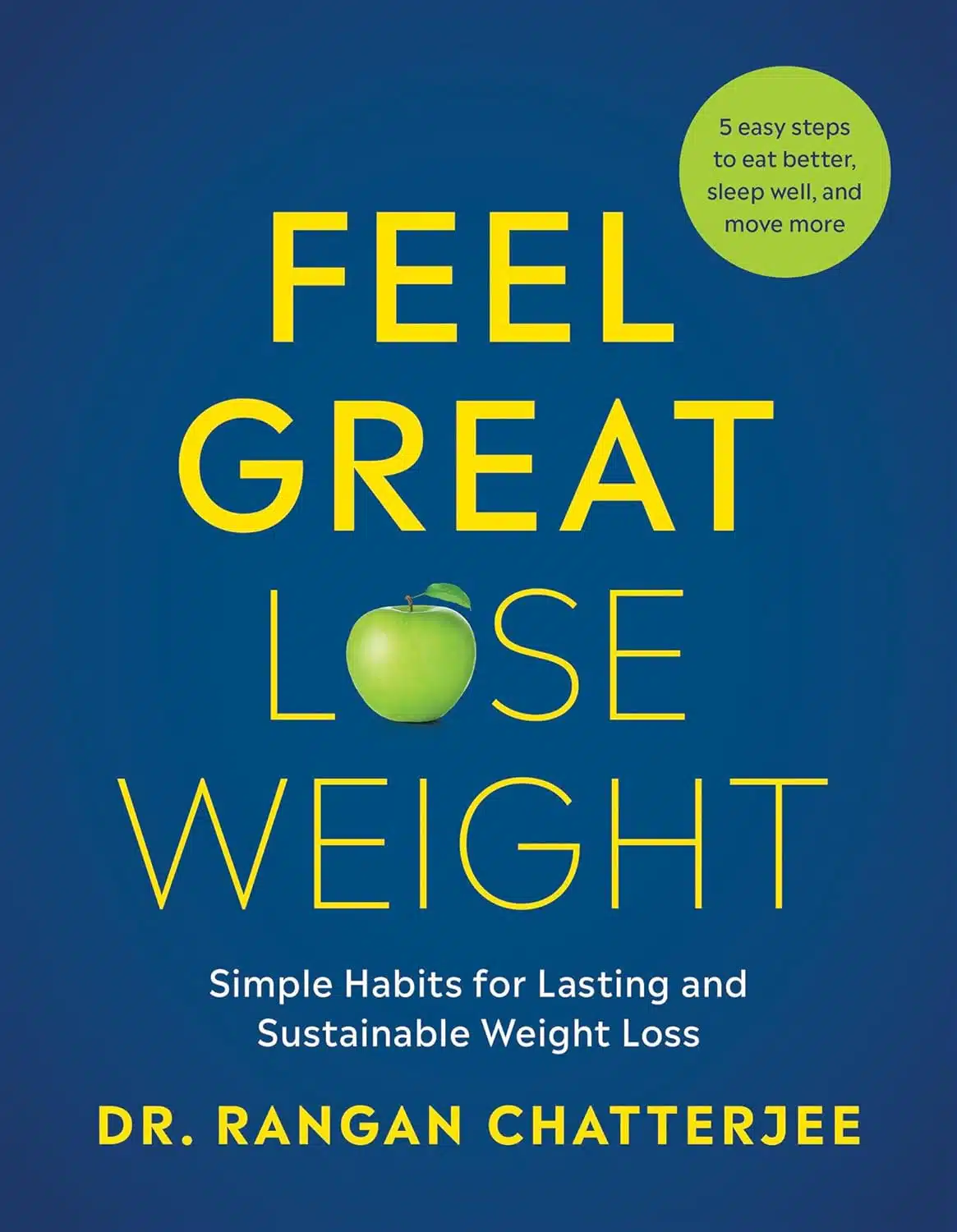
Feel Great, Lose Weight – by Dr. Rangan Chatterjee
10almonds is reader-supported. We may, at no cost to you, receive a portion of sales if you purchase a product through a link in this article.
We all know that losing weight sustainably tends to be harder than simply losing weight. We know that weight loss needs to come with lifestyle change. But how to get there?
One of the biggest problems that we might face while trying to lose weight is that our “metabolic thermostat” has got stuck at the wrong place. Trying to move it just makes our bodies think we are starving, and everything gets even worse. We can’t even “mind over matter” our way through it with willpower, because our bodies will do impressive things on a cellular level in an attempt to save us… Things that are as extraordinary as they are extraordinarily unhelpful.
Dr. Rangan Chatterjee is here to help us cut through that.
In this book, he covers how our metabolic thermostat got stuck in the wrong place, and how to gently tease it back into a better position.
Some advices won’t be big surprises—go for a whole foods diet, avoiding processed food, for example. Probably not a shocker.
Others are counterintuitive, but he explains how they work—exercising less while moving more, for instance. Sounds crazy, but we assure you there’s a metabolic explanation for it that’s beyond the scope of this review. And there’s plenty more where that came from, too.
Bottom line: if your weight has been either slowly rising, or else very stable but at a higher point than you’d like, Dr. Chatterjee can help you move the bar back to where you want it—and keep it there.
Don’t Forget…
Did you arrive here from our newsletter? Don’t forget to return to the email to continue learning!
Recommended
Learn to Age Gracefully
Join the 98k+ American women taking control of their health & aging with our 100% free (and fun!) daily emails:
-
Four Habits That Drastically Improve Mobility
10almonds is reader-supported. We may, at no cost to you, receive a portion of sales if you purchase a product through a link in this article.
Mobility is critical for health living, but stretching isn’t the entire story:
Beyond just stretching
Liv Townsend, of LivInLeggings fames, recommends these four habits:
- Sit less: prolonged sitting affects hip and shoulder mobility. Specifically, it affects it negatively. It is also a bringer of woe in many other ways beyond the scope of what we’re doing here today, but the important thing for mobility is to sit less. So, if you spent a lot of time at a desk, invest in a standing desk (writer’s note: I dearly love mine, which is technically a sit-stand converter like this one on Amazon but I just keep it in the up position all the time, so it’s easy to forget it has multiple settings. Anyway, it’s sooooooo much better for my back than sitting for hours at a time.). For how to deal with other (i.e. not desk-related) reasons you might be sitting a lot, check out: Stand Up For Your Health (Or Don’t*)
- Take creatine: more than just for strength and muscle-building (and even aside from its brain-benefits that it bestows to older people, but not young ones), creatine also supports mobility and flexibility. Any brand is fine, so long as creatine monohydrate is the sole ingredient. Also, micronized or not is also fine—that’s just to do with whether it’s been pre-compacted into super-tiny beads (so small that it will still effectively be a powder), which helps it to avoid clumping when mixed in a liquid, that’s all. It shouldn’t have any additives either way (so, check labels to ensure it doesn’t).
- Spend more time under tension: no, we’re not talking about texting your spouse “we need to talk”, but rather, this means that when we do stretch, we should spend longer in the stretched position. While dynamic stretching has its place, passive stretching (holding stretches for longer periods) is essential and shouldn’t be overlooked.
- Incorporate “movement snacks”: this is about when we are going about our daily life, we should move more while doing everyday tasks. Get in some shoulder stretches while waiting for the kettle to boil, deep squat while petting the dog, etc. These are very important, because mobility is very much a “use it or lose it” thing, and so moving in many different ways, frequently, is the only way to ensure full coverage (no stretching regimen is going to be able to cover the many compound movements that we do in everyday life).
*That article also covers how to avoid the damage of sitting even if you cannot physically stand!
For more on all of these, enjoy:
Click Here If The Embedded Video Doesn’t Load Automatically!
Want to learn more?
You might also like to read:
Mobility As Though A Sporting Pursuit: Train For The Event Of Your Life!
Take care!
Share This Post
-
Lime vs Starfruit – Which is Healthier?
10almonds is reader-supported. We may, at no cost to you, receive a portion of sales if you purchase a product through a link in this article.
Our Verdict
When comparing lime to starfruit, we picked the starfruit.
Why?
In terms of macros, this one’s a tie with equal fiber, and similar carbs and minimal protein.
In the category of vitamins, lime has more of vitamins B1, B2, B6, and E, while starfruit has more of vitamins A, B3, B5, B7, B9, and C, winning in this round.
Looking at minerals next, lime has more calcium, iron, and phosphorus, while starfruit has more copper, magnesium, manganese, potassium, selenium, and zinc, winning another round.
Adding up the sections makes for an overall win for starfruit, but by all means enjoy either or both, as diversity is good!
Want to learn more?
You might like:
What’s Your Plant Diversity Score?
Enjoy!
Share This Post
-
It’s a pool party! How to stay safe around the pool with friends this summer
10almonds is reader-supported. We may, at no cost to you, receive a portion of sales if you purchase a product through a link in this article.
It’s summer so kids’ playdates and birthday parties might start moving from the playground to the pool.
I research how to prevent drowning. I’m also a mum of two kids living in a house with a pool. So water safety is always front of mind.
Drowning deaths are at a record high in Australia. For pre-schoolers, this often happens in backyard pools. Although school-aged children have a much lower risk it’s still important to be vigilant.
Here are some key questions to ask and things to consider before you accept an invitation to a pool party or host your own.
With these tips, you’ll be able to navigate pool safety while ensuring the kids have heaps of fun.
Kindel Media/Pexels Not everyone knows how to swim
First, think about your child’s swimming ability. Have they learned to swim? Do you know how their ability stacks up against their peers? Check their skills against the recommended minimum national swimming and water safety benchmarks for their age.
Perhaps some top-up lessons or some intensive lessons over summer might give their skills a boost ahead of a busy swim season.
As important as swimming skills are, so too is knowing how to be safe around the water. Have you talked to your kids about water safety? Are they mindful that others may not be able to swim as well as they can and may not be comfortable disclosing this to their friends?
Have you discussed how dangerous it can be to hold each other down under the water or hold their breath to swim to the end of the pool repeatedly? It can lead to someone blacking out.
It’s also not just about drowning. Knowing about water depth, the dangers of diving into shallow water, and not running around a wet and slippery pool can help avoid injury.
It’s not just about the kids
You also have a more direct role in keeping everyone safe. If you’re hosting a playdate and planning to include a swim, have you checked with the child’s parents? Ask about children’s swimming abilities or fears.
Before everyone hits the water, discuss your pool safety rules and expectations with the kids, including your own. My kids, and their friends, are very used to my “lifeguard lectures” by now.
An important part of playing lifeguard is supervision. If your kids’ friends are weak or poor swimmers, regardless of their age, you should be in the water with them. This is usually more fun anyway.
For older kids and more confident swimmers it’s still best to supervise from a distance (maybe poolside) and be dressed ready to get into the water in an emergency.
If you’re expecting more than a couple of kids, you might need more than one adult to ensure adequate supervision (and keep your stress levels down). Ensure each person’s supervision responsibilities are clear to avoid tragic miscommunications, such as: “I thought you were looking after them.”
Have you refreshed your CPR skills lately? Does your pool have a CPR sign you can refer to? Is your pool fenced and compliant? Does the gate close and lock on its own?
What about at someone else’s house?
Are you confident in your child’s ability to swim and be safe around the pool, if you’re not there? Have the hosts asked about your child’s swimming ability and any concerns? If not, you should be proactive and flag them.
Remember that eveyone’s definition of “can swim” is different. Would the hosts mind if you stayed to help supervise?
If you’re going to do the “drop and run”, will the adults hosting be supervising? How vigilant will they be? Will the adults be drinking alcohol?
Having the conversation early can ensure all parents involved are aligned on matters of water safety.
We’re heading to the local pool instead
Many of the same rules apply if you’re meeting up with friends for a swim at your local pool.
Conditions here are more controlled with depth markers and safety equipment. But none of this replaces good swimming skills and safe behaviours.
Although lifeguards are on hand to help should anything go wrong, they are not a substitute for active parental supervision and shouldn’t be treated as babysitters.
In fact, reports of aggression and verbal and physical abuse of lifeguards are increasing, so please be respectful and keep your cool.
Keep yourself safe too
Kids aren’t the only ones who can get into trouble in the water. Adult drownings in a variety of different waterways are also on the rise.
So if you’re hitting the pool this summer, avoid alcohol around the water. You can even be impaired the day after heavy drinking.
Older adults can also be at risk of drowning in backyard pools due to medical incidents, such as a heart attack, or accidentally falling into the water.
If you keep all these issues in mind, we can all have a safe and enjoyable summer by the pool.
Amy Peden, NHMRC Research Fellow, School of Population Health and Co-founder UNSW Beach Safety Research Group, UNSW Sydney
This article is republished from The Conversation under a Creative Commons license. Read the original article.
Share This Post
Related Posts
-
Music can affect your driving – but not always how you’d expect
10almonds is reader-supported. We may, at no cost to you, receive a portion of sales if you purchase a product through a link in this article.
For many of us, listening to music is simply part of the driving routine – as ordinary as wearing a seatbelt. We build playlists for road trips, pick songs to stay awake, and even turn the volume up when traffic gets stressful.
More than 80% of drivers listen to music on most trips. And many young drivers find it difficult to concentrate without it.
We tend to think music relaxes us, energises us, or helps us focus when we’re behind the wheel.
But the science paints a more complicated picture. Decades of studies show music can sharpen some aspects of driving and dull others. And it affects young drivers differently from more experienced ones.
davidf/Getty Images How do researchers study driving and music?
Most studies use driving simulators, where participants drive through realistic road scenarios while researchers change only one thing: the music.
This allows precise measurement of indicators such as speed, reaction time, lane-keeping, braking, following distance, simulated collisions and even the driver’s physiological state under different music conditions.
Because everything else is held constant, any difference in driving performance can be attributed to the music.
Researchers have tested different music and driving scenarios in dozens of small studies – often with conflicting conclusions. To make sense of these results, researchers combine them in “meta-analyses” to see broad patterns.
So how does music affect our driving?
Meta-analyses show music changes how we drive in several ways.
Drivers listening to music tended to have more simulated collisions, poorer speed control and less stable following distances than those driving in silence.
Other outcomes such as lane position, signalling errors and pure reaction time show more mixed or inconsistent effects.
Music often changes the driver’s heart rate and makes it more variable. It also increases their arousal and mental workload, meaning how mentally “busy” or stretched they are while trying to drive.
Music can also help tired drivers stay alert on long, monotonous stretches but only for a short window. The boost fades by about 15 to 25 minutes.
So music can make you feel better and more alert, for shorter distances, even while it’s adding extra cognitive load and competing with the main task of driving.
Does the volume and type of music matter?
Volume does influence driving, but the effects are more subtle than many assume.
High- and medium-volume music tend to nudge drivers’ speeds slightly upward, while low-volume music consistently leads to slower driving. These effects are small, but relatively consistent in direction.
Fast music has a bad reputation, but the pooled evidence is less clear-cut. One meta-analysis found no overall effect of tempo on driving performance for an average driver. But it’s slightly different if you’re a novice driver.
Individual studies still suggest that very high-arousal, aggressive tracks can nudge some drivers toward riskier behaviour and make them more prone to errors. But tempo by itself doesn’t neatly predict safety.
Music tempo itself doesn’t predict safety. Gustavo Fring/Pexels Music you choose yourself tends to be less distracting than music imposed on you. Drivers often select music to regulate their mood and arousal – and that can stabilise their driving.
Conversely, several experiments show researcher-selected or imposed music leads to poorer performance: more collisions and violations, especially when the driver doesn’t like the music.
So it’s not just the music itself, but your relationship with it, that shapes how it affects your driving. Familiar or preferred music tends to maintain mood and reduce stress without adding as much mental load.
Inexperienced drivers are more affected
Inexperienced drivers are more vulnerable to distraction from music.
One study of 20- to 28-year-old drivers found less-experienced drivers were far more disrupted by music than experienced drivers. When music was playing – especially upbeat, “happy” tracks – inexperienced drivers were much more likely to drift into speeding.
Experienced drivers didn’t, suggesting their experience acts as a buffer.
Another experiment found exposing young drivers to more aggressive genres such as metal or certain folk-pop led to higher speeds, more driving errors and reduced attention to road signs.
For novice drivers, fast-tempo music increased their mental load and reduced their ability to spot hazards. This meant they were slower or less accurate in their responses.
Slow music, on the other hand, didn’t raise inexperienced drivers’ mental load and even moderately improved their ability to respond to hazards.
So what does this mean for my driving?
For most people, familiar songs, calmer genres and moderate volumes tend to create the least interference, while still keeping you alert and in a good mood.
Extremely loud, unfamiliar or highly aggressive tracks are the ones most likely to push up your speed, distract you, or overload your thinking.
But if you’re a newer driver, try turning the volume down, or even switching the music off, in demanding conditions.
Milad Haghani, Associate Professor and Principal Fellow in Urban Risk and Resilience, The University of Melbourne
This article is republished from The Conversation under a Creative Commons license. Read the original article.
Don’t Forget…
Did you arrive here from our newsletter? Don’t forget to return to the email to continue learning!
Learn to Age Gracefully
Join the 98k+ American women taking control of their health & aging with our 100% free (and fun!) daily emails:
-
What immunocompromised people want you to know
10almonds is reader-supported. We may, at no cost to you, receive a portion of sales if you purchase a product through a link in this article.
While many people in the U.S. have abandoned COVID-19 mitigations like vaccines and masking, the virus remains dangerous for everyone, and some groups face higher risks than others. Immunocompromised people—whose immune systems don’t work as well as they should due to health conditions or medications—are more vulnerable to infection and severe symptoms from the virus.
Public Good News spoke with three immunocompromised people about the steps they take to protect themselves and what they want others to know about caring for each other.
[Editor’s note: The contents of these interviews have been condensed for length.]
PGN: What measures have you been taking to protect yourself since the COVID-19 pandemic began?
Tatum Spears, Virginia
From less than a year old, I had serious, chronic infections and have missed huge chunks of my life. In 2020, I quit my public job, and I have not worked publicly since.
I have a degree in vocal performance and have been singing my whole life, but I haven’t performed publicly since 2019. I feel like a bird without wings. I had to stop traveling. Since no one wears a mask anymore, I can’t go to the movies or social outings or any party.
All my friends live in my phone now. It’s a community of people—a lot of them are immunocompromised or disabled in some way.
There are a good portion of them who just take COVID-19 seriously and want to protect their health, who feel the existential abandonment and the burden of all of this. It’s really isolating having to step back from any sort of social life. I have to assess my risk every single time I leave the house.
Gwendolyn Alyse Bishop, Washington
I was hit by a car when I was very young. I woke up from surgery, and doctors told me I had lost almost all of my spleen. So, I was always the sickest kid in my school.
When COVID-19 hit, I started working from home. At first, I wore cloth masks. I didn’t really learn about KN95 masks until right around the time that COVID-19 disabled me. [Editor’s note: N95 and KN95 masks have been shown to be significantly more effective at preventing the transmission of viral particles than cloth masks.]
I actually don’t get out much anymore because I am disabled by long COVID now, but when I do leave, I wear a respirator in all shared air spaces. My roommate and I have HEPA filters going in every room.And then we test. I have a Pluslife testing dock, and so we keep a weekly testing schedule with that and then test if there are any symptoms. I got reinfected [with COVID-19] last winter, and a Pluslife test helped me catch it early and get Paxlovid. [Editor’s note: Pluslife is a brand of an at-home COVID-19 nucleic acid amplification test, which has been shown to be significantly more effective at detecting COVID-19 than at-home antigen rapid tests.]
Abby Mahler, California
I have lupus, and in 2016, I started taking the drug hydroxychloroquine, which is an immunomodulator. I’m not as immunocompromised as some people, but I certainly don’t have a normal immune system, which has resulted in long-term infections like C. diff.I started masking early. My roommates and I prioritize going outside. We don’t remove our masks inside in public places.
We are in a pod with one other household, and the pod has agreements on the way that we interact with public space. So, we will only unmask with people who have tested ahead of time. We use Metrix, an at-home nucleic acid amplification test.
While it’s not easy and it’s not the life that we had prior to COVID-19’s existence, it is a life that has provided us quite a lot of freedom, in the sense that we are not sick all the time. We are conscientiously making decisions that allow us to have a nice time without a monkey on our backs, which is freeing.
PGN: What do you want people who are not immunocompromised to know?
T.S.: Don’t be afraid to be the only person in a room wearing a mask. Your own health is worth it. And you have to realize how callous [people who don’t wear a mask are] by existing in spaces and breathing [their] air [on immunocompromised people].
People think that vaccines are magic, but vaccines alone are not enough. I would encourage people to look at the Swiss cheese model of risk assessment.
Each slice of Swiss cheese has holes in it in different places, and each layer represents a layer of virus mitigation. One layer is vaccines. Another layer is masks. Then there’s staying home when you’re sick and testing.
G.A.B.: I wish people were masking. I wish people understood how likely it is that they are also now immunocompromised and vulnerable because of the widespread immune dysregulation that COVID-19 is causing. [Editor’s note: Research shows that COVID-19 infections may cause long-term harm to the immune system in some people.]
I want people to be invested in being good community members, and part of that is understanding that COVID-19 hits the poorest the hardest—gig workers, underpaid employees, frontline service workers, people who were already disabled or immunocompromised.
If people want to be good community members, they not only need to protect immunocompromised and disabled people by wearing a mask when they leave their homes, but they also need to actually start taking care of their community members and participating in mutual aid. [Editor’s note: Mutual aid is the exchange of resources and services within a community, such as people sharing extra N95 masks.]
I spend pretty much all of my time working on LongCOVIDAidBot, which promotes mutual aid for people who have been harmed by COVID-19.
A.M.: An important thing to think about when you’re not disabled is that it becomes a state of being for all people, if they’re lucky. You will become disabled, or you will die.
It is a privilege, in my opinion, to become disabled because I can learn different ways of living my life. And being able to see yourself as a body that changes over time, I hope, opens up a way of looking at your body as the porous reality that it is.
Some people think of themselves as being willing to make concessions or change their behavior when immunocompromised people are around, but you don’t always know when someone is immunocompromised.
So, if you’re not willing to change the way that you think about yourself as a person who is susceptible [to illness], then you should change the way that you consider other people around you. Wearing a mask—at the very least in public indoor spaces—means considering the unknown realities of all the people who are interacting with that space.
This article first appeared on Public Good News and is republished here under a Creative Commons license.
Don’t Forget…
Did you arrive here from our newsletter? Don’t forget to return to the email to continue learning!
Learn to Age Gracefully
Join the 98k+ American women taking control of their health & aging with our 100% free (and fun!) daily emails:
-
Healthy Homemade Flatbreads
10almonds is reader-supported. We may, at no cost to you, receive a portion of sales if you purchase a product through a link in this article.
Our recipes sometimes call for the use of flatbreads, or suggest serving with flatbreads. But we want you to be able to have healthy homemade ones! So here’s a very quick and easy recipe. You’ll probably need to order some of the ingredients in, but it’s worth it, and then if you keep a stock of the ingredients, you can whip these up in minutes anytime you want them.
You will need
- 1 cup garbanzo bean flour, plus more for dusting
- 1 cup quinoa flour
- 2 tbsp ground/milled flaxseed
- 1 tbsp baking powder
- 1 tbsp extra virgin olive oil, plus more for the pan
- ½ tsp MSG, or 1 tsp low-sodium salt, with MSG being the healthier and preferable option
- ½ tsp onion powder
- ½ tsp garlic powder
- ½ tsp dried cumin
- ½ tsp dried thyme
Method
(we suggest you read everything at least once before doing anything)
1) Mix the flaxseed with ⅓ cup of water and set aside for at least 5 minutes.
2) Combine the rest of the ingredients in a big bowl, plus the flax mixtures we just made, and an extra ½ cup of water. Knead this into a dough, adding a touch more water if it becomes necessary, but be sparing with it.
3) Divide the dough into 6 equal portions, shaping each into a ball. Dust a clean surface with the extra garbanzo bean flour, and roll each dough ball into in a thin 6″ circle.
4) Heat a skillet and add some olive oil for frying; when hot enough, place a dough disk in the pan and cook for a few minutes on each side until golden brown. Repeat with the other 5.
5) Serve! If you’re looking for a perfect accompaniment to these, try our Hero Homemade Hummus
Enjoy!
Want to learn more?
For those interested in some of the science of what we have going on today:
Take care!
Don’t Forget…
Did you arrive here from our newsletter? Don’t forget to return to the email to continue learning!
Learn to Age Gracefully
Join the 98k+ American women taking control of their health & aging with our 100% free (and fun!) daily emails:


