
Falling vaccination rates put children at risk of preventable diseases. Governments need a new strategy to boost uptake
10almonds is reader-supported. We may, at no cost to you, receive a portion of sales if you purchase a product through a link in this article.
Child vaccination is one of the most cost-effective health interventions. It accounts for 40% of the global reduction in infant deaths since 1974 and has led to big health gains in Australia over the past two decades.
Australia has been a vaccination success story. Ten years after we begun mass vaccination against polio in 1956, it was virtually eliminated. Our child vaccination rates have been among the best in the world.
But after peaking in 2020, child vaccination in Australia is falling. Governments need to implement a comprehensive strategy to boost vaccine uptake, or risk exposing more children to potentially preventable infectious diseases.
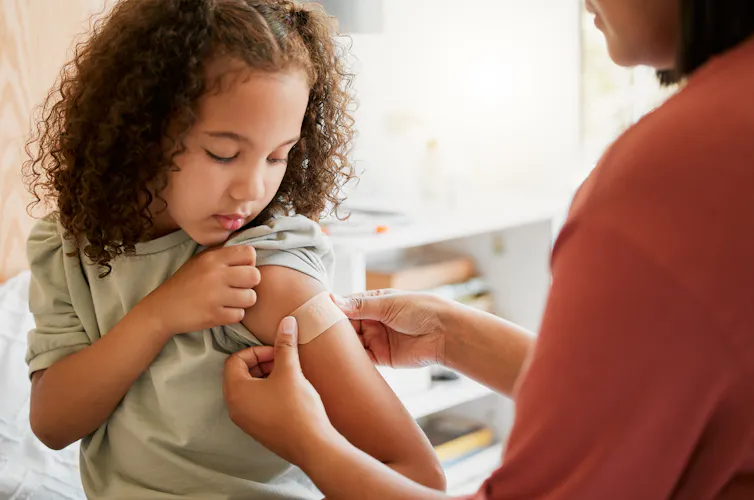
Child vaccination has been a triumph
Thirty years ago, Australiaâs childhood vaccination rates were dismal. Then, in 1997, governments introduced the National Immunisation Program to vaccinate children against diseases such as diphtheria, tetanus, and measles.
Measures to increase coverage included financial incentives for parents and doctors, a public awareness campaign, and collecting and sharing local data to encourage the least-vaccinated regions to catch up with the rest of the country.
What followed was a public health triumph. In 1995, only 52% of one-year-olds were fully immunised. By 2020, Australia had reached 95% coverage for one-year-olds and five-year-olds. At this level, itâs difficult even for highly infectious diseases, such as measles, to spread in the community, protecting both the vaccinated and unvaccinated.

Gaps between regions and communities closed too. In 1999, the Northern Territoryâs vaccination rate for one-year-olds was the lowest in the country, lagging the national average by six percentage points. By 2020, that gap had virtually disappeared.
The difference between vaccination rates for First Nations children and other children also narrowed considerably.
It made children healthier. The years of healthy life lost due to vaccine-preventable diseases for children aged four and younger fell by nearly 40% in the decade to 2015.
Some diseases have even been eliminated in Australia.
Our success is slipping away
But that success is at risk. Since 2020, the share of children who are fully vaccinated has fallen every year. For every child vaccine on the National Immunisation Schedule, protection was lower in 2024 than in 2020.
Gaps between parts of Australia are opening back up. Vaccination rates in the highest-coverage parts of Australia are largely stable, but they are falling quickly in areas with lower vaccination.
In 2018, there were only ten communities where more than 10% of one-year-old children were not fully vaccinated. Last year, that number ballooned to 50 communities. That leaves more areas vulnerable to disease and outbreaks.
While Noosa, the Gold Coast Hinterland and Richmond Valley (near Byron Bay) have persistently had some of the countryâs lowest vaccination rates, areas such as Manjimup in Western Australia and Tasmaniaâs South East Coast have recorded big declines since 2018.
Missing out on vaccination isnât just a problem for children.
One preprint study (which is yet to be peer-reviewed) suggests vaccination during pregnancy may also be declining.
Far too many older Australians are missing out on recommended vaccinations for flu, COVID, pneumococcal and shingles. Vaccination rates in aged care homes for flu and COVID are worryingly low.
Whatâs going wrong?
Australia isnât alone. Since the pandemic, child vaccination rates have fallen in many high-income countries, including New Zealand, the United Kingdom and the United States.
Globally, in 2023, measles cases rose by 20%, and just this year, a measles outbreak in rural Texas has put at least 13 children in hospital.
Alarmingly, some regions in Australia have lower measles vaccination than that Texas county.
The timing of trends here and overseas suggests things shifted, or at least accelerated, during the pandemic. Vaccine hesitancy, fuelled by misinformation about COVID vaccines, is a growing threat.
This year, vaccine sceptic Robert F. Kennedy Jr was appointed to run the US health system, and Louisianaâs top health official has reportedly cancelled the promotion of mass vaccination.
In Australia, a recent survey found 6% of parents didnât think vaccines were safe, and 5% believed they donât work.
Those concerns are far more common among parents with children who are partially vaccinated or unvaccinated. Among the 2% of parents whose children are unvaccinated, almost half believe vaccines are not safe for their child, and four in ten believe vaccines didnât work.
Other consequences of the pandemic were a spike in the cost of living, and a health system struggling to meet demand. More than one in ten parents said cost and difficulty getting an appointment were barriers to vaccinating their children.
Thereâs no single cause of sliding vaccination rates, so thereâs no one solution. The best way to reverse these worrying trends is to work on all the key barriers at once â from a lack of awareness, to inconvenience, to lack of trust.
What governments should do
Governments should step up public health campaigns that counter misinformation, boost awareness of immunisation and its benefits, and communicate effectively to low-vaccination groups. The new Australian Centre for Disease Control should lead the charge.
Primary health networks, the regional bodies responsible for improving primary care, should share data on vaccination rates with GPs and pharmacies. These networks should also help make services more accessible to communities who are missing out, such as migrant groups and disadvantaged families.
State and local governments should do the same, sharing data and providing support to make maternal child health services and school-based vaccination programs accessible for all families.

Governments should also be more ambitious about tackling the growing vaccine divides between different parts of the country. The relevant performance measure in the national vaccination agreement is weak. States must only increase five-year-old vaccination rates in four of the ten areas where it is lowest. That only covers a small fraction of low-vaccination areas, and only the final stage of child vaccination.
Australia needs to set tougher goals, and back them with funding.
Governments should fund tailored interventions in areas with the lowest rates of vaccination. Proven initiatives include training trusted community members as âcommunity championsâ to promote vaccinations, and pop-up clinics or home visits for free vaccinations.
At this time of year, childcare centres and schools are back in full swing. But every year, each new intake has less protection than the previous cohort. Governments are developing a new national vaccination strategy and must seize the opportunity to turn that trend around. If it commits to a bold national plan, Australia can get back to setting records for child vaccination.
Peter Breadon, Program Director, Health and Aged Care, Grattan Institute and Wendy Hu, Associate, Health Program, Grattan Institute
This article is republished from The Conversation under a Creative Commons license. Read the original article.
Don’t Forget…
Did you arrive here from our newsletter? Don’t forget to return to the email to continue learning!

Recommended
Learn to Age Gracefully
Join the 98k+ American women taking control of their health & aging with our 100% free (and fun!) daily emails:
-
Sunflower Seeds vs Sesame Seeds â Which is Healthier?
10almonds is reader-supported. We may, at no cost to you, receive a portion of sales if you purchase a product through a link in this article.
Our Verdict
When comparing sunflower seeds to sesame seeds, we picked the sunflower.
Why?
In moderation, both are very healthy. We say “in moderation” because they’re both about 50% fat and such fats, while vital for life, are generally best enjoyed in small portions. Of that fat, sunflower has the slightly better fat profile; they’re both mostly poly- and monounsaturated fats, but sunflower has 10% saturated fat while sesame has 15%. Aside from fats, sunflower has slightly more protein and sesame has slightly more carbs. While sesame has slightly more fiber, because of the carb profile sunflower still has the lower glycemic index. All in all, a moderate win for sunflower in the macros category.
You may be wondering, with all that discussion of fats, what they’re like for omega-3, and sesame seeds have more omega-3, though sunflower seeds contain it too. Still, a point in sesame’s favor here.
When it comes to vitamins, sunflower has more of vitamins A, B1, B2, B3, B5, B6, B9, C, E, and choline, while sesame is not higher in any vitamins.
In the category of minerals, sunflower has more phosphorus, potassium, and selenium, while sesame has more calcium, copper, iron, and zinc. This is nominally a marginal win for sesame, but it should be noted that sunflower is still very rich in copper, iron, and zinc too (but not calcium).
Adding up the categories makes for a moderate win for sunflower seeds, but as ever, enjoy both; diversity is best!
Want to learn more?
You might like to read:
Sunflower Seeds vs Pumpkin Seeds â Which is Healthier?
Take care!
Share This Post
-
Kombucha vs Kimchi â Which is Healthier
10almonds is reader-supported. We may, at no cost to you, receive a portion of sales if you purchase a product through a link in this article.
Our Verdict
When comparing kombucha to kimchi, we picked the kombucha.
Why?
While both are very respectable gut-healthy fermented products,
â˘â â the kombucha contains fermented tea, a little apple cider vinegar, and a little fiber
â˘â â the kimchi contains (after the vegetables) 810 mg sodium in that little tin, and despite the vegetables, no fiber.You may reasonably be surprised that they managed to take something that is made of mostly vegetables and ended up with no fiber without juicing it, but they did. Fermented vegetables are great for the healthy bacteria benefits (and are tasty too!), but the osmotic pressure due to the salt destroys the cell walls and thus the fiber.
Thus, we chose the kombucha that does the same job without delivering all that salt.
However! If you are comparing kombucha and kimchi out in the wilds of your local supermarket, do still check individual labels. Itâs not uncommon, for example, for stores to sell pre-made kombucha thatâs loaded with sugar.
About sugar and kombuchaâĤ
Sugar is required to make kombucha, to feed the yeast and helpful bacteria. However, there should be none of that sugar left (or only the tiniest trace amount) in the final product, because the yeast (and friends) consumed and metabolized it.
What some store brands do, however, is add in sugar afterwards, as they believe it improves the taste. This writer cannot imagine how, but that is their rationale in any case. Needless to say, it is not a healthy addition, and specifically, itâs bad for your gut, which (healthwise) is the whole point of drinking kombucha in the first place.
Want some? Here is an example product on Amazon, but feel free to shop around as there are many flavors available!
Read more about gut health: Gut Health 101
Share This Post
-
How Psychedelics Repair Brain Myelin!
10almonds is reader-supported. We may, at no cost to you, receive a portion of sales if you purchase a product through a link in this article.
We’ve written before about myelin (the protective sheath that neurons live inâbasically, myelin sheaths do for neurons what telomere caps do for DNA).
Behold: How To Rebuild Your Neuronsâ Myelin Sheaths â this is an article about phosphatidylserine’s role in that process
The health of our myelin is important, because as well as protecting the neurons, the myelin also insulates themâremember that in essence, nerves (made of neurons) are a lot like electrical wires, and they can absolutely be shorted out, misfired, etc, and myelin is a large part of what keeps that from happening (provided everything’s working as it should).
Consequently, demyelination is considered an issue partially responsible for the ill effects of several degenerative diseases, with multiple sclerosis (MS) being high on the list.
So, how do psychedelics help?
Psychedelics, myelin, and you
Regular readers may recall our articles about psychedelics and mental health, such as:
Taking A Trip Through The Evidence On Psychedelics
…and also:
…which has to do with the lasting benefits of a single dose of a psychedelic compound. How lasting, you wonder? Well, there’s nuance to the answer, so you’ll need to read the article for that, but “a surprisingly good while”.
Now, most recently, researchers (Dr. Mehmet BostancÄħklÄħoÄlu et al.) found that psychedelics can support long-term PTSD recovery by promoting myelin repair and (with it) reorganization of brain networks.
Why this matters in PTSD: post-traumatic stress disorder involves not just strongly encoded unpleasant memories, but also disrupted timing and coordination across brain circuits, particularly in memory-related regions like the dentate gyrus of the hippocampus. And that’s “how it gets you”, in terms of the brain not really fully accepting that the Bad Thing⢠is in the past, and that you are safe now, even if intellectually you know these things. It can sound like psychobabble or (more charitably) therapy talk, and in a way it is that latter, but there’s also some very clear neurology going on here, as this study elucidates.
What Dr. BostancÄħklÄħoÄlu and his team found is that low repeated doses of psilocybin and 3,4-methylenedioxymethamphetamine (MDMA) caused changes in oligodendrocytes (the cells that produce myelin) and multi-omic genetic signatures that are consistent with myelin remodeling, which gave the clue that that repairing neuronal insulation (i.e., the myelination) could help stabilize healthier circuit dynamics after psychedelic treatment.
Not liking to leave hypotheses untested, the team did find causation, not just correlation:
- Experimenting on rats, the researchers experimentally damaged myelin, finding that the anxiolytic effects of psilocybin and MDMA disappeared, while improving myelination supported recovery, showing that intact myelin was required for behavioural improvement.
- Next up, they blocked the serotonin 5-HT2A receptors, which prevented both behavioural benefits and myelin-related changes, showing that classic psychedelic receptor pathways are necessary for these structural effects too.
- Lastly, they found that using anisomycin to block fear-memory formation reduced anxiety but did not repair myelin, showing that mere symptom suppression (however potentially beneficial as an end in itself) differs from the true biological recovery that this provides.
In other words, it not only works (which we already somewhat knew, by virtue of studies such as those we talked about in our “Taking A Trip Through The Evidence On Psychedelics” article), but also, we now know how it works too.
Which is useful, because:
- understanding how it works helps us to help it to work better
- understanding how it works will promote more research
- understanding how it works will help improve accessibility*
*because, for example, health insurers find it harder to say no, the more strongly evidence-based a treatment is, and also doctors will be quicker to sign prescriptions for things that are well-understood.
You can read the paper in full, at: MDMA and psilocybin regulate oligodendrocyte-lineage cell numbers and anxiety-like behaviors in a rat model of fear
Want to learn more?
For more comprehensive brain-rebuilding advice, check out:
Building Your Brain At Every Age â for a more multimodal approach, because after all, why rely on just one thing?
And for more on psychedelics specifically, you might like this book we reviewed a little while back:
Psychedelics and Psychotherapy â Edited by Dr. Tim Read & Maria Papaspyrou
Take care!
Share This Post
Related Posts
-
Top 5 Exercises For Hip Mobility
10almonds is reader-supported. We may, at no cost to you, receive a portion of sales if you purchase a product through a link in this article.
Do more with less:
Let’s open things up…
Hip mobility exercises will, by default, be hip-opening exercises. The criteria used by mobility coach Liv Townsend to qualify these top 5 exercises are:
- improves both strength and range of motion
- these are the qualifying characteristics for a mobility exercise; if an exercise improves only one or the other, then it’s just a strength exercise or just a flexibility exercise
- is accessible from almost any starting point
- realistically, rather than “if you can’t do the vertical splits while balancing on one leg, start by doing the vertical splits against the wall” (yes, that’s a real piece of advice this writer saw in the wild one time)
- can be progressively loaded or deepened
- because otherwise we would get very limited benefits from it, so this characteristic is necessary too
- delivers high value by working multiple muscles
- because frankly, we have a lot of muscles, and working them all individually would take a lot longer than most of us have time to commit
With these criteria in mind, here are 5 exercises that do all those things, and do them well:
- Bulgarian split squat: ranks highest for accessibility, progression, strength, and mobility, improving hip extension in your back leg, hip flexion and internal-rotation stability in your front leg, and stretching your glutes, quads, and hip flexors through deep ranges, with balance easily assisted if needed.
- Lateral squat: delivers high value by improving mobility and strength in your glutes, quads, adductors, hamstrings, and ankles, emphasizes inner-thigh mobility and external hip rotation, and progresses with depth or load, but can be less accessible due to common form challenges.
- Single-leg Romanian deadlift: combines hamstring lengthening with strength through your full hinge range, is accessible at any flexibility level, and progresses easily with load, but ranks lower because it mainly targets a single mobility area.
- Squat: develops quad strength and stretches your quads and hip flexors on descent, is broadly accessible and scalable with depth, blocks, or bands, but offers lower overall value because it lacks hip rotation and minimal posterior-chain involvement.
- Shin box: builds strength and flexibility through internal and external hip rotation, strengthens your glutes on the lift, stretches your hip flexors and adductors at the top, and is easily progressed with load, but loses points for accessibility due to required internal rotation and starting-position demands.
For more on all of this, plus visual demonstrations, enjoy:
Click Here If The Embedded Video Doesnât Load Automatically!
Want to learn more?
You might also like:
The Most Underrated Hip Mobility Exercise (Not Stretching)
Take care!
Don’t Forget…
Did you arrive here from our newsletter? Don’t forget to return to the email to continue learning!
Learn to Age Gracefully
Join the 98k+ American women taking control of their health & aging with our 100% free (and fun!) daily emails:
- improves both strength and range of motion
-
Cantaloupe vs Pear â Which is Healthier?
10almonds is reader-supported. We may, at no cost to you, receive a portion of sales if you purchase a product through a link in this article.
Our Verdict
When comparing cantaloupe to pear, we picked the cantaloupe.
Why?
In terms of macros, they’re both mostly water, but pear has 3x the fiber and 2x the carbs, winning the first round.
In the category of vitamins, cantaloupe has a lot more of vitamins A, B1, B3, B5, B6, B7, B9, C, and choline, while pear has slightly more of vitamins B2, E, and K, meaning a clear win for cantaloupe here.
Looking at minerals, cantaloupe has more calcium, iron, magnesium, phosphorus, potassium, selenium, and zinc, while pear has more copper and manganese; another easy win for cantaloupe.
When it comes to polyphenols, neither has anything we know of in quantities worth mentioning. So, a tie here.
Adding up the sections makes for an overall win for pear, but by all means enjoy either or both; diversity is good!
Want to learn more?
You might like:
Things Many People Forget When It Comes To Hydration â including how eating water-rich fruit is often more hydrating than drinking water
Enjoy!
Don’t Forget…
Did you arrive here from our newsletter? Don’t forget to return to the email to continue learning!
Learn to Age Gracefully
Join the 98k+ American women taking control of their health & aging with our 100% free (and fun!) daily emails:
-
Wholesome Threesome Protein Soup
10almonds is reader-supported. We may, at no cost to you, receive a portion of sales if you purchase a product through a link in this article.
This soup has two protein– and fiber-rich pseudo-grains, one real wholegrain, and nutrient-dense cashews for yet even more protein, and all of the above are full of many great vitamins and minerals. All in all, a well-balanced and highly-nutritious light meal!
You will need
- â cup quinoa
- â cup green lentils
- â cup wholegrain rice
- 5 cups low-sodium vegetable stock (ideally you made this yourself from offcuts of vegetables, but failing that, low-sodium stock cubes can be bought in most large supermarkets)
- Âĵ cup cashews
- 1 tbsp dried thyme
- 1 tbsp black pepper, coarse ground
- ½ tsp MSG or 1 tsp low-sodium salt
Optional topping:
- â cup pine nuts
- â cup finely chopped fresh mint leaves
- 2 tbsp coconut oil
Method
(we suggest you read everything at least once before doing anything)
1) Rinse the quinoa, lentils, and rice.
2) Boil 4 cups of the stock and add the grains and seasonings (MSG/salt, pepper, thyme); simmer for about 25 minutes.
3) Blend the cashews with the other cup of vegetable stock, until smooth. Add the cashew mixture to the soup, stirring it in, and allow to simmer for another 5 minutes.
4) Heat the coconut oil in a skillet and add the pine nuts, stirring until they are golden brown.
5) Serve the soup into bowls, adding the mint and pine nuts to each.
Enjoy!
Want to learn more?
For those interested in some of the science of what we have going on today:
- Give Us This Day Our Daily Dozen
- Black Pepperâs Impressive Anti-Cancer Arsenal (And More)
- Why You Should Diversify Your Nuts!
Take care!
Don’t Forget…
Did you arrive here from our newsletter? Don’t forget to return to the email to continue learning!
Learn to Age Gracefully
Join the 98k+ American women taking control of their health & aging with our 100% free (and fun!) daily emails:


