
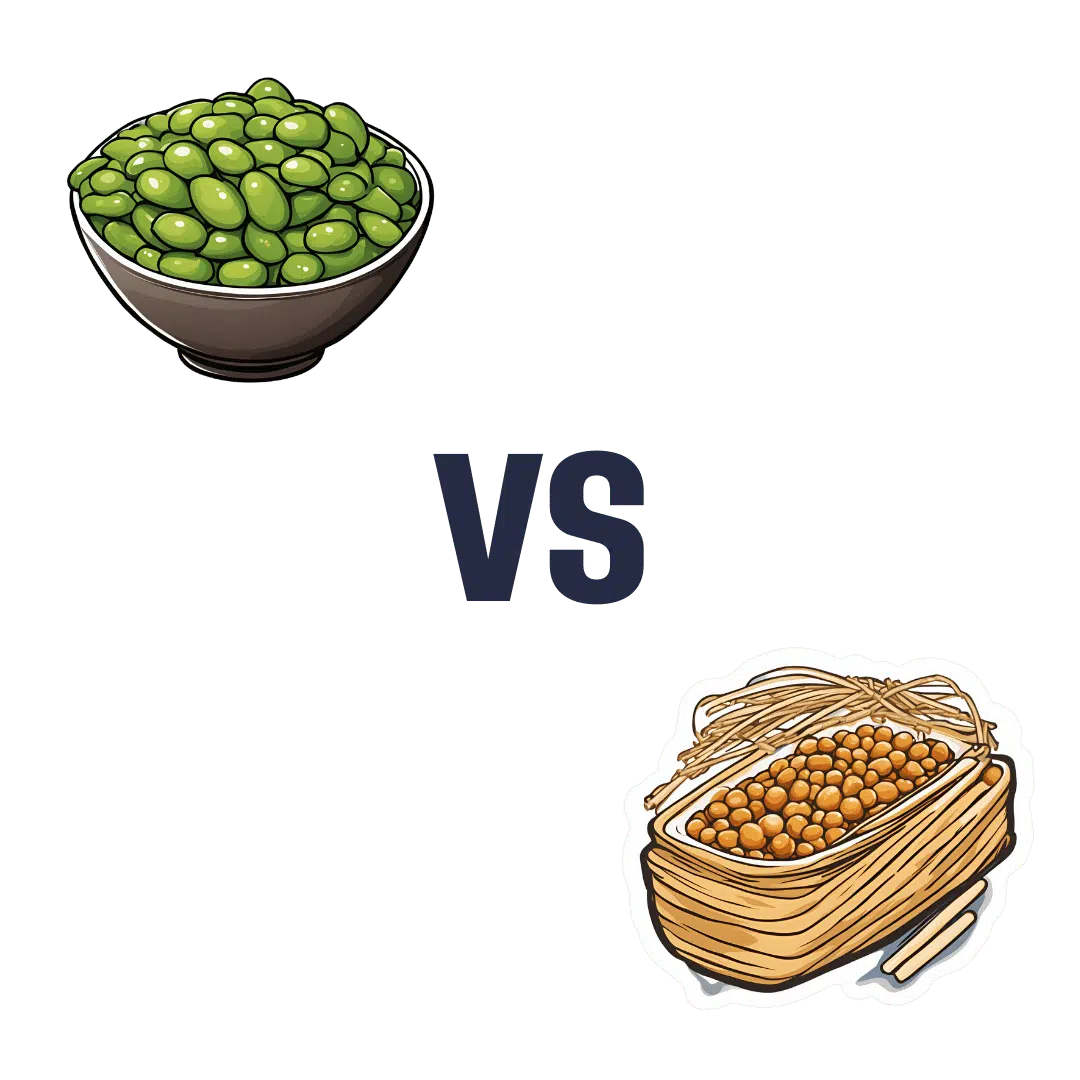
Edamame vs Natto – Which is Healthier?
10almonds is reader-supported. We may, at no cost to you, receive a portion of sales if you purchase a product through a link in this article.
Our Verdict
When comparing edamame to nattō, we picked the nattō.
Why?
Yes, they are both soy beans, but in the battle of young and green vs old and fermented, there are some important differences:
In terms of macros, nattō has nearly 2x the protein for only slightly more carbs, and slightly more fiber, as well as more fat, but it’s not much and it’s a healthy profile, mostly polyunsaturated. All in all, a win for nattō in the macros category.
In the category of vitamins, edamame has more of vitamins B1, B5, B9, E, and K, while nattō has more of vitamins B2, B6, and C, this a 5:3 win for edamame in this round.
When it comes to minerals, edamame is not higher in any minerals, while nattō has more calcium, copper, iron, magnesium, manganese, phosphorus, potassium, selenium, and zinc. An overwhelming win for nattō.
A word on phytoestrogens: soy in general contains these, including both of these iterations of soy, and/but the human body can’t use plant estrogens as such. What it can do, however, is break them down and use the bits to make human estradiol, if and only if you have ovaries that are present and operational (so, no menopause and/or bilateral ovariectomy). Either way, there’s nothing to set one ahead of the other in this matter in this head-to-head.
As an extra point in nattō’s favor, nattō is, like many fermented foods, extra-good for gut health by bringing a wealth of beneficial bacteria. Edamame is also good for gut health (just by virtue of being an edible plant and containing fiber), but not on the same level as nattō.
Adding up the sections makes a clear win for nattō, but by all means enjoy either or both—diversity is good!
Want to learn more?
You might like:
21% Stronger Bones in a Year at 62? Yes, It’s Possible (No Calcium Supplements Needed!) ← nattō features in the method!
Enjoy!
Don’t Forget…
Did you arrive here from our newsletter? Don’t forget to return to the email to continue learning!
Recommended

Learn to Age Gracefully
Join the 98k+ American women taking control of their health & aging with our 100% free (and fun!) daily emails:
-
Does Eating Shellfish Contribute To Gout?
10almonds is reader-supported. We may, at no cost to you, receive a portion of sales if you purchase a product through a link in this article.
It’s Q&A Day at 10almonds!
Have a question or a request? We love to hear from you!
In cases where we’ve already covered something, we might link to what we wrote before, but will always be happy to revisit any of our topics again in the future too—there’s always more to say!
As ever: if the question/request can be answered briefly, we’ll do it here in our Q&A Thursday edition. If not, we’ll make a main feature of it shortly afterwards!
So, no question/request too big or small 😎
❝I have a question about seafood as healthy, doesn’t eating shellfish contribute to gout?❞
It can do! Gout (a kind of inflammatory arthritis characterized by the depositing of uric acid crystals in joints) has many risk factors, and diet is one component, albeit certainly the most talked-about one.
First, you may be wondering: isn’t all arthritis inflammatory? Since arthritis is by definition the inflammation of joints, this is a reasonable question, but when it comes to classifying the kinds, “inflammatory” arthritis is caused by inflammation, while “non-inflammatory” arthritis (a slightly confusing name) merely has inflammation as one of its symptoms (and is caused by physical wear-and-tear). For more information, see:
- Tips For Avoiding/Managing Rheumatoid Arthritis ←inflammatory
- Tips For Avoiding/Managing Osteoarthritis ← “non-inflammatory”
As for gout specifically, top risk factors include:
- Increasing age: risk increases with age
- Being male: women do get gout, but much less often
- Hypertension: all-cause hypertension is the biggest reasonably controllable factor
There’s not a lot we can do about age (but of course, looking after our general health will tend to slow biological aging, and after all, diseases only care about the state of our body, not what the date on the calendar is).
As for sex, this risk factor is hormones, and specifically has to do with estrogen and testosterone’s very different effects on the immune system (bearing in mind that chronic inflammation is a disorder of the immune system). However, few if any men would take up feminizing hormone therapy just to lower their gout risk!
That leaves hypertension, which happily is something that we can all (barring extreme personal circumstances) do quite a bit about. Here’s a good starting point:
Hypertension: Factors Far More Relevant Than Salt
…and for further pointers:
How To Lower Your Blood Pressure (Cardiologists Explain)
As for diet specifically (and yes, shellfish):
The largest study into this (and thus, one of the top ones cited in a lot of other literature) looked at 47,150 men with no history of gout at the baseline.
So, with the caveat that their findings could have been different for women, they found:
- Eating meat in general increased gout risk
- Narrowing down specific meats: beef, pork, and lamb were the worst offenders
- Eating seafood in general increased gout risk
- Narrowing down specific seafoods: all seafoods increased gout risk within a similar range
- As a specific quirk of seafoods: the risk was increased if the man had a BMI under 25
- Eating dairy in general was not associated with an increased risk of gout
- Narrowing down specific dairy foods: low-fat dairy products such as yogurt were associated with a decreased risk of gout
- Eating purine-rich vegetables in general was not associated with an increased risk of gout
- Narrowing down to specific purine-rich vegetables: no purine-rich vegetable was associated with an increase in the risk of gout
Dairy products were included in the study, as dairy products in general and non-fermented dairy products in particular are often associated with increased inflammation. However, the association was simply not found to exist when it came to gout risk.
Purine-rich vegetables were included in the study, as animal products highest in purines have typically been found to have the worst effect on gout. However, the association was simply not found to exist when it came to plants with purines.
You can read the full study here:
Purine-Rich Foods, Dairy and Protein Intake, and the Risk of Gout in Men
So, the short answer to your question of “doesn’t eating shellfish contribute to the risk of gout” is:
Yes, it can, but occasional consumption probably won’t result in gout unless you have other risk factors going against you.
If you’re a slim male 80-year-old alcoholic smoker with hypertension, then definitely do consider skipping the lobster, but honestly, there may be bigger issues to tackle there.
And similarly, obviously skip it if you have a shellfish allergy, and if you’re vegan or vegetarian or abstain from shellfish for religious reasons, then you can certainly live very healthily without ever having any.
See also: Do We Need Animal Products, To Be Healthy?
For most people most of the time, a moderate consumption of seafood, including shellfish if you so desire, is considered healthy.
As ever, do speak with your own doctor to know for sure, as your individual case may vary.
For reference, this question was surely prompted by the article:
Lobster vs Crab – Which is Healthier?
Take care!
Share This Post
-
An apple cider vinegar drink a day? New study shows it might help weight loss
10almonds is reader-supported. We may, at no cost to you, receive a portion of sales if you purchase a product through a link in this article.
Made from fermented apples and naturally high in acetic acid, apple cider vinegar has been popular in recent years for its purported health benefits – from antibacterial properties to antioxidant effects and potential for helping manage blood sugars.
Its origins as a health tonic stretch much further back. Hippocrates used it to treat wounds, fever and skin sores.
An experimental study, released today, looks into whether apple cider vinegar could be effective for weight loss, reduce blood glucose levels and reduce blood lipids (cholesterol and triglycerides).
The results suggest it could reduce all three – but it might not be as simple as downing an apple cider vinegar drink a day.
What did they do?
A group of scientists in Lebanon did a double-blinded, randomised, clinical trial in a group of overweight and obese young people aged from 12–25 years.
Researchers randomly placed 30 participants in one of four groups. The participants were instructed to consume either 5, 10 or 15ml of apple cider vinegar diluted into 250ml of water each morning before they ate anything for 12 weeks. A control group consumed an inactive drink (a placebo) made (from lactic acid added to water) to look and taste the same.
Typically this sort of study provides high quality evidence as it can show cause and effect – that is the intervention (apple cider vinegar in this case) leads to a certain outcome. The study was also double-blinded, which means neither the participants or the scientists involved with collecting the data knew who was in which group.
So, what did they find?
After a period of three months apple cider vinegar consumption was linked with significant falls in body weight and body mass index (BMI). On average, those who drank apple cider vinegar during that period lost 6–8kg in weight and reduced their BMI by 2.7–3 points, depending on the dose. They also showed significant decreases in the waist and hip circumference.
The authors also report significant decreases in levels of blood glucose, triglycerides, and cholesterol in the apple cider groups. This finding echoes previous studies. The placebo group, who were given water with lactic acid, had much smaller decreases in weight and BMI. There were also no significant decreases in blood glucose and blood lipids.
From animal studies, it is thought the acetic acid in apple cider vinegar may affect the expression of genes involved in burning fats for energy. The new study did not explore whether this mechanism was involved in any weight loss.
Is this good news?
While the study appears promising, there are also reasons for caution.
Firstly, study participants were aged from 12 to 25, so we can’t say whether the results could apply to everyone.
The statistical methods used in the study don’t allow us to confidently say the same amount of weight loss would occur again if the study was done again.
And while the researchers kept records of the participants’ diet and exercise during the study, these were not published in the paper. This makes it difficult to determine if diet or exercise may have had an impact. We don’t know whether participants changed the amount they ate or the types of food they ate, or whether they changed their exercise levels.
The study used a placebo which they tried to make identical in appearance and taste to the active treatment. But people may still be able to determine differences. Researchers may ask participants at the end of a study to guess which group they were in to test the integrity of the placebo. Unfortunately this was not done in this study, so we can’t be certain if the participants knew or not.
Finally, the authors do not report whether anyone dropped out of the study. This could be important and influence results if people who did not lose weight quit due to lack of motivation.
Is that you mother? The enzymes in apple cider vinegar might be health-giving.
ShutterstockAny other concerns?
Apple cider vinegar is acidic and there are concerns it may erode tooth enamel. This can be a problem with any acidic beverages, including fizzy drinks, lemon water and orange juice.
To minimise the risk of acid erosion some dentists recommend the following after drinking acidic drinks:
- rinsing out your mouth with tap water afterwards
- chewing sugar-free gum afterwards to stimulate saliva production
- avoiding brushing your teeth immediately after drinking because it might damage the teeth’s softened top layer
- drink with a straw to minimise contact with the teeth.
Rinsing with water could prevent acid damaging your teeth.
ShutterstockDown the hatch?
This study provides us with some evidence of a link between apple cider vinegar and weight loss. But before health professionals can recommend this as a weight loss strategy we need bigger and better conducted studies across a wider age range.
Such research would need to be done alongside a controlled background diet and exercise across all the participants. This would provide more robust evidence that apple cider vinegar could be a useful aid for weight loss.
Still, if you don’t mind the taste of apple cider vinegar then you could try drinking some for weight loss, alongside a healthy balanced and varied dietary intake. This study does not suggest people can eat whatever they like and drink apple cider vinegar as a way to control weight.
Evangeline Mantzioris, Program Director of Nutrition and Food Sciences, Accredited Practising Dietitian, University of South Australia
This article is republished from The Conversation under a Creative Commons license. Read the original article.
Share This Post
-
A Very Cheap Way To Slow Biological Aging
10almonds is reader-supported. We may, at no cost to you, receive a portion of sales if you purchase a product through a link in this article.
“Multivitamins and minerals are good for longevity” is an interesting one as a topic, because:
- On the one hand, that is already popularly assumed
- On the other hand, multivitamins and minerals are equally popularly much-derided as a waste of money
And indeed, they have their limitations, and yes, it’s still better to get everything from one’s diet.
Warning: do not, however, fall into the trap that many do, and think “I don’t need to take supplements because it’s better to get it from my diet” and then not, in fact, get a full coverage from your diet
So, for whatever reason you might choose to take a multivitamin and mineral, let’s take a look at…
Cause and effect
Researchers (Dr. Sidong Li et al.) found that taking a daily multivitamin for two years slowed biological aging by the equivalent of about four months.
So, that’s basically as if every time you went forwards 6 years, you went back 1 year.
Compared to what, you ask?
Good question, because if it’s “compared to not taking it”, and if it’s an observational study, then there can be all kinds of confounding factors, most of them rooted in the theme “people who do thing 1 for their health are more likely to also do things 2, 3, 4, and 5 for their health”.
The answer, happily, is: “compared to placebo”. It was a randomized controlled trial.
Next up, some may be wondering what “biological age” is. In fact, biological age is not one thing but quite a lot of things, each of which can age at different rates.
See for example: Age & Aging: What Can (And Can’t) We Do About It?
One of the best ways to try to boil it down to a composite figure, however, is to look at epigenetic clocks.
First let’s quickly cover the question of: what does “epigenetic” mean? In few words and put simply, epigenetics is the study of “around genetics”, i.e. the things that are not the genes themselves, but modulate how (and indeed, whether or not) genes are expressed.
In this case, Dr. Li and her team used epigenetic clocks that estimate biological age based on patterns of DNA methylation, which influence gene expression and naturally change with age. The quicker the progression of the clock, the faster the aging.
The analysis included DNA methylation data from blood samples of 958 healthy participants with an average chronological age of 70 who were randomized to receive combinations of cocoa extract, multivitamins & minerals, or placebo.
- Good news: participants taking a multivitamin enjoyed slowing across all five epigenetic aging clocks tested, with strongest effects in the two clocks most strongly linked to mortality risk.
- Bad news: the cocoa extract supplement was a bit of a flop. Didn’t help. Or rather, it had no effect whatsoever on the 5 epigenetic clocks tested.
The reason why she tested cocoa extract for this, is because of: Cocoa vs Biological Aging!
…in which Dr. Li (yes, the same Dr. Li) and her team (mostly the same team, but not entirely the same) found that daily cocoa extract reduced hsCRP (a key inflammation marker tied to heart disease) by about 8.4% per year compared with placebo, suggesting anti-inflammatory and cardio-protective effects, and also noted that this cocoa extract supplementation reduced cardiovascular mortality by 27%.
Which is relevant, because epigenetic clocks and inflammatory markers are two out of three of: The 3 Best Predictors Of How Well You’ll Age
If you’d like to read Dr. Li’s latest work, you can find it here: Effects of daily multivitamin–multimineral and cocoa extract supplementation on epigenetic aging clocks in the COSMOS randomized clinical trial ← published literally today, at time of writing this article. Never let it be said we don’t bring you cutting edge health science news!
Want to learn more?
You might like this book we reviewed a while back
Eat Your Vitamins – by Mascha Davis, RDN ← This book methodically discusses an assortment of vitamins, minerals, and other nutrients; the “other nutrients” category including amino acids (branched chain and essential), prebiotics and probiotics, and triglycerides of various kinds.
Enjoy!
Share This Post
Related Posts
-
Radical Longevity – by Dr. Ann Gittleman
10almonds is reader-supported. We may, at no cost to you, receive a portion of sales if you purchase a product through a link in this article.
Dr. Gittleman takes a comprehensive approach, advising us about avoiding AGEs, freeing up fascia, stimulating cellular rejuvenation, the mind-gut connection, keeping the immune system healthy, and more.
The “plan” promised by the subtitle involves identifying the key factors of nutrition and lifestyle most impactful to you, and adjusting them accordingly, in a multistep, author-walks-the-reader-by-the-hand process.
There’s also, for those who prefer it, a large section (seven chapters) on a body part/system by body part/system approach, e.g. brain health, heart health, revitalizing skin, reversing hair loss, repairing bones, muscles, joints, etc.
The writing style is quite casual,butalso with a mind to education, with its call-out boxes, bullet-point summaries, and so forth. There is a “select references” section, but if one wants to find studies, it’s often necessary to go looking, as there aren’t inline citations.
Bottom line: we’d love to see better referencing, but otherwise this is a top-tier anti-aging book, and a lot more accessible than most, without skimping on depth and breadth.
Click here to check out Radical Longevity, and get rejuvenating radically!
Don’t Forget…
Did you arrive here from our newsletter? Don’t forget to return to the email to continue learning!
Learn to Age Gracefully
Join the 98k+ American women taking control of their health & aging with our 100% free (and fun!) daily emails:
-
Avocado vs Dates – Which is Healthier?
10almonds is reader-supported. We may, at no cost to you, receive a portion of sales if you purchase a product through a link in this article.
Our Verdict
When comparing avocado to dates, we picked the avocado.
Why?
Both have their strong merits!
In terms of macros, avocado has slightly more fiber, a lot more fat (famously, healthy fats, including omega-3 fatty acids), while dates have a lot more carbs, making avocado the more nationally-dense in the macros category.
In the category of vitamins, avocados have more of vitamins A, B1, B2, B3, B5, B6, B7, B9, C, E, and K, winning completely in this round, as dates are not higher in any vitamins.
Looking at minerals, however, avocados have more zinc, while dates have a lot more calcium, copper, iron, magnesium, manganese, phosphorus, potassium, and selenium, winning this round easily.
Adding up the sections makes for a clear overall win for avocados, but do enjoy either or both, as diversity is good!
Want to learn more?
You might like:
What Omega-3 Fatty Acids Really Do For Us
Enjoy!
Don’t Forget…
Did you arrive here from our newsletter? Don’t forget to return to the email to continue learning!
Learn to Age Gracefully
Join the 98k+ American women taking control of their health & aging with our 100% free (and fun!) daily emails:
-
Seeing the same midwife or doctor in pregnancy and labour reduces the risk of birth trauma
10almonds is reader-supported. We may, at no cost to you, receive a portion of sales if you purchase a product through a link in this article.
Every pregnant woman wants to deliver a healthy baby. During labour and birth, women also want to feel listened to and respected, and to come out of the experience physically and emotionally well.
But around 28% of Australian women describe their most recent birth as traumatic.
Birth trauma can include fear for their life or their baby’s life, a loss of control, damage to the perineum or pelvic floor, disrespectful care, or mistreatment from health care providers.
Our new research paper examined birth outcomes and both physical and psychological experiences of women and babies who experienced five different types (or models) of care in Australia during the COVID pandemic.
We found that seeing the same midwife or team of midwives was associated with lower rates of intervention and birth trauma, compared with standard care.
And for some women, private obstetric care also led to lower rates of birth trauma than standard care in the public system. Let’s take a look.
Fly View Productions/Getty Images Five main models of care
Most Australian women receive standard public care or GP shared care.
In standard public care, women see rotating hospital staff (midwives, obstetricians and at times, trainees) throughout pregnancy and often give birth with a midwife or doctor they’ve never met.
GP shared care is when there is an arrangement between a GP and hospital. Women see their GP most during pregnancy and hospital staff for some antenatal appointments. The GP doesn’t usually attend the birth, except in some rural, remote regions.
In continuity of care models, one or a small number of midwives and obstetricians deliver the majority of the care before, during and after birth. This includes continuity of:
- midwifery care in the public system
- private obstetric care
- private midwifery care.
When given a choice, women favour continuity of care models.
What our study found
Our study looked at the experiences of 3,682 Australian women who gave birth in 2020 and 2021.
Compared to women who had standard care, we found that those who had continuity of midwifery care (through the public system or a private midwife) were:
- less likely to be induced or have an oxytocin drip to speed up labour
- much more likely to have a vaginal birth
- more likely to have the midwife visit them at home after the birth
- less likely to have a caesarean section
- less likely to have their baby admitted to special or neonatal intensive care or receive formula in hospital when they had chosen to breastfeed
- half as likely to describe their birth as traumatic.
These differences were seen even after adjusting for differences in the groups that could affect outcomes, such as women’s age, medical risk, education, employment status, country of birth, income and mental health.
These findings line up with decades of evidence. A 2024 Cochrane review of 17 randomised controlled trials found midwifery continuity of care models reduce some birth interventions, including caesarean section, forceps and vacuum birth, and episiotomy (surgical cut to the perineum).
Our study also found that while women who had private obstetric care had higher rates of birth intervention, they had lower rates of birth trauma when compared to standard care. There was no difference in outcomes for the baby, such as admission to special care or neonatal intensive care.
This suggests when women’s choices align with their care provider’s philosophy, outcomes are better – even if intervention levels are higher. Some women seek, or are not concerned about, increased obstetric intervention. Continuity itself, regardless of who the lead health care professional is, reduces birth trauma.
What are the study’s limitations?
As with any study there are limitations. This study relied on women reporting their labour and birth outcomes, so there could be difficulties with recall that affected reporting of some health risks and other important information.
A high proportion of women responding (86%) were born in Australia and spoke English at home (92%) and only 2% were Aboriginal or Torres Strait Islander, meaning the diversity of the Australian population is not represented.
We did not examine stillbirth or neonatal deaths as all the women responding to the survey had a live baby. So people still could have had those experiences but they weren’t captured in our data.
Why does continuity of care make a difference?
Continuity gives women a stable, familiar guide who knows their story, understands their concerns and advocates for them when the system is under strain.
It also allows for the kind of personalised care women consistently say they want and which midwives wish they could deliver more often.
Nearly half of all models of care (49%) have a midwife as the designated carer, with 16% having midwifery continuity of care throughout the maternity period.
However, midwifery continuity of care models are more common in urban centres and can be harder to access in rural and remote areas. Even in urban centres, not everyone who wants to access them can. The popularity of these programs means they fill up fast and many women miss out if they don’t book in when they are first pregnant.
Private obstetric and private midwifery models of care come with out of pocket costs and are not available everywhere. There are few private midwives and many struggle to get admitting rights into hospitals like doctors have.
The recent New South Wales Birth Trauma Inquiry recommended expanding continuity of care models to help reduce the high rates of birth trauma in Australia. Our study shows that this could make a significant difference.
Hannah Dahlen, Professor of Midwifery, Associate Dean Research and HDR, Midwifery Discipline Leader, Western Sydney University; Hazel Keedle, Associate Professor of Midwifery, Western Sydney University, and Kingsley Emwinyore Agho, Professor of Biostatistics and Global Health, Western Sydney University
This article is republished from The Conversation under a Creative Commons license. Read the original article.
Don’t Forget…
Did you arrive here from our newsletter? Don’t forget to return to the email to continue learning!
Learn to Age Gracefully
Join the 98k+ American women taking control of their health & aging with our 100% free (and fun!) daily emails:


