
Early exposure to air pollution could affect brain development and mental health later in life
10almonds is reader-supported. We may, at no cost to you, receive a portion of sales if you purchase a product through a link in this article.
Exposure to air pollution in early life could have lasting effects on child development and mental health in adolescence, according to our recent study.
We integrated air pollution data with existing longitudinal data from the Christchurch Health and Development Study (CHDS). The CHDS has followed more than 1,200 children born in the city in 1977, with a strong focus on developmental and mental health outcomes.
Our aim was to examine how exposure to air pollution shapes development and mental health in later childhood and adolescence. We found an increased risk of attention problems, conduct issues, lower educational attainment and substance abuse in adolescence associated with higher exposure.
Existing evidence often focuses on adulthood. However, by tracking air pollution exposure from the prenatal period to the age of ten, and linking this data to subsequent cognitive and mental health outcomes, we were able to highlight the long-term consequences of growing up in polluted environments.
Air pollution is one of the leading environmental contributors to disease, especially respiratory and cardiovascular conditions. Children are especially vulnerable to air pollution because their brains and bodies are developing.
A growing body of evidence suggests air pollution could affect brain development, educational attainment and mental health, contributing to depression, anxiety and conduct or attention problems. Despite this, few studies have tracked long-term exposure to air pollution from early childhood.

Patterns of exposure
We chose to conduct this research in Christchurch because the city is a historical air-pollution hotspot, with a documented history of measurements, and because of its long-running birth cohort study.
The CHDS collects detailed information on participants’ health, development, education and family backgrounds from prenatal into adulthood.

For this study, we linked historical air-pollution data, measured as the concentration of black smoke from 1977 to 1987, to residential locations of birth cohort members. This allowed researchers to estimate each child’s annual exposure to air pollution during key developmental periods.
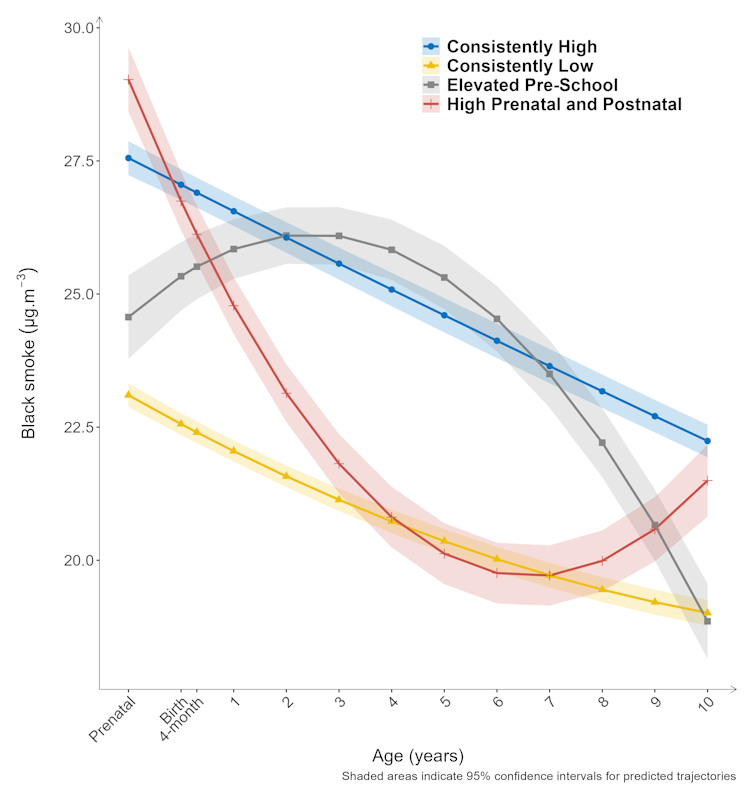
We found four distinct patterns of air-pollution exposure across childhood (see graph below):
- consistently low (these children had the lowest levels of air pollution throughout childhood)
- consistently high (this groups had the highest levels of air pollution from birth to the age of ten)
- elevated preschool (exposure peaked between ages three to six and then declined)
- high prenatal and postnatal (high exposure before and immediately after birth, but declining later).
We then examined whether children in the higher exposure groups were more likely to experience adverse impacts on cognition, educational achievement and mental health in later childhood and adolescence.
We adjusted for a range potential confounders such as socioeconomic status, neighbourhood disadvantage and parental characteristics.
We found children with elevated pre-school exposure had poorer educational attainment and a higher likelihood of conduct disorders and substance abuse problems. High prenatal and postnatal exposure was linked to a greater risk of attention problems as well as substance abuse in adolescence.
Children with persistently high air-pollution exposure were more likely to develop attention problems and had higher odds of substance abuse issues in adolescence.
What these findings mean
The effects of air pollution on several outcomes were small at an individual level, but they could be highly important at a population level.
This is because even small shifts in cognitive and mental health outcomes, when applied to entire populations of children exposed to poor air quality, could have major consequences affecting future educational achievement, workforce productivity and public health burdens.
These findings support previous research suggesting air pollution could affect brain function by causing inflammation, oxidative stress and affecting neurodevelopmental pathways. Importantly, they reinforce the idea that certain developmental periods, such as the prenatal period and early childhood, may be especially sensitive to pollution exposure.
We need further research to confirm our findings but potential considerations include reducing children’s exposure to air pollution and improving urban air quality by cutting emissions from vehicles, industry and residential heating.
We should also promote cleaner energy sources to decrease exposure to harmful pollutants such as nitrogen dioxide and fine particulate matter. Providing better access to green spaces may mitigate the impact of air pollution.
To strengthen public health and policy measures, we need stricter air quality regulations, particularly around schools and childcare centres. We should also implement air-quality monitoring in urban areas to identify high-risk zones for children.
Better public information is crucial to minimise indoor and outdoor pollution exposure. This could include the use of air purifiers for indoor activies or limiting outdoor exposure during peak pollution periods.
Further research and action
Our study highlights the need for more research on air pollution’s effects on children’s mental health and cognition, particularly in different environmental and socioeconomic contexts.
Policymakers, educators and healthcare professionals must consider air pollution as a potential risk factor for developmental challenges, not just a physical health concern.
Air pollution may not be visible in the same way as poor housing or inaccessible healthcare, but its impact on child development could be important at a population level.
Given the rising prevalence of mental ill health in young people and adults, tackling air pollution could be an overlooked but essential public health strategy for protecting future generations.
Matthew Hobbs, Associate Professor and Transforming Lives Fellow in Spatial Data Science and Planetary Health, Sheffield Hallam University; Joseph Boden, Professor of Psychology, Director of the Christchurch Health and Development Study, University of Otago; Lianne Jane Woodward, Professor of Child Developmental Psychology, University of Canterbury, and Susie (Bingyu) Deng, Postdoctoral Research Associate in Health Sciences, University of Liverpool
This article is republished from The Conversation under a Creative Commons license. Read the original article.
Don’t Forget…
Did you arrive here from our newsletter? Don’t forget to return to the email to continue learning!

Recommended
Learn to Age Gracefully
Join the 98k+ American women taking control of their health & aging with our 100% free (and fun!) daily emails:
-
Pineapple vs Strawberries – Which is Healthier?
10almonds is reader-supported. We may, at no cost to you, receive a portion of sales if you purchase a product through a link in this article.
Our Verdict
When comparing pineapple to strawberries, we picked the pineapple.
Why?
It was close, and both have their strong merits!
In terms of macros, pineapple has more carbs (while still having a low glycemic index), and they’re about equal on everything else, making pineapple the “more food per food” option here. So we could call this a small first-round win for pineapple.
In the category of vitamins, pineapple has more of vitamins A, B1, B2, B3, B5, B6, and B7, while strawberries have more of vitamins E and K, yielding a 7:2 win to pineapple here.
Looking at minerals, pineapple has more copper and manganese, while strawberries have more phosphorus and selenium, for a 2:2 tie in this round.
In other considerations, pineapple has bromelain, which is unique to it and has many beneficial properties (see the “learn more” section below), while strawberries (like most berries) have a lot more polyphenols. So, we’re calling this round a tie.
Adding up the sections makes for an overall win for pineapple, but strawberries are great too, so by all means enjoy either or both, as diversity is best!
Want to learn more?
You might like:
Enjoy!
Share This Post
-
Blackberries vs Pomegranate – Which is Healthier?
10almonds is reader-supported. We may, at no cost to you, receive a portion of sales if you purchase a product through a link in this article.
Our Verdict
When comparing blackberries to pomegranate, we picked the blackberries.
Why?
Both have their merits! But…
In terms of macros, blackberries have more fiber while pomegranates have more carbs, so that’s a first-round win for blackberries.
In the category of vitamins, blackberries have more of vitamins A, B3, C, E, and K, while pomegranates have more of vitamins B1, B2, B5, B6, and B9, so that’s a 5:5 tie in this round.
Looking at minerals, blackberries have more calcium, copper, iron, magnesium, manganese, and zinc, while pomegranates have more phosphorus, potassium, and selenium, so that’s a 6:3 win for blackberries here.
In other considerations, blackberries are much higher in polyphenols, while pomegranates do have some special health benefits of their own, but (!) they’re mostly found in the peel which most people don’t consume. So we’ll call this round a win for blackberries, as those polyphenols are a lot more accessible than having to dry out pomegranate peel, grind it into a powder, and take it as a supplement (for example as a suspension in water).
Adding up the sections makes for a clear overall win for blackberries, but by all means do enjoy either or both, as diversity is best!
Want to learn more?
You might like:
- Are You Getting The Right Kinds Of Flavonoids? ← blackberries are a great source
- 21 Most Beneficial Polyphenols & What Foods Have Them
- Pomegranate’s Health Gifts Are Mostly In Its Peel ← this is what we were talking about in the “other considerations” section
Enjoy!
Share This Post
-
Injured your ACL? It’s more than just a knee injury
10almonds is reader-supported. We may, at no cost to you, receive a portion of sales if you purchase a product through a link in this article.
It’s an athlete’s worst fear. Hearing a loud “pop” and feeling severe pain are usually the first signs you’ve torn your anterior cruciate ligament, also known as the ACL.
The ACL connects your shin and thigh bones, and is one of the key ligaments that help stabilise your knee joint.
Research suggests ACL injuries are becoming increasingly common across all age groups. Children as young as ten are rupturing their ACLs, with many never regaining their pre-injury strength or ability.
So how do ACL injuries happen? And what makes them so serious?
Paul Kane/Getty Why the ACL matters
The ACL is an indispensable part of your knee joint. Its main job is to keep your knee stable by stopping it from rotating or extending too much. This is especially important if you regularly twist, pivot or land on your knee joint.
ACL injuries are most often a result of the fatigue-failure process. This is the idea that repeatedly using and putting strain on the ACL, without proper training, makes it significantly weaker over time.
Doing specific strength exercises and regular physical activity can help slow this process. But if you don’t do these activities, even minor movements can gradually weaken your ACL.
Importantly, ACL injuries don’t just affect elite athletes. Injury rates are just as high in amateur and community sport, where access to athletic rehabilitation is typically more limited. This means people playing at amateur levels can face longer, more uncertain paths to recovery compared to professional athletes who have a specialist team of medical and performance staff. As a result, many amateur athletes stop playing sport altogether.
Why are ACL injuries so severe?
Unlike many other tissues in the body, the ACL has a very limited capacity to heal. Once torn or damaged, it can’t regenerate in a way that restores its original structure or function.
The ACL is a crucial ligament in the knee joint. blueringmedia/Getty ACL injuries impact the stability of the knee, often causing the joint to “give way”. This leads to physical symptoms such as pain and swelling. But ACL injuries can also damage other parts of the leg including the meniscus, cartilage and other ligaments.
Over time, a person with an ACL injury may develop osteoarthritis, a painful condition where the cartilage in your knee breaks down and causes the bones to rub together. Even with appropriate medical care, one in two people who tear their ACL will have knee osteoarthritis.
The road to recovery
Recovering from an ACL injury can be a long, and at times painful, process that typically lasts between nine and 12 months. Any attempt to speed this up increases the risk of re-injury. And subsequent ACL injuries often have more severe consequences than the initial rupture.
The recovery process starts with diagnosis. This usually involves seeing a medical professional, such as a GP or physiotherapist, in a clinic. They often use MRI imaging to assess the damage to your ligaments and knee joint.
Many people will then have surgery to reconstruct their torn ACL. This requires the surgeon to take a piece of suitable tissue, known as a graft, from another part of the body to put it where the torn ligament was. Using special screws, they then secure the replacement tissue to the bone.
No matter how you treat an ACL injury, rehabilitation is key. An exercise physiologist or physiotherapist can help you rebuild the strength and flexibility of your knee joint through exercises focused on reducing swelling and restoring your range of motion.
Rehabilitation is particularly important if you’re planning to return to sport. As you heal and recover, you’ll go through several phases of exercises. By taking this gradual approach, you’ll be better prepared to perform more high-risk movements, such as pivoting or jumping.
Increasingly, ACL rehabilitation prioritises psychological health. This has given rise to a biopsychosocial approach to recovery, where recovery relies on physical healing as well as a positive mindset. Athletes can use strategies such as goal setting to manage the emotional ups-and-downs of sustaining a serious injury. This approach also recognises how crucial an athlete’s support network, which may include coaches, teammates and family, is to their recovery.
Injuring your ACL can take an immense physical and psychological toll. That’s why getting support from qualified medical professionals, as well as a close social network, is vital.
Daniel Kadlec, Researcher, Athlete Health and Performance, School of Medical and Health Sciences, Edith Cowan University and Caitlin Fox-Harding, Senior Lecturer/Researcher in Exercise and Sports Science, Edith Cowan University
This article is republished from The Conversation under a Creative Commons license. Read the original article.
Share This Post
Related Posts
-
Cranberry juice really can help with UTIs – and reduce reliance on antibiotics
10almonds is reader-supported. We may, at no cost to you, receive a portion of sales if you purchase a product through a link in this article.
Cranberry juice has been used medicinally for centuries. Our new research indicates it should be a normal aspect of urinary tract infection (UTI) management today.
While some benefits of cranberry compounds for the prevention of UTIs have been suspected for some time, it hasn’t been clear whether the benefits from cranberry juice were simply from drinking more fluid, or something in the fruit itself.
For our study, published this week, we combined and collectively assessed 3,091 participants across more than 20 clinical trials.
Our analysis indicates that increasing liquids reduces the rate of UTIs compared with no treatment, but cranberry in liquid form is even better at reducing UTIs and antibiotic use.
Julie Falk/Flickr, CC BY-NC-ND Are UTIs really that bad?
Urinary tract infections affect more than 50% of women and 20% of men in their lifetime.
Most commonly, UTIs are caused from the bug called Escherichia coli (E.coli). This bug lives harmlessly in our intestines, but can cause infection in the urinary tract. This is why, particularly for women, it is recommended people wipe from front to back after using the toilet.
An untreated UTI can move up to the kidneys and cause even more serious illness.
Even when not managing infection, many people are anxious about contracting a UTI. Sexually active women, pregnant women and older women may all be at increased risk.
Why cranberries?
To cause a UTI, the bacteria need to attach to the wall of the urinary bladder. Increasing fluids helps to flush out bacteria before it attaches (or makes its way up into the bladder).
Some beneficial compounds in cranberry, such as proanthocyanidins (also called condensed tannins), prevent the bacteria from attaching to the wall itself.
While there are treatments, over 90% of the bugs that cause UTIs exhibit some form of microbial resistance. This suggests that they are rapidly changing and some cases of UTI might be left untreatable.
The juice of cranberries has long been thought to have infection-fighting properties. duckeesue/Shutterstock What we found
Our analysis showed a 54% lower rate of UTIs from cranberry juice consumption compared to no treatment. This means that significantly fewer participants who regularly consumed cranberry juice (most commonly around 200 millilitres each day) reported having a UTI during the periods assessed in the studies we analysed.
Cranberry juice was also linked to a 49% lower rate of antibiotic use than placebo liquid and a 59% lower rate than no treatment, based on analysis of indirect and direct effects across six studies. The use of cranberry compounds, whether in drinks or tablet form, also reduced the prevalence of symptoms associated with UTIs.
While some studies we included presented conflicts of interest (such as receiving funding from cranberry companies), we took this “high risk of bias” into account when analysing the data.
The study found extra hydration helped but not to the same extent as cranberry juice. Pixelshot/Shutterstock So, when can cranberry juice help?
We found three main benefits of cranberry juice for UTIs.
1. Reduced rates of infections
Increasing fluids (for example, drinking more water) reduced the prevalence of UTIs, and taking cranberry compounds (such as tablets) was also beneficial. But the most benefits were identified from increasing fluids and taking cranberry compounds at the same time, such as with cranberry juice.
2. Reduced use of antibiotics
The data shows cranberry juice lowers the need to use antibiotics by 59%. This was identified as fewer participants in randomised cranberry juice groups required antibiotics.
Increasing fluid intake also helped reduce antibiotic use (by 25%). But this was not as useful as increasing fluids at the same time as using cranberry compounds.
Cranberry compounds alone (such as tablets without associated increases in fluid intake) did not affect antibiotic use.
3. Reducing symptoms
Taking cranberry compounds (in any form, liquid or tablet) reduced the symptoms of UTIs, as measured in the overall data, by more than five times.
Take home advice
While cranberry juice cannot treat a UTI, it can certainly be part of UTI management.
If you suspect that you have a UTI, see your GP as soon as possible.
Christian Moro, Associate Professor of Science & Medicine, Bond University and Charlotte Phelps, Senior Teaching Fellow, Medical Program, Bond University
This article is republished from The Conversation under a Creative Commons license. Read the original article.
Don’t Forget…
Did you arrive here from our newsletter? Don’t forget to return to the email to continue learning!
Learn to Age Gracefully
Join the 98k+ American women taking control of their health & aging with our 100% free (and fun!) daily emails:
-
What Seasonal Allergies Mean For Your Heart
10almonds is reader-supported. We may, at no cost to you, receive a portion of sales if you purchase a product through a link in this article.
Most people associate seasonal allergies with itchy eyes and stuffy noses, but the effects can go a lot deeper.
This is because allergic reactions don’t just affect the respiratory system; they trigger chronic inflammation throughout the body, and in fact:
❝Allergic disease is a systemic and inflammatory condition❞
~ Dr. Rauno Joks, whose work we will cite in a moment
The important thing to understand in terms of heart health, is that chronic* systemic inflammation can contribute to coronary artery disease, where plaque buildup in arteries (bearing in mind, arterial plaque is in large part made of dead immune cells) raises the risk of heart attacks and strokes.
*Yes, a season once or twice per year counts as “chronic”.
A large (n=603,140) study found that allergic rhinitis (hay fever) increased the odds of coronary heart disease by 25% and heart attacks by 20%. Asthma, especially during flare-ups, posed an even greater risk:
Beyond biology
The effects aren’t just biological; allergies can limit physical activity, leading to a sedentary lifestyle that harms heart health.
In other words: if you’re not going outdoors because there’s pollen, and you’re not exercising because you’re exhausted, then the rest of your health is going to take a nose-dive (so to speak) too.
So, one more reason to take it seriously and not just dismiss it as “it’s just allergies, I’ll survive”.
Practical takeaways
Some things we can all do:
- Monitor your risk factors; i.e. keep on top of your heart health metrics, especially blood pressure and cholesterol, as well as any known genetic predisposition to cardiovascular disease.
- Watch out for alternative causes: symptoms like fatigue or shortness of breath may not always be allergies; they could signal asthma, reflux (for example if wheezing), or even heart disease. An allergist is a good first port-of-call, though.
- Be cautious with medications: some decongestants / allergy meds / asthma meds can raise blood pressure and/or interfere with other medications. Your pharmacist is the best person to speak to about this; they know this kind of thing much better than doctors, as a rule. And whenever you get a new medication, it is good practice to make a habit of always reading the information leaflet that comes with it, and/or look it up on a reputable website such as Drugs.com or the the BNF, to learn about what it is, how it works, what the risks are, what its contraindications are, etc.
- Don’t ignore warning signs: lightheadedness or chest pain could indicate a heart issue and should be addressed immediately. It’s better to be wrong and temporarily embarrassed, than wrong and permanently dead. Besides, even if it’s not a heart issue, it may be something else that would benefit from attention, so taking it seriously is always a good idea.
Want to know more?
Check out:
- What Your Mucus Says About Your Health
- Antihistamines’ Generation Gap
- Oh, Honey: The Bee’s Knees? ← what science has to say about “honey will inoculate you against allergies”
Take care!
Don’t Forget…
Did you arrive here from our newsletter? Don’t forget to return to the email to continue learning!
Learn to Age Gracefully
Join the 98k+ American women taking control of their health & aging with our 100% free (and fun!) daily emails:
-
Ear Candling: Is It Safe & Does It Work?
10almonds is reader-supported. We may, at no cost to you, receive a portion of sales if you purchase a product through a link in this article.
Does This Practice Really Hold A Candle To Evidence-Based Medicine?
In Tuesday’s newsletter, we asked you your opinion of ear candling, and got the above-depicted, below-described set of responses:
- Exactly 50% said “Under no circumstances should you put things in your ear and set fire to them”
- About 38% said “It is a safe, drug-free way to keep the ears free from earwax and pathogens”
- About 13% said “Done correctly, thermal-auricular therapy is harmless and potentially beneficial”
This means that if we add the two positive-to-candling answers together, it’s a perfect 50:50 split between “do it” and “don’t do it”.
(Yes, 38%+13%=51%, but that’s because we round to the nearest integer in these reports, and more precisely it was 37.5% and 12.5%)
So, with the vote split, what does the science say?
First, a quick bit of background: nobody seems keen to admit to having invented this. One of the major manufacturers of ear candles refers to them as “Hopi” candles, which the actual Hopi tribe has spent a long time asking them not to do, as it is not and never has been used by the Hopi people. Other proposed origins offered by advocates of ear candling include Traditional Chinese Medicine (not used), Ancient Egypt (no evidence of such whatsoever), and Atlantis:
Quackwatch | Why Ear Candling Is Not A Good Idea
It is a safe, drug-free way to keep the ears free from earwax and pathogens: True or False?
False! In a lot of cases of alternative therapy claims, there’s an absence of evidence that doesn’t necessarily disprove the treatment. In this case, however, it’s not even an open matter; its claims have been actively disproven by experimentation:
- It doesn’t remove earwax; on the contrary, experimentation “showed no removal of cerumen from the external auditory canal. Candle wax was actually deposited in some“
- It doesn’t remove pathogens, and the proposed mechanism of action for removing pathogens, that of the “chimney effect”: the idea that the burning candle creates a vacuum that draws wax out of the ear along with debris and bacteria, simply does not work; on the contrary, “Tympanometric measurements in an ear canal model demonstrated that ear candles do not produce negative pressure”.
- It isn’t safe; on the contrary, “Ear candles have no benefit in the management of cerumen and may result in serious injury”
In a medium-sized survey (n=122), the following injuries were reported:
- 13 x burns
- 7 x occlusion of the ear canal
- 6 x temporary hearing loss
- 3 x otitis externa (this also called “swimmer’s ear”, and is an inflammation of the ear, accompanied by pain and swelling)
- 1 x tympanic membrane perforation
Indeed, authors of one paper concluded:
❝Ear candling appears to be popular and is heavily advertised with claims that could seem scientific to lay people. However, its claimed mechanism of action has not been verified, no positive clinical effect has been reliably recorded, and it is associated with considerable risk.
No evidence suggests that ear candling is an effective treatment for any condition. On this basis, we believe it can do more harm than good and we recommend that GPs discourage its use❞
Source: Canadian Family Physician | Ear Candling
Under no circumstances should you put things in your ear and set fire to them: True or False?
True! It’s generally considered good advice to not put objects in general in your ears.
Inserting flaming objects is a definite no-no. Please leave that for the Cirque du Soleil.
You may be thinking, “but I have done this and suffered no ill effects”, which seems reasonable, but is an example of survivorship bias in action—it doesn’t make the thing in question any safer, it just means you were one of the one of the ones who got away unscathed.
If you’re wondering what to do instead… Ear oils can help with the removal of earwax (if you don’t want to go get it sucked out at a clinic—the industry standard is to use a suction device, which actually does what ear candles claim to do). For information on safely getting rid of earwax, see our previous article:
Take care!
Don’t Forget…
Did you arrive here from our newsletter? Don’t forget to return to the email to continue learning!
Learn to Age Gracefully
Join the 98k+ American women taking control of their health & aging with our 100% free (and fun!) daily emails:


