
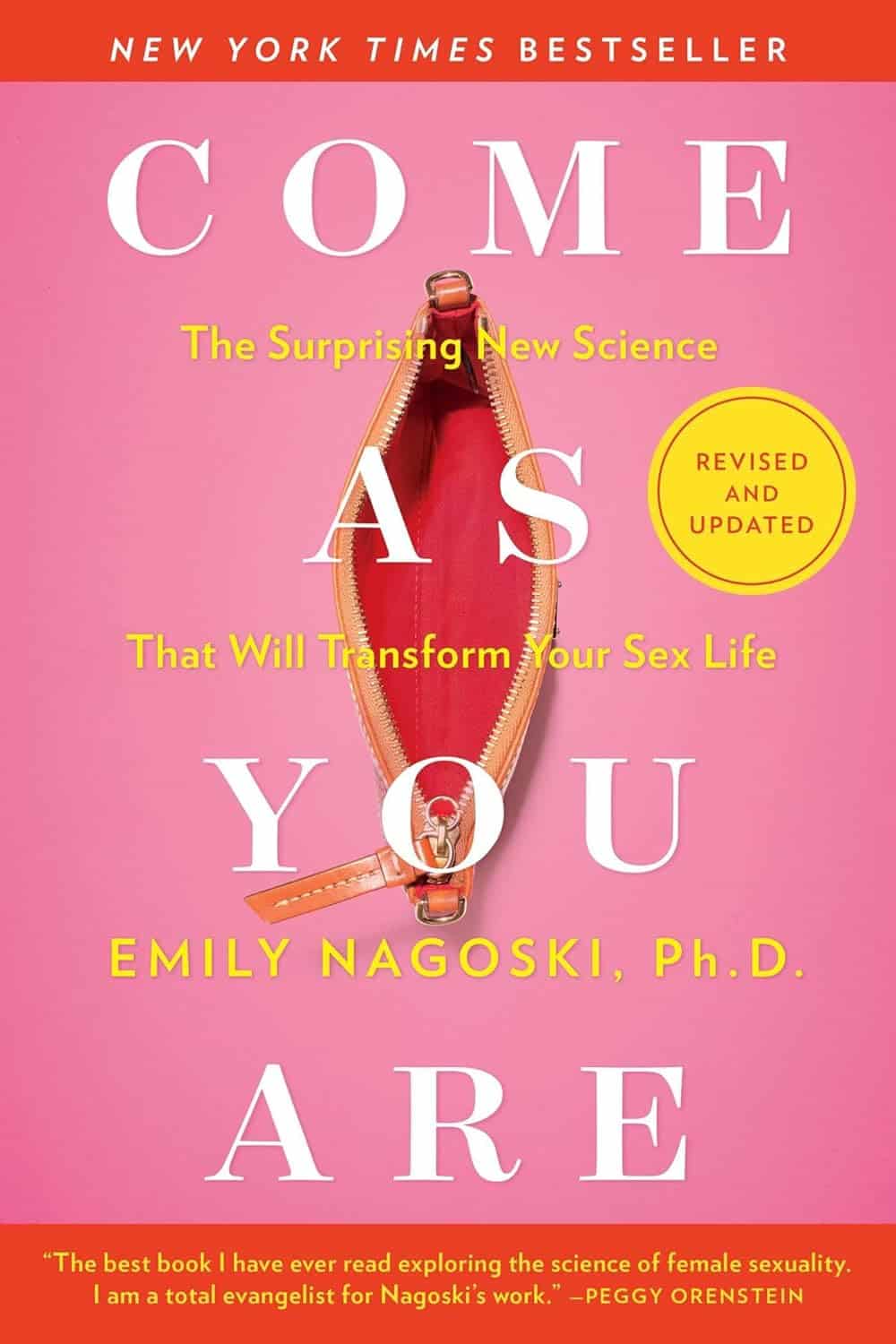
Come As You Are – by Dr. Emily Nagoski
10almonds is reader-supported. We may, at no cost to you, receive a portion of sales if you purchase a product through a link in this article.
We’ve all heard the jokes, things like: Q: “Why is the clitoris like Antarctica?” A: “Most men know it’s there; most don’t give a damn”
But… How much do people, in general, really know about the anatomy and physiology of sexual function? Usually very little, but often without knowing how little we know.
This book looks to change that. Geared to a female audience, but almost everyone will gain useful knowledge from this.
The writing style is very easy-to-read, and there are “tl;dr” summaries for those who prefer to skim for relevant information in this rather sizeable (400 pages) tome.
Yes, that’s “what most people don’t know”. Four. Hundred. Pages.
We recommend reading it. You can thank us later!
Don’t Forget…
Did you arrive here from our newsletter? Don’t forget to return to the email to continue learning!
Recommended
Learn to Age Gracefully
Join the 98k+ American women taking control of their health & aging with our 100% free (and fun!) daily emails:
-
Longevity Uncovered – by Ethan Caldwell
10almonds is reader-supported. We may, at no cost to you, receive a portion of sales if you purchase a product through a link in this article.
This is exactly what the subtitle claims it to be: a modern guide to slowing aging and building sustainable vitality. In other words, increasing healthspan.
The methods at hand are the usual ones: dietary patterns, exercise types, sleep quality and quantity, gut health, stress management, hormones, social connection, purpose, other Blue Zone learnings, supplements, drugs, and an array of tests (to inform us as we go along).
The style is mostly to-the-point and informational; easy-reading, and with a modest bibliography at the back.
Sometimes there is an interesting disconnect, such as for example on the topic of Blue Zone lifestyles, it is asked “Can we adapt their wisdom in a modern life?” as though the Blue Zone supercentenarians are not our contemporaries and aren’t living in the same modern day that we are. It’s a very American “wait, what do you mean Icelanders have access to the Internet, don’t they live in igloos?” energy.
Bottom line: regular 10almonds readers may not learn much (or, possibly, anything) new here, but it is nice to have it all in one book.
Click here to check out Longevity Uncovered, and enjoy an improved healthspan!
Share This Post
-
The Best Way To Take Creatine: Timing, Dosage, & More
10almonds is reader-supported. We may, at no cost to you, receive a portion of sales if you purchase a product through a link in this article.
Creatine is mostly associated with bodybuilding, but its benefits go far beyond that, and also change with age:
Muscle & brain benefits
Creatine offers benefits beyond exercise, such as improving muscle, strength, quickness, memory, and reducing dementia risk. Creatine monohydrate is the most common and effective form; it’s tasteless, inexpensive, and widely available. Get it micronized if you want to to be non-clumping (easier to mix into liquids), but this is only a physical change not a chemical one, and doesn’t affect its effects.
Dr. Hardwick-Smith recommends, as a daily dose:
- If under 120 lbs: start with 2.5g
- If between 120–160 lbs: start with 5g
- If over 160 lbs: consider starting with 10g
Doses up to 30 grams/day have been studied with no harm.
Many people use higher doses for the first week (a “loading period”), but this is not necessary and can cause bloating due to water retention, so she recommends not doing that.
About timing, she says that consistency is key: take it daily at a regular convenient time, such as paired to some time-specific habit, for example one’s morning coffee. Beyond that, she says timing and food intake do not matter—just take it regularly.
For more on all of this in her own words, enjoy:
Click Here If The Embedded Video Doesn’t Load Automatically!
Want to learn more?
You might also like:
Creatine: Very Different For Young & Old People
Take care!
Share This Post
-
How To Stay A Step Ahead Of Peripheral Artery Disease
10almonds is reader-supported. We may, at no cost to you, receive a portion of sales if you purchase a product through a link in this article.
Far less well-known than Coronary Artery Disease, it can still result in loss of life and limb (not in that order). Fortunately, there are ways to be on your guard:
What it is
Peripheral Artery Disease (PAD) is the same thing as Coronary Artery Disease (CAD), just, in the periphery—which by definition means “outside of the heart and brain”, but in practice, it starts with the extremities. And of the extremities, it tends to start with the feet and legs, for the simple reason that if someone’s circulation is sluggish, then because of gravity, that’s where’s going to get blocked first.
In both CAD and PAD, the usual root cause is atherosclerosis, that is to say, the build-up of fatty material inside the arteries, usually commensurate to LDL (“bad”) cholesterol, especially in men (high LDL is still a predictor of cardiovascular disease in women though, just more modestly so, at least pre-menopause or in cases of treated menopause whereby HRT has returned hormones to pre-menopause levels).
See also: Demystifying Cholesterol
And for that about sex differences: His & Hers: The Hidden Complexities of Statins and Cardiovascular Disease (CVD)
Why it is
This one’s straightforward, as it’s the same things as any kind of cardiovascular disease: high blood pressure, high cholesterol, older age, obesity, smoking, drinking, diabetes, and genetic factors (so, a risk factor is: family history of heart disease).
However, while those are the main causes and/or risk factors, it absolutely can still strike other people, so it’s as well to be watch out for…
What to look out for
Many people first notice signs and symptoms that turn out to be PAD when they experience pain or numbness in the foot or feet, and/or a discoloration of the feet (especially toes), and slow wound healing.
At that stage, chances are you will need to go urgently to a specialist, and surgery is a likely necessity. With a little luck, it’ll be a minimally-invasive surgery to unblock an artery; failing that, an amputation will be in order.
At that stage, under 50% will be alive 5 years from diagnosis:
You probably want to avoid those. Good news is, you can, by catching it earlier!
What to look out for before that
The most common test for PAD is one you can do at home, but enlisting a nurse to do it for you will help ensure accurate readings. It’s called the Ankle-Brachial Index (ABI) test, and it involves comparing the blood pressure in your ankle with the blood pressure in your arm, and expressing them as a ratio.
Here’s how to do it (instructions and a video demonstration if you want it):
Do Try This At Home: ABI Test For Clogged Arteries
If you need a blood pressure monitor, by the way, here’s an example product on Amazon.
- A healthy ABI score is between 1.0 and 1.4; anything outside this range may indicate arterial problems.
- Low ABI scores (below 0.8) suggest plaque is likely obstructing blood flow
- High ABI scores (above 1.4) may indicate artery hardening
Do note also that yes, if you have plaque obstructing blood flow and hardened arteries, your scores may cancel out and give you a “healthy” score, despite your arteries being very much not healthy.
For this reason, this test can be used to raise the alarm, but not to give the “all clear”.
There are other tests that clinicians can do for you, but you can’t do at home unless you have an MRI machine, a CT scanner, an x-ray machine, a doppler-and-ultrasound machine, etc. We’ll not go into those in detail here, but ask your doctor about them if you’re concerned.
What to do about it
In the mid-to-late stages of the disease, the options are medication and surgery, respectively, but your doctor will advise about those in that eventuality.
In the early stages of the disease, the first-line recommend treatment is exercise, of which, especially walking:
Lower Extremity Peripheral Artery Disease: Diagnosis and Treatment
Given that this more often happens when someone hasn’t been walking so much, it can be a walk-rest-walk approach at first (a treadmill on a low setting can be very useful for this):
See also: Exercise Comparison Head-to-Head: Treadmill vs Road
Take care!
Share This Post
Related Posts
-
Night School – by Dr. Richard Wiseman
10almonds is reader-supported. We may, at no cost to you, receive a portion of sales if you purchase a product through a link in this article.
Sleep is a largely neglected part of health for most people. Compared to factors like food and exercise, it’s something that experientially we’re mostly not present for! Little wonder then that we also often feel like it’s outside of our control.
While Dr. Wiseman does cover the usual advices with regard to getting good sleep, this book has a lot more than that.
Assuming that they go beyond the above, resources about sleep can usually be divided into one of two categories:
- Hard science: lots about brainwaves, sleep phases, circadian rhythms, melatonin production, etc… But nothing very inspiring!
- Fantastical whimsy: lots about dreams, spiritualism, and not a scientific source to be found… Nothing very concrete!
This book does better.
We get the science and the wonder. When it comes to lucid dreaming, sleep-learning, sleep hypnosis, or a miraculously reduced need for sleep, everything comes with copious scientific sources or not at all. Dr. Wiseman is well-known in his field for brining scientific skepticism to paranormal claims, by the way—so it’s nice to read how he can do this without losing his sense of wonder. Think of him as the Carl Sagan of sleep, perhaps.
Style-wise, the book is pop-science and easy-reading. Unsurprising, for a professional public educator and science-popularizer.
Structurally, the main part of the book is divided into lessons. Each of these come with background science and principles first, then a problem that we might want to solve, then exercises to do, to get the thing we want. It’s at once a textbook and an instruction manual.
Bottom line: this is a very inspiring book with a lot of science. Whether you’re looking to measurably boost your working memory or heal trauma through dreams, this book has everything.
Click here to check out Night School and learn what your brain can do!
Don’t Forget…
Did you arrive here from our newsletter? Don’t forget to return to the email to continue learning!
Learn to Age Gracefully
Join the 98k+ American women taking control of their health & aging with our 100% free (and fun!) daily emails:
-
Bulgarian Split Squats: How To Get The Best Glute Strength & Size
10almonds is reader-supported. We may, at no cost to you, receive a portion of sales if you purchase a product through a link in this article.
Even without considering aesthetics, the glutes are very important muscles (you absolutely cannot have a healthy back and hips without strong glutes).
Bulgarian split squats have a name that makes them sound complicated; they’re actually very simple, but there are mistakes that people make that sabotage their progress.
Professional coach Elisi Wolf explains in this video:
Mistakes most people make
There are quite a few, but bear with us, as they really do come together—and once you understand them, you’ll have it for life;
- Lack of neural pathway establishment: most people skip the step of building a mind-muscle connection before adding weight. Focus on bodyweight movements first until you can feel your glutes working.
- Not focusing on glute contraction: avoid counting reps; it distracts the brain. Don’t use weights too soon, as they can prevent neural pathway development. Focus on time under tension and feeling the glutes before adding resistance.
- Not lowering slowly enough: slow, controlled movements give the brain time to activate the glutes. This increases time under tension and improves neural pathway formation.
- Not wearing knee sleeves: knee sleeves stabilize the joint, allowing the brain to recruit the glutes more efficiently.
- Not leaning over to the working side: staying upright distributes weight to the back leg instead of the glute, whereas leaning over the working side maximizes glute activation.
- Holding two dumbbells instead of one: two dumbbells force your body to stay level, reducing glute activation. Instead, hold a single dumbbell on the opposite side to improve balance and allow for a greater lean. You can even rest it on your thigh if you like; you’re not here for an arm workout, after all, and allowing the body to focus on one task is better.
- Not pushing out the working knee: pushing the knee outward mimics a sprinting motion, engaging the glutes more effectively.
- Allowing the pelvis to tilt down: if the pelvis tilts as you lower, the glutes disengage. Keeping the pelvis level ensures the glute medius stays activated.
For more on all of these plus visual demonstrations, enjoy:
Click Here If The Embedded Video Doesn’t Load Automatically!
Want to learn more?
You might also like:
Strong Curves: A Woman’s Guide to Building a Better Butt and Body – by Bret Contreras & Kellie Davis
Take care!
Don’t Forget…
Did you arrive here from our newsletter? Don’t forget to return to the email to continue learning!
Learn to Age Gracefully
Join the 98k+ American women taking control of their health & aging with our 100% free (and fun!) daily emails:
-
Prolonged Grief: A New Mental Disorder?
10almonds is reader-supported. We may, at no cost to you, receive a portion of sales if you purchase a product through a link in this article.
The issue is not whether certain mental conditions are real—they are. It is how we conceptualize them and what we think treating them requires.
The latest edition of the Diagnostic and Statistical Manual of Mental Disorders (DSM-5) features a new diagnosis: prolonged grief disorder—used for those who, a year after a loss, still remain incapacitated by it. This addition follows more than a decade of debate. Supporters argued that the addition enables clinicians to provide much-needed help to those afflicted by what one might simply consider a too much of grief, whereas opponents insisted that one mustn’t unduly pathologize grief and reject an increasingly medicalized approach to a condition that they considered part of a normal process of dealing with loss—a process which in some simply takes longer than in others.
By including a condition in a professional classification system, we collectively recognize it as real. Recognizing hitherto unnamed conditions can help remove certain kinds of disadvantages. Miranda Fricker emphasizes this in her discussion of what she dubs hermeneutic injustice: a specific sort of epistemic injustice that affects persons in their capacity as knowers1. Creating terms like ‘post-natal depression’ and ‘sexual harassment’, Fricker argues, filled lacunae in the collectively available hermeneutic resources that existed where names for distinctive kinds of social experience should have been. The absence of such resources, Fricker holds, put those who suffered from such experiences at an epistemic disadvantage: they lacked the words to talk about them, understand them, and articulate how they were wronged. Simultaneously, such absences prevented wrong-doers from properly understanding and facing the harm they were inflicting—e.g. those who would ridicule or scold mothers of newborns for not being happier or those who would either actively engage in sexual harassment or (knowingly or not) support the societal structures that helped make it seem as if it was something women just had to put up with.
For Fricker, the hermeneutical disadvantage faced by those who suffer from an as-of-yet ill-understood and largely undiagnosed medical condition is not an epistemic injustice. Those so disadvantaged are not excluded from full participation in hermeneutic practices, or at least not through mechanisms of social coercion that arise due to some structural identity prejudice. They are not, in other words, hermeneutically marginalized, which for Fricker, is an essential characteristic of epistemic injustice. Instead, their situation is simply one of “circumstantial epistemic bad luck”2. Still, Fricker, too, can agree that providing labels for ill-understood conditions is valuable. Naming a condition helps raise awareness of it, makes it discursively available and, thus, a possible object of knowledge and understanding. This, in turn, can enable those afflicted by it to understand their experience and give those who care about them another way of nudging them into seeking help.
Surely, if adding prolonged grief disorder to the DSM-5 were merely a matter of recognizing the condition and of facilitating assistance, nobody should have any qualms with it. However, the addition also turns intense grief into a mental disorder—something for whose treatment insurance companies can be billed. With this, significant forces of interest enter the scene. The DSM-5, recall, is mainly consulted by psychiatrists. In contrast to talk-therapists like psychotherapists or psychoanalysts, psychiatrists constitute a highly medicalized profession, in which symptoms—clustered together as syndromes or disorders—are frequently taken to require drugs to treat them. Adding prolonged grief disorder thus heralds the advent of research into various drug-based grief therapies. Ellen Barry of the New York Times confirms this: “naltrexone, a drug used to help treat addiction,” she reports, “is currently in clinical trials as a form of grief therapy”, and we are likely to see a “competition for approval of medicines by the Food and Drug Administration.”3
Adding diagnoses to the DSM-5 creates financial incentives for players in the pharmaceutical industry to develop drugs advertised as providing relief to those so diagnosed. Surely, for various conditions, providing drug-induced relief from severe symptoms is useful, even necessary to enable patients to return to normal levels of functioning. But while drugs may help suppress feelings associated with intense grief, they cannot remove the grief. If all mental illnesses were brain diseases, they might be removed by adhering to some drug regimen or other. Note, however, that ‘mental illness’ is a metaphor that carries the implicit suggestion that just like physical illnesses, mental afflictions, too, are curable by providing the right kind of physical treatment. Unsurprisingly, this metaphor is embraced by those who stand to massively benefit from what profits they may reap from selling a plethora of drugs to those diagnosed with any of what seems like an ever-increasing number of mental disorders. But metaphors have limits. Lou Marinoff, a proponent of philosophical counselling, puts the point aptly:
Those who are dysfunctional by reason of physical illness entirely beyond their control—such as manic-depressives—are helped by medication. For handling that kind of problem, make your first stop a psychiatrist’s office. But if your problem is about identity or values or ethics, your worst bet is to let someone reify a mental illness and write a prescription. There is no pill that will make you find yourself, achieve your goals, or do the right thing.
Much more could be said about the differences between psychotherapy, psychiatry, and the newcomer in the field: philosophical counselling. Interested readers may benefit from consulting Marinoff’s work. Written in a provocative, sometimes alarmist style, it is both entertaining and—if taken with a substantial grain of salt—frequently insightful. My own view is this: from Fricker’s work, we can extract reasons to side with the proponents of adding prolonged grief disorder to the DSM-5. Creating hermeneutic resources that allow us to help raise awareness, promote understanding, and facilitate assistance is commendable. If the addition achieves that, we should welcome it. And yet, one may indeed worry that practitioners are too eager to move from the recognition of a mental condition to the implementation of therapeutic interventions that are based on the assumption that such afflictions must be understood on the model of physical disease. The issue is not whether certain mental conditions are real—they are. It is how we conceptualize them and what we think treating them requires.
No doubt, grief manifests physically. It is, however, not primarily a physical condition—let alone a brain disease. Grief is a distinctive mental condition. Apart from bouts of sadness, its symptoms typically include the loss of orientation or a sense of meaning. To overcome grief, we must come to terms with who we are or can be without the loved one’s physical presence in our life. We may need to reinvent ourselves, figure out how to be better again and whence to derive a new purpose. What is at stake is our sense of identity, our self-worth, and, ultimately, our happiness. Thinking that such issues are best addressed by popping pills puts us on a dangerous path, leading perhaps towards the kind of dystopian society Aldous Huxley imagined in his 1932 novel Brave New World. It does little to help us understand, let alone address, the moral and broader philosophical issues that trouble the bereaved and that lie at the root not just of prolonged grief but, arguably, of many so-called mental illnesses.
Footnotes:
1 For this and the following, cf. Fricker 2007, chapter 7.
2 Fricker 2007: 152
3 Barry 2022
References:
Barry, E. (2022). “How Long Should It Take to Grieve? Psychiatry Has Come Up With an Answer.” The New York Times, 03/18/2022, URL = https://www.nytimes.com/2022/03/18/health/prolonged-grief-
disorder.html [last access: 04/05/2022])
Fricker, M. (2007). Epistemic Injustice. Power & the Ethics of knowing. Oxford/New York: Oxford University Press.
Huxley, A. (1932). Brave New World. New York: Harper Brothers.
Marinoff, L. (1999). Plato, not Prozac! New York: HarperCollins Publishers.Professor Raja Rosenhagen is currently serving as Assistant Professor of Philosophy, Head of Department, and Associate Dean of Academic Affairs at Ashoka University. He earned his PhD in Philosophy from the University of Pittsburgh and has a broad range of philosophical interests (see here). He wrote this article a) because he was invited to do so and b) because he is currently nurturing a growing interest in philosophical counselling.
This article is republished from OpenAxis under a Creative Commons license. Read the original article.
Don’t Forget…
Did you arrive here from our newsletter? Don’t forget to return to the email to continue learning!
Learn to Age Gracefully
Join the 98k+ American women taking control of their health & aging with our 100% free (and fun!) daily emails:


