
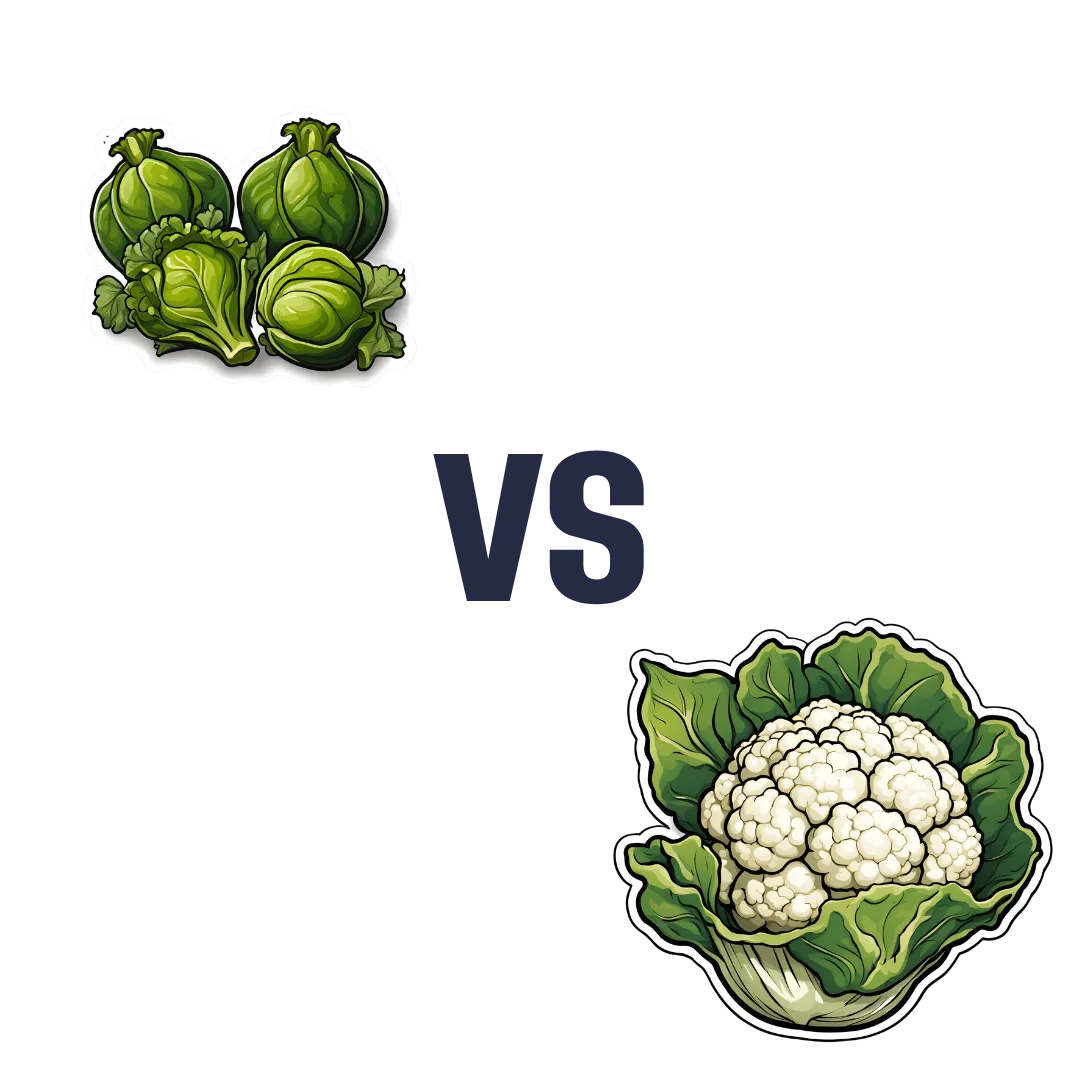
Brussels Sprouts vs Cauliflower – Which is Healthier?
10almonds is reader-supported. We may, at no cost to you, receive a portion of sales if you purchase a product through a link in this article.
Our Verdict
When comparing Brussels sprouts to cauliflower, we picked the sprouts.
Why?
In this comparison of Brassica oleracea vs Brassica oleracea (same species, different cultivar), there’s a clear winner and it’s a simple one today:
In terms of macros, the sprouts have approximately 2x more fiber, carbs, and protein, making them the more nutrient-dense option in the macros category.
In the category of vitamins, the sprouts have more of vitamins A, B1, B2, B3, B6, B7, B9, C, E, and K, while cauliflower has more of vitamin B5 and choline; a clear win for sprouts.
When it comes to minerals, sprouts have more calcium, copper, iron, magnesium, manganese, phosphorus, potassium, selenium, and zinc, while cauliflower is not higher in any mineral. A complete win for sprouts here.
Adding up the sections makes for an easy overall win for Brussels sprouts, but by all means enjoy either or both; diversity is good!
Want to learn more?
You might like:
What Do The Different Kinds Of Fiber Do? 30 Foods That Rank Highest
Enjoy!
Don’t Forget…
Did you arrive here from our newsletter? Don’t forget to return to the email to continue learning!
Recommended
Learn to Age Gracefully
Join the 98k+ American women taking control of their health & aging with our 100% free (and fun!) daily emails:
-
Spinach vs Chard – Which is Healthier?
10almonds is reader-supported. We may, at no cost to you, receive a portion of sales if you purchase a product through a link in this article.
Our Verdict
When comparing spinach to chard, we picked the spinach.
Why?
In terms of macros, spinach has slightly more fiber and protein, while chard has slightly more carbs. Now, those carbs are fine; nobody is getting metabolic disease from eating greens. But, by the numbers, this is a clear, albeit marginal, win for spinach.
In the category of vitamins, spinach has more of vitamins A, B1, B2, B3, B5, B6, B9, E, and K, while chard has more of vitamins C and choline. An even clearer victory for spinach this time.
When it comes to minerals, spinach has more calcium, copper, iron, magnesium, manganese, phosphorus, selenium, and zinc, while chard has more potassium. Once again, a clear win for spinach.
You may be wondering about oxalates, in which spinach is famously high. However, chard is nearly 2x higher in oxalates. In practical terms, this doesn’t mean too much for most people. If you have kidney problems or a family history of such, it is recommended to avoid oxalates. For everyone else, the only downside is that oxalates diminish calcium bioavailability, which is a pity, as spinach is (by the numbers) a good source of calcium.
However, oxalates are broken down by heat, so this means that cooked spinach (lightly steamed is fine; you don’t need to do anything drastic) will be much lower in oxalates (if you have kidney problems, do still check with your doctor/dietician, though).
All in all, spinach beats chard by most metrics, and by a fair margin. Still, enjoy either or both, unless you have kidney problems, in which case maybe go for kale or collard greens instead!
Want to learn more?
You might like to read:
Make Your Vegetables Work Better Nutritionally ← includes a note on breaking down oxalates, and lots of other information besides!
Enjoy!
Share This Post
-
The Science of Self-Learning – by Peter Hollins
10almonds is reader-supported. We may, at no cost to you, receive a portion of sales if you purchase a product through a link in this article.
Teaching oneself new things is often the most difficult kind of bootstrapping, especially when one is unsure of such critical things as:
- Where to begin? How, for that matter, do we find where to begin?
- What can/should a learning journey look like?
- What challenges should we expect, and how will we overcome them?
Hollins answers all of these questions and more. The greatest value of this book is perhaps in its clear presentation of concrete step-by-step instructions. Hollins gives illustrated examples too, but most importantly, he gives models that can be applied to any given type of learning.
The book also covers the most difficult problems most people face when trying to learn something by themselves, including:
- Keeping oneself on-task (maintaining discipline)
- Measuring progress (self-testing beyond memorization)
- Keeping a fair pace of progress (avoiding plateaus)
- How to know when one’s knowledge is sufficient or not (avoiding Dunning-Kruger Club)
All in all, if you’re looking to learn a new subject or skill, this could be a first step that saves you a lot of time later!
Get your copy of the Science of Self-Learning on Amazon today!
Share This Post
-
How Does Alcohol Cause Blackouts?
10almonds is reader-supported. We may, at no cost to you, receive a portion of sales if you purchase a product through a link in this article.
Sometimes people who have never experienced an alcoholic blackout wonder “is it real, or is it just a convenient excuse to avoid responsibility/embarrassment with regard to things done while drunk?”
In 1969 (so, still in the era of incredibly unethical psychological experiments that ranged from the 50s into the 70s), Dr. Donald Goodwin conducted a study in which intoxicated participants were asked to recall an object they had just seen. Most succeeded initially, but half were unable to remember the object just 30 minutes later, demonstrating alcohol-induced memory blackouts.
But, is it any different from regular forgetting? And the answer is: yes, it is indeed different.
The memories that never got stored
Ethanol, the active compound in alcohol, is lipophilic, enabling it to cross the blood-brain barrier and disrupt brain function. It impairs all kinds of things, including decision-making, impulse control, motor skills, and, notably, memory networks—which is what we’re looking at today.
Memory formation (beyond “working memory”, which is the kind that enables you to have an idea of what you were just doing, and carry out simple plans like “pick up this cup, raise it to my mouth, and take a sip”, without forgetting partway through) relies on a process called long-term potentiation (LTP), which strengthens neural connections to store information. Ethanol disrupts this process, preventing memory storage and causing blackouts.
In effect, this means you didn’t just forget a memory; you never stored it in the first place. For this reason, experiences from during an alcoholic blackout cannot be retrieved in the same ways we might retrieve other memories (e.g. in regular forgetting, it’s possible that a context clue jogs our memory and then we remember the experience—because in regular forgetting, the memory was in there; we just didn’t recall it until we were reminded).
Blackouts (in which the memory is never stored in the first place) typically occur when blood alcohol concentration (BAC) exceeds 0.16, while lower levels can result in partial memory loss (brownouts) in which some things may be recalled, but not others. Factors such as dehydration, genetics, medications, food consumption, and age influence the likelihood of complete blackouts.
While alcohol’s residual effects typically subside within a day, repeated over-drinking can cause permanent neuron damage, as well as of course plenty of damage to other organs in the body (especially the liver and gut).
For more on all of this, enjoy:
Click Here If The Embedded Video Doesn’t Load Automatically!
Want to learn more?
You might also like to read:
What Happens To Your Body When You Stop Drinking Alcohol
Take care!
Share This Post
Related Posts
-
What to say and how to help if someone close to you has attempted suicide
10almonds is reader-supported. We may, at no cost to you, receive a portion of sales if you purchase a product through a link in this article.
If someone close to you has attempted suicide, you may be feeling scared, confused or overwhelmed.
You’re not alone – the most recent data shows more than one in three Australians have been close to someone who has died by or attempted suicide.
Talking about suicide can be really hard. But your support can make a big difference. Here’s what you can do to support someone after a suicide attempt.
Adam Pretty/Getty It’s OK not to have all the answers
The days and weeks after a suicide attempt are often full of intense emotion — for the person who attempted and those who care about them.
Your loved one might feel guilt, shame, anger, confusion or relief. They might also be tired, both physically and emotionally. Meanwhile, you might feel worried, shocked, helpless, or unsure about what to say.
All of these feelings are normal. There’s no “right” way to feel in this situation. But staying connected and offering care (even in small ways) is one of the most powerful things you can do.
How you can help: emotional support
It’s OK to acknowledge the suicide attempt – avoiding it can add to feelings of stigma or isolation. But you don’t need to ask for details, and if you feel overwhelmed it’s also OK to set gentle boundaries.
If you’re unsure what to say, you can be honest about that.
Just be there. Let your loved one know you’re there to listen, without pressure or judgement.
Don’t rush the conversation. If they’re not ready to talk, that’s OK. Let them set the pace.
Avoid guilt or blame. Saying things like “how could you do this to us?” can make someone feel worse. Instead, say something like: “I’m really glad you’re still here. I care about you.”
Reassure them. Tell them they’re not alone and that it’s OK to ask for help.
How you can help: practical support
Offer help with everyday tasks, such as going to appointments, making meals or tidying up.
Encourage (but don’t force) activities they enjoy – maybe a walk, a movie, or just hanging out quietly.
If you’re not sure what would help, ask. Try: “What would make today a bit easier for you?”
Try not to take it personally if they seem withdrawn or say “nothing will help”. They may be feeling overwhelmed.
Stay with them, if they’re open to it, or check in later with a text message. Small acts that don’t require a response, such as dropping off a meal, can go a long way.
You don’t have to do this alone
Supporting someone after a suicide attempt can be both physically and emotionally draining. You might find yourself constantly alert, watching for signs they might be struggling again. This “hypervigilance” is normal, but remember – you don’t have to do this alone.
One person is not a support network. While your care and support make a real difference, professional help is essential too, whether from a psychologist, doctor or counsellor.
It can also help to bring in other trusted people, such as siblings, parents, friends or teachers. Ask your loved one who they’d like to involve, and how.
Support works best when shared.
If you’re worried it might happen again
Mental health professionals often help create a safety plan after a suicide attempt.
This is a step-by-step guide for what to do if suicidal thoughts come back. It usually includes information such as warning signs, how to reduce immediate risks, and strategies to use in the moment.
A plan can also involve personal motivations to keep going and a list of resources, trusted people and emergency contacts.
Lifeline has a free app called Beyond Now, where a plan can be written, saved, and shared with trusted people.
If you want to – and your loved one is open to it – ask if you can be part of the plan or at least know what to do if they’re in crisis again.
Don’t forget: your wellbeing matters too
This situation can take a toll on your own wellbeing. You might feel anxious, tired, sad, or even guilty, and struggle with sleep or appetite.
It’s OK to not be OK.
Make time to look after yourself – eat well, rest, move your body and talk to people you trust. You don’t need to share private details about your loved one to get the support you need.
If it feels overwhelming, speak to a doctor or therapist. Your GP can help set up a mental health treatment plan, which helps you access subsidised counselling.
And if you ever have thoughts of suicide yourself, or you’re deeply worried about someone, reach out – help is available 24/7.
Recovery is different for everyone
Recovery after a suicide attempt doesn’t follow a set path – it’s different for everyone. It may involve professional support, medication, changes in routine, or time off from work or school. Rebuilding takes time and often comes with ups and downs.
Patience and compassion – for your loved one and yourself – can make all the difference.
Remember, you’re not alone, and there is help available.
Beyond Blue:
- call: 1300 22 4636
- visit their website.
Suicide Call Back Service is a free nationwide service providing 24/7 phone and online counselling to people affected by suicide:
- call: 1300 659 467
- visit their website.
13YARN is a free and confidential 24/7 national crisis support line for Aboriginal and Torres Strait Islander people who are feeling overwhelmed or having difficulty coping. Call 13 92 76. WellMob also has a list of culturally safe mental health organisations for First Nations people.
Milena Heinsch, Professor and Head of Social Work, University of Tasmania and Campbell Tickner, Senior Fellow in Social Work, University of Tasmania
This article is republished from The Conversation under a Creative Commons license. Read the original article.
Don’t Forget…
Did you arrive here from our newsletter? Don’t forget to return to the email to continue learning!
Learn to Age Gracefully
Join the 98k+ American women taking control of their health & aging with our 100% free (and fun!) daily emails:
-
Rosehip’s Benefits, Inside & Out
10almonds is reader-supported. We may, at no cost to you, receive a portion of sales if you purchase a product through a link in this article.
It’s In The Hips
Rosehip (often also written: “rose hip”, “rosehips”, or “rose hips”, but we’ll use the singular compound here to cover its use as a supplement) is often found as an extra ingredient in various supplements, and also various herbal teas. But what is it and what does it actually do?
What it is: it’s the fruiting body that appears on rose plants underneath where the petals appear. They are seasonal.
As for what it does, read on…
Anti-inflammatory
Rosehip is widely sought for (and has been well-studied for) its anti-inflammatory powers.
Because osteoarthritis is one of the most common inflammatory chronic diseases around, a lot of the studies are about OA, but the mechanism of action is well-established as being antioxidant and anti-inflammatory in general:
❝Potent antioxidant radical scavenging effects are well documented for numerous rose hip constituents besides Vitamin C.
Furthermore, anti-inflammatory activities include the reduction of pro-inflammatory cytokines and chemokines, reduction of NF-kB signaling, inhibition of pro-inflammatory enzymes, including COX1/2, 5-LOX and iNOS, reduction of C-reactive protein levels, reduction of chemotaxis and chemoluminescence of PMNs, and an inhibition of pro-inflammatory metalloproteases.❞
Note that while rosehip significantly reduces inflammation, it doesn’t affect the range of movement in OA—further making clear its mechanism of action:
Read: Rosa canina fruit (rosehip) for osteoarthritis: a cochrane review
Anti-aging
This is partly about its antioxidant effect, but when it comes to skin, also partly its high vitamin C content. In this 8-week study, for example, taking 3mg/day resulted in significant reductions of many measures of skin aging:
Heart healthy
The dose required to achieve this benefit is much higher, but nonetheless its effectiveness is clear, for example:
❝Daily consumption of 40 g of rose hip powder for 6 weeks can significantly reduce cardiovascular risk in obese people through lowering of systolic blood pressure and plasma cholesterol levels. ❞
~ Dr. Mona Landin-Olsson et al.
Want to try some?
We don’t sell it, but here for your convenience is an example product on Amazon
Enjoy!
Don’t Forget…
Did you arrive here from our newsletter? Don’t forget to return to the email to continue learning!
Learn to Age Gracefully
Join the 98k+ American women taking control of their health & aging with our 100% free (and fun!) daily emails:
-
Intermittent Fasting In Women
10almonds is reader-supported. We may, at no cost to you, receive a portion of sales if you purchase a product through a link in this article.
It’s Q&A Day at 10almonds!
Have a question or a request? We love to hear from you!
In cases where we’ve already covered something, we might link to what we wrote before, but will always be happy to revisit any of our topics again in the future too—there’s always more to say!
As ever: if the question/request can be answered briefly, we’ll do it here in our Q&A Thursday edition. If not, we’ll make a main feature of it shortly afterwards!
So, no question/request too big or small
❝Does intermittent fasting differ for women, and if so, how?❞
For the sake of layout, we’ve put a shortened version of this question here, but the actual wording was as below, and merits sharing in full for context
Went down a rabbit hole on your site and now can’t remember how I got to the “Fasting Without Crashing” article on intermittent fasting so responding to this email lol, but was curious what you find/know about fasting for women specifically? It’s tough for me to sift through and find legitimate studies done on the results of fasting in women, knowing that our bodies are significantly different from men. This came up when discussing with my sister about how I’ve been enjoying fasting 1-2 days/week. She said she wanted more reliable sources of info that that’s good, since she’s read more about how temporary starvation can lead to long-term weight gain due to our bodies feeling the need to store fat. I’ve also read about that, but also that fasting enables more focused autophagy in our bodies, which helps with long-term staving off of diseases/ailments. Curious to know what you all think!
~ 10almonds subscriber
So, first of all, great question! Thanks for asking it
Next up, isn’t it strange? Books come in the format:
- [title]
- [title, for women]
You would not think women are a little over half of the world’s population!
Anyway, there has been some research done on the difference of intermittent fasting in women, but not much.
For example, here’s a study that looked at 1–2 days/week IF, in other words, exactly what you’ve been doing. And, they did have an equal number of men and women in the study… And then didn’t write down whether this made a difference or not! They recorded a lot of data, but neglected to note down who got what per sex:
Here’s a more helpful study, that looked at just women, and concluded:
❝In conclusion, intermittent fasting could be a nutritional strategy to decrease fat mass and increase jumping performance.
However, longer duration programs would be necessary to determine whether other parameters of muscle performance could be positively affected by IF. ❞
~ Dr. Martínez-Rodríguez et al.
Those were “active women”; another study looked at just women who were overweight or obese (we realize that “active women” and “obese or overweight women” is a Venn diagram with some overlap, but still, the different focus is interesting), and concluded:
❝IER is as effective as CER with regard to weight loss, insulin sensitivity and other health biomarkers, and may be offered as an alternative equivalent to CER for weight loss and reducing disease risk.❞
As for your sister’s specific concern about yo-yoing, we couldn’t find studies for this yet, but anecdotally and based on books on Intermittent Fasting, this is not usually an issue people find with IF. This is assumed to be for exactly the reason you mention, the increased cellular apoptosis and autophagy—increasing cellular turnover is very much the opposite of storing fat!
You might, by the way, like Dr. Mindy Pelz’s “Fast Like A Girl”, which we reviewed previously
Take care!
Don’t Forget…
Did you arrive here from our newsletter? Don’t forget to return to the email to continue learning!
Learn to Age Gracefully
Join the 98k+ American women taking control of their health & aging with our 100% free (and fun!) daily emails:


