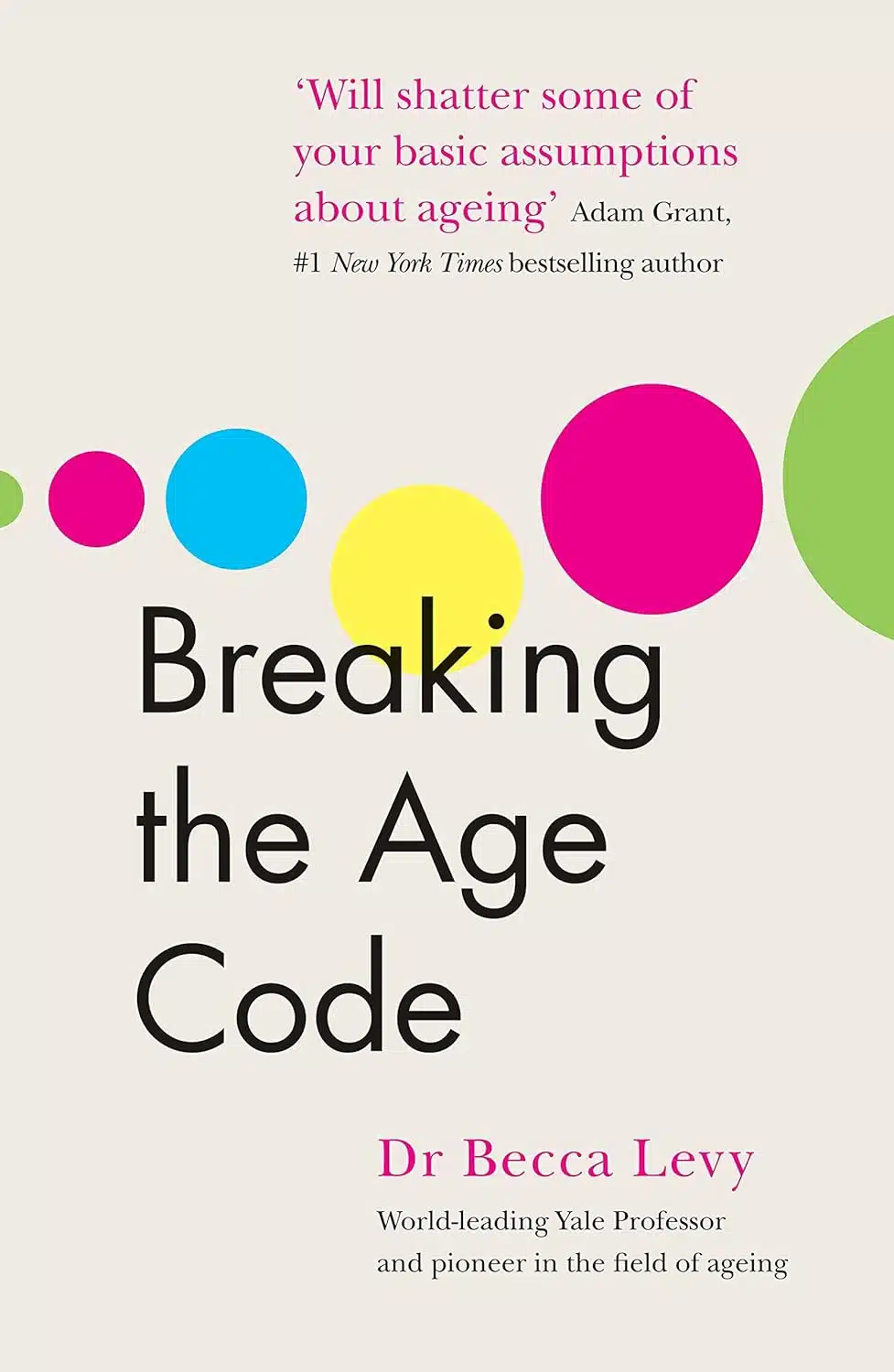
Breaking The Age Code – by Dr. Becca Levy

10almonds is reader-supported. We may, at no cost to you, receive a portion of sales if you purchase a product through a link in this article.

The author, a social psychologist, sets out to not only bust ageist expectations, but also boost life expectancy by 7.5 years.

How? By examining the extent to which how we think about our age affects our actual aging. Lest this sound wishy-washy, there are 52 pages of scientific references at the back.

We’ve written about this before at 10almonds, for example about the famous “Counterclockwise” study that saw reversals in biological markers of aging after a one-week intervention that consisted only of a (albeit rather intensive) mental reframe with regard to their age.

This book goes into such ideas much more than we can in a single article here, and in more ways, both on the personal level and the societal level.

The style is (despite its heavy leanings on hundreds of scientific studies) quite conversational in tone, with many personal anecdotes padding the pages a little, but it does get the message across and helps to illustrate things.

Bottom line: if you’d like a fresh take on aging, to make a big difference to yours, this book tackles that.

Click here to check out Breaking The Age Code, and break the age code!

Don’t Forget…

Did you arrive here from our newsletter? Don’t forget to return to the email to continue learning!

Learn to Age Gracefully

Join the 98k+ American women taking control of their health & aging with our 100% free (and fun!) daily emails:

  • What’s in the supplements that claim to help you cut down on bathroom breaks? And do they work?

    10almonds is reader-supported. We may, at no cost to you, receive a portion of sales if you purchase a product through a link in this article.

    With one in four Australian adults experiencing problems with incontinence, some people look to supplements for relief.

    With ingredients such as pumpkin seed oil and soybean extract, a range of products promise relief from frequent bathroom trips.

    But do they really work? Let’s sift through the claims and see what the science says about their efficacy.

    Christian Moro/Shutterstock

    What is incontinence?

    Incontinence is the involuntary loss of bladder or bowel control, leading to the unintentional leakage of urine or faeces. It can range from occasional minor leaks to a complete inability to control urination and defecation.

    This condition can significantly impact daily activities and quality of life, and affects women more often than it affects men.

    Some people don’t experience bladder leakage but can sometimes feel an urgent need to go to the bathroom. This is known as overactive bladder syndrome, and occurs when the muscles around the bladder tighten on their own, which greatly reduces its capacity. The result is the person feels the need to go to the bathroom much more frequently.

    There are many potential causes of incontinence and overactive bladders, including menopause, pregnancy and child birth, urinary tract infections, pelvic floor disorders, and an enlarged prostate. Conditions such as diabetes, neurological disorders and certain medications (such as diuretics, sleeping pills, antidepressants and blood-pressure drugs) can also contribute.

    While pelvic muscle rehabilitation and behavioural techniques for bladder retraining can be helpful, some people are interested in pharmaceutical solutions.

    What’s in these products?

    A number of supplements are available in Australia that include ingredients used in traditional medicine for urinary incontinence and overactive bladders. The three most common ingredients are:

    • Cucurbita pepo (pumpkin seed extract)
    • glycine max (soybean extract)
    • an extract from the bark of the Crateva magna or nurvala (Varuna) tree.
    The supplements have common ingredients. Author

    How are they supposed to work?

    Pumpkin seeds are rich in plant sterols that are thought to reduce the testosterone-related enlargement of the prostate, as well as having broader anti-inflammatory effects. The seed extracts can also contain oleic acid, which may help increase bladder capacity by relaxing the muscles around the organ.

    Soybean extracts are rich in isoflavones, especially daidzen and genistein. Like olieic acid, these are thought to act on the muscles around the bladder. Because isoflavones are similar in structure to the female hormone oestrogen, soy extracts may be most beneficial for postmenopausal women who have overactive bladders.

    Crateva extract is rich in lupeol- and sterol-based chemicals which have strong anti-inflammatory effects. This has benefits not just for enlarged prostates but possibly also for reducing urinary tract infections.

    Do they actually work?

    It’s important to note that the government has only approved these types of supplements as “listed medicines”. This means the ingredients have only been assessed for safety. The companies behind the products have not had to provide evidence they actually work.

    A 2014 clinical trial examined a combined pumpkin seed and soybean extract called cucurflavone on people with overactive bladders. The 120 participants received either a placebo or a daily 1,000mg dose of the herbal mixture over a period of 12 weeks.

    By the end of study, those in the cucurflavone group went to the bathroom around three fewer times per day, compared with people in the control group, who only went to the bathroom on average one fewer time each day.

    In a different trial, researchers examined a combination of Crateva bark extract with herbal extracts of horsetail and Japanese evergreen spicebush, called Urox.

    For the 150 participants, the Urox formulation helped participants go to the bathroom less frequently when compared with placebo treatment.

    After eight weeks of treatment, participants in the placebo group were going to the bathroom to urinate 11 times per day. Those in the Urox group were only going around to 7.5 times per day. And those who took Urox also needed to go to the bathroom one fewer time during the night.

    Finally, another study also examined a Creteva, horsetail and Japanese spicebush combination, but this time in children. They were given either a 420mg dose of the supplement or a placebo, and then monitored for how many times they wet the bed.

    After two months of taking the supplement, slightly more than 40% of the 24 kids in the supplement group wet the bed less often.

    While these results may look promising, there are considerable limitations to the studies which means the data may not be reliable. For example, the trials didn’t include enough participants to have reliable data. To conclusively provide efficacy, final-stage clinical trials require data for between 300 and 3,000 patients.

    From the studies, it is also not clear whether some participants were also taking other medicines as well as the supplement. This is important, as medications can interfere with how the supplements work, potentially making them less or more effective.

    What if you want to take them?

    If you have incontinence or an overactive bladder, you should always discuss this with your doctor, as it may due to a serious or treatable underlying condition.

    Otherwise, your GP may give you strategies or exercises to improve your bladder control, prescribe medications or devices, or refer you to a specialist.

    If you do decide to take a supplement, discuss this with your doctor and local pharmacist so they can check that any product you choose will not interfere with any other medications you may be taking.

    Nial Wheate, Professor of Pharmaceutical Chemistry, Macquarie University

    This article is republished from The Conversation under a Creative Commons license. Read the original article.

    Share This Post

  • Blackberries vs Pomegranate – Which is Healthier?

    10almonds is reader-supported. We may, at no cost to you, receive a portion of sales if you purchase a product through a link in this article.

    Our Verdict

    When comparing blackberries to pomegranate, we picked the blackberries.

    Why?

    Both have their merits! But…

    In terms of macros, blackberries have more fiber while pomegranates have more carbs, so that’s a first-round win for blackberries.

    In the category of vitamins, blackberries have more of vitamins A, B3, C, E, and K, while pomegranates have more of vitamins B1, B2, B5, B6, and B9, so that’s a 5:5 tie in this round.

    Looking at minerals, blackberries have more calcium, copper, iron, magnesium, manganese, and zinc, while pomegranates have more phosphorus, potassium, and selenium, so that’s a 6:3 win for blackberries here.

    In other considerations, blackberries are much higher in polyphenols, while pomegranates do have some special health benefits of their own, but (!) they’re mostly found in the peel which most people don’t consume. So we’ll call this round a win for blackberries, as those polyphenols are a lot more accessible than having to dry out pomegranate peel, grind it into a powder, and take it as a supplement (for example as a suspension in water).

    Adding up the sections makes for a clear overall win for blackberries, but by all means do enjoy either or both, as diversity is best!

    Want to learn more?

    You might like:

    Enjoy!

    Share This Post

  • 100 Hikes of a Lifetime – by Kate Siber

    10almonds is reader-supported. We may, at no cost to you, receive a portion of sales if you purchase a product through a link in this article.

    This is published by National Geographic, so you can imagine the quality of the photos throughout.

    Inside, and after a general introduction and guide to gear and packing appropriately, it’s divided into continents, with a diverse array of “trips of a lifetime” for anyone who enjoys hiking.

    It’s not a narrative book, rather, it is a guide, a little in the style of “Lonely Planet”, with many “know before you go” tips, information about the best time to go, difficult level, alternative routes if you want to get most of the enjoyment while having an easier time of it (or, conversely, if you want to see some extra sights along the way), and what to expect at all points.

    Where the book really excels is in balancing inspiration with information. There are some books that make you imagine being in a place, but you’ll never actually go there. There are other books that are technical manuals but not very encouraging. This one does both; it provides the motivation and the “yes, you really can, here’s how” information that, between them, can actually get you packing and on your way.

    Bottom line: if you yearn for breathtaking views and time in the great outdoors, but aren’t sure where to start, this will give you an incredible menu to choose from, and give you the tools to go about doing it.

    Click here to check out 100 Hikes Of A Lifetime, and live it!

    Share This Post

  • Red Light, Go!

    10almonds is reader-supported. We may, at no cost to you, receive a portion of sales if you purchase a product through a link in this article.

    Casting Yourself In A Healthier Light

    In Tuesday’s newsletter, we asked you for your opinion of red light therapy (henceforth: RLT), and got the above-depicted, below-described, set of responses:

    • About 51% said “I have no idea whether light therapy works or not”
    • About 24% said “Red light therapy is a valuable skin rejuvenation therapy”
    • About 23% said “I have not previously heard of red light therapy”
    • One (1) person said: “Red light therapy is a scam to sell shiny gadgets”

    A number of subscribers wrote with personal anecdotes of using red light therapy to beneficial effect, for example:

    ❝My husband used red light therapy after surgery on his hand. It did seem to speed healing of the incision and there is very minimal scarring. I would like to know if the red light really helped or if he was just lucky❞

    ~ 10almonds subscriber

    And one wrote to report having observed mixed results amongst friends, per:

    ❝Some people it works, others I’ve seen it breaks them out❞

    ~ 10almonds subscriber

    So, what does the science say?

    RLT rejuvenates skin, insofar as it reduces wrinkles and fine lines: True or False?

    True! This one’s pretty clear-cut, so we’ll just give one example study of many, which found:

    ❝The treated subjects experienced significantly improved skin complexion and skin feeling, profilometrically assessed skin roughness, and ultrasonographically measured collagen density.

    The blinded clinical evaluation of photographs confirmed significant improvement in the intervention groups compared with the control❞

    ~ Dr. Alexander Wunsch & Dr. Karsten Matuschka

    Read in full: A Controlled Trial to Determine the Efficacy of Red and Near-Infrared Light Treatment in Patient Satisfaction, Reduction of Fine Lines, Wrinkles, Skin Roughness, and Intradermal Collagen Density Increase

    RLT helps speed up healing of wounds: True or False?

    True! There is less science for this than the above claim, but the studies that have been done are quite compelling, for example this NASA technology study found that…

    ❝LED produced improvement of greater than 40% in musculoskeletal training injuries in Navy SEAL team members, and decreased wound healing time in crew members aboard a U.S. Naval submarine.❞

    ~ Dr. Harry Whelan et al.

    Read more: Effect of NASA light-emitting diode irradiation on wound healing

    RLT’s benefits are only skin-deep: True or False?

    False, probably, but we’d love to see more science for this, to be sure.

    However, it does look like wavelengths in the near-infrared spectrum reduce the abnormal tau protein and neurofibrillary tangles associated with Alzheimer’s disease, resulting in increased blood flow to the brain, and a decrease in neuroinflammation:

    Therapeutic Potential of Photobiomodulation In Alzheimer’s Disease: A Systematic Review

    Would you like to try RLT for yourself?

    There are some contraindications, for example:

    • if you have photosensitivity (for obvious reasons)
    • if you have Lupus (mostly because of the above)
    • if you have hyperthyroidism (because if you use RLT to your neck as well as face, it may help stimulate thyroid function, which in your case is not what you want)

    As ever, please check with your own doctor if you’re not completely sure; we can’t cover all bases here, and cannot speak for your individual circumstances.

    For most people though, it’s very safe, and if you’d like to try it, here’s an example product on Amazon, and by all means do read reviews and shop around for the ideal device for you

    Take care! 😎

    Don’t Forget…

    Did you arrive here from our newsletter? Don’t forget to return to the email to continue learning!

    Learn to Age Gracefully

    Join the 98k+ American women taking control of their health & aging with our 100% free (and fun!) daily emails:

  • Easily Digestible Vegetarian Protein Sources

    10almonds is reader-supported. We may, at no cost to you, receive a portion of sales if you purchase a product through a link in this article.

    It’s Q&A Day at 10almonds!

    Have a question or a request? You can always hit “reply” to any of our emails, or use the feedback widget at the bottom!

    In cases where we’ve already covered something, we might link to what we wrote before, but will always be happy to revisit any of our topics again in the future too—there’s always more to say!

    As ever: if the question/request can be answered briefly, we’ll do it here in our Q&A Thursday edition. If not, we’ll make a main feature of it shortly afterwards!

    So, no question/request too big or small

    ❝What could be easily digestible plant sources of protein for a vegetarian. My son is a gym holic and always looking for ways to get his protein from lentils other than eggs. He says to reach his protein requirement for the day, the amount of lentils he has to eat is sometimes heavy on the gut. Would really appreciate if you throw some light on this ❞

    Unless one has IBS or similar (or is otherwise unaccustomed to consuming healthy amounts of fiber), lentils shouldn’t be at all problematic for the digestion.

    However, the digestive process can still be eased by (speaking specifically for lentils here) blending them (in the water they were cooked in). This thick tasty liquid can then be used as the base of a soup, for example.

    Soy is an excellent source of complete protein too. Your son probably knows this because it’s in a lot of body-building supplements as soy protein isolate, but can also be enjoyed as textured soy protein (as in many plant-based meats), or even just soy beans (edamame). Tofu (also made from soy) is very versatile, and again can be blended to form the basis of a creamy sauce.

    Mycoproteins (as found in “Quorn” brand products and other meat substitutes) also perform comparably to meat from animals:

    Meatless Muscle Growth: Building Muscle Size and Strength on a Mycoprotein-Rich Vegan Diet

    See also, for interest:

    Vegan and Omnivorous High Protein Diets Support Comparable Daily Myofibrillar Protein Synthesis Rates and Skeletal Muscle Hypertrophy in Young Adults

    Don’t Forget…

    Did you arrive here from our newsletter? Don’t forget to return to the email to continue learning!

    Learn to Age Gracefully

    Join the 98k+ American women taking control of their health & aging with our 100% free (and fun!) daily emails:

  • Is honey good for you? Can it speed recovery if you’re sick or injured?

    10almonds is reader-supported. We may, at no cost to you, receive a portion of sales if you purchase a product through a link in this article.

    Honey is often praised for a range of health benefits, from soothing a sore throat and helping you get to sleep to healing woulds and lowering risk factors for diabetes and heart disease.

    Honey’s acidity has the potential to prevent bacterial growth, while its density and stickiness generates osmotic pressure (in the same way as quicksand) which restrain bacteria.

    Other compounds in honey contribute anti-inflammatory and antioxidant effects.

    But do the claims about honey for specific health problems and injuries stack up to science? Let’s check what the evidence says.

    abe livi/Unsplash

    First, what’s in honey?

    Honey contains up to 20% water. The remaining 80% is made of simple sugars: monasaccharides that we rapidly digest. Fructose (32-28%) and glucose (26-31%) are the main ones, followed by small amounts of sucrose and others.

    This can increase blood sugar levels to varying degrees. The glycemic index (GI) measures how fast blood sugars rise after eating or drinking. The GI of different Australian honeys ranges from 35 (low) to 72 (high), though most food labels don’t contain GI information.

    Honey also has traces of vitamins (A, B1, B2, B6, C), minerals (potassium, magnesium, iron, zinc), amino acids (protein) and enzymes from plant, bee and insect secretions.

    Nutrients vary depending on where the honeybees collected pollen, the time of honey harvest and how long it has been stored.

    Can honey heal wounds?

    A 2015 Cochrane review update assessed the effects of honey in treating acute burns, lacerations and chronic wounds, compared to topical treatments or other dressings.

    It found high-quality evidence that honey dressings healed second-degree burns 4–5 days faster than conventional dressings. There was moderate-quality evidence that wounds infected after surgery healed faster with honey.

    A 2020 review evaluated antimicrobial activity of Manuka and medical-grade honeys against a range of multi-drug resistant bacterial species. It found all honeys were effective against most species and could be considered for use in antibiotic-resistant infections.

    Only sterilised medical-grade honey that has been processed to remove contaminants, and meets safety and antibacterial standards, should be used, with guidance from your doctor.

    Does honey help adults sleep?

    Research on the effects of honey on sleep is limited.

    One trial compared sleep quality of 68 adults admitted to hospital. Half were given a mixture of milk (150mL) and honey (30g) twice a day, and half were not.

    Those in the honey-mixture group said they slept better after day three. But these results could be biased, because participants were aware they were getting honey-milk and drinking it can be associated with feeling of comfort.

    Can it soothe sore throats and coughs, or help kids sleep?

    Five studies in children have compared honey mixtures to over-the-counter cough medicines or no medication. Each study linked honey to better sleep and less severe coughs in children.

    But before you rush out to stock up on honey, there are major limitations related to the honey used. The quantity and type of honey given varies across the studies, with no certainty about which components are present. So the results need to be interpreted with caution.

    Chemical analysis of some honey varieties found traces of the “feel-good” brain chemical serotonin and the hormone melatonin, which affects sleep and circadian rhythm. But the researchers concluded the small amounts detected were more likely to affect activity of the bees, rather than affecting human behaviour.

    What about for diabetes, heart disease and cancer care?

    For diabetes, a 2023 review of 48 clinical trials found honey had some positive effects on a range of risk factors, including glucose tolerance and wound healing. However, the honey dose and type weren’t standardised, so the researchers concluded that honey could be used in addition to, but not instead of, regular medications.

    For heart disease, a 2022 analysis combining findings from trials evaluated the impact of honey on blood fats. It found no effect on several risk factors for heart disease: total cholesterol, triglycerides (another type of blood fat), low-density lipoprotein (LDL or bad) cholesterol or high-density lipoprotein (HDL or good) cholesterol.

    However a 2025 meta-analysis of propolis (bee glue) did find significant reductions in triglycerides, LDL (bad) cholesterol, fasting blood sugars, insulin and systolic blood pressure (the top number on a reading). But given most propolis supplement trials have only lasted a few months and supplements are expensive, that money is likely better spent on healthy foods.

    For cancer patients, a 2023 review found honey alleviated ulceration and inflammation in the mouth following chemotherapy or radiotherapy, and it reduced some of the toxic effects of chemotherapy.

    Can it affect your mind?

    Some honeys have psychotropic, or mind-altering effects. “Mad honey” comes from plant nectar of Rhododendron species and naturally contains grayanotoxins, which have pharmacological and toxic effects.

    These include nausea, dizziness, low blood pressure, severe bradycardia (an abnormally slow heart rate), neurological complications and even life-threatening cardiac arrhythmia (irregular heart beat).

    It’s illegal to import or sell “mad honey” in Australia but Nepal and Turkey have historically used it for medicinal and psychoactive properties.

    Who shouldn’t have honey?

    Although commercial honey is pasteurised, the process does not kill spores of the bacteria Clostridium botulinum. This is why babies under one year and immunocompromised people shouldn’t have honey.

    Clare Collins, Laureate Professor in Nutrition and Dietetics, University of Newcastle

    This article is republished from The Conversation under a Creative Commons license. Read the original article.

    Don’t Forget…

    Did you arrive here from our newsletter? Don’t forget to return to the email to continue learning!

    Learn to Age Gracefully

    Join the 98k+ American women taking control of their health & aging with our 100% free (and fun!) daily emails: