
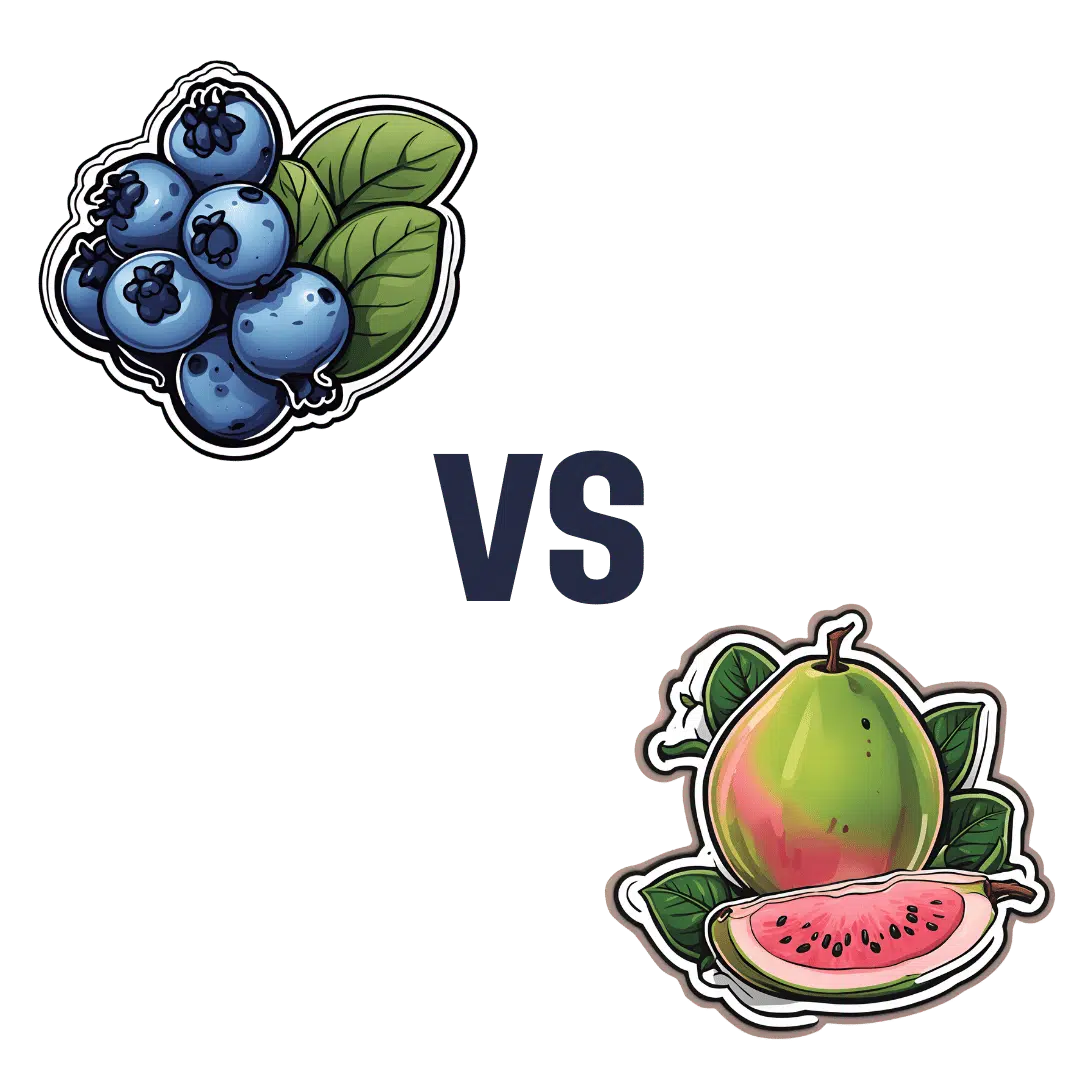
Blueberries vs Guava – Which is Healthier?
10almonds is reader-supported. We may, at no cost to you, receive a portion of sales if you purchase a product through a link in this article.
Our Verdict
When comparing blueberries to guava, we picked the guava.
Why?
Both have their merits! But…
In terms of macros, the guava has more than 2x the fiber for the same carbs, and nearly 3x the protein (not that this latter is much), winning easily in this category, mostly on account of the fiber.
In the category of vitamins, blueberries have a lot more vitamin K, while guava has a lot more of vitamins A, B1, B3, B5, B6, B7, B9, C, and E, winning this round by a country mile.
Looking at minerals, blueberries have more manganese, while guava has more calcium, copper, magnesium, phosphorus, potassium, selenium, and zinc, scoring another compelling victory for guava in this round.
In other considerations, like most berries, blueberries do have an abundance of polyphenols, rather more than guava, and thus win a round finally.
Adding up the sections makes for a clear overall win for guava, but by all means enjoy either or both, as blueberries’ polyphenol content is not to be overlooked, nor is all that vitamin K!
Want to learn more?
You might like:
21 Most Beneficial Polyphenols & What Foods Have Them
Enjoy!
Don’t Forget…
Did you arrive here from our newsletter? Don’t forget to return to the email to continue learning!
Recommended
Learn to Age Gracefully
Join the 98k+ American women taking control of their health & aging with our 100% free (and fun!) daily emails:
-
I’m So Effing Tired – by Dr. Amy Shah
10almonds is reader-supported. We may, at no cost to you, receive a portion of sales if you purchase a product through a link in this article.
It’s easy sometimes to feel like we know more or less what we should be doing… If only we had the energy to get going!
- We know we want a better diet… But we don’t have the time/energy to cook so will go for the quickest option even when it’s not the best?
- We know we should exercise… But feel we just need to crash out on the couch for a bit first?
- We would dearly love to get better sleep… But our responsibilities aren’t facilitating that?
…and so on. Happily, Dr. Amy Shah is here with ways to cut through the Gordian Knot that is this otherwise self-perpetuating cycle of exhaustion.
Most of the book is based around tackling what Dr. Shah calls “the energy trifecta“:
- Hormone levels
- Immune system
- Gut health
You’ll note (perhaps with relief) that none of these things require an initial investment of energy that you don’t have… She’s not asking you to hit the gym at 5am, or magically bludgeon your sleep schedule into its proper place, say.
Instead, what she gives is practical, actionable, easy changes that don’t require much effort, to gently slide us back into the fast lane of actually having energy to do stuff!
In short: if you’ve ever felt like you’d like to implement a lot of very common “best practice” lifestyle advice, but just haven’t had the energy to get going, there’s more value in this handbook than in a thousand motivational pep talks.
Click here to check out “I’m So Effing Tired” and get on a better track of life!
Share This Post
-
The Fastest Way To Get Strong At Home After 50
10almonds is reader-supported. We may, at no cost to you, receive a portion of sales if you purchase a product through a link in this article.
It doesn’t take much:
No gym? No problem!
Four ways to do it:
- Sit to stand with a heavy bag: sit on the edge of a chair with your feet pulled back and your back straight, holding a heavy backpack tight to your chest. Lean slightly forwards, stand up, then slowly lower back down for about four seconds. Use a load that lets you do 10–20 reps; go heavier if it feels easy, lighter if too hard.
- Heel raise on a step with weight: stand on the bottom step with just the balls of your feet supported, wearing or holding your backpack for resistance. Let your heels drop to feel a stretch in your calves, then rise onto your tiptoes and lower yourself back down slowly. Adjust the weight so you can do 10–20 reps.
- Chair press-up: place a chair against a wall, backrest facing you. Stand facing it, hands on the back of the chair at shoulder width, and walk your feet back until your body forms a straight line from heels to head. Keeping that line, bend your elbows to lower your chest towards the chair, then push away. It targets your chest, triceps, shoulders, and core.
- Farmer’s carry: hold a heavy object in each hand—like two filled watering cans or buckets—keeping your posture upright and shoulders back. Walk 10 paces forwards, turn, and walk 10 paces back, continuing for one minute. Rest for one minute, then repeat. It builds strength in your legs, back, grip, and overall stability.
For more on each of these plus visual demonstrations, enjoy:
Click Here If The Embedded Video Doesn’t Load Automatically!
Want to learn more?
You might also like:
Take care!
Share This Post
-
Cottage Cheese vs Ricotta – Which is Healthier?
10almonds is reader-supported. We may, at no cost to you, receive a portion of sales if you purchase a product through a link in this article.
Our Verdict
When comparing cottage cheese to ricotta, we picked the ricotta.
Why?
Cottage cheese is a famous health food, mostly for being a low-fat, low-carb, source of protein. And yet, ricotta beats it in most respects.
Looking at the macros first, cottage cheese has more carbs, while ricotta has more protein and fat. The fat profile is pretty much the same, and in both cases it’s two thirds saturated fat, which isn’t good in either case, but cottage cheese has less overall fat which means less saturated fat in total even if the percentage is the same. Because the difference in carbs and protein is not large, while ricotta has considerably more fat, we’ll call this category a win for cottage cheese.
In terms of vitamins, cottage cheese has more of vitamins B1, B5, and B12, while ricotta has more of vitamins A, B2, B3, B9, D, E, and K, so this one’s a win for ricotta.
In the category of minerals, cottage cheese has slightly more copper, while ricotta has much more calcium, iron, magnesium, manganese, potassium, selenium, and zinc. In particular, 2.5x more calcium, and 5x more iron! An easy and clear win for ricotta here.
Taking everything into account: yes, cottage cheese has less fat (and thus, in total, less saturated fat, although the percentage is the same), but that doesn’t make up for ricotta winning in pretty much every other respect. Still, enjoy either or both (in moderation!) if you be so inclined.
Want to learn more?
You might like to read:
Take care!
Share This Post
Related Posts
-
Weak Knees? Four Exercises To Strengthen Every Knee Muscle
10almonds is reader-supported. We may, at no cost to you, receive a portion of sales if you purchase a product through a link in this article.
Over-50s specialist physio Will Harlow shows us how:
The most bang-for-buck:
We’ll keep it simple; the four exercises are:
- Knee extensions while sitting: sit back in a chair, straighten your leg, pull your toes towards you, and strongly contract your thigh while pushing your knee down into the chair, before lowering and repeating.
- Hamstring bridge: lie on your back on the floor with your legs resting on a chair or similar elevated surface, press your lower back into the floor, then push through your heels to lift your pelvis by squeezing your hamstrings, before lowering slowly.
- Forward lean calf raise: stand about a meter from a wall, lean forwards with your hands on it, then rise onto your toes through a full range before lowering under control, progressing to one leg if reasonable.
- sit to stand progression: move from a standard sit-to-stand to a staggered stance, and eventually a single-leg version, leaning your body forwards, and controlling both the lift and the descent.
For more on all of this plus visual demonstrations, enjoy:
Click Here If The Embedded Video Doesn’t Load Automatically!
Want to learn more?
You might also like:
- Do This Before Walking To Suffer Less (It Takes 30 Seconds) ← when what feels like a problem in your knees is actually a lack of glute activation
- How To Make Downhill Walking Easier On The Knees ← famously more of a challenge than going uphill, in the case of dubious knees
- The Best Exercise to Stop Your Legs From Giving Out ← this one’s good if, like this writer, you have strong legs and/but also EDS or a similar connective tissue disorder that causes your joints to sometimes just fold like laundry for no obvious reason (it’s about the body’s misguided attempt to save you from something that’s not actually a problem but a tendon got confused so the muscle just dropped it)
Take care!
Don’t Forget…
Did you arrive here from our newsletter? Don’t forget to return to the email to continue learning!
Learn to Age Gracefully
Join the 98k+ American women taking control of their health & aging with our 100% free (and fun!) daily emails:
-
One More Way Exercise Improves Mental Health
10almonds is reader-supported. We may, at no cost to you, receive a portion of sales if you purchase a product through a link in this article.
“Exercise improves mental health” is itself not a new idea. For example,
We talk often about “what’s good for your heart is good for your brain“, and it goes not just for reducing risk factors (see: What’s Your Vascular Dementia Risk?), but also for improving cognitive function, e.g: How Your Exercise Today Gives A Brain Boost Tomorrow
But it’s not just cognitive function! It boosts mood too: Running or yoga can help beat depression, research shows, even if exercise is the last thing you feel like
…and, for that matter, Behavioral Activation Against Depression & Anxiety ← of which, exercise is not a definitionally required component, but it’s one of the most common ones
It even goes for quite specific forms of depression, such as: Dancing vs Parkinson’s Depression
But, what’s new?
Fitness & emotional resilience
In few words: researchers (Dr. Katja Weiss et al.) found that that higher cardiorespiratory fitness was linked to lower anxiety, lower anger, and greater emotional resilience under stress.
Indeed, the paper got titled: Cardiorespiratory fitness is associated with lower anger and anxiety and higher emotional resilience
What they did: healthy adults were split into above average and below average fitness groups based on exercise used to estimate VO₂Max, then viewed 69 neutral or unpleasant images across two 30-minute sessions, with anger and anxiety measured before and after.
The findings were as follows:
- For anxiety: VO₂Max predicted lower trait anxiety (β = −0.456, p = 0.001), and participants below average in fitness had a 775% greater risk of shifting from intermediate to high anxiety after unpleasant images (OR = 8.754, 95% CI [1.202; 63.759]).
- For anger: lower VO₂Max predicted greater increases in state anger during unpleasant image exposure (β = −0.241, p = 0.003), and higher anger-out scores also predicted anger increases (β = 0.333, p = 0.040), with less fit individuals showing poorer anger control.
Limitations: small sample size (n=40), estimated VO₂Max, questionnaire-based self-reports of some data.
Nevertheless, it is consistent with the idea that physical health and emotional resilience are closely tied together, in what’s most likely a bidirectional relationship (e.g. either one being strong supports the other being strong, whereas either one being weak weakens the other).
See for example: The Stress Prescription (Against Aging!) ← this is about the work of the remarkable Dr. Elissa Epel, who has for the past 20 years specialized in the effect of stress on aging. She’s led groundbreaking research on cortisol, telomeres, and telomerase, all in the context of aging, especially in women, as well as the relationship between stress and weight gain. She was elected member of the National Academy of Medicine for her work on stress pathways, and has been recognized as a key “Influencer in Aging” by the Alliance for Aging Research. Indeed, she’s also been named in the top 0.1% of researchers globally, in terms of publication impact.
So you can tackle this one from both sides! As for what you can do from the psychological side, see: Building Psychological Resilience (Without Undue Hardship)
Want to improve your VO₂Max?
We’ve got you covered:
53 Studies Later: The Best Way To Improve Your VO₂Max
Take care!
Don’t Forget…
Did you arrive here from our newsletter? Don’t forget to return to the email to continue learning!
Learn to Age Gracefully
Join the 98k+ American women taking control of their health & aging with our 100% free (and fun!) daily emails:
-
What is childhood dementia? And how could new research help?
10almonds is reader-supported. We may, at no cost to you, receive a portion of sales if you purchase a product through a link in this article.
“Childhood” and “dementia” are two words we wish we didn’t have to use together. But sadly, around 1,400 Australian children and young people live with currently untreatable childhood dementia.
Broadly speaking, childhood dementia is caused by any one of more than 100 rare genetic disorders. Although the causes differ from dementia acquired later in life, the progressive nature of the illness is the same.
Half of infants and children diagnosed with childhood dementia will not reach their tenth birthday, and most will die before turning 18.
Yet this devastating condition has lacked awareness, and importantly, the research attention needed to work towards treatments and a cure.
More about the causes
Most types of childhood dementia are caused by mutations (or mistakes) in our DNA. These mistakes lead to a range of rare genetic disorders, which in turn cause childhood dementia.
Two-thirds of childhood dementia disorders are caused by “inborn errors of metabolism”. This means the metabolic pathways involved in the breakdown of carbohydrates, lipids, fatty acids and proteins in the body fail.
As a result, nerve pathways fail to function, neurons (nerve cells that send messages around the body) die, and progressive cognitive decline occurs.
Childhood dementia is linked to rare genetic disorders. maxim ibragimov/Shutterstock What happens to children with childhood dementia?
Most children initially appear unaffected. But after a period of apparently normal development, children with childhood dementia progressively lose all previously acquired skills and abilities, such as talking, walking, learning, remembering and reasoning.
Childhood dementia also leads to significant changes in behaviour, such as aggression and hyperactivity. Severe sleep disturbance is common and vision and hearing can also be affected. Many children have seizures.
The age when symptoms start can vary, depending partly on the particular genetic disorder causing the dementia, but the average is around two years old. The symptoms are caused by significant, progressive brain damage.
Are there any treatments available?
Childhood dementia treatments currently under evaluation or approved are for a very limited number of disorders, and are only available in some parts of the world. These include gene replacement, gene-modified cell therapy and protein or enzyme replacement therapy. Enzyme replacement therapy is available in Australia for one form of childhood dementia. These therapies attempt to “fix” the problems causing the disease, and have shown promising results.
Other experimental therapies include ones that target faulty protein production or reduce inflammation in the brain.
Research attention is lacking
Death rates for Australian children with cancer nearly halved between 1997 and 2017 thanks to research that has enabled the development of multiple treatments. But over recent decades, nothing has changed for children with dementia.
In 2017–2023, research for childhood cancer received over four times more funding per patient compared to funding for childhood dementia. This is despite childhood dementia causing a similar number of deaths each year as childhood cancer.
The success for childhood cancer sufferers in recent decades demonstrates how adequately funding medical research can lead to improvements in patient outcomes.
Dementia is not just a disease of older people. Miljan Zivkovic/Shutterstock Another bottleneck for childhood dementia patients in Australia is the lack of access to clinical trials. An analysis published in March this year showed that in December 2023, only two clinical trials were recruiting patients with childhood dementia in Australia.
Worldwide however, 54 trials were recruiting, meaning Australian patients and their families are left watching patients in other parts of the world receive potentially lifesaving treatments, with no recourse themselves.
That said, we’ve seen a slowing in the establishment of clinical trials for childhood dementia across the world in recent years.
In addition, we know from consultation with families that current care and support systems are not meeting the needs of children with dementia and their families.
New research
Recently, we were awarded new funding for our research on childhood dementia. This will help us continue and expand studies that seek to develop lifesaving treatments.
More broadly, we need to see increased funding in Australia and around the world for research to develop and translate treatments for the broad spectrum of childhood dementia conditions.
Dr Kristina Elvidge, head of research at the Childhood Dementia Initiative, and Megan Maack, director and CEO, contributed to this article.
Kim Hemsley, Head, Childhood Dementia Research Group, Flinders Health and Medical Research Institute, College of Medicine and Public Health, Flinders University; Nicholas Smith, Head, Paediatric Neurodegenerative Diseases Research Group, University of Adelaide, and Siti Mubarokah, Research Associate, Childhood Dementia Research Group, Flinders Health and Medical Research Institute, College of Medicine and Public Health, Flinders University
This article is republished from The Conversation under a Creative Commons license. Read the original article.
Don’t Forget…
Did you arrive here from our newsletter? Don’t forget to return to the email to continue learning!
Learn to Age Gracefully
Join the 98k+ American women taking control of their health & aging with our 100% free (and fun!) daily emails:


