
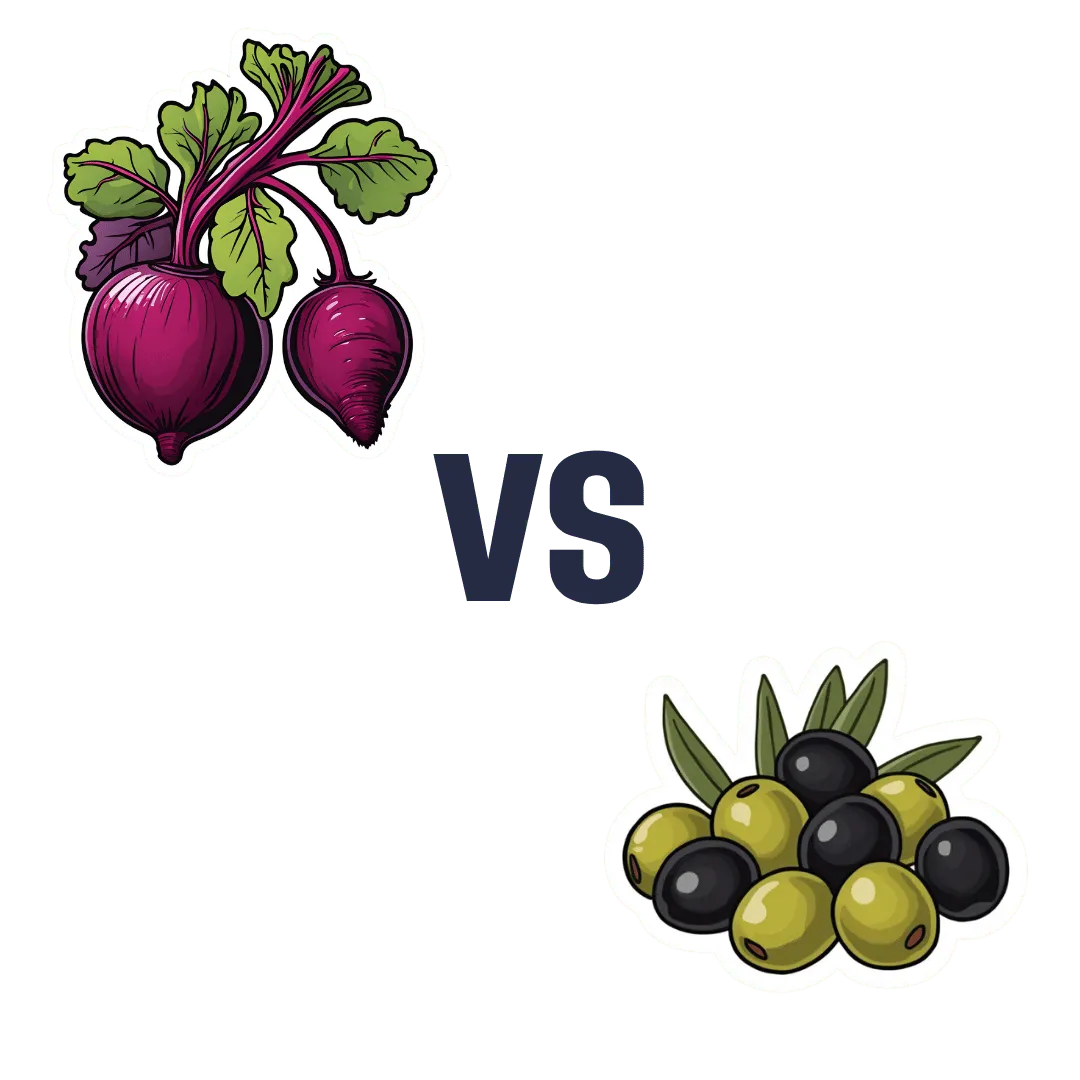
Beetroot vs Olives – Which is Healthier?
10almonds is reader-supported. We may, at no cost to you, receive a portion of sales if you purchase a product through a link in this article.
Our Verdict
When comparing beetroot to olives, we picked the beetroot.
Why?
Both of these salad items are strong contenders and bring different things to the table, so it comes down to how they stack up:
In terms of macros, beetroot has slightly more protein and carbs, while olives have slightly more fiber and rather more fat (famously healthy fats, though). All in all, we’d call it a nominal win for olives based on the fats.
In the category of vitamins, beetroot has more of vitamins B1, B2, B3, B5, B6, B7, B9, and C, while olives have more of vitmains A, E, K, and choline. Thus, an 8:4 win for beetroot.
When it comes to minerals, beetroot has more magnesium, manganese, phosphorus, potassium, and zinc, while olives have more calcium, copper, iron, and selenium. That would be a marginal 5:4 win for beetroot already, but it’s worth noting that olives are also high in one other mineral; namely, olives are about 10x higher in sodium. Which, except under very specific circumstances, is not usually what we want for good health, so we’ll consider it a point against olives here, making this an stronger win for beetroot.
Looking at polyphenols and other phytochemicals, both are good, but beetroot has most, and especially its betalain content goes a long way (see link below).
Adding up the sections makes for an overall win for beetroot, but by all means do enjoy either or both; diversity is good!
Want to learn more?
You might like:
Beetroot For More Than Just Your Blood Pressure
Enjoy!
Don’t Forget…
Did you arrive here from our newsletter? Don’t forget to return to the email to continue learning!
Recommended

Learn to Age Gracefully
Join the 98k+ American women taking control of their health & aging with our 100% free (and fun!) daily emails:
-
Surviving with Beans And Rice – by Eliza Whool
10almonds is reader-supported. We may, at no cost to you, receive a portion of sales if you purchase a product through a link in this article.
If you’d like to be well-set the next time a crisis shuts down supply lines, this is one of those books you’ll want to have read.
Superficially, “have in a large quantity of dried beans and rice” is good advice, but obvious. Why a book?
Whool gives a lot of advice on keeping your nutrition balanced while subsisting on the same quite few ingredients, which is handy.
More than that, she offers 100 recipes using the ingredients that will be in your long-term pantry. That’s over three months without repeating a meal! And if you don’t think rice and beans can be tasty and exciting and varied, then most of the chefs of the Global South might want to have a word about that.
Anyway, we’re not here to sell you rice and beans (we’re just enthusiastic and correct). What we are here to do is to give you a fair overview of this book.
The recipes are just-the-recipes, very simple clear instructions, one two-page spread per recipe. Most of the book is devoted to these. As a quick note, it does cover making things gluten-free if necessary, and other similar adjustments for medical reasons.
The planning-and-storage section of the book is helpful too though, especially as it covers common mistakes to avoid.
Bottom line: this is a great book, and remember what we said about doing the things now that future you will thank you for!
Get yourself a copy of Surviving with Beans And Rice from Amazon today!
Share This Post
-
The Yoga of Breath – by Richard Rosen
10almonds is reader-supported. We may, at no cost to you, receive a portion of sales if you purchase a product through a link in this article.
You probably know to breathe through your nose, and to breathe with your diaphragm. But did you know you’re usually only breathing through one nostril at a time, and alternate between nostrils every few hours? And did you know how to breathe through both nostrils equally instead, and the benefits that can bring?
The above is one example of many, of things that make this book stand out from the crowd when it comes to breathing exercises. Author Richard Rosen has a deep expertise in this topic, and explains everything clearly and comprehensively, without leaving room for ambiguity.
While most of the book focuses on the mechanics and physical techniques of breathing, he does also cover some more mindstate-related things too—without which, it wouldn’t be yoga.
If the book has a downside, it’s that its comprehensive nature could be off-putting to readers new to breathing work in general. However, since he does explain everything from the ground up, that’s no reason to be put off this book, iff you’re serious about learning.
Bottom line: if you’d like a deeper understanding of breathwork than “breathe slowly through your nose, using your diaphragm”, this book will teach you depths of breathing you probably didn’t know were possible.
Click here to check out The Yoga of Breath, and catch yours!
Share This Post
-
Why can’t I keep still after intense exercise?
10almonds is reader-supported. We may, at no cost to you, receive a portion of sales if you purchase a product through a link in this article.
Do you ever feel like you can’t stop moving after you’ve pushed yourself exercising? Maybe you find yourself walking around in circles when you come off the pitch, or squatting and standing and squatting again when you finish a run.
Sometimes the body knows what’s best for us, even if we’re not aware of the science.
Moving around after intense exercise actually helps the body recover faster. Here’s how it works – plus a tip for if you feel exactly the opposite (and just want to lie down).
Drazen Zigic/Shutterstock What is ‘intense’ exercise?
There are different ways to measure exercise intensity. One is simply how hard it feels to you, known as the “rating of perceived exertion”.
This takes into account how fast you’re breathing, how much you’re sweating and how tired your muscles are. It also considers heart rate.
The average resting heart rate when you’re not exerting yourself is around 60–80 beats per minute, although this can vary between people.
The maximum healthy heart rate is based on subtracting your age from 220. So, if you’re 20 years old, that’s 200 beats per minute when you’re exercising as hard as you can.
This decreases as you age. If you’re 50 years old, your maximum heart rate would be around 170 beats per minute.
An increased heart rate helps pump blood faster to deliver fuel and oxygen to the muscles that are working hard. Once you stop exercising your body will begin its recovery, to return to resting levels.
Let’s look at how continuing to move after intense exercise helps do this.
Removing waste from the muscles
Whenever the body converts fuel into energy it also produces leftover substances, known as metabolic byproducts. This includes lactate (sometimes called lactic acid).
During intense exercise we need to burn more fuel (oxygen and glucose) and this can make the body produce lactate much more quickly than it can clear it. When lactate accumulates in the muscles it may delay their recovery.
We can reuse lactate to provide energy to the heart and brain and modulate the immune system. But to do this, lactate must be cleared from the muscles into the bloodstream.
After intense exercise, continuing to move your body – but less intensely – can help do this. This kind of active recovery has been shown to be more efficient than passive recovery (meaning you don’t move).
Intense exercise can mean your muscles produce more metabolic byproducts. Tom Wang/Shutterstock Returning blood to the heart
Intense exercise also makes our heart pump more blood into the body. The volume pumped to the muscles increases dramatically, while blood flow to other tissues – especially the abdominal organs such as the kidneys – is reduced.
Moving after intense exercise can help redistribute the blood flow and speed up recovery of the respiratory and cardiovascular systems. This will also clear metabolic byproducts faster.
After a long run, for example, there will be much more blood in your leg muscles. If you stand still for a long time, you may feel dizzy or faint, thanks to lowered blood pressure and less blood flow to the brain.
Moving your legs, whether through stretching or walking, will help pump blood back to the heart.
In fact around 90% of the blood returning from the legs via veins relies on the foot, calf and thigh muscles moving and pumping. The calf muscle plays the largest role (about 65%). Moving your heels up and down after exercising can help activate this motion.
What if you don’t feel like moving?
Maybe after exercise you just want to sit down in a heap. Should you?
If you’re too tired to do light movement such as stretching or walking, you may still benefit from elevating your legs.
You can lie down – research has shown blood from the veins returns more easily to the heart after exercise when you’re lying down, compared to sitting up, even if you’re still. Elevating your legs has an added benefit, as it reverses the effect of gravity and helps circulation.
Ken Nosaka, Professor of Exercise and Sports Science, Edith Cowan University
This article is republished from The Conversation under a Creative Commons license. Read the original article.
Share This Post
Related Posts
-
Heal Your Stressed Brain
10almonds is reader-supported. We may, at no cost to you, receive a portion of sales if you purchase a product through a link in this article.
Rochelle Walsh, therapist, explains the problem and how to fix it:
Not all brain damage is from the outside
Long-term stress and burnout cause brain damage; it’s not just a mindset issue—it impacts the brain physiologically. To compound matters, it also increases the risk of neurodegenerative diseases. While the brain can indeed grow new neurons and regenerate itself, chronic stress damages specific regions, and inhibits that.
There are some effects of chronic stress that can seem positive—the amygdalae and hypothalamus are seen to grow larger and stronger, for instance—but this is, unfortunately, “all the better to stress you with”. In compensation for this, chronic stress deprioritizes the pre-frontal cortex and hippocampi, so there goes your reasoning and memory.
This often results in people not managing chronic stress well. Just like a weak heart and lungs might impede the exercise that could make them stronger, the stressed brain is not good at permitting you to do the things that would heal it—preferring to keep you on edge all day, worrying and twitchy, mind racing and body tense. It also tends to lead to autoimmune diseases, due to the increased inflammation (because the body’s threat-detection system as at “jumping at own shadow” levels so it’s deploying every defense it has, including completely inappropriate ones).
Notwithstanding the “Heal Your Stressed Brain” thumbnail, she doesn’t actually go into this in detail and bids us sign up for her masterclass. We at 10almonds however like to deliver, so you can find useful advice and free resources in our links-drop at the bottom of this article.
Meanwhile, if you’d like to hear more about the neurological woes described above, enjoy:
Click Here If The Embedded Video Doesn’t Load Automatically!
Want to learn more?
You might also like to read:
- Meditation That You’ll Actually Enjoy
- How To Manage/Reduce Chronic Stress
- Lower Your Cortisol! (Here’s Why & How)
- How Healthy People Regulate Their Emotions
- Sleep: Yes, You Really Do Still Need It!
- Give Your Adrenal Glands A Chance
- The Stress Prescription (Against Aging!)
Take care!
Don’t Forget…
Did you arrive here from our newsletter? Don’t forget to return to the email to continue learning!
Learn to Age Gracefully
Join the 98k+ American women taking control of their health & aging with our 100% free (and fun!) daily emails:
-
Kiwi vs Lime – Which is Healthier?
10almonds is reader-supported. We may, at no cost to you, receive a portion of sales if you purchase a product through a link in this article.
Our Verdict
When comparing kiwi to lime, we picked the kiwi.
Why?
In terms of macros, kiwi has more protein, more carbs, and more fiber. As with most fruits, the fiber is the number we’re most interested in for health purposes; in this case, kiwi is just slightly ahead of limes on all three of those. So, a modest win for kiwis.
In the category of vitamins, kiwi has more of vitamins A, B2, B3, B6, B9, C, E, and K, while lime has a tiny bit more vitamin B5. That’s vitamin B as in, the vitamin that’s in pretty much anything and is practically impossible to be deficient in unless you are literally starving to death. You may be thinking: aren’t limes a famously good source of vitamin C? And yes, yes they are. But kiwis have >3x more. In other big differences, kiwis also have >6x more vitamin E and >67 times more vitamin K. So this round’s a super-easy win for kiwis.
Looking at minerals, kiwi has more calcium, copper, magnesium, manganese, phosphorus, potassium, and zinc, while lime has more iron and selenium. Another clear win for kiwis.
In other considerations, kiwi has some anticancer properties that lime can’t boast, so that’s another point in favor of kiwi.
Adding up the sections makes for an overwhelming overall win for kiwi, but by all means enjoy either or both, as diversity is best!
Want to learn more?
You might like to read:
Top 8 Fruits That Prevent & Kill Cancer ← kiwi is top of the list; it promotes cancer cell death while sparing healthy cells 😎
Take care!
Don’t Forget…
Did you arrive here from our newsletter? Don’t forget to return to the email to continue learning!
Learn to Age Gracefully
Join the 98k+ American women taking control of their health & aging with our 100% free (and fun!) daily emails:
-
Before You Eat Breakfast: 3 Surprising Facts About Intermittent Fasting
10almonds is reader-supported. We may, at no cost to you, receive a portion of sales if you purchase a product through a link in this article.
Dr. William Li is well-known for his advocacy of “eating to beat disease”, and/but today he has advice for us about not eating to beat disease. In moderation, of course, thus: intermittent fasting.
The easy way
Dr. Li explains the benefits of intermittent fasting; how it improves the metabolism and gives the body a chance to do much-needed maintainance, including burning off any excess fat we had hanging around.
However, rather than calling for us to do anything unduly Spartan, he points out that it’s already very natural for us to fast while sleeping, so we only need to add a couple of hours before and after sleeping (assuming an 8 hour sleep), to make it to a 12-hour fast for close to zero effort and probably no discomfort.
And yes, he argues that a 12-hour fast is beneficial, and even if 16 hours would be better, we do not need to beat ourselves up about getting to 16; what is more important is sustainability of the practice.
Dr. Li advocates for flexibility in fasting, and that it should be done by what manner is easiest, rather than trying to stick to something religiously (of course, if you do fast for religious reasons, that is another matter, and/but beyond the scope of this today).
For more information on each of these, as well as examples and tips, enjoy:
Click Here If The Embedded Video Doesn’t Load Automatically!
Want to learn more?
You might also like to read:
- Intermittent Fasting: What’s the truth?
- 16/8 Intermittent Fasting For Beginners
- Meal Timings & Health: How Important Is Breakfast?
Take care!
Don’t Forget…
Did you arrive here from our newsletter? Don’t forget to return to the email to continue learning!
Learn to Age Gracefully
Join the 98k+ American women taking control of their health & aging with our 100% free (and fun!) daily emails:


