Asparagus vs Olives – Which is Healthier?

10almonds is reader-supported. We may, at no cost to you, receive a portion of sales if you purchase a product through a link in this article.

Our Verdict

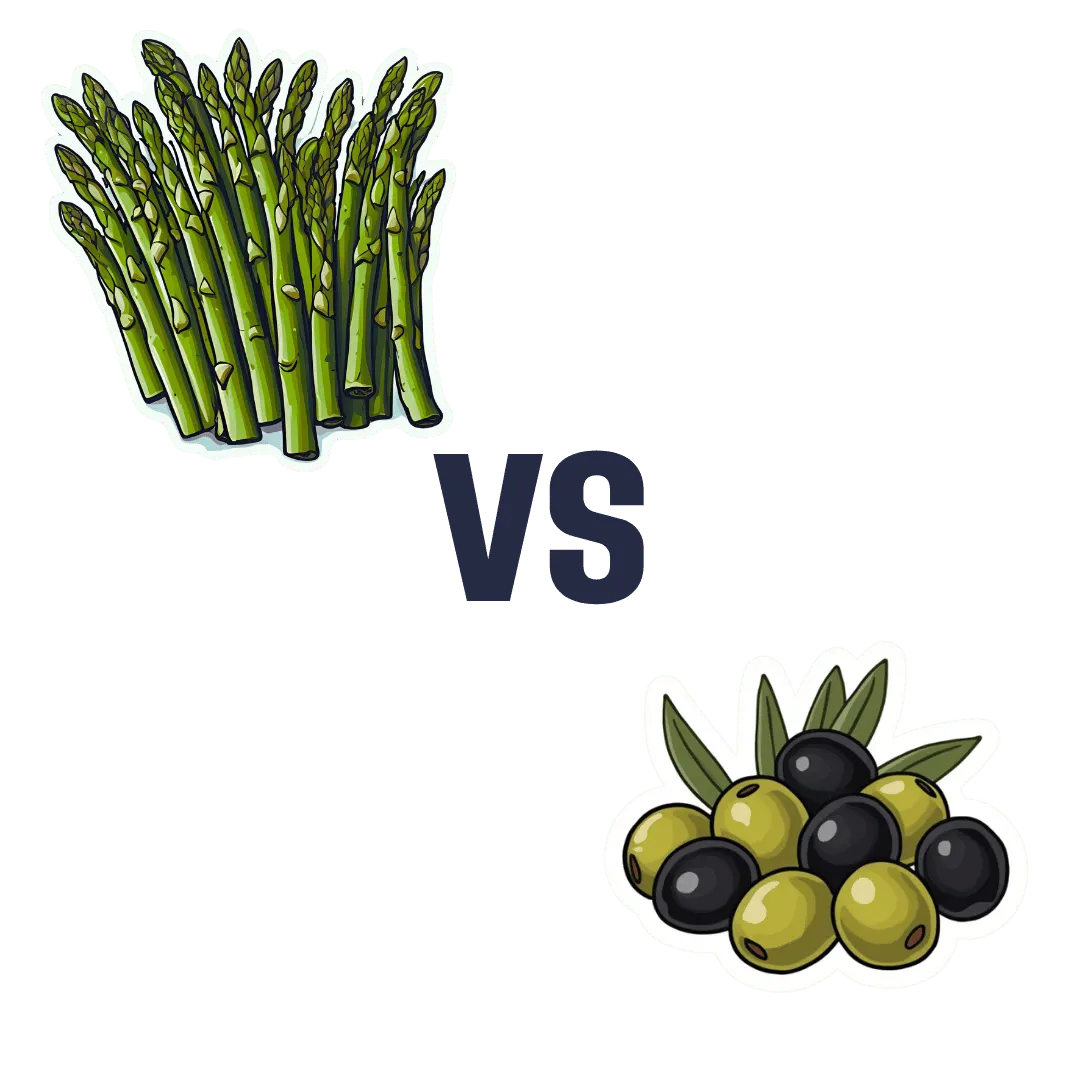
When comparing asparagus to olives, we picked the asparagus.

Why?

Both have their strong merits!

In terms of macros, asparagus has more protein, while olives have more fiber, (healthy) fats, and carbs, winning in this category.

In the category of vitamins, asparagus has more of vitamins A, B1, B2, B3, B5, B6, B7, B9, C, and K, while olives have more vitamin E, giving an overwhelming win to asparagus in this round.

Looking at minerals, asparagus has more magnesium, manganese, phosphorus, potassium, selenium, and zinc, while olives have more calcium, copper, and iron, yield to asparagus a 6:3 win here.

In other considerations, both are abundant sources of polyphenols, making this round most fairly a tie.

Adding up the sections makes for an overall win for asparagus, but like we say, both have their strong merits, and as ever, diversity is best!

Want to learn more?

You might like:

21 Most Beneficial Polyphenols & What Foods Have Them

Enjoy!

Don’t Forget…

Did you arrive here from our newsletter? Don’t forget to return to the email to continue learning!

  • Potatoes & Anxiety
    Peeling potatoes can become a therapeutic ritual, easing your anxiety one slice at a time. Learn other secret tricks here!

Learn to Age Gracefully

Join the 98k+ American women taking control of their health & aging with our 100% free (and fun!) daily emails:

  • Is black mould really as bad for us as we think? A toxicologist explains

    10almonds is reader-supported. We may, at no cost to you, receive a portion of sales if you purchase a product through a link in this article.

    Mould in houses is unsightly and may cause unpleasant odours. More important though, mould has been linked to a range of health effects – especially triggering asthma.

    However, is mould exposure linked to a serious lung disease in children, unrelated to asthma? As we’ll see, this link may not be real, or if it is, it’s so rare to not be a meaningful risk. Yet we still hear mould in damp homes described as “toxic”.

    Indeed, mouldy homes can harm people’s health, but not necessarily how you might think.

    Peeradontax/Shutterstock

    What is mould?

    Mould is the general term for a variety of fungi. The mould that people have focused on in damp homes is “black mould”. This forms unsightly black patches on walls and other parts of damp-affected buildings.

    Black mould is not a single fungus. But when people talk about black mould, they generally mean the fungus Stachybotrys chartarum or S. chartarum for short. It’s one of experts’ top ten feared fungi.

    The focus on this species comes from a report in the 1990s on cases of haemorrhagic lung disease in a number of infants. This is a rare disease where blood leaks into the lungs, and can be fatal. The report suggested chemicals known as mycotoxins associated with this species of fungus were responsible for the outbreak.

    What are mycotoxins?

    A variety of fungi produce mycotoxins to defend themselves, among other reasons.

    Hundreds of different chemicals are listed as myocytoxins. These include ones in poisonous mushrooms, and ones associated with the soil fungi Aspergillus flavus and A. parasiticus.

    The fungus typically associated with black mould S. chartarum can produce several mycotoxins. These include roridin, which inhibits protein synthesis in humans and animals, and satratoxins, which have numerous toxic effects including bleeding in the lungs.

    While the satratoxins, in particular, were mentioned in the report from the 90s in children, there are some problems when we look at the evidence.

    The amount of mycotoxins S. chartarum makes can vary considerably. Even if significant amounts of mycotoxin are present, getting them into the body in the required amount to cause damage is another thing.

    Inhaling spores in contaminated (mouldy) homes is the most probable way mycotoxins enter the body. For instance, we know mycotoxins can be found in S. chartarum spores. We also know direct injection of high concentrations of mycotoxin-bearing spores directly in the noses of mice can cause some lung bleeding.

    Stachybotrys chartarum mould
    Stachybotrys chartarum mycotoxins have been blamed for lung issues after exposure to black mould. Kateryna Kon/Shutterstock

    But just because inhaling spores is the probable route of contamination doesn’t mean this is very likely.

    That’s because S. chartarum doesn’t release a lot of spores. Its spores are typically embedded in a slimy mass and it rarely produces the spore densities needed to replicate the animal studies.

    The original reports suggesting the US infants who were diagnosed with haemorrhagic lung disease were exposed to toxic levels of mycotoxins were also flawed.

    Among other issues, the concentrations of mould spores was calculated incorrectly. Subsequent correction for these issues resulted in the association between S. chartarum and this disease cluster basically disappearing.

    The American Academy of Asthma Allergy and Immunology states while there is a clear, well-established relationship between damp indoor spaces and detrimental health effects, there is no good evidence black mould mycotoxins are involved.

    But mould can cause allergies

    Moulds can affect human health in ways unrelated to mycotoxins, typically through allergic reactions. Moulds including black moulds can trigger or worsen asthma attacks in people with mould allergies.

    Some rarer but severe reactions can include allergic fungal sinusitis, allergic bronchopulmonary aspergillosis and rarer still, hypersensitivity pneumonitis.

    These can typically be controlled by removing the mould (or removing the person from the source of mould).

    People with impaired immune systems (such as people taking immune-suppressant medications) may also be prone to mould infections.

    In a nutshell

    There is sufficient evidence that household mould is associated with respiratory issues attributable to their allergic effects.

    However, there is no strong evidence mycotoxins from household mould – and in particular black mould – are associated with substantial health issues.

    Ian Musgrave, Senior lecturer in Pharmacology, University of Adelaide

    This article is republished from The Conversation under a Creative Commons license. Read the original article.

    Share This Post

  • Medicinal cannabis is most often prescribed for pain, anxiety and sleep. Here’s what the evidence says

    10almonds is reader-supported. We may, at no cost to you, receive a portion of sales if you purchase a product through a link in this article.

    Medicinal cannabis use has increased rapidly in recent years in Australia. Since access pathways were expanded in 2016, more than 700,000 prescription approvals have been issued.

    The vast majority of medicinal cannabis products on the market have not been registered on the Australian Register of Therapeutic Goods. But medical practitioners can apply to the Therapeutic Goods Administration (TGA) for approval to prescribe them to patients.

    Data shows the three most common conditions for which scripts are approved are chronic pain, anxiety and sleep disorders.

    Although many patients report benefits, professional bodies and regulators have raised concerns about whether prescribing is outpacing the evidence.

    So what does the evidence actually say? Does medicinal cannabis work for the conditions for which it’s most commonly prescribed?

    Vilin Visuals/Getty Images

    Medicinal cannabis for pain

    Medicinal cannabis refers to cannabis products that are legally prescribed to treat a medical condition. This can be the plant itself, or natural compounds extracted from the plant. Some compounds similar to or the same as those found in cannabis (for example, dronabinol and nabilone) are made in a lab.

    Two of the most common compounds in the plant are THC (tetrahydrocannabinol) and CBD (cannabidiol), known as cannabinoids.

    These are commonly found at various concentrations in medicinal cannabis products which come in forms including oils, capsules, dried flower (used in a vaporiser), sprays and gummies.

    Chronic pain is the most common reason for medicinal cannabis use. But as we’ve written in a previous article, research shows only modest benefits, with limited improvements in pain and physical functioning.

    The TGA says there’s limited evidence medicinal cannabis provides clinically significant pain relief for many conditions, and should only be tried if other standard therapies haven’t helped.

    Does medicinal cannabis work for anxiety?

    Beside chronic pain, a growing number of people are now turning to medicinal cannabis for anxiety.

    Multiple reviews have examined whether it works for this purpose and have come to similar conclusions. For THC-based products the evidence is mixed, with some patients finding relief, while others report their symptoms are worse.

    There is emerging evidence for CBD, however it’s too soon to recommend medical cannabis as a first-line treatment for anxiety. So far, studies of CBD in anxiety have been small, only measured effects under experimental conditions designed to induce stress, had no comparison group, or only tested a one-off dose. Because of these limitations, the studies can’t tell us if CBD is effective for ongoing anxiety management.

    A recent review found CBD had positive effects on anxiety, but these effects were seen in studies deemed to have problems with their methods, and not in studies that were more rigorously designed and conducted.

    Similarly, a small Australian study (with no control group) demonstrated positive effects of CBD in young people with anxiety who had already tried other treatments. However, the authors stated more rigorous trials were still needed.

    What’s more, there are recent case reports of acute psychosis arising from medicinal cannabis use. Taken together with the ambiguous evidence, the role for cannabinoids for anxiety remains far from clear.

    How about sleep disorders?

    The evidence for cannabis in the treatment of sleep disorders and insomnia is perhaps even more limited, with neither CBD or THC having shown clear benefits reducing the number of awakenings or time spent awake during the night, or improved sleep quality. That said, some people do report they have fewer symptoms of insomnia when using medicinal cannabis.

    Similar to anxiety, many of the studies have major weaknesses in their study design which make it difficult to draw strong conclusions. There are also few studies that compare medicinal cannabis to proven treatments for sleep disorders and insomnia. This makes it hard to make recommendations for treatment based on the current research evidence.

    THC can make you drowsy, and in the short term, may help people fall asleep, or feel like they’re getting more sleep. But there are some important downsides to consider, too.

    For example, if you take medicinal cannabis regularly to fall asleep your body can get used to it, making it harder to fall asleep without it. In the long term, medicinal cannabis can also affect the amounts of light and deep sleep a person will have, which can result in poorer sleep quality.

    There is good evidence for some conditions

    Some of the strongest evidence for medicinal cannabis products are for rare forms of epilepsy that don’t respond to existing treatments, and for treating symptoms associated with multiple sclerosis.

    The only TGA-approved medicinal cannabis products are for these conditions.

    There’s also evidence medicinal cannabis can help with chemotherapy-induced nausea and vomiting. Though as newer medications with fewer side effects are now available, medicinal cannabis products are not considered first-line treatments.

    Risks and side effects

    Common side effects with THC in the short term include drowsiness, anxiety, dry mouth, nausea, vomiting and appetite changes. For some people, these effects reduce over time.

    Some people with preexisting health conditions such as schizophrenia, psychosis or heart conditions may be more prone to experiencing side effects.

    An estimated one in four people using medical cannabis meet the criteria for dependence (known as cannabis use disorder). In the longer term, dependence appears more common with medical use, particularly when combined with non-medical use.

    If you are suffering with anxiety, sleep problems or chronic pain, and are wondering what treatments might be most effective for you, speak to your regular GP.

    Suzanne Nielsen, Professor and Deputy Director, Monash Addiction Research Centre, Monash University and Myfanwy Graham, NHMRC Postgraduate Scholar and Fulbright Alumna in Public Health Policy, Monash University

    This article is republished from The Conversation under a Creative Commons license. Read the original article.

    Share This Post

  • What’s the difference between period pain and endometriosis pain?

    10almonds is reader-supported. We may, at no cost to you, receive a portion of sales if you purchase a product through a link in this article.

    Menstruation, or a period, is the bleeding that occurs about monthly in healthy people born with a uterus, from puberty to menopause. This happens when the endometrium, the tissue that lines the inside of the uterus, is shed.

    Endometriosis is a condition that occurs when endometrium-like tissue is found outside the uterus, usually within the pelvic cavity. It is often considered a major cause of pelvic pain.

    Pelvic pain significantly impacts quality of life. But how can you tell the difference between period pain and endometriosis?

    Polina Zimmerman/Pexels

    Periods and period pain

    Periods involve shedding the 4-6 millimetre-thick endometrial lining from the inside of the uterus.

    As the lining detaches from the wall of the uterus, the blood vessels which previously supplied the lining bleed. The uterine muscles contract, expelling the blood and crumbled endometrium.

    The crumbled endometrium and blood mostly pass through the cervix and vagina. But almost everyone back-bleeds via their fallopian tubes into their pelvic cavity. This is known as “retrograde menstruation”.

    Woman holds uterus model
    Most of the lining is shed through the vagina. Andrey_Popov/Shutterstock

    The process of menstrual shedding is caused by inflammatory substances, which also cause nausea, vomiting, diarrhoea, headaches, aches, pains, dizziness, feeling faint, as well as stimulating pain receptors.

    These inflammatory substances are responsible for the pain and symptoms in the week before a period and the first few days.

    For women with heavy periods, their worst days of pain are usually the heaviest days of their period, coinciding with more cramps to expel clots and more retrograde bleeding.

    Many women also have pain when they are releasing an egg from their ovary at the time of ovulation. Ovulation or mid-cycle pain can be worse in those who bleed more, as those women are more likely to bleed into the ovulation follicle.

    Around 90% of adolescents experience period pain. Among these adolescents, 20% will experience such severe period pain they need time off from school and miss activities. These symptoms are too often normalised, without validation or acknowledgement.

    What about endometriosis?

    Many symptoms have been attributed to endometriosis, including painful periods, pain with sex, bladder and bowel-related pain, low back pain and thigh pain.

    Other pain-related conditions such migraines and chronic fatigue have also been linked to endometriosis. But these other pain-related symptoms occur equally often in people with pelvic pain who don’t have endometriosis.

    Girl holds pad
    One in five adolescents who menstrate experience severe symptoms. CGN089/Shutterstock

    Repeated, significant period and ovulation pain can eventually lead some people to develop persistent or chronic pelvic pain, which lasts longer than six months. This appears to occur through a process known as central sensitisation, where the brain becomes more sensitive to pain and other sensory stimuli.

    Central sensitisation can occur in people with persistent pain, independent of the presence or absence of endometriosis.

    Eventually, many people with period and/or persistent pelvic pain will have an operation called a laparoscopy, which allows surgeons to examine organs in the pelvis and abdomen, and diagnose and treat endometriosis.

    Yet only 50% of those with identical pain symptoms who undergo a laparoscopy will end up having endometriosis.

    Endometriosis is also found in pain-free women. So we cannot predict who does and doesn’t have endometriosis from symptoms alone.

    How is this pain managed?

    Endometriosis surgery usually involves removing lesions and adhesions. But at least 30% of people return to pre-surgery pain levels within six months or have more pain than before.

    After surgery, emergency department presentations for pain are unchanged and 50% have repeat surgery within a few years.

    Suppressing periods using hormonal therapies (such as continuous oral contraceptive pills or progesterone-only approaches) can suppress endometriosis and reduce or eliminate pain, independent of the presence or absence of endometriosis.

    Not every type or dose of hormonal medications suits everyone, so medications need to be individualised.

    The current gold-standard approach to manage persistent pelvic pain involves a multidisciplinary team approach, with the aim of achieving sustained remission and improving quality of life. This may include:

    • physiotherapy for pelvic floor and other musculoskeletal problems
    • management of bladder and bowel symptoms
    • support for self-managing pain
    • lifestyle changes including diet and exercise
    • psychological or group therapy, as our moods, stress levels and childhood events can affect how we feel and experience pain.

    Whether you have period pain, chronic pelvic pain or pain you think is associated with endometriosis, if you feel pain, it’s real. If it’s disrupting your life, you deserve to be taken seriously and treated as the whole person you are.

    Sonia R. Grover, Senior Research Fellow, Murdoch Children’s Research Institute; Clinical Professor of Gynaecology, The University of Melbourne

    This article is republished from The Conversation under a Creative Commons license. Read the original article.

    Share This Post

  • Rice vs Buckwheat – Which is Healthier?

    10almonds is reader-supported. We may, at no cost to you, receive a portion of sales if you purchase a product through a link in this article.

    Our Verdict

    When comparing rice to buckwheat, we picked the buckwheat.

    Why?

    It’s a simple one today:

    • The vitamin and mineral profiles are very similar, so neither of these are a swaying factor
    • In terms of macros, rice is higher in carbohydrates while buckwheat is higher in fiber
    • Buckwheat also has more protein, but not by much
    • Buckwheat has the lower glycemic index, and a lower insulin index, too

    While buckwheat cannot always be reasonably used as a substitute for rice (often because the texture would not work the same), in many cases it can be.

    And if you love rice, well, so do we, but variety is also the spice of life indeed, not to mention important for good health. You know that whole “eat 30 different plants per week” thing? Grains count in that tally! So substituting buckwheat in place of rice sometimes seems like a very good bet.

    Not sure where to buy it?

    Here for your convenience is an example product on Amazon

    Want to know more about today’s topic?

    Check out: Carb-Strong or Carb-Wrong?

    Enjoy!

    Don’t Forget…

    Did you arrive here from our newsletter? Don’t forget to return to the email to continue learning!

    Learn to Age Gracefully

    Join the 98k+ American women taking control of their health & aging with our 100% free (and fun!) daily emails:

  • Pineapple vs Watermelon – Which is Healthier?

    10almonds is reader-supported. We may, at no cost to you, receive a portion of sales if you purchase a product through a link in this article.

    Our Verdict

    When comparing pineapple to watermelon, we picked the pineapple.

    Why?

    Both have their merits, but there’s a clear winner here:

    In terms of macros, pineapple has more than 3x the fiber and just under 2x the carbs, making it the best in this category.

    In the category of vitamins, pineapple has more of vitamins B1, B2, B3, B6, B9, C, K, and choline, while watermelon has more of vitamins A and E; a clear win for pineapple here, by the numbers.

    When it comes to minerals, pineapple has more calcium, copper, iron, magnesium, manganese, and zinc, while watermelon has more phosphorus and potassium. Another win for pineapple.

    Looking at other considerations, it’s worth noting that pineapple has bromelain (a highly beneficial enzyme group that’s unique to pineapple), and watermelon is an excellent source of lycopene (better even than tomatoes, which are famous for their lycopene content). So, a tie in this round.

    Adding up the sections makes for an easy overall win for pineapple, but by all means enjoy either or both; diversity is good!

    Want to learn more?

    You might like:

    Enjoy!

    Don’t Forget…

    Did you arrive here from our newsletter? Don’t forget to return to the email to continue learning!

    Learn to Age Gracefully

    Join the 98k+ American women taking control of their health & aging with our 100% free (and fun!) daily emails:

  • Tomatoes vs Carrots – Which is Healthier?

    10almonds is reader-supported. We may, at no cost to you, receive a portion of sales if you purchase a product through a link in this article.

    Our Verdict

    When comparing tomatoes to carrots, we picked the carrots.

    Why?

    Both known for being vitamin-A heavyweights, there is nevertheless a clear winner:

    In terms of macros, carrots have a little over 2x the carbs, and/but also a little over 2x the fiber, so we consider category this a win for carrots.

    In the category of vitamins, tomatoes have more vitamin C, while carrots have more of vitamins A, B1, B2, B3, B5, B6, B9, E, K, and choline. And about that vitamin A specifically: carrots have over 20x the vitamin A of tomatoes. An easy win for carrots here!

    When it comes to minerals, tomatoes have a little more copper, while carrots have more calcium, iron, magnesium, manganese, phosphorus, potassium, selenium, and zinc. Another clear win for carrots.

    Looking at polyphenols, carrots are good but tomatoes have more, including a good healthy dose of quercetin; they also have more lycopene, not technically a polyphenol by virtue of its chemical structure (it’s a carotenoid), but a powerful phytochemical nonetheless (and much more prevalent in sun-dried tomatoes, in any case, which is not what we were looking at today—perhaps another day we’ll do sun-dried tomatoes and carrots head-to-head!).

    Still, a) carrots are not short of carotenoids either (including lycopene), and b) we don’t think the moderate win on polyphenols is enough to outdo carrots having won all the other categories.

    All in all, carrots win the day, but of course, do enjoy either or both; diversity is good!

    Want to learn more?

    You might like to read:

    Lycopene’s Benefits For The Gut, Heart, Brain, & More

    Enjoy!

    Don’t Forget…

    Did you arrive here from our newsletter? Don’t forget to return to the email to continue learning!

    Learn to Age Gracefully

    Join the 98k+ American women taking control of their health & aging with our 100% free (and fun!) daily emails: