
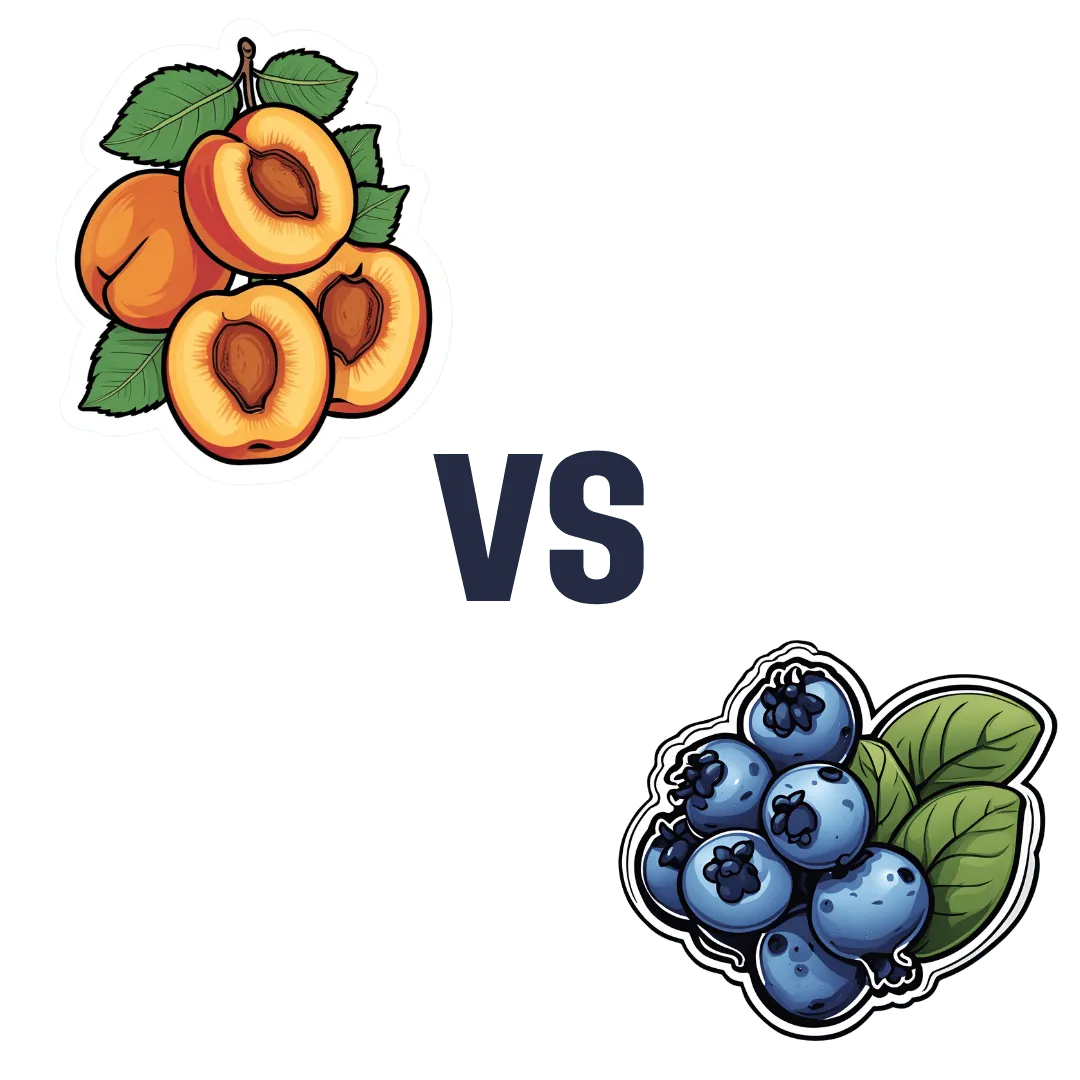
Apricots vs Blueberries – Which is Healthier?
10almonds is reader-supported. We may, at no cost to you, receive a portion of sales if you purchase a product through a link in this article.
Our Verdict
When comparing apricots to blueberries, we picked the apricots.
Why?
Both have their merits!
In terms of macros, apricots have about 2x the protein (but it’s not a lot) while blueberries have very slightly more fiber and carbs. Ultimately we’re calling this category a tie, but it could be swung one way or the other if you have strong feelings about prioritizing things.
In the category of vitamins, apricots have more of vitamins A, B3, B5, B7, B9, C, and E, while blueberries have more of vitamins B1, K, and choline. A clear win for apricots here, even before considering the huge margin of difference on vitamin A (apricots having 32x the amount that blueberries do).
When it comes to minerals, apricots have more calcium, copper, iron, magnesium, manganese, phosphorus, potassium, and zinc, while blueberries have more manganese. Another win for apricots.
Looking at phytochemicals, apricots have some cancer-killing properties, while blueberries have more polyphenols in total. Pros and cons to each, here. We’re going to call this category a tie, but as with the macros, an argument could be made for either fruit.
Adding up the sections gives us an overall win for apricots, but it’s close, and blueberries are certainly great too, so by all means enjoy either or both!
Want to learn more?
You might like:
Top 8 Fruits That Prevent & Kill Cancer
Enjoy!
Don’t Forget…
Did you arrive here from our newsletter? Don’t forget to return to the email to continue learning!
Recommended
Learn to Age Gracefully
Join the 98k+ American women taking control of their health & aging with our 100% free (and fun!) daily emails:
-
100 Hikes of a Lifetime – by Kate Siber
10almonds is reader-supported. We may, at no cost to you, receive a portion of sales if you purchase a product through a link in this article.
This is published by National Geographic, so you can imagine the quality of the photos throughout.
Inside, and after a general introduction and guide to gear and packing appropriately, it’s divided into continents, with a diverse array of “trips of a lifetime” for anyone who enjoys hiking.
It’s not a narrative book, rather, it is a guide, a little in the style of “Lonely Planet”, with many “know before you go” tips, information about the best time to go, difficult level, alternative routes if you want to get most of the enjoyment while having an easier time of it (or, conversely, if you want to see some extra sights along the way), and what to expect at all points.
Where the book really excels is in balancing inspiration with information. There are some books that make you imagine being in a place, but you’ll never actually go there. There are other books that are technical manuals but not very encouraging. This one does both; it provides the motivation and the “yes, you really can, here’s how” information that, between them, can actually get you packing and on your way.
Bottom line: if you yearn for breathtaking views and time in the great outdoors, but aren’t sure where to start, this will give you an incredible menu to choose from, and give you the tools to go about doing it.
Click here to check out 100 Hikes Of A Lifetime, and live it!
Share This Post
-
Blackberries vs Elderberries – Which is Healthier?
10almonds is reader-supported. We may, at no cost to you, receive a portion of sales if you purchase a product through a link in this article.
Our Verdict
When comparing blackberries to elderberries, we picked the elderberries.
Why?
It was super-close! But…
In terms of macros, blackberries technically have more protein, but the numbers are truly tiny, and let’s face it, nobody is eating blackberries for the protein. Meanwhile, elderberries have more fiber and carbs. We consider this a win for elderberries, based on total fiber and total macronutrients, but if you want to consider the carbs and fiber against each other, you might want to call this round a tie.
In the category of vitamins, blackberries have more of vitamins B5, B9, E, K, and choline, while elderberries have more of vitamins A, B1, B2, B6, and C. Thus, a tie here.
When it comes to minerals, blackberries have more copper, magnesium, manganese, and zinc, while elderberries have more calcium, iron, phosphorus, potassium, and selenium, adding up to marginal win for elderberries.
Looking at polyphenols, both are great but elderberries have more (mostly anthocyanins, whence the color, but also quercetin, and in both cases blackberries are good but elderberries have so much more).
Adding up the sections makes for an overall win for elderberries (grow them in your garden if you can, as stores don’t often sell elderberries), but by all means enjoy either or both; diversity is good!
Want to learn more?
You might like:
Herbs For Evidence-Based Health & Healing ← elderberry significantly hastens recovery from upper respiratory viral infections 😎
Enjoy!
Share This Post
-
Where Nutrition Meets Habits!
10almonds is reader-supported. We may, at no cost to you, receive a portion of sales if you purchase a product through a link in this article.
Where Nutrition Meets Habits…
This is Claudia Canu, MSc., INESEM. She’s on a mission to change the way we eat:
Often, diet is a case of…
- Healthy
- Easy
- Cheap
(choose two)
She wants to make it all three, and tasty too. She has her work cut out for her, but she’s already blazed quite a trail personally:
❝Nine months before turning 40 years old, I set a challenge for myself: Arrive to the day I turn 40 as the best possible version of myself, physically, mentally and emotionally.❞
~ Claudia Canu
In Her Own Words: My Journey To My Healthy 40s
And it really was quite a journey:
- September: Changes That Destabilize
- October: Looking for Focus
- November: New Habits
- December: Analyzing The First Results
- January: Traveling & Perfectionism
- February: Habits & Goals
- March: Connection, Cravings, & Organization
- April: Physical & Emotional Changes After 7 Months
- May: Reflections & Considerations
- June: Challenge Is Over
For those of us who’d like the short-cut rather than a nine-month quasi-spiritual journey… based on both her experience, and her academic and professional background in nutrition, her main priorities that she settled on were:
- Making meals actually nutritionally balanced, which meant re-thinking what she thought a meal “should” be
- Making nutritionally balanced meals that didn’t require a lot of skill and/or resources
- That’s it!
But, easier said than done… Where to begin?
She shares an extensive list of recipes, from meals to snacks (I thought I was the only one who made coffee overnight oats!), but the most important thing from her is:
Claudia’s 10 Guiding Principles:
- Buy only fresh ingredients that you are going to cook yourself. If you decide to buy pre-cooked ones, make sure they do not have added ingredients, especially sugar (in all its forms).
- Use easy and simple cooking methods.
- Change ingredients every time you prepare your meals.
- Prepare large quantities for three or four days.
- Store the food separately in tightly closed Tupperware.
- Organize yourself to always have ready-to-eat food in the fridge.
- When hungry, mix the ingredients in the ideal amounts to cover the needs of your body.
- Chew well and take the time to taste your food.
- Eat foods that you like and enjoy.
- Do not overeat but don’t undereat either.
We have only two quibbles with this fine list, which are:
About Ingredients!
Depending on what’s available around you, frozen and/or tinned “one-ingredient” foods can be as nutritional as (if not more nutritional than) fresh ones. By “one-ingredient” foods here we mean that if you buy a frozen pack of chopped onions, the ingredients list will be: “chopped onions”. If you buy a tin of tomatoes, the ingredients will say “Tomatoes” or at most “Tomatoes, Tomato Juice”, for example.
She does list the ingredients she keeps in; the idea that with these in the kitchen, you’ll never be in the position of “oh, we don’t have much in, I guess it’s a pizza delivery night” or “well there are some chicken nuggets at the back of the freezer”.
Check Out And Plan: 10 Types Of Ingredients You Should Always Keep In Your Kitchen
Here Today, Gone Tomorrow?
Preparing large quantities for three or four days can result in food for one or two days if the food is unduly delicious
But! Claudia has a remedy for that:
Read: How To Eliminate Food Cravings And What To Do When They Win
Anyway, there’s a wealth of resources in the above-linked pages, so do check them out!
Perhaps the biggest take-away is to ask yourself:
“What are my guiding principles when it comes to food?”
If you don’t have a ready answer, maybe it’s time to tackle that—whether Claudia’s way or your own!
Share This Post
Related Posts
-
The first night effect: why it’s hard to sleep when you’re somewhere new
10almonds is reader-supported. We may, at no cost to you, receive a portion of sales if you purchase a product through a link in this article.
It’s nighttime and you’re exhausted. But the hotel bed feels wrong. The mini fridge won’t stop making that low, irritating hum. The power outlet lights feel brighter than the sun. Outside, random car honks and noises make sleep feel like a distant possibility.
Many of us struggle to sleep in new environments, even when we’re physically tired. But why? The short answer: a mix of biology and psychology.
Vitaly Gariev/Unsplash Broken routines and missing sleep cues
Your brain is wired for predictability, especially at night, during our most vulnerable behaviour: sleep.
A combination of internal and external cues work together to create the right conditions for rest.
Internally, your body signals that it’s time to sleep by decreasing core body temperature and increasing the sleep-promoting hormone melatonin. This makes you less alert.
Externally, your environment needs to support these signals, not compete with it. At home, your typical pre-sleep wind-down habits and familiar surroundings tell your body it is safe to sleep.
But sleeping somewhere new often disrupts these sights, sounds and sensations your body relies on.
There may be different light levels (for example, from hotel room clocks or street lights), unfamiliar noises (such as elevators, traffic and neighbours) and different bedding (for instance, a firmer mattress or softer pillows).
And you may be doing different activities, such as eating out late or working on a laptop on your bed.
An alert brain in a new place
From an evolutionary perspective, lighter sleep or more frequent awakenings when we’re somewhere new may be protective, allowing us to detect potential threats more quickly and respond to danger.
This is known as the “first-night effect”. It means when we sleep somewhere new, our brains don’t fully switch off.
Brain activity recordings have shown that during the first night in a new environment, the left side of the brain remains more responsive to unfamiliar sounds, even during deep sleep, compared to the second night. Once we become familiar with the space, this vigilance usually fades.
But even when we start to get used to a new environment, other factors can still interfere with our sleep.
Stress, travel and emotions
Sleeping in a new environment can also be stressful.
Your brain may be running through logistics and to-do lists, thinking about your early flight, or scenarios where you forget important belongings. Maybe you’re also experiencing jet lag.
Emotions such as homesickness, excitement, anticipation or anxiety can disrupt sleep as well. Even positive stress – for example, feeling excited about a big trip – activates the same arousal systems in the brain as negative stress. The brain doesn’t distinguish why those systems are switched on.
Unfortunately, a heightened arousal system and sleep are competitors. When your stress response is active, it directly interferes with the brain’s ability to disengage and transition into sleep, even when you’re physically exhausted.
But some people actually sleep better away from home
For some of us, being away from home can actually remove everyday distractions: there are no household responsibilities, no unfinished tasks competing for attention, and clearer boundaries between “work time” and “rest time”.
The change of environment may also reduce bedtime rumination, which is often triggered by familiar home environments tied to stress, deadlines or to-do lists.
Better sleep when we are away may be to do with the amount of sleep we usually get at home. Research shows that individuals who are not getting enough sleep at home are likely to get better sleep when travelling.
If your sleep improves when you’re away, it might be an opportunity to consider how stimulating or busy your usual sleep environment has become – and what you can do to make it calmer.
Tips for sweet dreams at home or away
Reassure yourself. If you have a rough night of sleep in a new place it doesn’t mean something is “wrong” with you. It’s a normal, protective response from a brain that’s tuned to safety and familiarity. You might need a night or two to settle in.
Choose sleep-friendly accommodation when you can. Many hotels are deliberately designed to support good sleep and these features, such as pillow menus, melatonin-rich foods on the room-service menu, or even a personal sleep butler, can make a real difference.
Plan for a slower first day. If you know you’re sleeping somewhere new, expect that the first night might not be your best. Where possible, avoid scheduling demanding tasks the next morning and give yourself time to adjust.
Pack your sleep routine in your suitcase. Just as parents might do for their small child, pack your sleep routine with you. If you have a particular pillow case or a sleep mask, or a certain scent that helps you sleep at home, try bringing these with you so your brain has some familiar cues in an unfamiliar environment.
If you notice you sleep better away from home, take a look at your home sleep routine and environment. Keep your room cool and dark and make your bed comfortable with supportive pillows and fresh bedding. Establish a relaxing wind-down routine: dim lights and limit screens in the evening, and stick to consistent bed and wake times, even on weekends.
Charlotte Gupta, Sleep Researcher, Appleton Institute, HealthWise Research Group, CQUniversity Australia and Dayna Easton, Postdoctoral Research Fellow, College of Medicine and Public Health, Flinders University
This article is republished from The Conversation under a Creative Commons license. Read the original article.
Don’t Forget…
Did you arrive here from our newsletter? Don’t forget to return to the email to continue learning!
Learn to Age Gracefully
Join the 98k+ American women taking control of their health & aging with our 100% free (and fun!) daily emails:
-
Do You Know Which Supplements You Shouldn’t Take Together? (10 Pairs!)
10almonds is reader-supported. We may, at no cost to you, receive a portion of sales if you purchase a product through a link in this article.
Dr. LeGrand Peterson wants us to get the most out of our supplements, so watch out for these…
Time to split up some pairs…
In most cases these are a matter of competing for absorption; sometimes to the detriment of both, sometimes to the detriment of one or the other, and sometimes, the problem is entirely different and they just interact in a way that could potentially cause other problems. Dr. Peterson advises as follows:
- Vitamin C and vitamin B12: taking these together can reduce the absorption of Vitamin B12, as vitamin C can overpower it.
- Vitamin C and copper: high amounts of vitamin C can decrease copper absorption, especially in those who are severely copper deficient.
- Magnesium and calcium: these two minerals compete for absorption in the intestines, potentially reducing the effectiveness of both.
- Calcium and iron: calcium can decrease iron absorption, so they should not be taken together, especially if you are iron deficient.
- Calcium and zinc: calcium also competes with zinc, reducing zinc absorption; they should be taken at different times.
- Zinc and copper: zinc and copper compete for absorption, so they should be taken at separate times.
- Iron and zinc: iron can decrease zinc absorption, and thus, they should not be taken together.
- Iron and green tea: perhaps a surprising one, but green tea can reduce iron absorption, so they should not be taken simultaneously.
- Vitamin E and vitamin K: vitamin E increases bleeding risk, while vitamin K promotes clotting, making them opposites and risky to take together.
- Fish oil and ginkgo biloba: both are anticoagulants and can increase the risk of bleeding, especially if taken with blood thinners like warfarin.
If you need to take supplements that compete (or conflict or otherwise potentially adversely interact) with each other, it’s recommended to separate them by at least 4 hours, or better yet, take one in the morning and the other at night. If in doubt, do speak with your pharmacist or doctor for personalized advice
You may be thinking: half my foods contain half of these nutrients! And yes, assuming you have a nutritionally dense diet, this is probably the case. Foods typically release nutrients more slowly than supplements, and unlike supplements, do not usually contain megadoses (although they can, such as the selenium content of Brazil nuts, or vitamin A in carrots). Basically, food is in most cases safer and gentler than supplements. If concerned, do speak with your nutritionist or doctor for personalized advice.
For more information on all of these, enjoy:
Click Here If The Embedded Video Doesn’t Load Automatically!
Want to learn more?
You might also like to read:
Do We Need Supplements, And Do They Work?
Take care!
Don’t Forget…
Did you arrive here from our newsletter? Don’t forget to return to the email to continue learning!
Learn to Age Gracefully
Join the 98k+ American women taking control of their health & aging with our 100% free (and fun!) daily emails:
-
Sugar Blues – by William Dufty
10almonds is reader-supported. We may, at no cost to you, receive a portion of sales if you purchase a product through a link in this article.
This is a “read it cover to cover” book. It charts the rise of sugar’s place in world diets in general and the American diet in particular, and draws many conclusions about the effect this has had on us.
This book will challenge you. Sometimes, it will change your mind. Sometimes, you’ll go “no, I’m sure that’s not right”, and you’ll go Googling. Either way, you’ll learn something.
And that, for us, is the most important measure of any informational book: did we gain something from it? In Sugar Blues, perhaps the single biggest “gain” for the reader is that it’s an eye-opener and a call-to-arms—the extent to which you heed that is up to you, but it sure is good to at least be familiar with the battlefield.
Don’t Forget…
Did you arrive here from our newsletter? Don’t forget to return to the email to continue learning!
Learn to Age Gracefully
Join the 98k+ American women taking control of their health & aging with our 100% free (and fun!) daily emails:


