
Alzheimer’s may have once spread from person to person, but the risk of that happening today is incredibly low

10almonds is reader-supported. We may, at no cost to you, receive a portion of sales if you purchase a product through a link in this article.

An article published this week in the prestigious journal Nature Medicine documents what is believed to be the first evidence that Alzheimer’s disease can be transmitted from person to person.

The finding arose from long-term follow up of patients who received human growth hormone (hGH) that was taken from brain tissue of deceased donors.

Preparations of donated hGH were used in medicine to treat a variety of conditions from 1959 onwards – including in Australia from the mid 60s.

The practice stopped in 1985 when it was discovered around 200 patients worldwide who had received these donations went on to develop Creuztfeldt-Jakob disease (CJD), which causes a rapidly progressive dementia. This is an otherwise extremely rare condition, affecting roughly one person in a million.

What’s CJD got to do with Alzehimer’s?

CJD is caused by prions: infective particles that are neither bacterial or viral, but consist of abnormally folded proteins that can be transmitted from cell to cell.

Other prion diseases include kuru, a dementia seen in New Guinea tribespeople caused by eating human tissue, scrapie (a disease of sheep) and variant CJD or bovine spongiform encephalopathy, otherwise known as mad cow disease. This raised public health concerns over the eating of beef products in the United Kingdom in the 1980s.

Human growth hormone used to come from donated organs

Human growth hormone (hGH) is produced in the brain by the pituitary gland. Treatments were originally prepared from purified human pituitary tissue.

But because the amount of hGH contained in a single gland is extremely small, any single dose given to any one patient could contain material from around 16,000 donated glands.

An average course of hGH treatment lasts around four years, so the chances of receiving contaminated material – even for a very rare condition such as CJD – became quite high for such people.

hGH is now manufactured synthetically in a laboratory, rather than from human tissue. So this particular mode of CJD transmission is no longer a risk.
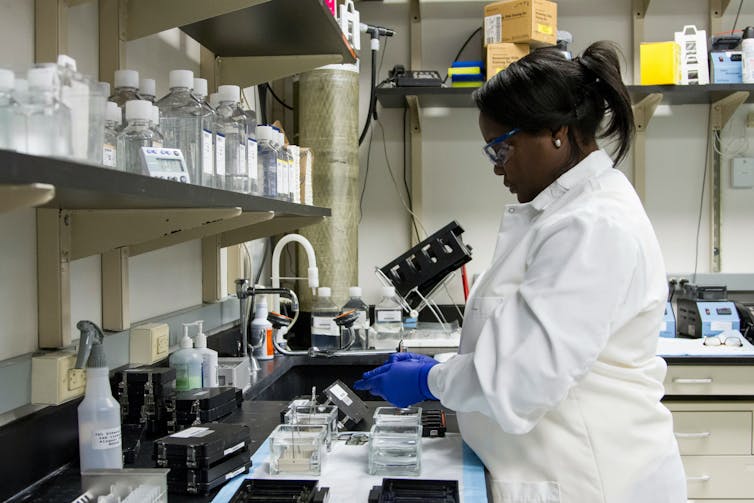
Scientist in a lab
Human growth hormone is now produced in a lab.
National Cancer Institute/Unsplash

What are the latest findings about Alzheimer’s disease?

The Nature Medicine paper provides the first evidence that transmission of Alzheimer’s disease can occur via human-to-human transmission.

The authors examined the outcomes of people who received donated hGH until 1985. They found five such recipients had developed early-onset Alzheimer’s disease.

They considered other explanations for the findings but concluded donated hGH was the likely cause.

Given Alzheimer’s disease is a much more common illness than CJD, the authors presume those who received donated hGH before 1985 may be at higher risk of developing Alzheimer’s disease.

Alzheimer’s disease is caused by presence of two abnormally folded proteins: amyloid and tau. There is increasing evidence these proteins spread in the brain in a similar way to prion diseases. So the mode of transmission the authors propose is certainly plausible.

However, given the amyloid protein deposits in the brain at least 20 years before clinical Alzheimer’s disease develops, there is likely to be a considerable time lag before cases that might arise from the receipt of donated hGH become evident.

When was this process used in Australia?

In Australia, donated pituitary material was used from 1967 to 1985 to treat people with short stature and infertility.

More than 2,000 people received such treatment. Four developed CJD, the last case identified in 1991. All four cases were likely linked to a single contaminated batch.

The risks of any other cases of CJD developing now in pituitary material recipients, so long after the occurrence of the last identified case in Australia, are considered to be incredibly small.

Early-onset Alzheimer’s disease (defined as occurring before the age of 65) is uncommon, accounting for around 5% of all cases. Below the age of 50 it’s rare and likely to have a genetic contribution.

Older man places his hands on his head
Early onset Alzheimer’s means it occurs before age 65.
perfectlab/Shutterstock

The risk is very low – and you can’t ‘catch’ it like a virus

The Nature Medicine paper identified five cases which were diagnosed in people aged 38 to 55. This is more than could be expected by chance, but still very low in comparison to the total number of patients treated worldwide.

Although the long “incubation period” of Alzheimer’s disease may mean more similar cases may be identified in the future, the absolute risk remains very low. The main scientific interest of the article lies in the fact it’s first to demonstrate that Alzheimer’s disease can be transmitted from person to person in a similar way to prion diseases, rather than in any public health risk.

The authors were keen to emphasise, as I will, that Alzheimer’s cannot be contracted via contact with or providing care to people with Alzheimer’s disease.The Conversation

Steve Macfarlane, Head of Clinical Services, Dementia Support Australia, & Associate Professor of Psychiatry, Monash University

This article is republished from The Conversation under a Creative Commons license. Read the original article.

Don’t Forget…

Did you arrive here from our newsletter? Don’t forget to return to the email to continue learning!

Learn to Age Gracefully

Join the 98k+ American women taking control of their health & aging with our 100% free (and fun!) daily emails:

  • Self-Care for Tough Times – by Suzy Reading

    10almonds is reader-supported. We may, at no cost to you, receive a portion of sales if you purchase a product through a link in this article.

    A note on the author: while not “Dr. Reading”, she is a “CPsychol, B Psych (Hons), M Psych”; a Chartered Psychologist specializing in wellbeing, stress management and facilitation of healthy lifestyle change. So this is coming from a place of research and evidence!

    The kinds of “tough times” she has in mind are so numerous that listing them takes two pages in the book, so we won’t try here. But suffice it to say, there are a lot of things that can go wrong for us as humans, and this book addresses how to take care of ourselves mindfully in light of them.

    The author takes a “self-care is health care” approach, and goes about things with a clinical mindset and/but a light tone, offering both background information, and hands-on practical advice.

    Bottom line: there may be troubles ahead (and maybe you’re in the middle of troubles right now), but there’s always room for a little sunshine too.

    Click here to check out Self-Care For Tough Times, and care for yourself in tough times!

    Share This Post

  • 10almonds Tells The Tea…

    10almonds is reader-supported. We may, at no cost to you, receive a portion of sales if you purchase a product through a link in this article.

    Let’s Bust Some Myths!

    It’s too late after puberty, hormones won’t change xyz

    While yes, many adult trans people dearly wish they’d been able to medically transition before going through the “wrong” puberty, the truth is that a lot of changes will still occur later… even to “unchangeable” things like the skeleton.

    The body is remaking itself throughout life, and hormones tell it how to do that. Some parts are just quicker or slower than others. Also: the skeleton is pulled-on constantly by our muscles, and in a battle of muscle vs bone, muscle will always win over time.

    Examples of this include:

    • trans men building bigger bones to support their bigger muscles
    • trans women getting smaller, with wider hips and a pelvic tilt

    Trans people have sporting advantages

    Assuming at least a year’s cross-sex hormonal treatment, there is no useful advantage to being trans when engaging in a sport. There are small advantages and disadvantages (which goes for any person’s body, really). For example:

    • Trans women will tend to be taller than cis women on average…
      • …but that larger frame is now being powered by smaller muscles, because they shrink much quicker than the skeleton.
    • Trans men taking T are the only athletes allowed to take testosterone…
      • …but they will still often be smaller than their fellow male competitors, for example.

    Read: Do Trans Women Athletes Have Advantages? (A rather balanced expert overview, which does also cover trans men)

    There’s a trans population explosion; it’s a social contagion epidemic!

    Source for figures: The Overall Rate Of Left-Handedness (Researchgate)

    Left-handed people used to make up around 3% of the population… Until the 1920s, when that figure jumped sharply upwards, before plateauing at around 12% in around 1960, where it’s stayed since. What happened?! Simple, schools stopped forcing children to use their right hand.

    Today, people ask for trans healthcare because they know it exists! Decades ago, it wasn’t such common knowledge.

    The same explanation can be applied to other “population explosions” such as for autism and ADHD.

    Fun fact: Mt. Everest was “discovered” in 1852, but scientists suspect it probably existed long before then! People whose ancestors were living on it long before 1852 also agree. Sometimes something exists for a long time, and only comes to wider public awareness later.

    Transgender healthcare is too readily available, especially to children!

    To believe some press outlets, you’d think:

    • HRT is available from school vending machines,
    • kids can get a walk-in top surgery at recess,
    • and there’s an after-school sterilization club.

    In reality, while availability varies from place to place, trans healthcare is heavily gatekept. Even adults have trouble getting it, often having to wait years and/or pay large sums of money… and get permission from a flock of doctors, psychologists, and the like. For those under the age of 18, it’s almost impossible in many places, even with parental support.

    Puberty-blockers shouldn’t be given to teenagers, as the effects are irreversible

    Quick question: who do you think should be given puberty-blockers? For whom do you think they were developed? Not adults, for sure! They were not developed for trans teens either, but for cis pre-teens with precocious puberty, to keep puberty at bay, to do it correctly later. Nobody argues they’re unsafe for much younger cis children, and only object when it’s trans teens.

    They’re not only safe and reversible, but also self-reversing. Stop taking them, and the normally scheduled puberty promptly ensues by itself. For trans kids, the desired effect is to buy the kid time to make an informed and well-considered decision. After all, the effects of the wrong puberty are really difficult to undo!

    A lot of people rush medical transition and regret it!

    Trans people wish it could be rushed! It’s a lot harder to get gender-affirming care as a trans person, than it is to get the same (or comparable) care as a cis person. Yes, cis people get gender-affirming care, from hormones to surgeries, and have done for a long time.

    As for regret… Medical transition has around a 1% regret rate. For comparison, hip replacement has a 4.8% regret rate and knee replacement has a 17.1% regret rate.

    A medical procedure with a 99% success rate would generally be considered a miracle cure!

    Share This Post

  • 52 Small Changes – by Brett Blumenthal

    10almonds is reader-supported. We may, at no cost to you, receive a portion of sales if you purchase a product through a link in this article.

    We see a lot of books that exhort us to get a six-pack in a month, change our life in 7 days, learn Japanese in 24 hours. The reality is, things take time!

    Brett Blumenthal is more realistic while being just as motivational:

    The idea is simple… Make one small change per week for 52 weeks, and at the end of the year, you’ll be healthier and happier.

    At 10almonds, we’re big fans of small changes that add up (or rather: compound!) to make big differences, so this one’s absolutely our style!

    Best of all, she offers us not just “do this” advice, but also “and here’s the information and resources you’ll need to make this change work the best it can for you”

    The advices range in topic from nutrition to exercise to sleep to mental wellness to interpersonal stuff and more. The biggest focus is on personal health, though, with small changes to exercise and nutrition making up the lion’s share of the changes.

    Bottom line: this is a book you’ll want to grab once a week. Consider setting a reminder on your phone to check in with it each Sunday, for example!

    Take the first step and order “52 Small Changes” from Amazon today!

    Share This Post

  • How To Escape From A Despairing Mood

    10almonds is reader-supported. We may, at no cost to you, receive a portion of sales if you purchase a product through a link in this article.

    When we are in a despairing mood, that’s when it can feel hardest to actually implement anything we know about getting out of one. That’s why sometimes, the simplest solutions are the best:

    Imagination Is Key

    Despairing moods occur when it’s hard to envision a better life. Imagination is the power to envision alternatives, such as new jobs, relationships, or lifestyle, but sadness can cloud our ability to imagine solutions like changing careers, moving house, or starting fresh. With enough imagination, most problems can be worked around—and new opportunities can always be found.

    Importantly: we are not bound by our past or present circumstances; we have the freedom and flexibility to choose new paths. That doesn’t mean it’ll always be a walk in the park, but “this too shall pass”.

    You may be thinking: “sometimes the hardship does pass, but can last many years”, and that is true. All the more reason to check if there’s a freer lane you can slip into to speed ahead. Even if there isn’t, the mere act of imagining such lanes is already respite from the hardships—and having envisioned such will make it much easier for you to recognise when opportunities for change do come along.

    To foster imagination, we are advised to expose ourselves to different narratives, preparing ourselves for alternative ways of living. Thus, we can reframe life’s challenges as intellectual puzzles, urging us to rebuild creatively and find new solutions!

    For more on all this, enjoy:

    Click Here If The Embedded Video Doesn’t Load Automatically!

    Want to learn more?

    You might also like to read:

    Behavioral Activation Against Depression & Anxiety

    Take care!

    Don’t Forget…

    Did you arrive here from our newsletter? Don’t forget to return to the email to continue learning!

    Learn to Age Gracefully

    Join the 98k+ American women taking control of their health & aging with our 100% free (and fun!) daily emails:

  • Anticancer: A New Way Of Life – by Dr. David Servan-Schreiber

    10almonds is reader-supported. We may, at no cost to you, receive a portion of sales if you purchase a product through a link in this article.

    A cancer survivor himself, Dr. Servan-Schreiber found himself unimpressed with the advice he was given upon diagnosis, and set out to find better. This, he achieved.

    He first provides an introductory overview of cancer, and then devotes most of the book to detailing how to create a “terrain” (the environment of your body and all that you do with/to it) that is hostile to cancer.

    This includes things like diet, of course, but also exercise (the right way!), mindset, and much more. He doesn’t cover much about standard medical treatments, as he assumes the reader will already be advised about those by their oncologist, and in any case, such treatments are constantly changing as new discoveries are made. It’s worth mentioning that while he advocates strongly for complementary medicine, he does also make clear it should be just that—complementary—and not a replacement for regular treatments in cases where such are recommended.

    The style is comprehensible pop-science, written for the lay reader, and yet with copious scientific references—more than 30 pages thereof. But as well as that, it’s a personal account, often revisiting his own cancer journey to illustrate one point or another, be it something that went well for him or badly, there’s always something to learn.

    Bottom line: this book is important for anyone facing cancer, and useful for anyone who simply would like to improve their odds in a more informed fashion. As he notes, “all of us have cancer cells in our bodies, but not all of us will develop cancer”, and it’s good to try to be on the healthiest side of that.

    Click here to check out Anticancer, and live an anticancer life!

    Don’t Forget…

    Did you arrive here from our newsletter? Don’t forget to return to the email to continue learning!

    Learn to Age Gracefully

    Join the 98k+ American women taking control of their health & aging with our 100% free (and fun!) daily emails:

  • Alzheimer’s vs Cancer

    10almonds is reader-supported. We may, at no cost to you, receive a portion of sales if you purchase a product through a link in this article.

    Alzheimer’s is of course not good, and neither is cancer. Don’t worry, you don’t have to choose between them!

    However, people don’t usually get both. Now, we could argue that people prone to cancer are more likely to die before getting Alzheimer’s, but there’s more to it than that, to the point that one may provide a therapeutic approach to keep the other at bay.

    It’s about the T-cells

    People with Alzheimer’s are far less likely to develop cancer.

    How much less likely, you wonder? Researchers (Dr. Kalyani Sonawane et al.) found that people aged 60+ with Alzheimer’s are 21x less likely to get cancer than those without, and that’s based on a 5-year risk ratio, looking at people who survived the duration, so it’s not a case of “people died of one before they had a chance to get the other”.

    Further, Dr. Sonawane and her team found that although amyloid-β harms neurons by disrupting mitophagy (the removal of damaged mitochondria), it benefits cancer-fighting T-cells by preserving their mitochondria, providing more energy for anti-tumour activity. This cuts both ways with the same blade, so to speak, because amyloid-β depletes fumarate, a molecule that prevents excessive mitophagy; restoring fumarate levels helps maintain healthy mitochondria and boosts T-cell energy.

    What does this mean in practical terms? When they tested this by transplanting mitochondria from Alzheimer’s patients’ T-cells into aging T-cells, the older cells regained youthful energy and function.

    And that’s why we said “don’t worry, you don’t have to choose between them”, as you don’t need to get Alzheimer’s to get the protective effect that Alzheimer’s gives vs cancer; doctors just need to do one or both of:

    • transplanting healthy mitochondria from Alzheimer’s patients
    • supplementing fumarate (which has the benefit of not relying on mitochondrial donations from Alzheimer’s patients)

    You find the paper itself, here: Alzheimer’s Disease–Associated Amyloid-β Precursor Protein Prevents Aging Stress–Induced Mitophagy and Fumarate Depletion to Improve Antitumor Immunity

    Want to know more?

    You can tackle both problems at once, without conflict:

    5 Ways To Beat Cancer (And Other Diseases)

    …and further, for women at least, there’s another thing that reduces the risk of both Alzheimer’s and several kinds of cancer:

    Alzheimer’s Sex Differences May Not Be What They Appear ← this is about hormones

    On which note, lastly, you might want to consider: The Hormone Therapy That Reduces Breast Cancer Risk & More

    Take care!

    Don’t Forget…

    Did you arrive here from our newsletter? Don’t forget to return to the email to continue learning!

    Learn to Age Gracefully

    Join the 98k+ American women taking control of their health & aging with our 100% free (and fun!) daily emails: