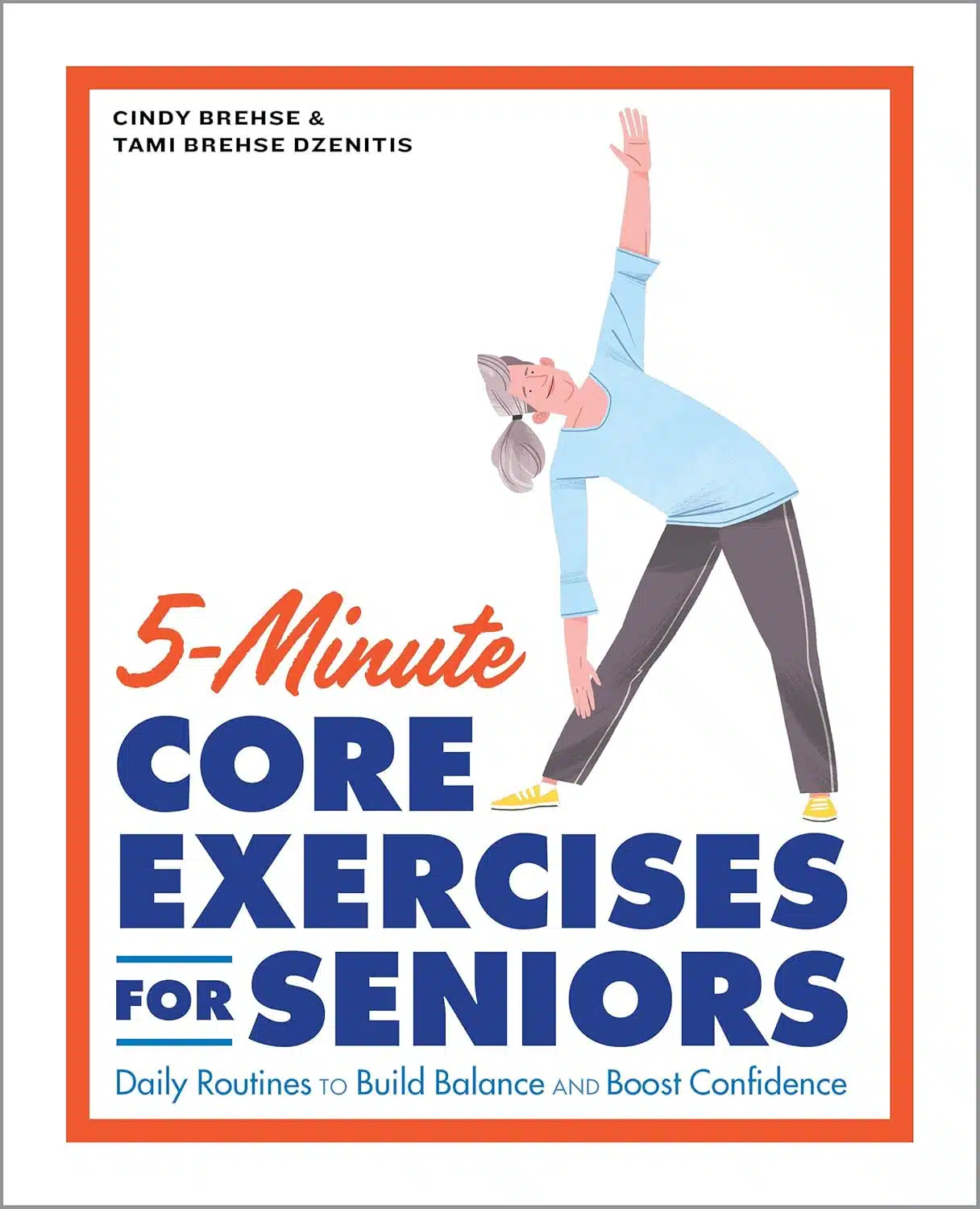
5-Minute Core Exercises For Seniors – by Cindy Brehse & Tami Brehse-Dzenitis

10almonds is reader-supported. We may, at no cost to you, receive a portion of sales if you purchase a product through a link in this article.

The authors are a mother-and-daughter team, instructors in the Athletics and Fitness Association of America, and Cindy Brehse (the mother of co-author Tami Brehse-Dzenitis) is also a Silver Sneakers instructor, and a Golden Hearts Active At Any Age Fitness Specialist. They’ve both made a career out of helping people to get the most out of their bodies.

The primary goal of this book—on which it delivers—is to provide core exercise that can be done by almost anyone, while still actually building strength, mobility, etc, without the need for a gym membership or expensive equipment.

They offer individual exercises and routines, including sections specifically designed for various purposes, such as improving stability, improving mobility, relieving various aches and pains, etc. There are also modification tips for each exercise, i.e. how to increase or decrease the intensity of each, to meet your personal needs.

The style is very light pop-science with minimal jargon and very clear explanations. The lightness of scientific content is reflected in its one-page bibliography (when many books of this genre have 10 or 20 pages of bibliography).

Bottom line: if you’d like to improve your core fitness, but aren’t about to embark on an intensive CrossFit training regimen or such, but would like to nevertheless see results, then this book is a fine option.

Click here to check out 5-Minute Core Exercises For Seniors, and build your core strength and fitness!

Don’t Forget…

Did you arrive here from our newsletter? Don’t forget to return to the email to continue learning!

Learn to Age Gracefully

Join the 98k+ American women taking control of their health & aging with our 100% free (and fun!) daily emails:

  • Glucose Revolution – by Jessie Inchauspé

    10almonds is reader-supported. We may, at no cost to you, receive a portion of sales if you purchase a product through a link in this article.

    While we all know that keeping balanced blood sugars is important for all us (be we diabetic, pre-diabetic, or not at all), it can be a mystifying topic!

    Beyond a generic “sugar is bad”…

    • What does it all mean and how does it all work?
    • Should we go low-carb?
    • What’s the deal with fruit?
    • Carbs or protein for breakfast?
    • Is “quick energy” ever a good thing?
    • How do starches weigh in again?

    It’s all so confusing!

    Happily, Jessie Inchauspé has the incredible trifecta of qualifications to help us: she’s a biochemist, a keen cook, and a great educator. What we mean by this latter is:

    Instead of dry textbook explanations, or “trust me” hand-waives, she explains biochemistry in a clear, simple, digestible (if you’ll pardon the pun) way with very helpful diagrams what things cause (or flatten) blood sugar spikes and how and why. If you read this book, you will understand, without guesswork or gaps, exactly what is happening on a physical level, and why and how her “10 hacks” work.

    Her “10 hacks” are explained so thoroughly that each gets a chapter of its own, but we’ll not keep them a mystery from you meanwhile, they are:

    1. Eat foods in the right order
    2. Add a green starter to your meals
    3. Stop counting calories
    4. Flatten your breakfast curve
    5. Have any type of sugar you like—they’re all the same
    6. Pick dessert over a sweet snack
    7. Reach for the vinegar before you eat
    8. After you eat, move
    9. If you have to snack, go savoury
    10. Put some clothes on your carbs

    She then finishes up with a collection of handy cheat-sheets and some of her own recipes.

    Bottom line: this isn’t just a “how-to” book. It gives the how-to, yes, but it also gives such good explanations that you’ll never be confused again by what’s going on in your glucose-related health.

    Get your copy of Jessie Inchauspé’s #1 international bestseller, “Glucose Revolution”, from Amazon today!

    Share This Post

  • 5 Exercises That Fix Stiff Shoulders

    10almonds is reader-supported. We may, at no cost to you, receive a portion of sales if you purchase a product through a link in this article.

    Shoulders are often one of the first places people lose mobility, but it doesn’t have to be that way:

    Reach for good health

    It’s about more than just stretching! This is because stretching without strengthening leaves shoulder movement gaps that create imbalances, pain, and recurring stiffness.

    How a lot of people think of the shoulder as moving: a spectrum from forwards/down/in, to up/back/out.

    How the shoulder actually moves: it’s a ball joint that works through flexion, extension, abduction, adduction, internal rotation, external rotation, and circumduction, and a restriction in even one direction can cause pain elsewhere.

    So, what we’re looking for here is to restore full-range shoulder motion, while building strength and control so your shoulders open up and stay pain-free.

    Here’s how:

    1. Overhead compression reach: sit on your heels, squeeze an object between your hands, engage your core with a posterior pelvic tilt, and raise your straight arms overhead under control, (when you’re ready) progress it by using a resistance band to gently pull your arms back while you maintain full-body stability.
    2. Wall-supported shoulder mobility sequence: stand with your entire back against a wall, slide your straight arms overhead, lower to a 90° elbow position, rotate your forearms internally and externally, and (when you’re ready) progress it by performing prone alternating arm pulls with light resistance while keeping your body grounded.
    3. Plank shoulder opener: start in a plank, push your chest down while lifting your hips to open your shoulders and upper back, and (when you’re ready) progress it by elevating your feet and adding controlled alternating shoulder taps at the top position.
    4. Thoracic-supported shoulder reach: lie back over a ball with your hips on the floor, lower your straight arms towards the ground to open your shoulders, and (when you’re ready) progress it by supporting your upper back on a bench and coordinating arm movement with a controlled hip drop.
    5. Hanging shoulder decompression: hang from a bar with relaxed arms and steady breathing to decompress your shoulders and spine, and (when you’re ready) progress it by actively pulling your shoulder blades down and back without bending your elbows.

    For more on all of this plus visual demonstrations, enjoy:

    Click Here If The Embedded Video Doesn’t Load Automatically!

    Want to learn more?

    You might also like:

    Mobility For Now & For Later: Train For The Marathon That Is Your Life!

    Take care!

    Share This Post

  • Awakening Your Ikigai – by Dr. Ken Mogi

    10almonds is reader-supported. We may, at no cost to you, receive a portion of sales if you purchase a product through a link in this article.

    It’s been well-established in supercentenarian studies that one of the key factors beyond diet or exercise or suchlike (important as those things definitely are), is having a purpose to one’s life.

    Neuroscientist Dr. Ken Mogi explains in this very easy-to-read book, how we can bring ikigai into our lives.

    From noticing the details of the small things in life, to reorienting one’s life around what’s most truly most important to us, Dr. Mogi gives us not just a “this is ikigai” exposé, but rather, a practical and readily applicable how-to guide.

    Bottom line: if you’ve so far been putting off ikigai as “I’ll get to that”, the time to start is today.

    Click here to check out Awakening Your Ikigai, and actually awaken yours!

    Share This Post

  • Teen Daily Delivery Requested

    10almonds is reader-supported. We may, at no cost to you, receive a portion of sales if you purchase a product through a link in this article.

    It’s Q&A Day at 10almonds!

    Have a question or a request? You can always hit “reply” to any of our emails, or use the feedback widget at the bottom!

    In cases where we’ve already covered something, we might link to what we wrote before, but will always be happy to revisit any of our topics again in the future too—there’s always more to say!

    As ever: if the question/request can be answered briefly, we’ll do it here in our Q&A Thursday edition. If not, we’ll make a main feature of it shortly afterwards!

    So, no question/request too big or small

    I thoroughly enjoy your daily delivery. I’d love to see one for teens too!

    That’s great to hear! The average age of our subscribers is generally rather older, but it’s good to know there’s an interest in topics for younger people. We’ll bear that in mind, and see what we can do to cater to that without alienating our older readers!

    That said: it’s never too soon to be learning about stuff that affects us when we’re older—there are lifestyle factors at 20 that affect Alzheimer’s risk at 60, for example (e.g. drinking—excessive drinking at 20* is correlated to higher Alzheimer’s risk at 60).

    *This one may be less of an issue for our US readers, since the US doesn’t have nearly as much of a culture of drinking under 21 as some places. Compare for example with general European practices of drinking moderately from the mid-teens, or the (happily, diminishing—but historically notable) British practice of drinking heavily from the mid-teens.

    Don’t Forget…

    Did you arrive here from our newsletter? Don’t forget to return to the email to continue learning!

    Learn to Age Gracefully

    Join the 98k+ American women taking control of their health & aging with our 100% free (and fun!) daily emails:

  • Cost of living: if you can’t afford as much fresh produce, are canned veggies or frozen fruit just as good?

    10almonds is reader-supported. We may, at no cost to you, receive a portion of sales if you purchase a product through a link in this article.

    The cost of living crisis is affecting how we spend our money. For many people, this means tightening the budget on the weekly supermarket shop.

    One victim may be fresh fruit and vegetables. Data from the Australian Bureau of Statistics (ABS) suggests Australians were consuming fewer fruit and vegetables in 2022–23 than the year before.

    The cost of living is likely compounding a problem that exists already – on the whole, Australians don’t eat enough fruit and vegetables. Australian dietary guidelines recommend people aged nine and older should consume two serves of fruit and five serves of vegetables each day for optimal health. But in 2022 the ABS reported only 4% of Australians met the recommendations for both fruit and vegetable consumption.

    Fruit and vegetables are crucial for a healthy, balanced diet, providing a range of vitamins and minerals as well as fibre.

    If you can’t afford as much fresh produce at the moment, there are other ways to ensure you still get the benefits of these food groups. You might even be able to increase your intake of fruit and vegetables.

    New Africa/Shutterstock

    Frozen

    Fresh produce is often touted as being the most nutritious (think of the old adage “fresh is best”). But this is not necessarily true.

    Nutrients can decline in transit from the paddock to your kitchen, and while the produce is stored in your fridge. Frozen vegetables may actually be higher in some nutrients such as vitamin C and E as they are snap frozen very close to the time of harvest. Variations in transport and storage can affect this slightly.

    Minerals such as calcium, iron and magnesium stay at similar levels in frozen produce compared to fresh.

    Another advantage to frozen vegetables and fruit is the potential to reduce food waste, as you can use only what you need at the time.

    A close up of frozen vegetables (peas, carrot and corn).
    Freezing preserves the nutritional quality of vegetables and increases their shelf life. Tohid Hashemkhani/Pexels

    As well as buying frozen fruit and vegetables from the supermarket, you can freeze produce yourself at home if you have an oversupply from the garden, or when produce may be cheaper.

    A quick blanching prior to freezing can improve the safety and quality of the produce. This is when food is briefly submerged in boiling water or steamed for a short time.

    Frozen vegetables won’t be suitable for salads but can be eaten roasted or steamed and used for soups, stews, casseroles, curries, pies and quiches. Frozen fruits can be added to breakfast dishes (with cereal or youghurt) or used in cooking for fruit pies and cakes, for example.

    Canned

    Canned vegetables and fruit similarly often offer a cheaper alternative to fresh produce. They’re also very convenient to have on hand. The canning process is the preservation technique, so there’s no need to add any additional preservatives, including salt.

    Due to the cooking process, levels of heat-sensitive nutrients such as vitamin C will decline a little compared to fresh produce. When you’re using canned vegetables in a hot dish, you can add them later in the cooking process to reduce the amount of nutrient loss.

    To minimise waste, you can freeze the portion you don’t need.

    Fermented

    A jar of red peppers in oil.
    Fermented vegetables are another good option. Angela Khebou/Unsplash

    Fermentation has recently come into fashion, but it’s actually one of the oldest food processing and preservation techniques.

    Fermentation largely retains the vitamins and minerals in fresh vegetables. But fermentation may also enhance the food’s nutritional profile by creating new nutrients and allowing existing ones to be absorbed more easily.

    Further, fermented foods contain probiotics, which are beneficial for our gut microbiome.

    5 other tips to get your fresh fix

    Although alternatives to fresh such as canned or frozen fruit and vegetables are good substitutes, if you’re looking to get more fresh produce into your diet on a tight budget, here are some things you can do.

    1. Buy in season

    Based on supply and demand principles, buying local seasonal vegetables and fruit will always be cheaper than those that are imported out of season from other countries.

    2. Don’t shun the ugly fruit and vegetables

    Most supermarkets now sell “ugly” fruit and vegetables, that are not physically perfect in some way. This does not affect the levels of nutrients in them at all, or their taste.

    A mother and daughter preparing food in the kitchen.
    Buying fruit and vegetables during the right season will be cheaper. August de Richelieu/Pexels

    3. Reduce waste

    On average, an Australian household throws out A$2,000–$2,500 worth of food every year. Fruit, vegetables and bagged salad are the three of the top five foods thrown out in our homes. So properly managing fresh produce could help you save money (and benefit the environment).

    To minimise waste, plan your meals and shopping ahead of time. And if you don’t think you’re going to get to eat the fruit and vegetables you have before they go off, freeze them.

    4. Swap and share

    There are many websites and apps which offer the opportunity to swap or even pick up free fresh produce if people have more than they need. Some local councils are also encouraging swaps on their websites, so dig around and see what you can find in your local area.

    5. Gardening

    Regardless of how small your garden is you can always plant produce in pots. Herbs, rocket, cherry tomatoes, chillies and strawberries all grow well. In the long run, these will offset some of your cost on fresh produce.

    Plus, when you have put the effort in to grow your own produce, you are less likely to waste it.

    Evangeline Mantzioris, Program Director of Nutrition and Food Sciences, Accredited Practising Dietitian, University of South Australia

    This article is republished from The Conversation under a Creative Commons license. Read the original article.

    Don’t Forget…

    Did you arrive here from our newsletter? Don’t forget to return to the email to continue learning!

    Learn to Age Gracefully

    Join the 98k+ American women taking control of their health & aging with our 100% free (and fun!) daily emails:

  • Come As You Are – by Dr. Emily Nagoski

    10almonds is reader-supported. We may, at no cost to you, receive a portion of sales if you purchase a product through a link in this article.

    We’ve all heard the jokes, things like: Q: “Why is the clitoris like Antarctica?” A: “Most men know it’s there; most don’t give a damn”

    But… How much do people, in general, really know about the anatomy and physiology of sexual function? Usually very little, but often without knowing how little we know.

    This book looks to change that. Geared to a female audience, but almost everyone will gain useful knowledge from this.

    The writing style is very easy-to-read, and there are “tl;dr” summaries for those who prefer to skim for relevant information in this rather sizeable (400 pages) tome.

    Yes, that’s “what most people don’t know”. Four. Hundred. Pages.

    We recommend reading it. You can thank us later!

    Get your copy of Come As You Are from Amazon today!

    Don’t Forget…

    Did you arrive here from our newsletter? Don’t forget to return to the email to continue learning!

    Learn to Age Gracefully

    Join the 98k+ American women taking control of their health & aging with our 100% free (and fun!) daily emails: