
4 things ancient Greeks and Romans got right about mental health

10almonds is reader-supported. We may, at no cost to you, receive a portion of sales if you purchase a product through a link in this article.

According to the World Health Organization, about 280 million people worldwide have depression and about one billion have a mental health problem of any kind.

People living in the ancient world also had mental health problems. So, how did they deal with them?

As we’ll see, some of their insights about mental health are still relevant today, even though we might question some of their methods.
Jr Morty/Shutterstock

1. Our mental state is important

Mental health problems such as depression were familiar to people in the ancient world. Homer, the poet famous for the Iliad and Odyssey who lived around the eighth century BC, apparently died after wasting away from depression.

Already in the late fifth century BC, ancient Greek doctors recognised that our health partly depends on the state of our thoughts.

In the Epidemics, a medical text written in around 400BC, an anonymous doctor wrote that our habits about our thinking (as well as our lifestyle, clothing and housing, physical activity and sex) are the main determinants of our health.

Bronze statue of Homer on Greek island of IOS
Homer, the ancient Greek poet, had depression. Thirasia/Shutterstock

2. Mental health problems can make us ill

Also writing in the Epidemics, an anonymous doctor described one of his patients, Parmeniscus, whose mental state became so bad he grew delirious, and eventually could not speak. He stayed in bed for 14 days before he was cured. We’re not told how.

Later, the famous doctor Galen of Pergamum (129-216AD) observed that people often become sick because of a bad mental state:

It may be that under certain circumstances ‘thinking’ is one of the causes that bring about health or disease because people who get angry about everything and become confused, distressed and frightened for the slightest reason often fall ill for this reason and have a hard time getting over these illnesses.

Galen also described some of his patients who suffered with their mental health, including some who became seriously ill and died. One man had lost money:

He developed a fever that stayed with him for a long time. In his sleep he scolded himself for his loss, regretted it and was agitated until he woke up. While he was awake he continued to waste away from grief. He then became delirious and developed brain fever. He finally fell into a delirium that was obvious from what he said, and he remained in this state until he died.

3. Mental illness can be prevented and treated

In the ancient world, people had many different ways to prevent or treat mental illness.

The philosopher Aristippus, who lived in the fifth century BC, used to advise people to focus on the present to avoid mental disturbance:

concentrate one’s mind on the day, and indeed on that part of the day in which one is acting or thinking. Only the present belongs to us, not the past nor what is anticipated. The former has ceased to exist, and it is uncertain if the latter will exist.

The philosopher Clinias, who lived in the fourth century BC, said that whenever he realised he was becoming angry, he would go and play music on his lyre to calm himself.

Doctors had their own approaches to dealing with mental health problems. Many recommended patients change their lifestyles to adjust their mental states. They advised people to take up a new regime of exercise, adopt a different diet, go travelling by sea, listen to the lectures of philosophers, play games (such as draughts/checkers), and do mental exercises equivalent to the modern crossword or sudoku.

Galen, the physician
Galen, a famous doctor, believed mental problems were caused by some idea that had taken hold of the mind. Pierre Roche Vigneron/Wikimedia

For instance, the physician Caelius Aurelianus (fifth century AD) thought patients suffering from insanity could benefit from a varied diet including fruit and mild wine.

Doctors also advised people to take plant-based medications. For example, the herb hellebore was given to people suffering from paranoia. However, ancient doctors recognised that hellebore could be dangerous as it sometimes induced toxic spasms, killing patients.

Other doctors, such as Galen, had a slightly different view. He believed mental problems were caused by some idea that had taken hold of the mind. He believed mental problems could be cured if this idea was removed from the mind and wrote:

a person whose illness is caused by thinking is only cured by taking care of the false idea that has taken over his mind, not by foods, drinks, [clothing, housing], baths, walking and other such (measures).

Galen thought it was best to deflect his patients’ thoughts away from these false ideas by putting new ideas and emotions in their minds:

I put fear of losing money, political intrigue, drinking poison or other such things in the hearts of others to deflect their thoughts to these things […] In others one should arouse indignation about an injustice, love of rivalry, and the desire to beat others depending on each person’s interest.

4. Addressing mental health needs effort

Generally speaking, the ancients believed keeping our mental state healthy required effort. If we were anxious or angry or despondent, then we needed to do something that brought us the opposite of those emotions.
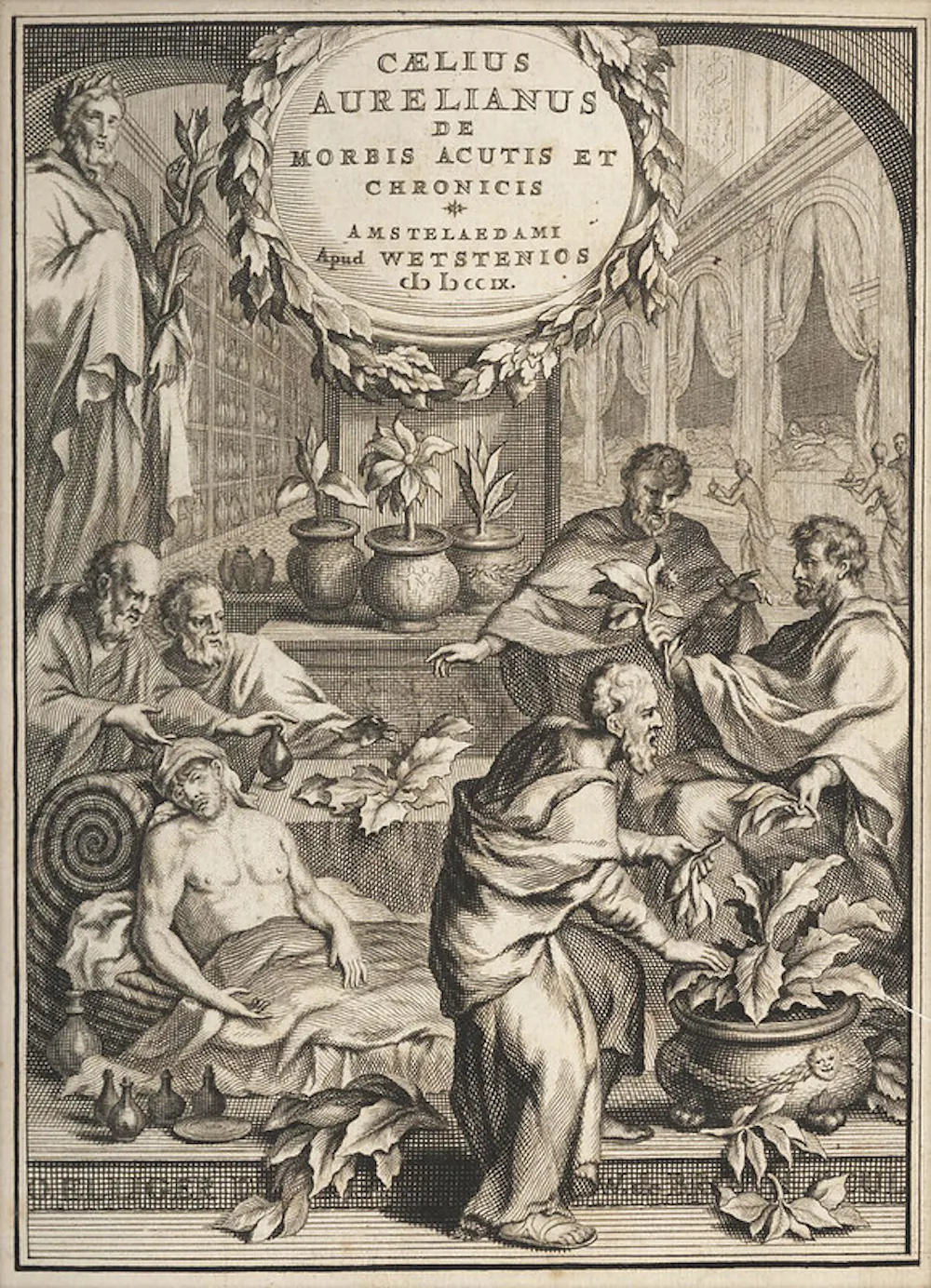
De Morbis acutis et Chronicis by Caelius Aurelianus
Watch some comedy, said physician Caelius Aurelianus. VCU Tompkins-McCaw Library/Flickr, CC BY-NC-SA

This can be achieved, they thought, by doing some activity that directly countered the emotions we are experiencing.

For example, Caelius Aurelianus said people suffering from depression should do activities that caused them to laugh and be happy, such as going to see a comedy at the theatre.

However, the ancients did not believe any single activity was enough to make our mental state become healthy. The important thing was to make a wholesale change to one’s way of living and thinking.

When it comes to experiencing mental health problems, we clearly have a lot in common with our ancient ancestors. Much of what they said seems as relevant now as it did 2,000 years ago, even if we use different methods and medicines today.


If this article has raised issues for you, or if you’re concerned about someone you know, call Lifeline on 13 11 14.

Konstantine Panegyres, McKenzie Postdoctoral Fellow, researching Greco-Roman antiquity, The University of Melbourne

This article is republished from The Conversation under a Creative Commons license. Read the original article.

Don’t Forget…

Did you arrive here from our newsletter? Don’t forget to return to the email to continue learning!

Learn to Age Gracefully

Join the 98k+ American women taking control of their health & aging with our 100% free (and fun!) daily emails:

  • How To Engage Your Whole Brain

    10almonds is reader-supported. We may, at no cost to you, receive a portion of sales if you purchase a product through a link in this article.

    The Stroke Of Insight That Nobody Wants

    This is Dr. Jill Bolte Taylor. She’s a neuroanatomist, who, at the age of 37 (when she was a post-doctoral fellow at Harvard Medical School), had what she refers to as her “stroke of insight”.

    That is to say, she had a massive stroke, and after a major brain surgery to remove a clot the size of a golf ball, she spent the next 8 years re-learning to do everything.

    Whereas previously she’d been busy mapping the brain to determine how cells communicate with each other, now she was busy mapping whether socks or shoes should go on first. Needless to say, she got an insight into neuroplasticity that few people would hope for.

    What does she want us to know?

    Dr. Taylor (now once again a successful scientist, lecturer, and author) advocates for “whole brain living”, which involves not taking parts of our brain for granted.

    About those parts…

    Dr. Taylor wants us to pay attention to all the parts regardless of size, ranging from the two hemispheres, all the way down to the billions of brain cells, and yet even further, to the “trillions of molecular geniuses”—because each brain cell is itself reliant on countless molecules of the many neurochemicals that make up our brain.

    For a quick refresher on some of the key players in that latter category, see our Neurotransmitter Cheatsheet 😎

    When it comes to the hemispheres, there has historically been a popular belief that these re divided into:

    • The right brain: emotional, imaginative, creative, fluid feeling
    • The left brain: intellectual, analytical, calculating, crystal thinking

    …which is not true, anatomically speaking, because there are cells on both sides doing their part of both of these broad categories of brain processes.

    However, Dr. Taylor found, while one hemisphere of her brain was much more damaged than the other, that nevertheless she could recover some functions more quickly than others, which, once she was able to resume her career, inspired her model of four distinct ways of cogitating that can be switched-between and played with or against each other:

    Meet The Four Characters Inside Your Brain

    Why this matters

    As she was re-learning everything, the way forward was not quick or easy, and she also didn’t know where she was going, because for obvious reasons, she couldn’t remember, much less plan.

    Looking backwards after her eventual full recovery, she noted a lot of things that she needed during that recovery, some of which she got and some of which she didn’t.

    Most notably for her, she needed the right kind of support that would allow all four of the above “characters” as she puts it, to thrive and grow. And, when we say “grow” here we mean that literally, because of growing new brain cells to replace the lost ones (as well as the simple ongoing process of slowly replacing brain cells).

    For more on growing new brain cells, by the way, see:

    How To Grow New Brain Cells (At Any Age)

    In order to achieve this in all of the required brain areas (i.e., and all of the required brain functions), she also wants us to know… drumroll please

    When to STFU

    Specifically, the ability to silence parts of our brain that while useful in general, aren’t necessarily being useful right now. Since it’s very difficult to actively achieve a negative when it comes to brain-stuff (don’t think of an elephant), this means scheduling time for other parts of our brain to be louder. And that includes:

    • scheduling time to feel (emotionally)
    • scheduling time to feel (gut feelings)
    • scheduling time to feel (kinesthetically)

    …amongst others.

    Note: those three are presented in that order, from least basic to most basic. And why? Because, clever beings that we are, we typically start from a position that’s not remotely basic, such as “overthinking”, for example. So, there’s a wind-down through thinking just the right amount, thinking through simpler concepts, feeling, noticing one’s feelings, noticing noticing one’s feelings, all the way down to what, kinesthetically, are we actually physically feeling.

    ❝It is interesting to note that although our limbic system fucntions throughout our lifetime, it does not mature. As a result, when our emotional “buttons” are pushed, we retain the ability to react to incoming stimulation as though we were a two-year-old, even when we are adults.❞

    ~ Dr. Jill Taylor

    Of course, sometimes the above is not useful, which is why the ability to switch between brain modes is a very important and useful skill to develop.

    And how do we do that? By practising. Which is something that it’s necessary to take up consciously, and pursue consistently. When children are at school, there are (hopefully, ideally) curricula set out to ensure they engage and train all parts of their brain. As adults, this does not tend to get the same amount of focus.

    “Children’s brains are still developing”—indeed, and so are adult brains:

    The Brain As A Work-In-Progress

    Dr. Taylor had the uncommon experience of having to, in many ways, neurologically speaking, redo childhood. And having had a second run at it, she developed an appreciation of the process that most of us didn’t necessarily get when doing childhood just the once.

    In other words: take the time to feel stuff; take the time to quiet down your chatty mind, take the time engage your senses, and take it seriously! Really notice, as though for the first time, what the texture of your carpet is like. Really notice, as though for the first time, what it feels like to swallow some water. Really notice, as though for the first time, what it feels like to experience joy—or sadness, or comfort, or anger, or peace. Exercise your imagination. Make some art (it doesn’t have to win awards; it just has to light up your brain!). Make music (again, it’s about wiring your brain in your body, not about outdoing Mozart in composition and/or performance). Make changes! Make your brain work in the ways it’s not in the habit of doing.

    If you need a little help switching off parts of your brain that are being too active, so that you can better exercise other parts of your brain that might otherwise have been neglected, you might want to try:

    The Off-Button For Your Brain

    Enjoy!

    Share This Post

  • It Didn’t Start with You – by Mark Wolynn

    10almonds is reader-supported. We may, at no cost to you, receive a portion of sales if you purchase a product through a link in this article.

    There is a trend in psychology to “blame the parents” for “childhood trauma” that can result in problems later in life. Sometimes fairly, sometimes not. This book’s mostly not about that.

    It does touch on our own childhood trauma, if applicable. But mostly, it’s about epigenetic trauma inheritance. In other words, not just trauma that’s passed on in terms of “the cycle of abuse”, but trauma that’s passed on in terms of “this generation experienced trauma x, developed trauma response y, encoded it epigenetically, and passed it on to their offspring”.

    So, how does one heal from a trauma one never directly experienced, and just inherited the response to it? That’s what most of this book is about, after establishing how epigenetic trauma inheritance works.

    The author, a therapist, provides practical advice for how to do the things that can be done to rewrite the epigenetic code we inherited. Better late than never!

    Bottom line: it is well-established that trauma is inheritable. But unlike one’s eye color or the ability to smell asparagus metabolites in urine, we can rewrite epigenetic things, to a degree. This book explains how.

    Click here to check out It Didn’t Start With You, and put things to rest!

    Share This Post

  • Loss, Trauma, and Resilience – by Dr. Pauline Boss

    10almonds is reader-supported. We may, at no cost to you, receive a portion of sales if you purchase a product through a link in this article.

    Most books about bereavement are focused on grieving healthily and then moving on healthily. And, while it may be said “everyone’s grief is on their own timescale”… society’s expectation is often quite fixed:

    “Time will heal”, they say.

    But what if it doesn’t? What happens when that’s not possible?

    Ambiguous loss occurs when someone is on the one hand “gone”, but on the other hand, not necessarily.

    This can be:

    • Someone was lost in a way that didn’t leave a body to 100% confirm it
      • (e.g. disaster, terrorism, war, murder, missing persons)
    • Someone remains physically present but in some ways already “gone”
      • (e.g. Alzheimer’s disease or other dementia, brain injury, coma)

    These things stop us continuing as normal, and/but also stop us from moving on as normal.

    When either kind of moving forward is made impossible, everything gets frozen in place. How does one deal with that?

    Dr. Boss wrote this book for therapists, but its content is equally useful for anyone struggling with ambiguous loss—or who has a loved one who is, in turn, struggling with that.

    The book looks at the impact of ambiguous loss on continuing life, and how to navigate that:

    • How to be resilient, in the sense of when life tries to break you, to have ways to bend instead.
    • How to live with the cognitive dissonance of a loved one who is a sort of “Schrödinger’s person”.
    • How, and this is sometimes the biggest one, to manage ambiguous loss in a society that often pushes toward: “it’s been x period of time, come on, get over it now, back to normal”

    Will this book heal your heart and resolve your grief? No, it won’t. But what it can do is give a roadmap for nonetheless thriving in life, while gently holding onto whatever we need to along the way.

    Click here to check out “Ambiguous loss, Trauma, and Resilience” on Amazon—it can really help

    Share This Post

  • An Accessible New Development Against Alzheimer’s

    10almonds is reader-supported. We may, at no cost to you, receive a portion of sales if you purchase a product through a link in this article.

    Dopamine vs Alzheimer’s

    One of the key hallmarks of Alzheimer’s disease is the formation of hardened beta-amyloid plaques around neurons. The beta-amyloid peptides themselves are supposed to be in the brain, but the hardened pieces of them that form the plaques are not.

    While the full nature of the relationship between those plaques and Alzheimer’s disease is not known for sure (there are likely other factors involved, and “the amyloid hypothesis” is at this stage nominally just that, a hypothesis), one thing that has been observed is that increasing or reducing the plaques increases or reduces (respectively) Alzheimer’s symptoms such as memory loss.

    Neprilysin

    There is an enzyme, neprilysin, that can break down those plaques.

    Neprilysin is made naturally in the brain, and/but we cannot take it as a supplement or medication, because it’s too big to pass through the blood-brain barrier.

    A team of researchers led by Dr. Takaomi Saido genetically manipulated mice to produce more neprilysin, and those mice resultantly experienced fewer beta-amyloid plaques and better memory in their old age.

    However wonderful for the mice (and a great proof of principle) the above approach is not useful as a treatment for humans whose genomes weren’t modified at our conception in a lab.

    Since (as mentioned before) we also can’t take it as a medication/supplement, that leaves one remaining option: find a way to make our already-existing brains produce more of it.

    The team’s previous research allowed them to narrow this down to “there is probably a hormone made in the hypothalamus that modulates this”, so they began experimenting with making the mice produce more hormones there.

    The DREADD switch

    DREADDs, or Designer Receptors Exclusively Activated by Designer Drugs, were the next tool in the toolbox. The scientists attached these designer receptors to dopamine-producing neurons in the mice, so that they could be activated by the appropriate designer drugs—basically, allowing for a “make more dopamine” button, without having to literally wire up the brains with electrodes. The “button” gets triggered instead by a chemical trigger, the designer drug. You can read more about them here:

    DREADDs for Neuroscientists: A Primer

    The result was positive; when the mice made more dopamine, the result was that they also made more neprilysin. So far, the hypothesis is that the presence of dopamine upregulates the production of neprilysin. In other words, the increased neprilysin levels were caused by the increased dopamine levels (the alternatives would have been: they were both caused by the same thing—in this case that’d be the DREADD activation—or the increase was caused by something else entirely that hadn’t been controlled for).

    As to how the causal relationship was determined…

    “But I don’t have (or want) a DREADD switch in my head”

    Happily for us (and probably happily for the mice too, because dopamine causes feelings of happiness), the experiments continued.

    This time, instead of using the DREADD system, they tried simply supplementing the mouse food with l-dopa, a dopamine precursor. L-dopa is often used in the treatment of Parkinson’s disease, because the molecules are small enough to pass through the blood-brain barrier, and can be converted to full dopamine inside the brain itself. So, taking l-dopa normally raises dopamine levels.

    The results? The mice who were given l-dopa enjoyed:

    • higher dopamine levels
    • higher neprilysin levels
    • lower beta-amyloid plaque levels
    • better memory in tests

    The next step for the researchers is to investigate how exactly dopamine regulates neprilysin in the brain, but for now, the relationship between l-dopa consumption and the reduction of Alzheimer’s symptoms seems clear.

    You can read about the study here:

    The dopaminergic system promotes neprilysin-mediated degradation of amyloid-β in the brain

    Is there a catch?

    L-dopa has common side effects that are not pleasant; the list begins with nausea and vomiting, and continues with things that one might expect from having “too much of a good thing” when it comes to dopamine, such as dyskinesia (extra movements) and hallucinations.

    You can read about it more here at the Parkinson’s Foundation:

    Parkinson’s Foundation | Levodopa

    However! All is not lost. Rather than reaching for the heavy guns by taking l-dopa unnecessarily, there are other dopamine precursors that don’t have those side effects (and are consequently less restricted, to the point they can be purchased as supplements, or indeed, enjoyed where they occur naturally in some foods).

    Top of the list of such safe* and readily-available dopamine precursors is…

    N-Acetyl L-Tyrosine (NALT): The Dopamine Precursor & More

    If you’d like to try that, here’s an example product on Amazon… Or you could eat fish, white beans, tofu, natto, or pumpkin seeds 😉

    *Quick note on safety: “safe” is a relative term and may vary from person to person. Please speak with your own doctor to be sure, check with your pharmacist in case of any meds interactions, and be especially careful taking anything that increases dopamine levels if you have bipolar disorder or are otherwise prone to psychosis of any kind. For most people, this shouldn’t be an issue as our brains have a built-in mechanism for scrubbing excess dopamine and ensuring we don’t end up with too much, but for some people whose dopamine regulation is not so good in that regard, it can cause problems. So again, speak with your doctor to be sure, because we are not doctors, let alone your doctor.

    Lastly…

    If you’d like an entirely drug-free approach, that’s skipping even the “nutraceuticals”, you might enjoy:

    Short On Dopamine? Science Has The Answer

    Take care!

    Don’t Forget…

    Did you arrive here from our newsletter? Don’t forget to return to the email to continue learning!

    Learn to Age Gracefully

    Join the 98k+ American women taking control of their health & aging with our 100% free (and fun!) daily emails:

  • Black Pepper’s Impressive Anti-Cancer Arsenal

    10almonds is reader-supported. We may, at no cost to you, receive a portion of sales if you purchase a product through a link in this article.

    Black Pepper’s Impressive Anti-Cancer Arsenal (And More)

    Piperine, a compound found in Piper nigrum (black pepper, to its friends), has many health benefits. It’s included as a minor ingredient in some other supplements, because it boosts bioavailability. In its form as a kitchen spice, it’s definitely a superfood.

    What does it do?

    First, three things that generally go together:

    These things often go together for the simple reason that oxidative stress, inflammation, and cancer often go together. In each case, it’s a matter of cellular wear-and-tear, and what can mitigate that.

    For what it’s worth, there’s generally a fourth pillar: anti-aging. This is again for the same reason. That said, black pepper hasn’t (so far as we could find) been studied specifically for its anti-aging properties, so we can’t cite that here as an evidence-based claim.

    Nevertheless, it’s a reasonable inference that something that fights oxidation, inflammation, and cancer, will often also slow aging.

    Special note on the anti-cancer properties

    We noticed two very interesting things while researching piperine’s anti-cancer properties. It’s not just that it reduces cancer risk and slows tumor growth in extant cancers (as we might expect from the above-discussed properties). Let’s spotlight some studies:

    It is selectively cytotoxic (that’s a good thing)

    Piperine was found to be selectively cytotoxic to cancerous cells, while not being cytotoxic to non-cancerous cells. To this end, it’s a very promising cancer-sniper:

    Piperine as a Potential Anti-cancer Agent: A Review on Preclinical Studies

    It can reverse multi-drug resistance in cancer cells

    P-glycoprotein, found in our body, is a drug-transporter that is known for “washing out” chemotherapeutic drugs from cancer cells. To date, no drug has been approved to inhibit P-glycoprotein, but piperine has been found to do the job:

    Targeting P-glycoprotein: Investigation of piperine analogs for overcoming drug resistance in cancer

    What’s this about piperine analogs, though? Basically the researchers found a way to “tweak” piperine to make it even more effective. They called this tweaked version “Pip1”, because calling it by its chemical name,

    ((2E,4E)-5-(benzo[d][1,3]dioxol-5-yl)-1-(6,7-dimethoxy-3,4-dihydroisoquinolin-2(1 H)-yl)penta-2,4-dien-1-one)

    …got a bit unwieldy.

    The upshot is: Pip1 is better, but piperine itself is also good.

    Other benefits

    Piperine does have other benefits too, but the above is what we were most excited to talk about today. Its other benefits include:

    Enjoy!

    Don’t Forget…

    Did you arrive here from our newsletter? Don’t forget to return to the email to continue learning!

    Learn to Age Gracefully

    Join the 98k+ American women taking control of their health & aging with our 100% free (and fun!) daily emails:

  • Enjoy Bitter Foods For Your Heart & Brain

    10almonds is reader-supported. We may, at no cost to you, receive a portion of sales if you purchase a product through a link in this article.

    When Bitter Is Better

    A good general rule of thumb for “does this food contain a lot of healthy polyphenols?” is:

    “is this (edible) plant bitter/astringent/pungent”?

    If it is, it’s probably rich in polyphenols:

    Deciphering the role of bitter and astringent polyphenols in promoting well-being

    …which is why it’s no surprise that black coffee and bitter chocolate score highly, as do hot peppers and even garlic.

    See also: Our Top 5 Spices: How Much Is Enough For Benefits?

    Even fruits, generally considered something sweet to eat, often contain more polyphenols when they are bitter—many berries are great examples of this!

    Read more: Goji Berries: Which Benefits Do They Really Have?

    You can read more about the science of this here:

    Sensory Nutrition and Bitterness and Astringency of Polyphenols

    Important for multiple reasons (including heart and brain health)

    Polyphenols have many benefits, and they’re most well known for their heart-healthy properties, but their antioxidant effect (and other mechanisms) also means these foods are generally neuroprotectants too:

    A century of research shows eating these compounds can help protect against heart disease and Alzheimer’s

    The science of this is not all as obvious as you might think!

    It is reasonable to expect “ok, this has antioxidant effect, so it will reduce oxidative damage to brain cells too”, and while that is true (and yes, polyphenols do cross the blood-brain barrier), they also help in other ways, including through the gut:

    Where to Look into the Puzzle of Polyphenols and Health? The Postbiotics and Gut Microbiota Associated with Human Metabotypes

    What if I don’t like bitter/astringent/pungent foods?

    If you do not have a medical condition that proscribes them (do check with your doctor if unsure), the best advice is to simply eat them anyway, and your tastes will adapt.

    It will also help if you avoid sweet foods (though this too is also a good general rule of thumb!), as this will move the balance of where your brain’s “set range” is for “good taste”.

    Bonus tip: dark chocolate (80%+ cocoa if possible, 95% if you can get it) and chilli peppers go great with each other. Here’s an example of a chilli chocolate product on Amazon; it’s 70% cocoa (which is not bad, but could be better). You might be able to get a higher percentage locally, especially if you ask your local chocolatière, or make it yourself!

    Enjoy!

    Don’t Forget…

    Did you arrive here from our newsletter? Don’t forget to return to the email to continue learning!

    Learn to Age Gracefully

    Join the 98k+ American women taking control of their health & aging with our 100% free (and fun!) daily emails: