
Yes, you still need to use sunscreen, despite what you’ve heard on TikTok
10almonds is reader-supported. We may, at no cost to you, receive a portion of sales if you purchase a product through a link in this article.
Summer is nearly here. But rather than getting out the sunscreen, some TikTokers are urging followers to chuck it out and go sunscreen-free.
They claim it’s healthier to forgo sunscreen to get the full benefits of sunshine.
Here’s the science really says.
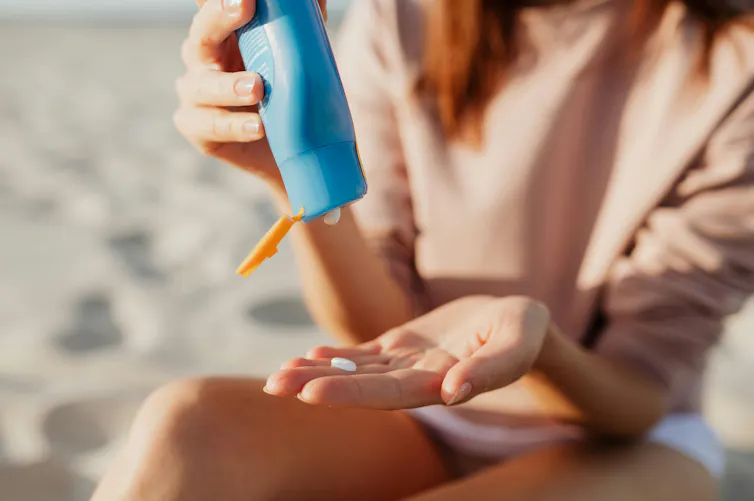
How does sunscreen work?
Because of Australia’s extreme UV environment, most people with pale to olive skin or other risk factors for skin cancer need to protect themselves. Applying sunscreen is a key method of protecting areas not easily covered by clothes.
Sunscreen works by absorbing or scattering UV rays before they can enter your skin and damage DNA or supportive structures such as collagen.
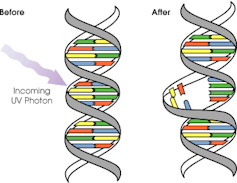
When UV particles hit DNA, the excess energy can damage our DNA. This damage can be repaired, but if the cell divides before the mistake is fixed, it causes a mutation that can lead to skin cancers.
The most common skin cancers are basal cell carcinoma (BCC) and squamous cell carcinoma (SCC). Melanoma is less common, but is the most likely to spread around the body; this process is called metastasis.
Two in three Australians will have at least one skin cancer in their lifetime, and they make up 80% of all cancers in Australia.
Around 99% of skin cancers in Australia are caused by excessive exposure to UV radiation.
Excessive exposure to UV radiation also affects the appearance of your skin. UVA rays are able to penetrate deep into the skin, where they break down supportive structures such as elastin and collagen.
This causes signs of premature ageing, such as deep wrinkling, brown or white blotches, and broken capillaries.
Sunscreen can help prevent skin cancers
Used consistently, sunscreen reduces your risk of skin cancer and slows skin ageing.
In a Queensland study, participants either used sunscreen daily for almost five years, or continued their usual use.
At the end of five years, the daily-use group had reduced their risk of squamous cell carcinoma by 40% compared to the other group.
Ten years later, the daily use group had reduced their risk of invasive melanoma by 73%
Does sunscreen block the health-promoting properties of sunlight?
The answer is a bit more complicated, and involves personalised risk versus benefit trade-offs.
First, the good news: there are many health benefits of spending time in the sun that don’t rely on exposure to UV radiation and aren’t affected by sunscreen use.
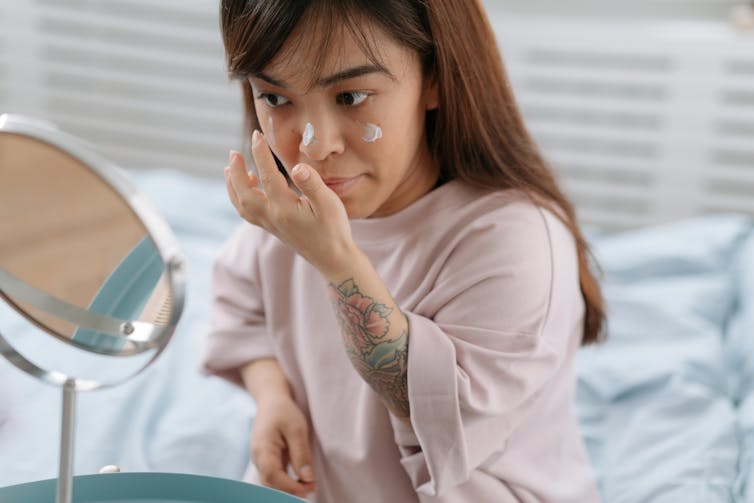
Sunscreen only filters UV rays, not visible light or infrared light (which we feel as heat). And importantly, some of the benefits of sunlight are obtained via the eyes.
Visible light improves mood and regulates circadian rhythm (which influences your sleep-wake cycle), and probably reduces myopia (short-sightedness) in children.
Infrared light is being investigated as a treatment for several skin, neurological, psychiatric and autoimmune disorders.
So what is the benefit of exposing skin to UV radiation?
Exposing the skin to the sun produces vitamin D, which is critical for healthy bones and muscles.
Vitamin D deficiency is surprisingly common among Australians, peaking in Victoria at 49% in winter and being lowest in Queensland at 6% in summer.
Luckily, people who are careful about sun protection can avoid vitamin D deficiency by taking a supplement.
Exposing the skin to UV radiation might have benefits independent of vitamin D production, but these are not proven. It might reduce the risk of autoimmune diseases such as multiple sclerosis or cause release of a chemical that could reduce blood pressure. However, there is not enough detail about these benefits to know whether sunscreen would be a problem.
What does this mean for you?
There are some benefits of exposing the skin to UV radiation that might be blunted by sunscreen. Whether it’s worth foregoing those benefits to avoid skin cancer depends on how susceptible you are to skin cancer.
If you have pale skin or other factors that increase you risk of skin cancer, you should aim to apply sunscreen daily on all days when the UV index is forecast to reach 3.
If you have darker skin that rarely or never burns, you can go without daily sunscreen – although you will still need protection during extended times outdoors.
For now, the balance of evidence suggests it’s better for people who are susceptible to skin cancer to continue with sun protection practices, with vitamin D supplementation if needed.
Katie Lee, PhD Candidate, Dermatology Research Centre, The University of Queensland and Rachel Neale, Principal research fellow, QIMR Berghofer Medical Research Institute
This article is republished from The Conversation under a Creative Commons license. Read the original article.
Don’t Forget…
Did you arrive here from our newsletter? Don’t forget to return to the email to continue learning!
Recommended
Learn to Age Gracefully
Join the 98k+ American women taking control of their health & aging with our 100% free (and fun!) daily emails:
-
5 Minute Posture Improvement Routine!
10almonds is reader-supported. We may, at no cost to you, receive a portion of sales if you purchase a product through a link in this article.
McKay Lang walks us through it:
Step by Step
Breathing exercise:
- Place your hands on your lower abdomen.
- Take three deep breaths, focusing on body tension in the shoulders and neck… And release.
Shoulder squeeze:
- With your hands on your hips, inhale and squeeze your shoulders upwards.
- Hold your breath for 3–4 seconds, then exhale.
- Repeat two more times, holding the squeeze a little longer each time.
Upper shoulder massage:
- Massage your upper shoulder muscles to release tension stored there.
Overhead arm stretch:
- Raise your arms above your head, clasping each elbow with the opposite hand.
- Inhale deeply, stretch upwards, then exhale and release.
- Repeat, alternating elbows.
Neck and head push:
- Place your palms on the back of the head, and push your head into your hands (and vice versa, because of Newton’s Third Law of Motion).
- Do the same sideways (one side and then the other), to engage the other neck muscles.
Cool down:
- Gently unclasp your hands, bring your head upright, and massage your muscles. And breathe.
For variations and a visual demonstration of all, enjoy:
Click Here If The Embedded Video Doesn’t Load Automatically!
Want to learn more?
You might also like to read:
6 Ways To Look After Your Back
Take care!
Share This Post
-
The Life-Changing Manga Of Tidying Up – by Marie Kondo
10almonds is reader-supported. We may, at no cost to you, receive a portion of sales if you purchase a product through a link in this article.
Everyone knows the slogan “does this spark joy?”, but there’s a whole method to the magic that goes far beyond that. It spans all manner of things from the over-arching strategy of taking on a house-sized tidying project, to practical little tips like “store these things this way instead; now they’re safe, tidy and accessible—and look good too!”.
You may be wondering: why are we reviewing this book instead of the much more famous “The Life-Changing Magic of Tidying Up”?
It’s simple: here at 10almonds, we like things to be super simple and easy to digest.
This book is smaller, simpler, and more digestible than her more famous book, without sacrificing content. And you know what? We held it in our hands and it sparked joy
Bottom line is: it’s useful, it’s beautiful, it will change your life (and your underwear drawer).
PS: this 10almonds team-member gifted a copy to her 12-year-old son. He implemented it the same day, unbidden. Magic indeed!
Share This Post
-
3 Life-Changing Mobility Movements To Train
10almonds is reader-supported. We may, at no cost to you, receive a portion of sales if you purchase a product through a link in this article.
If you’ve ever momentarily struggled to stand up straight after sitting for too long, or had to take a moment to get up off the floor, this one’s for you.
And if you’ve never done those things? Well, this one’s still for you—prevention is better than cure, after all!
From the hips
Most movements that we need to do in life depend on our hips. They support our spine, on which almost everything else depends, and on the flipside, they’re where our legs are plugged in, so they’re pretty critical for lower body mobility too.
So, with that in mind, here are the three exercise promised—or five, depending on how you want to count them:
- For hip mobility most directly: start with a combination of donkey kicks and fire hydrants. From a tabletop position, lift one leg behind you as if putting a footprint on the ceiling, keeping your tailbone tucked in and your core engaged to avoid using your lower back. Then, bring your leg back and lift it sideways like a dog peeing on a hydrant, keeping your torso level and pelvis stable. Alternate between the two movements for 20 total reps (i.e. 10 each), then switch legs.
- For hip, spinal, and upper body mobility: now we get to thread the needle. From all fours, inhale and reach one arm up (as far as comfortable), then exhale and thread it under your body to the opposite side. Lower your shoulder close to the mat but without touching it, using your core to twist. Follow your breath rhythm—inhale to lift, exhale to thread—and do 10 reps on each side.
- For hip and ankle mobility: use a split lunge with two parts. From an upright lunge, put your hands on your front thigh and tuck your tailbone in to engage the back glute. Lunge forwards while keeping your front heel flat on the floor, while your knee moves past the toes. Then, without changing pelvis position, lift your back knee and try to straighten your leg, pushing your heel backwards without raising your hips. Return to start and repeat 10 times per side.
For more on all of this plus visual demonstrations, enjoy:
Click Here If The Embedded Video Doesn’t Load Automatically!
Want to learn more?
You might also like:
How Tight Are Your Hips? Test (And Fix!) With This
Take care!
Share This Post
Related Posts
-
Do we really need to burp babies? Here’s what the research says
10almonds is reader-supported. We may, at no cost to you, receive a portion of sales if you purchase a product through a link in this article.
Parents are often advised to burp their babies after feeding them. Some people think burping after feeding is important to reduce or prevent discomfort crying, or to reduce how much a baby regurgitates milk after a feed.
It is true babies, like adults, swallow air when they eat. Burping releases this air from the top part of our digestive tracts. So when a baby cries after a feed, many assume it’s because the child needs to “be burped”. However, this is not necessarily true.
Why do babies cry or ‘spit up’ after a feed?
Babies cry for a whole host of reasons that have nothing to do with “trapped air”.
They cry when they are hungry, cold, hot, scared, tired, lonely, overwhelmed, needing adult help to calm, in discomfort or pain, or for no identifiable reason. In fact, we have a name for crying with no known cause; it’s called “colic”.
“Spitting up” – where a baby gently regurgitates a bit of milk after a feed – is common because the muscle at the top of a newborn baby’s stomach is not fully mature. This means what goes down can all too easily go back up.
Spitting up frequently happens when a baby’s stomach is very full, there is pressure on their tummy or they are picked up after lying down.
Spitting up after feeding decreases as babies get older. Three-quarters of babies one month old spit up after feeding at least once a day. Only half of babies still spit up at five months and almost all (96%) stop by their first birthdays.
There’s not much research out there on ‘burping’ babies. antoniodiaz/Shutterstock Does burping help reduce crying or spitting up?
Despite parents being advised to burp their babies, there’s not much research evidence on the topic.
One study conducted in India encouraged caregivers of 35 newborns to burp their babies, while caregivers of 36 newborns were not given any information about burping.
For the next three months, mothers and caregivers recorded whether their baby would spit up after feeding and whether they showed signs of intense crying.
This study found burping did not reduce crying and actually increased spitting up.
When should I be concerned about spitting up or crying?
Most crying and spitting up is normal. However, these behaviours are not:
- refusing to feed
- vomiting so much milk weight gain is slow
- coughing or wheezing distress while feeding
- bloody vomit.
If your baby has any of these symptoms, see a doctor or child health nurse.
If your baby seems unbothered by vomiting and does not have any other symptoms it is a laundry problem rather than something that needs medical attention.
It is also normal for babies to cry and fuss quite a lot; two hours a day, for about the first six weeks is the average.
This has usually reduced to about one hour a day by the time they are three months of age.
Crying more than this doesn’t necessarily mean there is something wrong. The intense, inconsolable crying of colic is experienced by up to one-quarter of young babies but goes away with time on its own .
If your baby is crying more than average or if you are worried there might be something wrong, you should see your doctor or child health nurse.
If your baby likes being ‘burped’, then it’s OK to do it. But don’t stress if you skip it. Miljan Zivkovic/Shutterstock Not everyone burps their baby
Burping babies seems to be traditional practice in some parts of the world and not in others.
For example, research in Indonesia found most breastfeeding mothers rarely or never burped their babies after feeding.
One factor that may influence whether a culture encourages burping babies may be related to another aspect of infant care: how much babies are carried.
Carrying a baby in a sling or baby carrier can reduce the amount of time babies cry.
Babies who are carried upright on their mother or another caregiver’s front undoubtedly find comfort in that closeness and movement.
Babies in slings are also being held firmly and upright, which would help any swallowed air to rise up and escape via a burp if needed.
Using slings can make caring for a baby easier. Studies (including randomised controlled trials) have also shown women have lower rates of post-natal depression and breastfeed for longer when they use a baby sling.
It is important baby carriers and slings are used safely, so make sure you’re up to date on the latest advice on how to do it.
So, should I burp my baby?
The bottom line is: it’s up to you.
Gently burping a baby is not harmful. If you feel burping is helpful to your baby, then keep doing what you’re doing.
If trying to burp your baby after every feed is stressing you or your baby out, then you don’t have to keep doing it.
Karleen Gribble, Adjunct Associate Professor, School of Nursing and Midwifery, Western Sydney University and Nina Jane Chad, Research Fellow, University of Sydney School of Public Health, University of Sydney
This article is republished from The Conversation under a Creative Commons license. Read the original article.
Don’t Forget…
Did you arrive here from our newsletter? Don’t forget to return to the email to continue learning!
Learn to Age Gracefully
Join the 98k+ American women taking control of their health & aging with our 100% free (and fun!) daily emails:
-
GLP-1 Without Drugs? Yes, & Here’s How!
10almonds is reader-supported. We may, at no cost to you, receive a portion of sales if you purchase a product through a link in this article.
Nutrition coach Julene Montgomery (BS, CNC, BCHN) gives us the insider information:
Bon appétit
First, understand what GLP-1 actually is: a gut hormone released when you eat that helps your pancreas release the right amount of insulin, lowers glucagon, slows stomach emptying, and increases fullness without causing hypoglycemia (unlike some diabetes meds like metformin, which can cause hypoglycemia).
This is important, because it directly supports the systems that struggle in pre-diabetes and type 2 diabetes, including post-meal blood sugar spikes, appetite regulation, and insulin response.
So, 7 kinds of food to prioritize:
- Protein-rich foods: protein is one of the strongest stimulators of GLP-1 and satiety hormones, helping you feel full sooner and longer while stabilizing blood sugar (examples include fish, eggs, yogurt, cottage cheese, tofu, and lentils).
- Fermented foods: because GLP-1 is produced in the gut, a healthier microbiome improves GLP-1 signaling and insulin response (examples include yogurt, kefir, sauerkraut, kimchi, and miso).
- High-fiber foods: fiber slows digestion, extends GLP-1 release, blunts glucose spikes, and produces short-chain fatty acids like butyrate that further support GLP-1 (examples include leafy greens, beans, lentils, oats, berries, flaxseed, and chia seeds).
- Healthy fats: fats slow gastric emptying and improve satiety, and certain fats like omega-3s and monounsaturated fats can actively increase GLP-1 levels (examples include avocados, olive oil, nuts, seeds, salmon, sardines, and mackerel).
- Bitter foods: bitter compounds activate gut receptors that stimulate GLP-1 release and support digestion (examples include arugula, dandelion greens, kale, mustard greens, and bitter melon).
- Herbs and spices: spices can increase GLP-1 secretion and/or improve signaling, with cinnamon being especially well studied for blood sugar support (others include ginger, turmeric, fenugreek, garlic, and black pepper), but watch out: Sweet Cinnamon vs Regular Cinnamon – Which is Healthier?
- Vegetables in general: provide fiber and phytonutrients that support gut health, reduce inflammation, and improve GLP-1 activity (top-tier examples include broccoli, Brussels sprouts, cabbage, spinach, and carrots).
For more on all of this, enjoy:
Click Here If The Embedded Video Doesn’t Load Automatically!
Want to learn more?
You might also like:
Take care!
Don’t Forget…
Did you arrive here from our newsletter? Don’t forget to return to the email to continue learning!
Learn to Age Gracefully
Join the 98k+ American women taking control of their health & aging with our 100% free (and fun!) daily emails:
-
Could the shingles vaccine lower your risk of dementia?
10almonds is reader-supported. We may, at no cost to you, receive a portion of sales if you purchase a product through a link in this article.
A recent study has suggested Shingrix, a relatively new vaccine given to protect older adults against shingles, may delay the onset of dementia.
This might seem like a bizarre link, but actually, research has previously shown an older version of the shingles vaccine, Zostavax, reduced the risk of dementia.
In this new study, published last week in the journal Nature Medicine, researchers from the United Kingdom found Shingrix delayed dementia onset by 17% compared with Zostavax.
So how did the researchers work this out, and how could a shingles vaccine affect dementia risk?
Melinda Nagy/Shutterstock From Zostavax to Shingrix
Shingles is a viral infection caused by the varicella-zoster virus. It causes painful rashes, and affects older people in particular.
Previously, Zostavax was used to vaccinate against shingles. It was administered as a single shot and provided good protection for about five years.
Shingrix has been developed based on a newer vaccine technology, and is thought to offer stronger and longer-lasting protection. Given in two doses, it’s now the preferred option for shingles vaccination in Australia and elsewhere.
In November 2023, Shingrix replaced Zostavax on the National Immunisation Program, making it available for free to those at highest risk of complications from shingles. This includes all adults aged 65 and over, First Nations people aged 50 and older, and younger adults with certain medical conditions that affect their immune systems.
What the study found
Shingrix was approved by the US Food and Drugs Administration in October 2017. The researchers in the new study used the transition from Zostavax to Shingrix in the United States as an opportunity for research.
They selected 103,837 people who received Zostavax (between October 2014 and September 2017) and compared them with 103,837 people who received Shingrix (between November 2017 and October 2020).
By analysing data from electronic health records, they found people who received Shingrix had a 17% increase in “diagnosis-free time” during the follow-up period (up to six years after vaccination) compared with those who received Zostavax. This was equivalent to an average of 164 extra days without a dementia diagnosis.
The researchers also compared the shingles vaccines to other vaccines: influenza, and a combined vaccine for tetanus, diphtheria and pertussis. Shingrix and Zostavax performed around 14–27% better in lowering the risk of a dementia diagnosis, with Shingrix associated with a greater improvement.
The benefits of Shingrix in terms of dementia risk were significant for both sexes, but more pronounced for women. This is not entirely surprising, because we know women have a higher risk of developing dementia due to interplay of biological factors. These include being more sensitive to certain genetic mutations associated with dementia and hormonal differences.
Why the link?
The idea that vaccination against viral infection can lower the risk of dementia has been around for more than two decades. Associations have been observed between vaccines, such as those for diphtheria, tetanus, polio and influenza, and subsequent dementia risk.
Research has shown Zostavax vaccination can reduce the risk of developing dementia by 20% compared with people who are unvaccinated.
But it may not be that the vaccines themselves protect against dementia. Rather, it may be the resulting lack of viral infection creating this effect. Research indicates bacterial infections in the gut, as well as viral infections, are associated with a higher risk of dementia.
Notably, untreated infections with herpes simplex (herpes) virus – closely related to the varicella-zoster virus that causes shingles – can significantly increase the risk of developing dementia. Research has also shown shingles increases the risk of a later dementia diagnosis.
This isn’t the first time research has suggested a vaccine could reduce dementia risk. ben bryant/Shutterstock The mechanism is not entirely clear. But there are two potential pathways which may help us understand why infections could increase the risk of dementia.
First, certain molecules are produced when a baby is developing in the womb to help with the body’s development. These molecules have the potential to cause inflammation and accelerate ageing, so the production of these molecules is silenced around birth. However, viral infections such as shingles can reactivate the production of these molecules in adult life which could hypothetically lead to dementia.
Second, in Alzheimer’s disease, a specific protein called Amyloid-β go rogue and kill brain cells. Certain proteins produced by viruses such as COVID and bad gut bacteria have the potential to support Amyloid-β in its toxic form. In laboratory conditions, these proteins have been shown to accelerate the onset of dementia.
What does this all mean?
With an ageing population, the burden of dementia is only likely to become greater in the years to come. There’s a lot more we have to learn about the causes of the disease and what we can potentially do to prevent and treat it.
This new study has some limitations. For example, time without a diagnosis doesn’t necessarily mean time without disease. Some people may have underlying disease with delayed diagnosis.
This research indicates Shingrix could have a silent benefit, but it’s too early to suggest we can use antiviral vaccines to prevent dementia.
Overall, we need more research exploring in greater detail how infections are linked with dementia. This will help us understand the root causes of dementia and design potential therapies.
Ibrahim Javed, Enterprise and NHMRC Emerging Leadership Fellow, UniSA Clinical & Health Sciences, University of South Australia
This article is republished from The Conversation under a Creative Commons license. Read the original article.
Don’t Forget…
Did you arrive here from our newsletter? Don’t forget to return to the email to continue learning!
Learn to Age Gracefully
Join the 98k+ American women taking control of their health & aging with our 100% free (and fun!) daily emails:


