
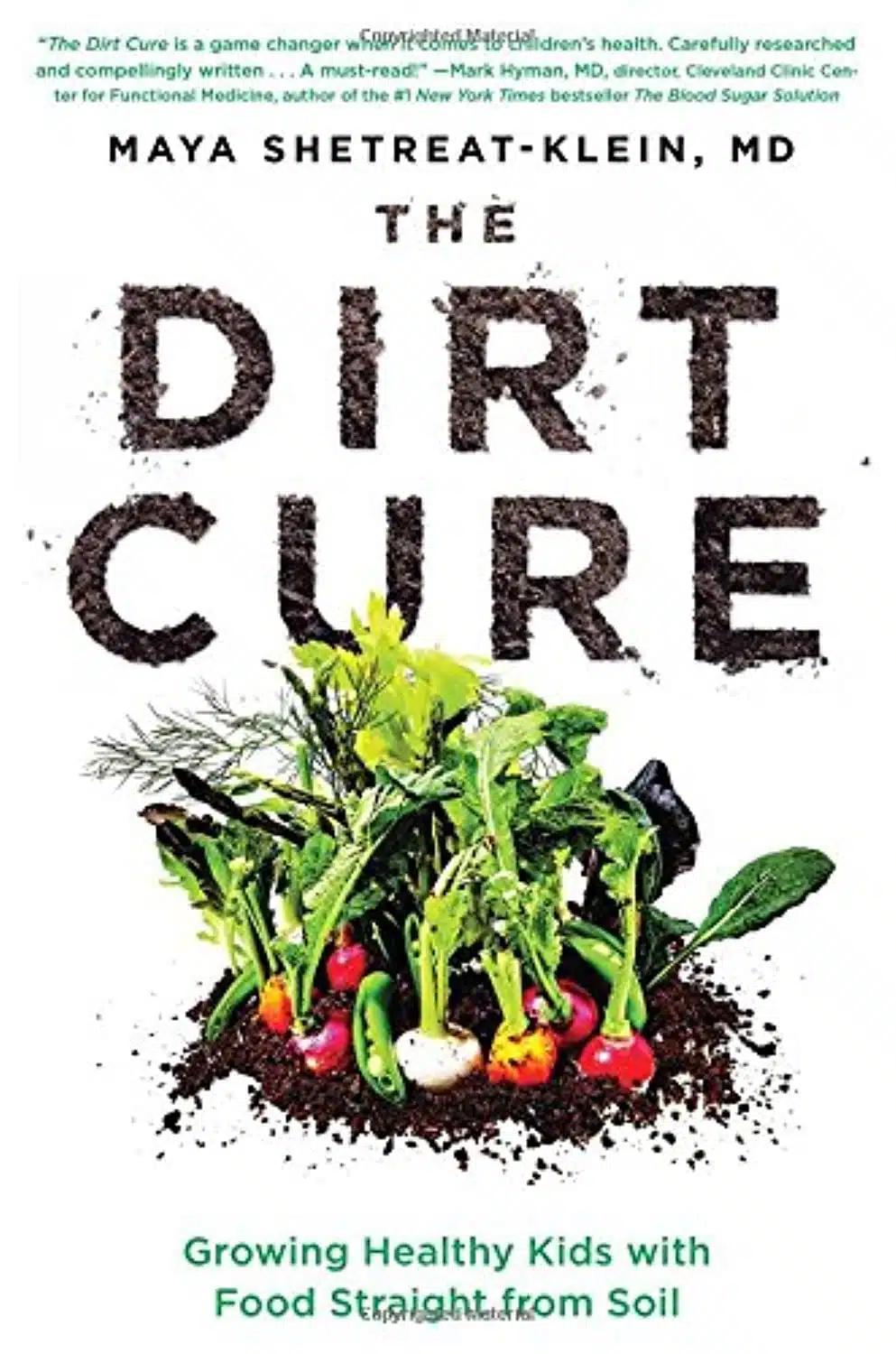
The Dirt Cure – by Dr. Maya Shetreat-Klein

10almonds is reader-supported. We may, at no cost to you, receive a portion of sales if you purchase a product through a link in this article.

As we discussed in our article “Stop Sabotaging Your Gut”, there is indeed merit to living a little dirty, in particular when it comes to what we put in our mouths. Having the space of an entire book rather than a small article, Dr. Shetreat-Klein expands on this in great detail.

The subtitle mentions “growing healthy kids with food straight from the soil”; it’s worth noting that all the information here (with the exception of concerning breastfeeding etc) is equally applicable to adults too—so if it’s your own health you’re focused on rather than that of kids or grandkids, then that’s fine too.

You may be wondering: what more is there to say than “don’t scrub your vegetables as though you’re about to perform surgery with them”?

There’s a lot of background information on what things help or harm our bodies in the first place, most notably via our gut, and as an important extra consideration, the gut-brain axis. Incidentally, the author is a neurologist by professional background.

Then she gets more specific, into “include and exclude” recommendations. In this matter we have one criticism: she does recommend raw milk over pasteurized, and that is, by overwhelming scientific consensus, a terrible idea. Raw milk is an abundant source of pathogens and a breeding ground for even more. There is “living dirty” and there is “living dangerously”, and drinking raw milk is the latter. See also: Pasteurization: What It Does And Doesn’t Do

However, for the most part, the rest of her advice is sound, and there’s even a recipes section too.

The style is something of a polemic throughout, but the extensive venting does not take away from there being a lot of genuine information in here too.

Bottom line: please skip the raw milk, but aside from that, if you’d like to improve your diet to improve your gut and immune health, then this book can help with that.

Click here to check out The Dirt Cure, and dirty it up!

Don’t Forget…

Did you arrive here from our newsletter? Don’t forget to return to the email to continue learning!

Learn to Age Gracefully

Join the 98k+ American women taking control of their health & aging with our 100% free (and fun!) daily emails:

  • Medicinal cannabis concerns include psychosis and child poisonings. We’re not the only ones worried

    10almonds is reader-supported. We may, at no cost to you, receive a portion of sales if you purchase a product through a link in this article.

    The ABC this week revealed more than 600 side effects have been reported in three years to the medicines regulator after Australians took unapproved medicinal cannabis.

    After a Freedom of Information request, the Therapeutic Goods Administration (TGA) told the ABC there had been reports of 615 side effects (known officially as adverse events) in three years to June 2025. These included more than 50 reports of psychosis, and 14 of suicidal thoughts and behaviour.

    Most people don’t report adverse events to the TGA, so these numbers are likely a gross underestimate.

    Earlier this year, we published research charting the rise in calls to Australia’s largest poisons information centre about cannabis poisoning in the years after medicinal cannabis was legalised. This included a rise in accidental poisoning in children.

    Here’s what we know about the risks linked to these unapproved products. https://www.youtube.com/embed/bPYkKmxZz78?wmode=transparent&start=0

    LordHenriVoton/Getty

    Why medicinal cannabis is unique

    All medicines come with a risk of adverse events. Cannabis medicines are no different.

    What is unique is that the vast majority of medicinal cannabis use in Australia involves unapproved products. These are ones the TGA has not assessed for quality, safety or effectiveness – but are still legally available.

    More than 1,000 unapproved medicinal cannabis products are available in Australia. People often take these for conditions where we have no strong evidence they work.

    This is in contrast to the two “approved” medicinal cannabis products, whose manufacturers or suppliers have to provide such evidence.

    The rise of medicinal cannabis

    Medicinal cannabis was legalised in Australia in 2016. But use really took off in 2021, when the TGA changed how people could access the unapproved products.

    Use in young men has been increasing the fastest. Generally, about one-third of use is for anxiety.

    This is despite TGA guidance stating medicinal cannabis containing THC (tetrahydrocannabinol) is generally not appropriate for patients who “have a previous psychotic or concurrent active mood or anxiety disorder”.

    What are the risks?

    Concerns about cannabis (both recreational and medicinal) and mental illness are not new. And liberalisation of cannabis policy worldwide is renewing these concerns.

    For instance, a large Canadian study found schizophrenia associated with cannabis use almost tripled following cannabis legalisation reforms.

    Cases of first-time psychosis associated with medicinal cannabis have also been reported in Australia.

    There have been large increases in emergency department presentations for anxiety disorder involving cannabis in Canada. However, it is unclear whether this reflects more people using cannabis to manage anxiety, or whether cannabis use played a role in developing anxiety disorders. And not all of these presentations involved medicinal cannabis.

    The potential for drug interactions with medicinal cannabis is often under-appreciated. For example, one common component, cannabidiol, interacts with a range of commonly used medicines. These include epilepsy medicines, antidepressants, opioids and blood thinners.

    How about in Australia?

    Reports of adverse events after taking a medicine have their limitations. Just because someone reports an adverse event this doesn’t necessarily mean the medicine caused it.

    Existing reporting mechanisms are also not designed to monitor broader drug-related harms. These include illicit use, misuse and accidental child poisonings.

    But other datasets can fill these gaps. For example, earlier this year we published a paper about trends in calls about cannabis (medicinal and recreational) to Australia’s largest poisons centre.

    We showed calls about cannabis poisoning have been increasing. Poisonings after taking concentrated products (for instance, cannabis oils) and edibles have become much more common.

    Unintentional poisonings have increased the most rapidly. This category includes dosing errors from medicinal cannabis, unwanted side effects, and accidental exposures in children.

    This risk to children is often ignored in conversations about cannabis safety. Children exposed to cannabis can end up in a coma or having seizures, and often need intensive care.

    Confectionary and foods containing cannabis pose an unacceptable risk to children. They are tasty, look like regular foods, and often contain high concentrations of cannabis. These have been implicated in rapidly rising numbers of poisonings in children in many countries, especially since cannabis has become more widely available.

    Calls for more oversight

    The Australian Health Practitioner Regulation Agency has put practitioners on notice over questionable prescribing of medicinal cannabis.

    There has been a surge in “single-purpose dispensaries” whose whole business model relies on supplying medicinal cannabis via telehealth. Some consultations last mere seconds.

    Prescribing data reveals eight practitioners wrote more than 10,000 medicinal cannabis scripts in a six-month period.

    Best practice would involve new cannabis medicines being prescribed only by a person’s usual GP or specialist. This would typically require considerable time to advise on risks and benefits, and assess for drug interactions, or contraindications (where use is advised against), such as if someone has a history of psychiatric illness or substance use.

    The TGA is currently consulting on whether the current regulatory processes around access to unapproved medicinal cannabis products is appropriate. This review may signal future changes to this blockbuster industry.

    What are some practical things I can do?

    For now, anyone considering medicinal cannabis should talk to their regular GP or specialist. This should involve a thorough assessment, including considering your medical history and current medications.

    Ask about the risks and benefits of medicinal cannabis, and whether there is evidence it works for your condition.

    If you are prescribed medicinal cannabis, keep it out of reach and out of sight of young children.

    If this article has raised issues for you, or if you’re concerned about someone you know, call Lifeline on 13 11 14.

    Rose Cairns, Senior Lecturer in Pharmacy, NHMRC Emerging Leadership Fellow, University of Sydney and Nicholas Buckley, Professor of Clinical Pharmacology, University of Sydney

    This article is republished from The Conversation under a Creative Commons license. Read the original article.

    Share This Post

  • 8 Signs Of High Cortisol & How To Reverse “Cortisol Face”

    10almonds is reader-supported. We may, at no cost to you, receive a portion of sales if you purchase a product through a link in this article.

    Dr. Shereene Idriss has insights about the facial features that might indicate chronically elevated cortisol levels, and what to do about same:

    At face value

    Dr. Idriss notes that for most people, this should not be cause for undue concern, although hypercortisolism can also be associated with genetic disorders such as Cushing’s syndrome, as well as prolonged use of certain medication, or the presence of certain tumors. As well as facial swelling, hypercortisolism can also result in other physical changes like acne, weight gain, skin thinning, stretch marks, infections, and hair loss.

    As for what to do about it, she recommends addressing lifestyle factors like poor sleep, unhealthy diet, alcohol consumption, and lack of hydration to reduce facial puffiness related to stress. Diet suggestions include incorporating foods rich in magnesium, vitamin C, and omega-3s, such as leafy greens, fatty fish, nuts and seeds, and berries.

    She also suggests some supplements to consider, such as ashwagandha, magnesium, omega-3s, and/or l-theanine, but you might want to speak to your doctor/pharmacist to check in case of contraindications per any other conditions you may have, or medications you may be on.

    For more on all of this, enjoy:

    Click Here If The Embedded Video Doesn’t Load Automatically!

    Want to learn more?

    You might also like to read:

    Take care!

    Share This Post

  • Should I test for flu at home if I have the sniffles?

    10almonds is reader-supported. We may, at no cost to you, receive a portion of sales if you purchase a product through a link in this article.

    You are “coming down with something”. Maybe you have a scratchy throat and body aches. You have an old, combination flu/COVID rapid antigen test in the cupboard.

    Should you use it to see if you have the flu? Will it detect the “super-K” flu you’ve heard about? Or is it worth seeing a doctor for a test instead?

    Here’s what to know about testing for flu at home.

    Polina Tankilevitch/Pexels

    Remind me, how do we test for flu?

    There are two main ways to test for flu.

    The reverse transcriptase-polymerase chain reaction test is known as RT-PCR or, more commonly, just PCR. This is what your GP orders after taking a swab of your nose and back of the throat. This test detects viral genetic material.

    But rapid antigen tests or RATs are the type you do at home. These detect particular viral proteins (antigens) in your saliva or nasal secretions.

    The Therapeutic Goods Administration lists RATs currently approved in Australia to detect respiratory viruses.

    You can check your test against the list. This includes tests that detect various combinations of influenza (types A and B), respiratory syncytial virus (RSV), adenovirus (listed as ADV) and COVID.

    Which test is best?

    Both types of tests have their pros and cons. So here are some things to consider.

    Speed

    RATs are quick and you can do them at home. Once the sample is in the device, you will generally have your result in 15–20 minutes. You won’t need to make and attend a GP appointment. An at-home test means you are also not inflicting your germs on the GP, staff or other patients in the waiting room.

    A PCR test takes longer. First you have to wait for a GP appointment. Then, you may have to wait several days for the results.

    Cost

    The cost of both tests can differ. A combination flu/COVID RAT can cost a few dollars, less per test if you buy in packs of five or more.

    You would not usually be charged for a PCR test in Australia. However, if your doctor does not bulk bill, you will have to pay an out-of-pocket fee for the medical appointment itself.

    Accuracy and the super-K variant

    PCR tests are more accurate than RATs, and can detect a viral infection when your viral load (the amount of virus present) is much lower that what a RAT can detect. This is because the PCR process copies a section of the viral genome many times to make it more easily detectable.

    So a negative RAT is no guarantee you don’t have the flu. If your symptoms continue and you are concerned, a PCR will provide a more accurate answer.

    But can RATs detect new variants of the flu virus? Fortunately, RATs detect “highly conserved” proteins. These are proteins that tend to be stable between different variants. A new variant should not interfere with the sensitivity of the RAT – its ability to correctly detect the flu.

    So it’s likely that a flu RAT can detect the new H3N2 subclade K influenza variant, dubbed “super-K”, although no data have been published on this yet.

    What if I’m at high risk?

    People 65 or older, young children, pregnant women, and people taking immunosuppressive medications (such as, transplant recipients, or those having chemotherapy for cancer) are at greater risk of having more serious illness if they catch the flu.

    In these higher-stakes situations, it might be better to see a GP as they can prescribe anti-flu drugs as a precaution.

    These drugs may reduce the severity and duration of illness, and the risk of complications and hospitalisation associated with the flu.

    If you decide to see your GP, let the surgery know you have symptoms. You may need to do an online consultation or wear a mask in the waiting room.

    Are old RATs OK?

    Before using a RAT that has been sitting in your cupboard, ensure it is within its use-by date and has been stored appropriately. If you have refrigerated the test, leave it at room temperature for about 30 minutes before using, otherwise it won’t work properly.

    I’ve written previously about other do’s and don’ts of using RATs, including how to avoid sampling snot and how best to dispose of the test.

    To detect flu it’s best to test within three to four days of symptoms starting. At this point the viral load will be highest and the test will be most accurate.

    In a nutshell

    If you have symptoms of a respiratory illness, and you want to see what you have, using a RAT is a good idea. That’s as long as the test has not expired, has been stored correctly and you are not in a high-risk group.

    If it’s likely flu could be more serious for you (or someone you may be in contact with), a GP appointment may allow you to access anti-viral medications to reduce your risk of severe illness, and a PCR test would offer a more accurate diagnosis.

    Thea van de Mortel, Professor Emerita, Nursing, School of Nursing and Midwifery, Griffith University

    This article is republished from The Conversation under a Creative Commons license. Read the original article.

    Share This Post

  • The Kitchen Prescription – by Saliha Mahmood Ahmed

    10almonds is reader-supported. We may, at no cost to you, receive a portion of sales if you purchase a product through a link in this article.

    One of the biggest challenges facing anyone learning to cook more healthily, is keeping it tasty. What to cook when your biggest comfort foods all contain things you “should” avoid?

    Happily for us, Dr. Ahmed is here with a focus on comfort food that’s good for your gut health. It’s incidentally equally good for the heart and good against diabetes… but Dr. Ahmed is a gastroenterologist, so that’s where she’s coming from with these.

    There’s a wide range of 101 recipes here, including many tagged vegetarian, vegan, and/or gluten-free, as appropriate.

    While this is not a vegetarian cookbook, Dr. Ahmed does consider the key components of a good diet to be, in order of quantity that should be consumed:

    1. Fruits and vegetables
    2. Whole grains
    3. Legumes
    4. Pulses
    5. Nuts and seeds

    …and as such, the recipes are mostly plant-based.

    The recipes are from all around the world, and/but the ingredients are mostly things that are almost universal. In the event that something might be hard-to-get, she suggests an appropriate substitution.

    The recipes are straightforward and clear, as well as being beautifully illustrated.

    All in all, a fine addition to anyone’s kitchen!

    Get your copy of The Kitchen Prescription from Amazon today!

    Don’t Forget…

    Did you arrive here from our newsletter? Don’t forget to return to the email to continue learning!

    Learn to Age Gracefully

    Join the 98k+ American women taking control of their health & aging with our 100% free (and fun!) daily emails:

  • Spicy Foods & Your Gut

    10almonds is reader-supported. We may, at no cost to you, receive a portion of sales if you purchase a product through a link in this article.

    Capsaicin, the compound in hot peppers that makes them spicy, is a chemical irritant and a neurotoxin. However, humans being humans, we decided to eat them for fun.

    In contrast to many other things that humans recreationally enjoy despite them being objectively poisonous (for example alcohol, tobacco, many other drugs), consuming capsaicin (in moderation) is considered to have health benefits, such as aiding weight loss (by boosting metabolism) and reducing inflammation.

    We’ve written before about those well-studied benefits: Capsaicin For Weight Loss And Against Inflammation

    …and also about some of the risks: How Internal Organs Can Be Affected By Spicy Foods

    The risks are usually only if one takes very spicy food without building up tolerance first by regularly enjoying less spicy foods and working one’s way up the hotness scale, but still, it’s important to know that if you do inadvisably and/or accidentally eat something well above your normal tolerance level, then the fact that you just ate a poison for which your body was unprepared will have consequences (specifically: bad ones).

    Most people who do not regularly enjoy spices will be able to vividly imagine the connection between spice consumption and how happy one’s gut is about it, and that imagination may nor conjure a very pleasant image. But, assuming we do indeed have and/or build up a comfortable tolerance to the point that we do indeed regularly enjoy spicy food, what does the science have to say about what that’s doing to our gut?

    The Spice Must Flow

    Or rather, with apologies to Frank Herbert:

    • the spice must proceed regularly through the gastrointestinal tract (i.e. habituation)
    • the spice must then be further metabolized by the liver (i.e. hepatic metabolism)

    Researchers (Dr. Angela Elena Martínez-Medina et al.) investigated this thoroughly, and found…

    Capsaicin improves gut microbiota composition! Specifically, it promotes beneficial bacteria (especially short-chain-fatty-acid-producers such as butyrate-forming microbes) and reduces pro-inflammatory bacteria.

    Dose matters, though:

    • low doses support gut mucin secretion, increase microbial diversity, and prevent dysbiosis (these are all good things for it to do)
    • high doses (>80 mg/kg) may cause intestinal damage and reduce helpful bacteria like Akkermansia muciniphila.

    To illustrate that high dose, 80mg/kg means, if you weigh the same as this writer, you’d need to consume 6g of capsaicin to hit that danger zone. Not 6g of chilli mass or chilli powder, but 6g of capsaicin. If you’re getting this from peppers, then for example cayenne pepper (a good source of capsaicin) contains around 2.5mg of capsaicin per 1 gram of cayenne. Which means you’d need to consume 2.4kg of cayenne pepper to hit that danger zone. That’s a little over 5 lbs. Now, this writer here likes spicy food, but even she goes lighter on the seasoning than 2.4kg of cayenne per meal. Hopefully you do too.

    You may be wondering: why was that even tested, then? And the answer is: because while cayenne is a very good source of capsaicin from food, the sky’s the limit when it comes to capsaicin from supplements. So, check doses when using those!

    The researchers had more to say about its effects, including:

    ❝It crosses the blood–brain barrier, alters neurotransmitter levels, and accumulates in brain regions involved in cognition.

    In addition to its systemic effects, capsaicin appears to undergo microbial transformation and influences gut microbial composition, favoring short-chain fatty acid producers and suppressing pro-inflammatory taxa.

    These changes contribute to anti-obesity, anti-inflammatory, and potentially anticancer effects.❞

    You can read the paper in full, here: Capsaicin as a Microbiome Modulator: Metabolic Interactions and Implications for Host Health

    Want to learn more?

    You might like this book that we reviewed a little while back:

    Healing Spices: How to Use 50 Everyday and Exotic Spices to Boost Health and Beat Disease – by Dr. Bharat Aggarwal & Debora Yost

    Enjoy!

    Don’t Forget…

    Did you arrive here from our newsletter? Don’t forget to return to the email to continue learning!

    Learn to Age Gracefully

    Join the 98k+ American women taking control of their health & aging with our 100% free (and fun!) daily emails:

  • Beetroot For More Than Just Your Blood Pressure

    10almonds is reader-supported. We may, at no cost to you, receive a portion of sales if you purchase a product through a link in this article.

    Beetroot is well-known for being good for blood pressure, but what else can it do?

    Firstly, blood pressure, yes

    This is because… Well, we’ll quote from a paper:

    ❝As a source of nitrate, beetroot ingestion provides a natural means of increasing in vivo nitric oxide (NO) availability and has emerged as a potential strategy to prevent and manage pathologies associated with diminished NO bioavailability, notably hypertension and endothelial function❞

    Source: The Potential Benefits of Red Beetroot Supplementation in Health and Disease

    That’s a little modest in its wording though, so let’s just be clear, it does work:

    …where you can see that it significantly reduced systolic and diastolic blood pressure.

    Note: this does mean that if you suffer conversely from hypotension (dangerously low blood pressure) you should probably skip the beetroot.

    For your blood sugar levels, too

    The fiber in whole beetroot or powdered beetroot extract (but not beetroot juice) is, as usual, good for balancing blood sugars. However, in the case of beetroot, it (probably because of the betalain content, specifically betanin) also improves insulin sensitivity, resulting in lower fasting and postprandial (after-dinner) insulin levels:

    Evaluation of 12-Week Standardized Beetroot Extract Supplementation in Older Participants: A Preliminary Study of Human Health Safety

    See also (cited in the above paper): Post-prandial effect of beetroot (beta vulgaris) juice on glucose and lipids levels of apparently healthy subjects

    For your blood lipids, also

    This one has less readily available research to support it, so in the category of “papers that aren’t paywalled into oblivion”, here’s one that concludes with the entertainingly specific:

    Results: Beetroot juice intake increased plasma high density lipoprotein (t= -60.88, P<0.05). Triglyceride, total cholesterol, and low density lipoprotein were reduced (P<0.05). Compared with placebo, beetroot juice reduced the concentrations of triglyceride, total cholesterol, and low density lipoprotein (P<0.05).

    Conclusion: Regular beetroot juice intake has significant effects on lipid profile in female soccer players, hence its suggestion for preventing diseases such as hypercholesterolemia and hypertension in female soccer players.❞

    However, even if you are not a female soccer player, chances are it will have the same effect on your physiology as theirs (but, credit where it’s due, it’s right that they make claims about only what they know for sure).

    Here’s the paper: Efficacy of Beetroot Juice Consumption on the Lipid Profile of Female Soccer Players

    What’s good for your blood, is good for your brain

    …and that’s just as true here:

    Exploring beetroot (Beta vulgaris L.) for diabetes mellitus and Alzheimer’s disease dual therapy: in vitro and computational studies

    When reading that, you’ll see that as well as two health outcome benefits (antidiabetic and anti-Alzheimer’s), there are also two mechanisms of action, which are:

    • The blood sugar lowering, insulin sensitivity increasing, lipid improving, qualities we discussed already
    • Its fabulous flavonoid content

    These two things each in turn have a lot of other components and nuances, so here’s an infographic covering them ← this flowchart makes it all a lot clearer

    On which note, those flavonoids aren’t the only active compounds present that result in…

    Antioxidant & anti-inflammatory action

    This one’s pretty straightforward, but it’s worth mentioning also that (as is commonly the case) what fights oxidation also fights cancer:

    ❝In recent years, the beetroot, especially the betalains (betanin) and nitrates it contains, now has received increasing attention for their effective biological activity.

    Betalains have been proven to eliminate oxidative and nitrative stress by scavenging DPPH, preventing DNA damage, and reducing LDL.

    It also has been found to exert antitumor activity by inhibiting cell proliferation, angiogenesis, inducing cell apoptosis, and autophagy.❞

    Read in full: Beetroot as a functional food with huge health benefits: Antioxidant, antitumor, physical function, and chronic metabolomics activity

    Want to try some?

    We don’t sell it, but you can easily grow your own or find it at your local supermarket; if you prefer it in supplement form, dried is better than juice (for a multitude of reasons), so here for your convenience is an example product on Amazon 😎

    Enjoy!

    Don’t Forget…

    Did you arrive here from our newsletter? Don’t forget to return to the email to continue learning!

    Learn to Age Gracefully

    Join the 98k+ American women taking control of their health & aging with our 100% free (and fun!) daily emails: