
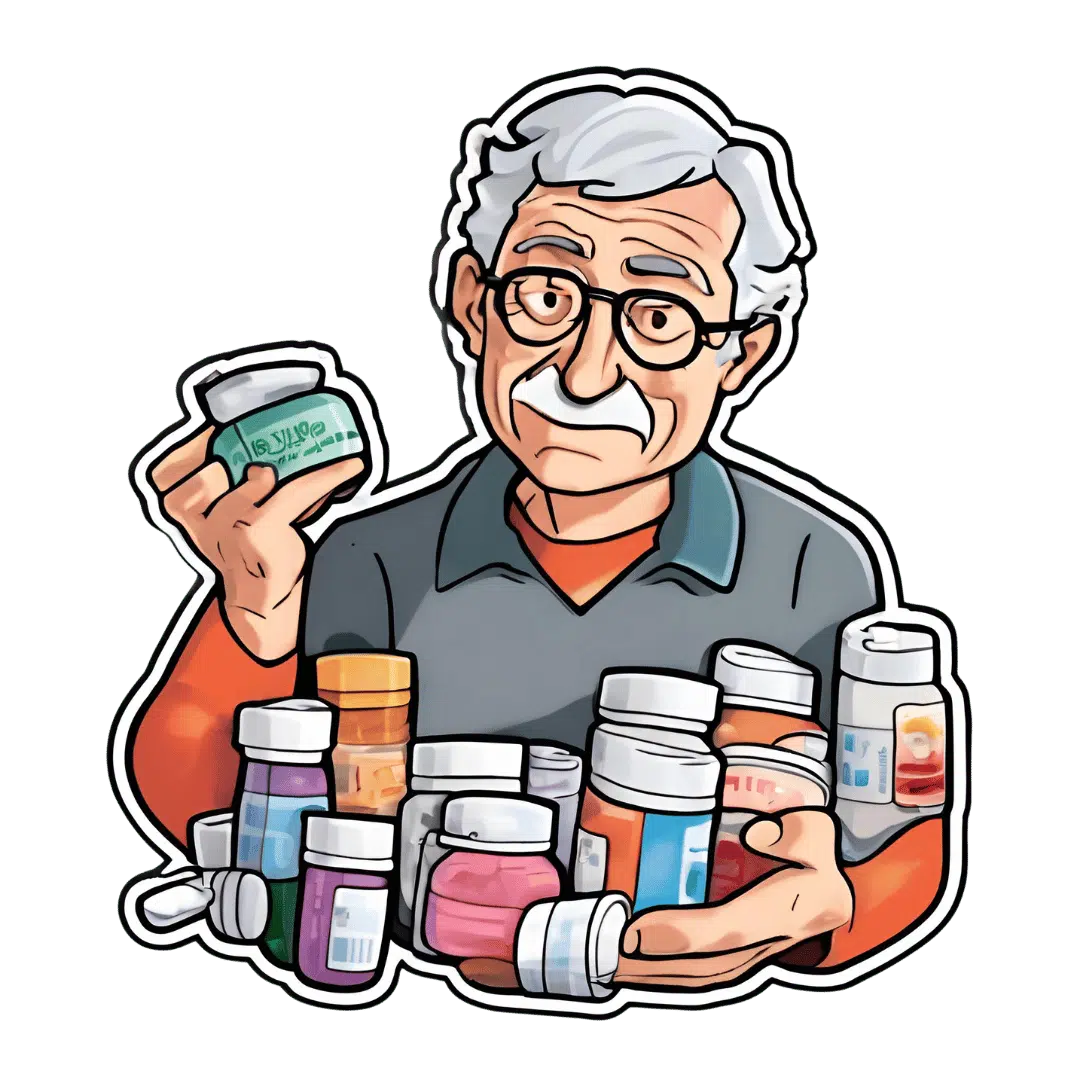
Are You Taking PIMs?
10almonds is reader-supported. We may, at no cost to you, receive a portion of sales if you purchase a product through a link in this article.
Getting Off The Overmedication Train
The older we get, the more likely we are to be on more medications. It’s easy to assume that this is because, much like the ailments they treat, we accumulate them over time. And superficially at least, that’s what happens.
And yet, almost half of people over 65 in Canada are taking “potentially inappropriate medications”, or PIMs—in other words, medications that are not needed and perhaps harmful. This categorization includes medications where the iatrogenic harms (side effects, risks) outweigh the benefits, and/or there’s a safer more effective medication available to do the job.
You may be wondering: what does this mean for the US?
Well, we don’t have the figures for the US because we’re working from Canadian research today, but given the differences between the two country’s healthcare systems (mostly socialized in Canada and mostly private in the US), it seems a fair hypothesis that if it’s almost half in Canada, it’s probably more than half in the US. Socialized healthcare systems are generally quite thrifty and seek to spend less on healthcare, while private healthcare systems are generally keen to upsell to new products/services.
The three top categories of PIMs according to the above study:
- Gabapentinoids (anticonvulsants also used to treat neuropathic pain)
- Proton pump inhibitors (PPIs)
- Antipsychotics (especially, to people without psychosis)
…but those are just the top of the list; there are many many more.
The list continues: opioids, anticholinergics, sulfonlyurea, NSAIDs, benzodiazepines and related rugs, and cholinesterase inhibitors. That’s where the Canadian study cuts off (although it also includes “others” just before NSAIDs), but still, you guessed it, there are more (we’re willing to bet statins weigh heavily in the “others” section, for a start).
There are two likely main causes of overmedication:
The side effect train
This is where a patient has a condition and is prescribed drug A, which has some undesired side effects, so the patient is prescribed drug B to treat those. However, that drug also has some unwanted side effects of its own, so the patient is prescribed drug C to treat those. And so on.
For a real-life rundown of how this can play out, check out the case study in:
The Hidden Complexities of Statins and Cardiovascular Disease (CVD)
The convenience factor
No, not convenient for you. Convenient for others. Convenient for the doctor if it gets you out of their office (socialized healthcare) or because it was easy to sell (private healthcare). Convenient for the staff in a hospital or other care facility.
This latter is what happens when, for example, a patient is being too much trouble, so the staff give them promazine “to help them settle down”, notwithstanding that promazine is, besides being a sedative, also an antipsychotic whose common side effects include amenorrhea, arrhythmias, constipation, drowsiness and dizziness, dry mouth, impotence, tiredness, galactorrhoea, gynecomastia, hyperglycemia, insomnia, hypotension, seizures, tremor, vomiting and weight gain.
This kind of thing (and worse) happens more often towards the end of a patient’s life; indeed, sometimes precipitating that end, whether you want it or not:
Mortality, Palliative Care, & Euthanasia
How to avoid it
Good practice is to be “open-mindedly skeptical” about any medication. By this we mean, don’t reject it out of hand, but do ask questions about it.
Ask your prescriber not only what it’s for and what it’ll do, but also what the side effects and risks are, and an important question that many people don’t think to ask, and for which doctors thus don’t often have a well-prepared smooth-selling reply, “what will happen if I don’t take this?”
And look up unbiased neutral information about it, from reliable sources (Drugs.com and The BNF are good reference guides for this—and if it’s important to you, check both, in case of any disagreement, as they function under completely different regulatory bodies, the former being American and the latter being British. So if they both agree, it’s surely accurate, according to best current science).
Also: when you are on a medication, keep a journal of your symptoms, as well as a log of your vitals (heart rate, blood pressure, weight, sleep etc) so you know what the medication seems to be helping or harming, and be sure to have a regular meds review with your doctor to check everything’s still right for you. And don’t be afraid to seek a second opinion if you still have doubts.
Want to know more?
For a more in-depth exploration than we have room for here, check out this book that we reviewed not long back:
To Medicate or Not? That is the Question! – by Dr. Asha Bohannon
Take care!
Don’t Forget…
Did you arrive here from our newsletter? Don’t forget to return to the email to continue learning!

Recommended
Learn to Age Gracefully
Join the 98k+ American women taking control of their health & aging with our 100% free (and fun!) daily emails:
-
Longevity Guidebook – by Dr. Peter Diamandis
10almonds is reader-supported. We may, at no cost to you, receive a portion of sales if you purchase a product through a link in this article.
The main goal of this book is extending healthspan by maintaining various bodily functions, most notably cardiac, neuromuscular, cognitive, metabolic, and respiratory.
His tools for this task are mostly the usual lifestyle considerations, since they account for most of our longevity, not genetics—though he does also discuss CRISPR, gene therapy, and cellular medicine.
There is also a chapter on, as the subtitle promises, how to not die from something stupid. This, however, is about lifesaving breakthroughs in technology—not, for example, things like “don’t hold a maskless superspreader event during a pandemic lockdown” (such as he famously did, and yes, a lot of people got sick).
The style is chatty and personal; Dr. Diamandis likes to tell stories, and name-drops celebrities at a remarkable rate, often recommending difficult-to-come-by (and expensive) therapies that they have enjoyed. While this may be a wearying habit socially, it’s actually a good habit scientifically (in the cases where the celebrities in question are famous doctors and scientists), because it means crediting everyone for what they did and said, and allowing for full traceability of ideas/information. Still, most of that is little more than informative gossip, but on a more formal level, there are citations for claims throughout, and a generous bibliography at the back, which we love to see.
Bottom line: there’s a lot of practical advice in here, most of it well-sourced (however, his 75 different supplements that he takes are a bit hit-and-miss in that regard). Aside from that, much of the book is a “who’s who” of the the longevity industry, which may or may not interest all readers.
Click here to check out Longevity Guidebook, and get inspired!
Share This Post
-
The Five Invitations – by Frank Ostaseski
10almonds is reader-supported. We may, at no cost to you, receive a portion of sales if you purchase a product through a link in this article.
This book covers exactly what its subtitle promises, and encourages the reader to truly live life fully, something that Ostaseski believes cannot be done in ignorance of death.
Instead, he argues from his experience of decades working at a hospice, we must be mindful of death not only to appreciate life, but also to make the right decisions in life—which means responding well to what he calls, as per the title of this book, “the five invitations”.
We will not keep them a mystery; they are:
- Don’t wait; do the important things now
- Welcome everything; push away nothing
- Bring your whole self to the experience
- Find a place in the middle of things
- Cultivate a “don’t know” mind
Note, for example, that “do the important things now” requires knowing what is important. For example, ensuring a loved one knows how you feel about them, might be more important than scratching some item off a bucket list. And “push away nothing” does mean bad things too; rather, of course try to make life better rather than worse, but accept the lessons and learnings of the bad too, and see the beauty that can be found in contrast to it. Enjoying the fullness of life without getting lost in it; carrying consciousness through the highs and lows. And yes, approaching the unknown (which means not only death, but also the large majority of life) with open-minded curiosity and wonder.
The style of the book is narrative and personal, without feeling like a collection of anecdotes, but rather, taking the reader on a journey, prompting reflection and introspection along the way.
Bottom line: if you’d like to minimize the regrets you have in life, this book is a fine choice.
Click here to check out The Five Invitations, and answer with a “yes” to the call of life!
Share This Post
-
Is cancer more common in women after IVF?
10almonds is reader-supported. We may, at no cost to you, receive a portion of sales if you purchase a product through a link in this article.
Since fertility treatments such as in vitro fertilisation (IVF) began, there has been concern they could cause cancer.
Concerns have included whether aspects of treatment – such as taking hormonal medications, or puncturing the ovaries to retrieve eggs – could stimulate the growth of cancer cells.
Now, our new study, published on Wednesday, has found women who underwent fertility treatments had a comparable overall rate of cancer to similarly aged women.
However, there were some differences: they had more uterine, ovarian, and melanoma cancers, and fewer lung and cervical cancers. Let’s take a look at what this means.
Shaw Photography Co./Getty What we did
Our study wanted to find out whether women who underwent fertility treatments had a different rate of cancer from the general population.
We used individual records from Medicare and the Pharmaceutical Benefits Scheme to find women who had fertility treatments between 1991 and 2018. We linked this data to the Australian Cancer Database to find cancer diagnoses.
We found 417,984 women who received fertility treatments and followed them for about a decade on average:
- 274,676 women had treatments where the egg was removed from the women’s body (IVF and similar treatments)
- 120,739 women had treatments with a specialist where the egg was not removed (mainly intrauterine insemination)
- 175,510 women received a prescription for clomiphene citrate (also known as Clomid), a medication that induces ovulation.
One woman could have had multiple types of treatment.
Their median age (the midpoint of their ages) was 32–34 years. Compared to the general population, fewer lived in disadvantaged areas.
We compared these women’s rates of cancers to women in the general population, by statistically matching them on factors such as age and the state they lived in.
What we found
Women who received fertility treatments, either with or without egg removal, had close to the exact total number of cancers we would expect in the general population of women.
But women who used clomiphene citrate had 1.04 times the rate of cancer, or 8.6 extra cancers for every 100,000 women treated each year.
Rates of uterine cancer, ovarian cancer (except for those who used clomiphene citrate), and melanoma were 1.07–1.83 times higher, depending on treatment type. This means about three to seven more of these cancers for every 100,000 women treated each year.
This difference could be due to risk factors unrelated to the treatment. For example, endometriosis – a risk factor for infertility – is linked to ovarian cancer. Similarly, more Caucasian women receive fertility treatments, and fair skin is an established risk factor for melanoma.
Across all treatments rates of cervical cancer and lung cancer were 1.43–1.92 times lower. This translates to around two to six fewer cancers for every 100,000 treated women each year.
These decreases could be due to women receiving fertility treatment being less likely to smoke. Women who receive fertility treatment may also be more likely to be screened for cervical cancer, as clinicians often encourage them to get screened before treatment. But this is anecdotal – we don’t yet have data on this.
What this means
Overall, these findings are reassuring for women who have received or are planning fertility treatments.
The number of people undergoing fertility treatments is increasing worldwide. These findings deepen our understanding of the types of cancers diagnosed in women who receive fertility treatment.
Our study shows some cancers are more common in women who received fertility treatments than in the general population of women.
However, the absolute numbers of these cancers are small, similar to those observed for women using some other medical interventions (including the contraceptive pill).
It is normal to see differences in cancer risk in specific populations when compared to the general population.
So, does this mean IVF does not cause cancer?
This study design cannot determine if fertility treatments themselves cause or prevent cancer.
Though fertility treatments may contribute to cancer risk, women who receive fertility treatments have a different health and socio-demographic profile to the general population of women. These factors may affect cancer risk.
We did not have any data on why women were using fertility treatments to get pregnant and whether this is connected to their cancer risk. For example, we don’t know if they were receiving treatment for medical infertility, or for another reason (such as same-sex couples trying to conceive).
Our study also only followed women for around ten years, and the cancer risk profile may change as these women age.
The takeaway
As with every medical treatment, it is important for women and their health-care practitioners to make informed decisions before and after fertility treatment, including considering potential changes in cancer risk.
Women considering fertility treatment, and those who’ve used fertility treatment, should continue to participate in the routine cancer screening programs they’re eligible for.
If women are worried about their risk of cancer, they should consult their doctor to understand the steps they can take to reduce their risk.
Adrian Raymond Walker, Research Fellow, Centre for Big Data Research in Health, UNSW Sydney and Claire Vajdic, Professor, The Kirby Institute, UNSW Sydney
This article is republished from The Conversation under a Creative Commons license. Read the original article.
Share This Post
Related Posts
-
Beyond Balancing The Books – by George Marino, CPA, CFP
10almonds is reader-supported. We may, at no cost to you, receive a portion of sales if you purchase a product through a link in this article.
We hear a lot about the importance of mindfulness, yet how can Zen-like non-attachment to the material world go well with actually surviving (let alone thriving) in a Capitalist society?
Books that try to connect the two often end up botching it badly to the level of early 2000s motivational posters.
So, what does this book do differently? Mostly it’s because rather than a motivational speech with exhortations to operate on a higher plain and manifest your destiny and all that, it gives practical, down-to-earth advice and offers small simple things you can do or change to mindfully engage with the world of business rather than operating on auto-pilot.
Basically: how to cut out the stress without cutting out your performance.
All in all, we think both your health and your productivity will thank you for it!
Take Your Business (and Brain) “Beyond Balancing The Books” Today
Don’t Forget…
Did you arrive here from our newsletter? Don’t forget to return to the email to continue learning!
Learn to Age Gracefully
Join the 98k+ American women taking control of their health & aging with our 100% free (and fun!) daily emails:
-
Women told they have dense breasts don’t know what to do next, new study shows
10almonds is reader-supported. We may, at no cost to you, receive a portion of sales if you purchase a product through a link in this article.
Imagine a 57-year-old woman, let’s call her Maria, who’s just opened a letter about her mammography results. She’s had several mammograms before, but this time reads new information: “Your breasts are dense”.
While the letter assures her that dense breasts are common, it also indicates it could make it harder to see breast cancer on the mammogram.
Maria is confused about what to do next and wonders if she should be worried. Does she need to see her GP?
Maria may be fictional but she reflects the findings from the first trial of its kind we publish today.
We show women notified they have dense breasts alongside their mammogram result are more confused and anxious, do not feel more informed, and have greater intentions to see their GP for advice.
Andrii Zastrozhnov/Getty Remind me, what is breast density?
Dense breast tissue appears white on a mammogram and can hide (or mask) a cancer, which also appears white.
Dense breasts are very common. About 25–40% of women are considered to have dense breasts.
Breast density is one of several independent risk factors for breast cancer. After years of consumer advocacy, more women are being told about their breast density when they get their results from breast cancer screening.
The idea is simple: let women know if they have dense breasts – something that can raise cancer risk and make mammograms harder to read – so they can decide whether to get extra testing, such as an ultrasound or MRI.
Notifying women about their breast density is now legislated in the United States, recommended in Australia, and is being considered in other jurisdictions, such as the United Kingdom.
This is despite the lack of robust evidence on whether the benefits of notifying breast density at screening outweigh potential harms for women, and the impact on health services.
What we did and what we found
Our trial was co-designed with BreastScreen Queensland. From September 2023 to July 2024 we randomised 2,401 women (average age 57) who had a clear mammogram (their mammogram didn’t show cancer), but had dense breasts, into three categories:
- Control: no notification of dense breasts (standard care)
- Intervention 1: notification of breast density as part of the screening results letter plus extra written information in a leaflet
- Intervention 2: notification of breast density as part of the screening results letter plus a link to extra information in an online video.
Eight weeks after screening, we found women notified they had dense breasts felt more anxious and confused about what to do about their breast health compared to the control group.
They also did not feel more informed to make decisions about their breast health, and had greater intentions to discuss this with their GP.
We haven’t followed participants for long enough yet, nor was the trial specifically designed to see if notifying women about their breast density led to extra cancers being detected.
The trial also had some limitations. For example there was a low proportion of women from non-English speaking backgrounds.
However, this is the first randomised trial world-wide to evaluate the immediate impact of breast density notification on women in the context of mammography screening.
It provides evidence for breast screening programs internationally to carefully consider the potential impact of such notification.
What next?
In Australia, where breast density notification is now recommended, it is important we acknowledge that the topic of breast density may be confusing and some women may be worried.
Communicating about breast density, including public messaging, should be focused on density being one of many risk factors for breast cancer and that there are other potentially modifiable ways to reduce a woman’s overall risk.
This includes maintaining a healthy weight, being physically active, reducing alcohol intake, and not smoking. Messaging should also emphasise that mammograms remain the best way to screen for breast cancer in most women even if they have dense breasts.
GPs need to be prepared to have conversations with women about breast density and their overall risk of breast cancer. This includes discussing the benefits and harms of extra screening (via ultrasound, MRI or contrast-enhanced mammograms) that can detect cancers not found on mammograms.
But even that’s not straight forward. For instance, while there is evidence extra screening will detect more cancers, there’s currently no evidence on whether it will reduce advanced-stage breast cancers or death from breast cancer.
Extra screening may lead to adverse effects such as false-positives – apparent abnormalities that, after further evaluation, are found not to be cancer.
Extra screening is also not equitable for all women due to out-of-pocket costs and limited availability through public services.
We need better pathways for evidence-based, equitable care in Australia so the benefits of notifying women about their breast density indeed outweigh any adverse consequences for women and the health system. These pathways need to be evaluated to ensure they are feasible, acceptable, effective and equitable.
Brooke Nickel, NHMRC Emerging Leader Research Fellow, University of Sydney and Nehmat Houssami, Professor of Public Health, University of Sydney
This article is republished from The Conversation under a Creative Commons license. Read the original article.
Don’t Forget…
Did you arrive here from our newsletter? Don’t forget to return to the email to continue learning!
Learn to Age Gracefully
Join the 98k+ American women taking control of their health & aging with our 100% free (and fun!) daily emails:
-
If you have a pet as a kid, does this lower your risk of asthma and eczema?
10almonds is reader-supported. We may, at no cost to you, receive a portion of sales if you purchase a product through a link in this article.
As the number of people with allergies grows worldwide, scientists are trying to work out precisely how and why these conditions – such as asthma and eczema – develop.
One long-standing idea is the “hygiene hypothesis”. This suggests our modern indoor lifestyles are to blame, as they limit our early exposure to germs and allergens which help train the immune system.
But growing evidence suggests having a pet may counter this effect. As any pet owner knows, our furry friends bring a lot of mess, germs and fur into our homes – along with the cuddles.
So, does spending time with animals lower children’s risk of allergies? Here’s what we know.
Catherine Delahaye/Getty Images How allergies develop
During early childhood, our immune systems learn what to attack and what to ignore to stop us getting sick.
Evidence suggests early exposure – to family members, food, germs, dust, dirt, pollen and pet dander (skin flakes) – shapes this immune response.
Allergic conditions develop when the immune system overreacts to harmless substances, such as dust, pollen or certain foods. These reactions can affect the skin, airways and gut.
Dogs bring both love and mess – which might be just what a developing immune system needs. Samantha Chan/Author provided, CC BY-NC-ND However, we still don’t fully understand why some people develop allergies while others don’t.
Scientists have identified genes linked to allergic conditions. But most have subtle effects on the immune system and act as “risk factors” – they increase the chance of disease but don’t cause it outright.
Recent research suggests exposure to bacteria in our environment could be another major factor.
From birth, our bodies are colonised by bacteria, especially in the gut. This community of microorganisms is known as the microbiome.
Ongoing “crosstalk” between the microbiome and immune system is crucial for healthy immune function. When this balance is disturbed, it can contribute to inflammation and disease.
The effect of our early environment
In the last few decades, studies of children raised on farms gave us some of the first clues that early environments can affect allergy risk.
Compared to children raised in cities, children on farms are less likely to have allergic conditions such as eczema and asthma. This is especially true of those in close contact with animals.
Notably, farm-raised children tend to develop a more diverse microbiome than children raised in urban environments. This may help make their immune system more tolerant to foreign substances (such as bacteria and dirt) and less likely to develop allergies.
However, across the world children are increasingly living in urban areas.
This means a pet may be the closest contact they have with animals. So, does this still lower their risk of developing allergies?
Children raised on farms, especially those in close contact with animals, seem to have a lower risk of allergic diseases. Peter van Haastrecht / 500px/Getty Images What the studies show in eczema
Some studies indicate children with pets may be less likely to have allergies.
However this evidence hasn’t always been easy to interpret.
It can be difficult to tell whether lower allergy rates are due to the pets themselves or other factors, such as location, lifestyle or a family history of allergies.
A review of results from 23 studies found children exposed to dogs early in life were significantly less likely to develop eczema.
Another 2025 study analysed genetic data from more than 270,000 people. It found a gene linked to eczema only increased risk of eczema in children who hadn’t been exposed to dogs.
This suggests early dog exposure may help protect children who are genetically more likely to develop eczema.
What about asthma?
When it comes to asthma, the story gets trickier.
One 2001 study followed more than 1,000 children in the United States from birth to age 13. It found those living with dogs indoors were less likely to develop frequent wheezing – a common asthma symptom – but only if they didn’t have a family history of asthma.
A Korean study from 2021 found those who had dogs during childhood were less likely to develop allergies. But they had a slightly higher risk of non-allergic wheeze — a type of breathing difficulty usually caused by airway irritation or infections (not allergens).
This suggests while growing up with a dog may protect against allergic conditions, such as asthma, it may increase the chance of certain non-allergic respiratory symptoms.
What about cats?
It’s challenging to tease apart the specific effects of cats versus dogs, since many early studies grouped all furry pets together.
But in studies that have looked at them separately, living with cats didn’t seem to reduce allergy risk.
One potential reason is cats and dogs carry very different microbes, which may influence how they shape the household environment.
Cats and dogs carry very different microbes, which may influence how they shape the household environment. Photo by Mochamad Reza Aditya on Unsplash So, should you get a pet?
If you’re already thinking about getting a dog, there’s decent evidence early exposure could reduce your child’s risk of eczema, and possibly other allergic conditions too.
It’s not a guarantee, but a potential bonus – alongside companionship, joy and never having to worry about what to do with leftovers.
And if a dog’s not on the cards, don’t worry. Spending time outdoors, encouraging messy play, and avoiding overuse of disinfectants can all help build a more resilient immune response.
Samantha Chan, Immunology and Allergy Lead, Snow Centre for Immune Health, WEHI (Walter and Eliza Hall Institute of Medical Research) and Jo Douglass, Professor of Medicine University of Melbourne and Director of Research, Royal Melbourne Hospital., The University of Melbourne
This article is republished from The Conversation under a Creative Commons license. Read the original article.
Don’t Forget…
Did you arrive here from our newsletter? Don’t forget to return to the email to continue learning!
Learn to Age Gracefully
Join the 98k+ American women taking control of their health & aging with our 100% free (and fun!) daily emails:


