
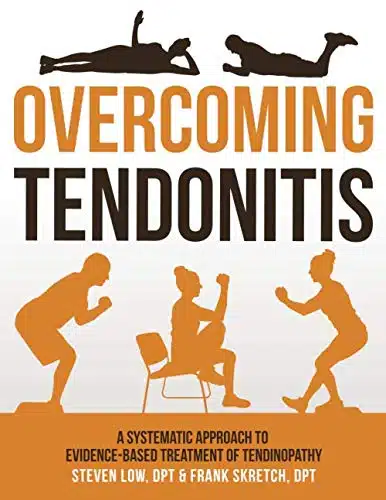
Overcoming Tendonitis – by Dr. Steven Low & Dr. Frank Skretch

10almonds is reader-supported. We may, at no cost to you, receive a portion of sales if you purchase a product through a link in this article.

If you assumed tendonitis to be an inflammatory condition, you’re not alone. However, it’s not; the “-itis” nomenclature is a misnomer, and while one can rarely go wrong with reducing chronic/systemic inflammation, it’s not the cure for tendonitis.

What, then, is tendonitis and what does cure it? It’s a non-inflammatory proliferation disorder, meaning, something is growing (or in this case, simply being replaced) in a way it shouldn’t. As to fixing it, that’s more complex.

This book does cover 20 interventions (sorted into “major” and “minor”), ranging from exercise therapies to surgery, with many things between. It also examines popular myths that do not help, such as rest, ice, heat, and analgesics.

The style of this book is hard science, but don’t worry, it explains everything along the way. It does however mean that if you’re not very accustomed to wading through scientific material, you can’t just dip into the middle of the book and be guaranteed to understand what’s going on. Indeed, before even getting to discussing tendonitis/tendinopathy, the first chapter is very reassuringly dedicated to “understanding the levels and classification of evidence in studies”, along with the assorted scales and guidelines of the Center for Evidence-Based Medicine.

The rest, however, is about the etiology, diagnosis, and treatment of tendonitis and tendinopathy more generally. One interesting thing is that, according to the abundant high-quality evidence presented in this book, what works for one body part’s tendonitis does not necessarily work for another body part, so we get quite a part-by-part rundown.

Bottom line: this book has a wealth of useful, applicable information about management of tendonitis, making it indispensable if you or a loved one suffer from such—but settle in, because it’s not a light read.

Click here to check out Overcoming Tendonitis, and overcome tendonitis!

Don’t Forget…

Did you arrive here from our newsletter? Don’t forget to return to the email to continue learning!
  • Why You Feel Like You Have To Pee Again Right After You Just Went
    Dr. Amy Konvalin talks us through breaking the pattern: When nature calls… Repeatedly Fun fact: feeling like you need to pee again right after standing up is often more a matter of bladder sensation, pelvic floor tension, positioning, and learned bathroom habits, rather than necessarily incomplete emptying. Notably, repeatedly sitting back down “just in case” can…

Learn to Age Gracefully

Join the 98k+ American women taking control of their health & aging with our 100% free (and fun!) daily emails:

  • Ending Aging – by Dr. Aubrey de Grey

    10almonds is reader-supported. We may, at no cost to you, receive a portion of sales if you purchase a product through a link in this article.

    We know about how to slow aging. We know about diet, exercise, sleep, intermittent fasting, and other lifestyle tweaks to make. But how much can we turn back the clock, according to science?

    Dr. Aubrey de Grey’s foundational principle is simple: the body is a biological machine, and aging is fundamentally an engineering problem.

    He then outlines the key parts to that problem: the princple ways in which cells (and DNA) get damaged, and what we need to do about that in each case. Car tires get damaged over time; our approach is to replace them within a certain period of time so that they don’t blow out. In the body, it’s a bit similar with cells so that we don’t get cancer, for example.

    The book goes into detail regards each of the seven main ways we accumulate this damage, and highlights avenues of research looking to prevent it, and in at least some cases, the measures already available to so.

    Bottom line: if you want a hard science overview of actual rejuvenation research in biogerontology, this is a book that presents that comprehensively, without assuming prior knowledge.

    Click here to check out Ending Aging and never stop learning!

    Share This Post

  • The Anti-Inflammatory Diet Slow Cooker Cookbook – by Madeline Given

    10almonds is reader-supported. We may, at no cost to you, receive a portion of sales if you purchase a product through a link in this article.

    The author, a nutritionist, has a strongly reactionary take on what’s inflammatory or not, so we see some interesting choices such as including red meat and excluding soy beans, but for the most part, the recipes are from ingredients generally considered at least non-inflammatory, if not anti-inflammatory (which many are, especially the herbs, spices, berries, and leafy greens).

    For those who do wish to avoid specific foods due to allergies or intolerances, they are marked as being, for example, dairy-free, nut-free, nightshade-free, and so forth.

    By default, she does give us mostly dairy-free recipes, by the way, usually swapping any unfermented dairy for plant-based alternatives. Of course, not every plant-based alternative will be right for every reader, but a degree of common sense can be assumed with regard to substitutions (e.g. maybe don’t go with the recommendation of a nut milk if you have a nut allergy, etc).

    The recipes themselves, of which there are 90, are pleasant and clearly described, and (consistent with what one would expect from a book of slow cooker recipes) involve an absolute minimum of preparation time.

    Bottom line: this one will go best if you are already aware of what’s inflammatory or not for you personally; aside from that, it’s a mostly very respectable book of tasty slow cooker recipes.

    Click here to check out The Anti-Inflammatory Diet Slow Cooker Cookbook, and go slow!

    Share This Post

  • What Most People Don’t Know About Blood Pressure

    10almonds is reader-supported. We may, at no cost to you, receive a portion of sales if you purchase a product through a link in this article.

    Do you know the symptoms of high blood pressure?

    Challenge yourself: take a moment to list them in your head / count them on your fingers, and then scroll down to see what you got right!

    👇

    This way

    👇

    Keep going

    👇

    All the way

    👇

    Nearly there

    👇

    Drumroll please

    👇

    The answer is…

    No, you don’t know the symptoms of high blood pressure 😉

    But don’t worry, nobody else does, either:

    ❝High blood pressure usually has no warning signs or symptoms, and many people do not know they have it.

    Measuring your blood pressure is the only way to know whether you have high blood pressure.❞

    Source: CDC | About High Blood Pressure

    And, that’s a critical thing that most people don’t know about high blood pressure—in the sense of: most people don’t know that it has no symptoms.

    Which is a problem, because it means that often the first people learn about it is when they sustain some vascular injury as a result (stroke, heart attack, kidney disease, etc).

    And, about that kidney disease?

    • Good news: the human body can function for a fair while on a kidney that’s been reduced to a fraction of its functionality
    • Bad news: that’s very bad for you and simply means you now have a second serious problem of which you’re unaware

    For more on this, check out: Are your Kidneys Ok? Detect Early To Protect Kidney Health (Here’s How)

    And for what to do about it: Keeping Your Kidneys Healthy (Far More Than Just Hydration)

    Most people also don’t know what high blood pressure is

    Well, they know it conceptually, but not numerically—based on a US survey that found, in answer to a multiple choice question on the topic:

    • 25% believed that anything under 140/90 was fine
    • 18% considered 130/90 to be the threshold
    • 16% thought it was 140/80
    • 13% got it right, at 130/80

    Read in full: Most Americans cannot identify what counts as high blood pressure

    In the same survey, by the way, only 39% knew that high blood pressure has no symptoms.

    However, that 130/80 threshold for high blood pressure doesn’t mean that 129/79 is fine.

    120/79, for example counts as elevated blood pressure.

    Rather than take up undue space here, we’ll mention that you should aim for under 120/80, and for the rest, we’ll just quickly link to…

    Blood Pressure Readings Explained (With A Colorful Chart)

    More details of specifics, at:

    Hypotension | Normal | Elevated | Stage 1 | Stage 2 | Danger zone

    And as for how to measure it yourself without getting it wrong, check out:

    Wrong Arm Position = Wrong Measurement Of Blood Pressure (Here’s How To Get It Right)

    How to lower it

    We wrote a main feature on this before, because a lot of people focus on the wrong thing:

    Hypertension: Factors Far More Relevant Than Salt

    If you’re already taking care of those things, and want to really optimize your blood-pressure-lowering efforts, check out:

    What is the best workout to lower your blood pressure? ← counterintuitively, it’s isometric exercises (i.e. exercises where you hold a position without moving, such as wall sits or abdominal planks)

    And if you are perchance a postmenopausal woman, there may be an extra reason to enjoy mangos specifically:

    Short-Term Cardiometabolic Response to Mango Intake in Postmenopausal Women

    Enjoy!

    Share This Post

  • Hello Sleep – by Dr. Jade Wu

    10almonds is reader-supported. We may, at no cost to you, receive a portion of sales if you purchase a product through a link in this article.

    We’ve reviewed other sleep books before, so what makes this one stand out?

    Mostly, it’s because this one takes quite a different approach.

    While still giving a nod to the sensible advice you’ve already read in many places (including here at 10almonds), Dr. Wu looks to help the reader avoid falling into the trap (or: help the reader get out of the trap, if already there) of focussing so much on getting better sleep that it becomes an all-consuming stressor that takes up much of the day thinking about it, and guess what, much of the night too, because you’re busy working out how sleep-deprived you’re going to be tomorrow.

    Instead, Dr. Wu recommends to work with your body rather than against it, worry less, and ultimately sleep better. Of course, the “how” of this is what makes most of the book.

    She does also give chapters on things that may be different for you, based on such things as hormones, age, or medical conditions.

    The writing style is pop-science but with frequent references to scientific papers as appropriate, making good science very accessible.

    Bottom line: if you’ve tried everything else and/but good sleep still eludes you, this book will help you to end the battle and make friends with your sleep (a metaphor the author uses throughout the book, by the way).

    Click here to check out Hello Sleep, and indeed get better sleep!

    Don’t Forget…

    Did you arrive here from our newsletter? Don’t forget to return to the email to continue learning!

    Learn to Age Gracefully

    Join the 98k+ American women taking control of their health & aging with our 100% free (and fun!) daily emails:

  • Is Your Gut Leading You Into Osteoporosis?

    10almonds is reader-supported. We may, at no cost to you, receive a portion of sales if you purchase a product through a link in this article.

    Bacterioides Vulgatus & Bone Health

    We’ve talked before about the importance of gut health:

    And we’ve shared quite some information and resources on osteoporosis:

    How the two are connected

    A recent study looked at Bacterioides vulgatus, a very common gut bacterium, and found that it suppresses the gut’s production of valeric acid, a short-chain fatty acid that enhances bone density:

    ❝For the study, researchers analyzed the gut bacteria of more than 500 peri- and post-menopausal women in China and further confirmed the link between B. vulgatus and a loss of bone density in a smaller cohort of non-Hispanic White women in the United States.❞

    Pop-sci source: Does gut bacteria cause osteoporosis?

    The study didn’t stop there, though. They proceeded to test, with a rodent model, the effect of giving them either:

    • more B. vulgatus, or
    • valeric acid supplements

    The results of this were as expected:

    • Those who were given more B. vulgatus got worse bone microstructure
    • Those who were given valeric acid supplements got stronger bones overall

    Study source: Gut microbiota impacts bone via Bacteroides vulgatus-valeric acid-related pathways

    Where can I get valeric acid?

    We couldn’t find a handy supplement for this, but it is in many foods, including avocados, blueberries, cocoa beans, and an assortment of birds.

    Click here to see a more extensive food list (you’ll need to scroll down a little)

    Bonus: if you happen to be on HRT in the form of Estradiol valerate (e.g: Progynova), then that “valerate” is an ester of valeric acid, that your body can metabolize and use as such.

    Enjoy!

    Don’t Forget…

    Did you arrive here from our newsletter? Don’t forget to return to the email to continue learning!

    Learn to Age Gracefully

    Join the 98k+ American women taking control of their health & aging with our 100% free (and fun!) daily emails:

  • Blood-Sugar-Friendly Ice Pops

    10almonds is reader-supported. We may, at no cost to you, receive a portion of sales if you purchase a product through a link in this article.

    This generic food product has so many regional variant names that it’s difficult to get a universal name, but in N. America they’re also known by the genericized brand name of popsicles. Anyway, they’re usually very bad news for blood sugars, being merely frozen juice even if extra sugar wasn’t added. Today’s recipe, on the other hand, makes for a refreshing and nutrient-dense treat that won’t spike your blood glucose!

    You will need

    • 1 cup fresh blueberries
    • 1 can (12oz/400g) coconut milk
    • ½ cup yogurt with minimal additives
    • 1 tbsp honey (omit if you prefer less sweetness)
    • Juice of ¼ lime (increase if you prefer more sourness)

    Method

    (we suggest you read everything at least once before doing anything)

    1) Blend everything

    2) Pour into ice pop molds and freeze overnight

    3) Serve at your leisure:

    Enjoy!

    Want to learn more?

    For those interested in some of the science of what we have going on today:

    Take care!

    Don’t Forget…

    Did you arrive here from our newsletter? Don’t forget to return to the email to continue learning!

    Learn to Age Gracefully

    Join the 98k+ American women taking control of their health & aging with our 100% free (and fun!) daily emails: