

I’ve recovered from a cold but I still have a hoarse voice. What should I do?

10almonds is reader-supported. We may, at no cost to you, receive a portion of sales if you purchase a product through a link in this article.

Cold, flu, COVID and RSV have been circulating across Australia this winter. Many of us have caught and recovered from one of these common upper respiratory tract infections.

But for some people their impact is ongoing. Even if your throat isn’t sore anymore, your voice may still be hoarse or croaky.

So what happens to the voice when we get a virus? And what happens after?

Here’s what you should know if your voice is still hoarse for days – or even weeks – after your other symptoms have resolved.

Why does my voice get croaky during a cold?

A healthy voice is normally clear and strong. It’s powered by the lungs, which push air past the vocal cords to make them vibrate. These vibrations are amplified in the throat and mouth, creating the voice we hear.

The vocal cords are two elastic muscles situated in your throat, around the level of your laryngeal prominence, or Adam’s apple. (Although everyone has one, it tends to be more pronounced in males.) The vocal cords are small and delicate – around the size of your fingernail. Any small change in their structure will affect how the voice sounds.

When the vocal cords become inflamed – known as laryngitis – your voice will sound different. Laryngitis is a common part of upper respiratory tract infections, but can also be caused through misuse.
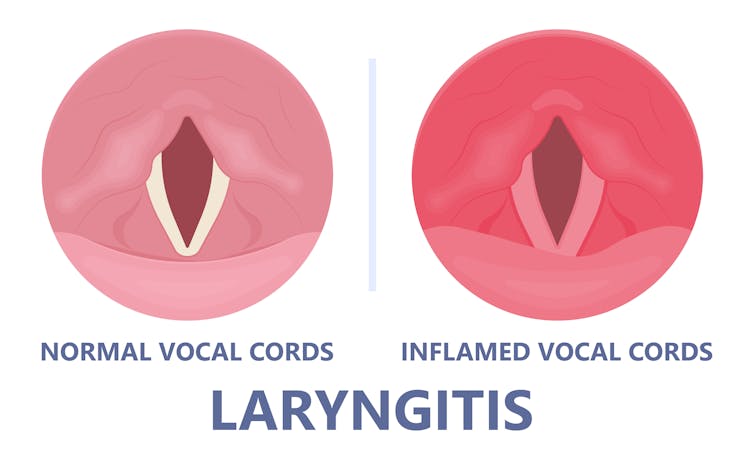
Two drawn circles comparing normal vocal cords with inflamed, red vocal cords.
Viruses such as the common cold can inflame the vocal cords. Pepermpron/Shutterstock

Catching a virus triggers the body’s defence mechanisms. White blood cells are recruited to kill the virus and heal the tissues in the vocal cords. They become inflamed, but also stiffer. It’s harder for them to vibrate, so the voice comes out hoarse and croaky.

In some instances, you may find it hard to speak in a loud voice or have a reduced pitch range, meaning you can’t go as high or loud as normal. You may even “lose” your voice altogether.

Coughing can also make things worse. It is the body’s way of trying to clear the airways of irritation, including your own mucus dripping onto your throat (post-nasal drip). But coughing slams the vocal cords together with force.

Chronic coughing can lead to persistent inflammation and even thicken the vocal cords. This thickening is the body trying to protect itself, similar to developing a callus when a pair of new shoes rubs.

Thickening on your vocal cords can lead to physical changes in the vocal cords – such as developing a growth or “nodule” – and further deterioration of your voice quality.
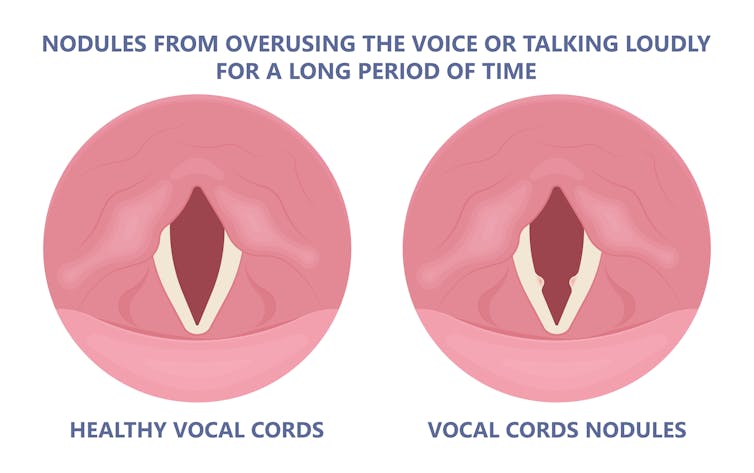
Diagram compares healthy vocal cords with cords that have nodules, two small bumps.
Coughing and exertion can cause inflamed vocal cords to thicken and develop nodules. Pepermpron/Shutterstock

How can you care for your voice during infection?

People who use their voices a lot professionally – such as teachers, call centre workers and singers – are often desperate to resume their vocal activities. They are more at risk of forcing their voice before it’s ready.

The good news is most viral infections resolve themselves. Your voice is usually restored within five to ten days of recovering from a cold.

Occasionally, your pharmacist or doctor may prescribe cough suppressants to limit additional damage to the vocal cords (among other reasons) or mucolytics, which break down mucus. But the most effective treatments for viral upper respiratory tract infections are hydration and rest.

Drink plenty of water, avoid alcohol and exposure to cigarette smoke. Inhaling steam by making yourself a cup of hot water will also help clear blocked noses and hydrate your vocal cords.

Rest your voice by talking as little as possible. If you do need to talk, don’t whisper – this strains the muscles.

Instead, consider using “confidential voice”. This is a soft voice – not a whisper – that gently vibrates your vocal cords but puts less strain on your voice than normal speech. Think of the voice you use when communicating with someone close by.

During the first five to ten days of your infection, it is important not to push through. Exerting the voice by talking a lot or loudly will only exacerbate the situation. Once you’ve recovered from your cold, you can speak as you would normally.

What should you do if your voice is still hoarse after recovery?

If your voice hasn’t returned to normal after two to three weeks, you should seek medical attention from your doctor, who may refer you to an ear nose and throat specialist.

If you’ve developed a nodule, the specialist would likely refer you to a speech pathologist who will show you how to take care of your voice. Many nodules can be treated with voice therapy and don’t require surgery.

You may have also developed a habit of straining your vocal cords, if you forced yourself to speak or sing while they were inflamed. This can be a reason why some people continue to have a hoarse voice even when they’ve recovered from the cold.

In those cases, a speech pathologist may play a valuable role. They may teach you to exercises that make voicing more efficient. For example, lip trills (blowing raspberries) are a fun and easy way you can learn to relax the voice. This can help break the habit of straining your voice you may have developed during infection.

Yeptain Leung, Postdoctoral Research and Lecturer of Speech Pathology, School of Health Sciences, The University of Melbourne

This article is republished from The Conversation under a Creative Commons license. Read the original article.

Don’t Forget…

Did you arrive here from our newsletter? Don’t forget to return to the email to continue learning!
Learn to Age Gracefully

Join the 98k+ American women taking control of their health & aging with our 100% free (and fun!) daily emails:

  • Yes, you can be intolerant to fruit and veg

    10almonds is reader-supported. We may, at no cost to you, receive a portion of sales if you purchase a product through a link in this article.

    For most people, eating a wide variety of fruit and vegetables is the cornerstone of a healthy diet.

    But for people with hereditary fructose intolerance, even a couple of bites of juicy watermelon or some sun-dried tomatoes in a salad can cause serious health problems.

    This rare condition isn’t a food allergy or sensitivity.

    But it can lead to serious health problems if not identified and correctly managed.

    Any Lane/Pexels

    What is hereditary fructose intolerance?

    Hereditary fructose intolerance is a rare genetic condition that affects how the body manages the sugar fructose.

    Fructose isn’t just in fruit. It’s in honey, some vegetables, sweetened drinks, and many packaged foods, such as cakes, cookies, sauces and some breads. Fructose can also be added during the processing of some meats (deli meats and sausages) and dairy products (chocolate milk).

    Sucrose (table sugar) and sorbitol (a sugar substitute often in chewing gum, toothpaste and medications) also contain fructose or are converted into fructose during digestion. This means people with hereditary fructose intolerance are also intolerant to these sugars.

    People with the condition don’t have the key enzyme aldolase B needed to break down fructose.

    This means fructose builds up in the liver, kidneys and intestines. This excess fructose can cause serious health problems, such as seizures, coma and, in some cases, death from liver and kidney failure.

    How common is it?

    Hereditary fructose intolerance is passed down to a person when both their parents carry the gene. It is considered a rare condition that affects about one in 10,000 people.

    It usually becomes noticeable when babies begin eating solid foods including fruit, vegetables or sweetened baby foods that contain fructose.

    In adults, hereditary fructose intolerance can be missed or misdiagnosed as other conditions such as glycogen storage disease, an eating disorder or recurrent hepatitis.

    Because of this overlap in symptoms, hereditary fructose intolerance in adults can remain undetected for years.

    How is it different to a food allergy or sensitivity?

    Hereditary fructose intolerance is markedly different to a food allergy. A food allergy involves the immune system reacting to a food – for example, cow’s milk protein – as if it’s harmful to the body. This can cause symptoms such as hives and welts, swelling of the mouth or trouble breathing.

    Hereditary fructose intolerance is also different to a food sensitivity, such as lactose intolerance or non-coeliac gluten sensitivity. This doesn’t involve the immune system but can still cause discomfort such as bloating, altered bowel habits or stomach pain.

    Hereditary fructose intolerance is a genetic condition that causes a food intolerance and is not immune-related.

    The condition is also different to fructose malabsorption (which, confusingly has previously been referred to as “dietary fructose intolerance” informally). This is a milder digestive condition where the small intestine doesn’t absorb fructose well, and causes symptoms such as stomach pain, bloating and gas.

    How do you know if you have it?

    In babies and young children, symptoms may include vomiting, unusual sleepiness or irritability, food refusal and failure to gain weight.

    Some children instinctively avoid sweet foods, which may mask the condition until later in childhood or adulthood.

    In adults, symptoms can include chronic stomach pain, fatigue and unexplained low blood glucose (sugar) levels. Doctors may notice subtle clues such as a swollen liver, abnormal liver tests or signs of fatty liver disease.

    Confirming the condition requires genetic testing or a specialised glucose (sugar) tolerance test. But for many, diagnosis only comes after years of confusion, frustration, and dietary trial and error.

    How is it managed?

    There’s no cure for hereditary fructose intolerance. But it can be managed by strictly avoiding fructose, sucrose and sorbitol. Reading labels becomes essential for daily life, as even sauces, medications and toothpaste can contain these sugars.

    People with the condition need to watch the following:

    • fruits: avoid all fruits, juices, canned fruit and other fruit products
    • cereals/grains: avoid cereals with added sugars, honey, molasses, dried fruit or sweet flavourings. Pasta, rice and other plain grains such as quinoa or buckwheat are generally safe but avoid flavoured or pre-made varieties
    • vegetables: most vegetables are fine, except sweeter ones such as peas, corn, beetroot, onions, pumpkin, sweet potatoes, carrots and zucchini
    • breads: only those made without added sugars or sweeteners are OK.
    • desserts and dairy: avoid sweetened desserts or flavoured yogurts (natural yogurts are usually fine). Be wary of plant-based milks, such as almond milks, which often have added sugars
    • protein: non-sweetened or flavoured red meat, chicken, turkey, fish, beans and lentils, eggs, tofu and tempeh are usually safe. But avoid processed meats, such as sausages/deli meats, or marinated meats
    • other foods: be cautious with sauces, dressings and condiments as they many contain hidden sugars or sorbitol. Choose homemade versions using safe ingredients.

    Awareness matters

    If someone avoids certain foods or if they unwell after eating fruit, don’t assume they’re fussy or dieting – they might have hereditary fructose intolerance.

    Greater awareness of this rare condition could mean earlier diagnosis and better support for those affected.

    For parents, noticing a child’s sudden or strong aversion to sweets, repeated vomiting or slow growth can be an important clue.

    And for doctors, considering hereditary fructose intolerance as a possible cause of unexplained digestive problems, low blood glucose or liver changes could make a life-changing difference.


    More information about hereditary fructose intolerance is available, including recipes, tips on how to read food labels, and support.

    Lauren Ball, Professor of Community Health and Wellbeing, The University of Queensland; Emily Burch, Accredited Practising Dietitian and Lecturer, Southern Cross University, and Mackenzie Derry, Nutritionist, Dietitian & PhD Candidate, The University of Queensland

    This article is republished from The Conversation under a Creative Commons license. Read the original article.

    Share This Post

  • More Mediterranean – by American’s Test Kitchen

    10almonds is reader-supported. We may, at no cost to you, receive a portion of sales if you purchase a product through a link in this article.

    Regular 10almonds readers will know that we talk about the Mediterranean diet often, and with good reason; it’s been for quite a while now the “Gold Standard” when it comes to scientific consensus on what constitutes a good diet for healthy longevity.

    However, it’s easy to get stuck in a rut of cooking the same three meals and thinking “I must do something different, but not today, because I have these ingredients and don’t know what to cook” and then when one is grocery-shopping, it’s “I should have researched a new thing to cook, but since I haven’t, I’ll just get the ingredients for what I usually cook, since we need to eat”, and so the cycle continues.

    This book will help break you out of that cycle! With (as the subtitle promises) hundreds of recipes, there’s no shortage of good ideas. The recipes are “plant-forward” rather than plant-based per se (i.e. there are some animal products in them), though for the vegetarians and vegans, it’s nothing that’s any challenge to substitute.

    Bottom line: if you’re looking for “delicious and nutritious”, this book is sure to put a rainbow on your plate and a smile on your face.

    Click here to check out More Mediterranean, and inspire your kitchen!

    Share This Post

  • Beetroot vs Green Beans – Which is Healthier?

    10almonds is reader-supported. We may, at no cost to you, receive a portion of sales if you purchase a product through a link in this article.

    Our Verdict

    When comparing beetroot to green beans, we picked the beetroot.

    Why?

    Both have their merits!

    In terms of macros, there’s really nothing between them and we’re calling this first category a tie.

    In the category of vitamins, beetroot has more of vitamins B5, B6, B7, and B9, while green beans have more of vitamins A, B1, B2, B3, C, E, and K, winning.

    Looking at minerals, beetroot has more copper, phosphorus, potassium, selenium, and zinc, while green beans have more calcium, yielding a 5:1 win to beetroot here.

    In other considerations, beetroot has more nitrates, more polyphenols, and a generous betalain content, especially betanin, for a compelling win in this round.

    Adding up the sections makes for an overall win for beetroot, but by all means do enjoy either or both, as diversity is best!

    Want to learn more?

    You might like:

    Beetroot For More Than Just Your Blood Pressure

    Enjoy!

    Share This Post

  • The Galveston Diet – by Dr. Mary Claire Haver

    10almonds is reader-supported. We may, at no cost to you, receive a portion of sales if you purchase a product through a link in this article.

    We’ve previously reviewed “It’s Not You, It’s Your Hormones” by nutritionist Nikki Williams, and noted at the time that it was very similar to the bestselling “The Galveston Diet”, not just in its content but all the way down its formatting. Some Amazon reviewers have even gone so far as to suggest that “It’s Not You, It’s Your Hormones” (2017) brazenly plagiarized “The Galveston Diet” (2023). However, after carefully examining the publication dates, we feel quite confident that the the earlier book did not plagiarize the later one.

    Of course, we would not go so far as to make a counter-accusation of plagiarism the other way around; it was surely just a case of Dr. Haver having the same good ideas 6 years later.

    Still, while the original book by Nikki Williams did not get too much international acclaim, the later one by Dr. Mary Claire Haver has had very good marketing and thus received a lot more attention, so let’s review it:

    Dr. Haver’s basic principle is (again) that we can manage our hormonal fluctuations, by managing our diet. Specifically, in the same three main ways:

    • Intermittent fasting
    • Anti-inflammatory diet
    • Eating more protein and healthy fats

    Why should these things matter to our hormones? The answer is to remember that our hormones aren’t just the sex hormones. We have hormones for hunger and satedness, hormones for stress and relaxation, hormones for blood sugar regulation, hormones for sleep and wakefulness, and more. These many hormones make up our endocrine system, and affecting one part of it will affect the others.

    Will these things magically undo the effects of the menopause? Well, some things yes, other things no. No diet can do the job of HRT. But by tweaking endocrine system inputs, we can tweak endocrine system outputs, and that’s what this book is for.

    The style is once again very accessible and just as clear, and Dr. Haver also walks us just as skilfully through the changes we may want to make, to avoid the changes we don’t want. The recipes are also very similar, so if you loved the recipes in the other book, you certainly won’t dislike this book’s menu.

    In the category of criticism, there is (as with the other book by the other author) some extra support that’s paywalled, in the sense that she wants the reader to buy her personally-branded online plan, and it can feel a bit like she’s holding back in order to upsell to that.

    Bottom line: this book is (again) aimed at peri-menopausal and post-menopausal women. It could also (again) definitely help a lot of people with PCOS too, and, when it comes down to it, pretty much anyone with an endocrine system. It’s (still) a well-evidenced, well-established, healthy way of eating regardless of age, sex, or (most) physical conditions.

    Click here to check out The Galveston Diet, and enjoy its well-told, well-formatted advice!

    Don’t Forget…

    Did you arrive here from our newsletter? Don’t forget to return to the email to continue learning!

    Learn to Age Gracefully

    Join the 98k+ American women taking control of their health & aging with our 100% free (and fun!) daily emails:

  • 8 Signs Of Hypothyroidism Beyond Tiredness & Weight Gain

    10almonds is reader-supported. We may, at no cost to you, receive a portion of sales if you purchase a product through a link in this article.

    When it comes to hypothyroidism, most people know to look out for tiredness and weight gain, and possibly menstrual disturbances in those who menstruate. But those symptoms could be caused by very many things, so what more specific signs and symptoms of hypothyroidism should we look out for?

    Dr. James O’Donovan shows us in this short video:

    The lesser-known signs

    Dr. O’Donovan discusses:

    1. Asteatotic eczema (also called: eczema craquelé): dry, cracked skin with a “crazy paving” appearance, leading to fissures. It’s common on the lower legs, back, torso, and arms, especially in older patients and especially in winter.
    2. Cold peripheries with pale, dry, coarse skin: cold hands and feet, along with dryness due to decreased sweating; these invariably come together, though the exact link is unclear.
    3. Yellowish hue to the skin (carotenoderma): yellow-orange discoloration from elevated beta-carotene levels. This can easily be mistaken for jaundice and also occurs in diabetes, liver, and kidney diseases.
    4. Thin, brittle hair: the hair on one’s head may become dry, coarse, and fall out in handfuls.
    5. Loss of hair on the outer third of eyebrows: thinning or disappearance of hair in this very specific area.
    6. Slow-growing, rigid, brittle nails: slowed nail growth due to decreased cell turnover rate. Ridges may form as keratin cells accumulate.
    7. Myxedema: puffy face, eyelids, legs, and feet caused by tissue swelling from cutaneous deposition.
    8. Delayed wound healing: is what it sounds like; a slower healing process.

    10almonds note: this video, like much of medical literature as well, does focus on what things are like for white people. Black people with hypothyroidism are more likely to see a lightening of hair pigmentation, and, in contrast, hyperpigmentation of the skin, usually in patches. We couldn’t find data for other ethnicities or skintones, but it does seem that most of the signs and symptoms (unrelated to pigmentation) should be the same for most people.

    Meanwhile, for more on the above 8 signs, with visuals, enjoy:

    Click Here If The Embedded Video Doesn’t Load Automatically!

    Want to learn more?

    You might also like to read:

    The Three Rs To Boost Thyroid-Related Energy Levels

    Take care!

    Don’t Forget…

    Did you arrive here from our newsletter? Don’t forget to return to the email to continue learning!

    Learn to Age Gracefully

    Join the 98k+ American women taking control of their health & aging with our 100% free (and fun!) daily emails:

  • Getting COMFY – by Jordan Gross

    10almonds is reader-supported. We may, at no cost to you, receive a portion of sales if you purchase a product through a link in this article.

    It’s easy to see how good “morning people” seem to have it; it’s harder, it seems, to become one.

    And, if we’re forced by circumstance to be the morning person we’re not? We all-too-easily find ourselves greeting each coming day without the joy that, in an ideal world, we might.

    So, is it possible to learn this power? Jordan Gross has it mapped out for it us…

    The “COMFY” of the title is indeed an acronym, and it stands for:

    • Calm
    • Openness
    • Movement
    • Funny
    • You

    There’s a chapter explaining each in detail, and they’re bookended with other chapters explaining more about the whys and the hows.

    As you might expect, the key to a good morning starts the night before, but there’s also a formula to follow. Of course, you can change it up, mix and match if you like… but this book provides a base framework to build from, which is something that can make a huge difference!

    Bottom line: it’s a highly enjoyable book to read, and also provides genuine powerful help to bring us the brighter happier mornings we deserve—the set-up to the perfect day!

    Click here to check out “Getting COMFY” and perk up your mornings—you deserve it!

    Don’t Forget…

    Did you arrive here from our newsletter? Don’t forget to return to the email to continue learning!

    Learn to Age Gracefully

    Join the 98k+ American women taking control of their health & aging with our 100% free (and fun!) daily emails: