
What is ‘double pneumonia’, the condition that’s put Pope Francis in hospital?
10almonds is reader-supported. We may, at no cost to you, receive a portion of sales if you purchase a product through a link in this article.
Pope Francis has been in hospital for more than a week with what some media reports are now calling “double pneumonia”.
The Vatican released a statement on Tuesday evening saying
laboratory tests, chest X-rays, and the clinical condition of the Holy Father continue to present a complex picture.
The 88-year-old Catholic leader has a long history of respiratory illness.
So, what makes this bout of pneumonia – a severe lung infection – so “complex”? And how will it be treated?

What is double pneumonia?
Pneumonia is a serious infection that fills the lungs with liquid or pus and can make it difficult to breathe. People may also have chest pain, cough up green mucus and have a fever.
“Double pneumonia” is not an official medical term. It may be being used to describe two different aspects of Pope Francis’s condition.
1. A bilateral infection
Pope Francis has pneumonia in both lungs. This is known as “bilateral pneumonia”.
An infection in both lungs doesn’t necessarily mean it’s more severe, but location is important. It can make a difference which parts of the lung are affected.
When just one part of the lung or one lung is affected, the person can continue to breathe using the other lung while their body fights the infection.
However when both lungs are compromised, the person will be receiving very little oxygen.
2. A polymicrobial infection
The Vatican has also said the infection affecting Pope Francis’s lungs is “polymicrobial”.
This means the infection is being caused by more than one kind of microorganism (or “pathogen”).
So, the cause could be two (or more) different kinds of bacteria, or any combination of bacteria, virus and fungus. It’s vital to know what’s causing the infection to effectively treat it.
How is it diagnosed?
Usually, when someone presents with suspected pneumonia the hospital will sample their lungs with a sputum test or swab.
They will often also undergo an X-ray, usually to confirm which parts of the lung are involved.
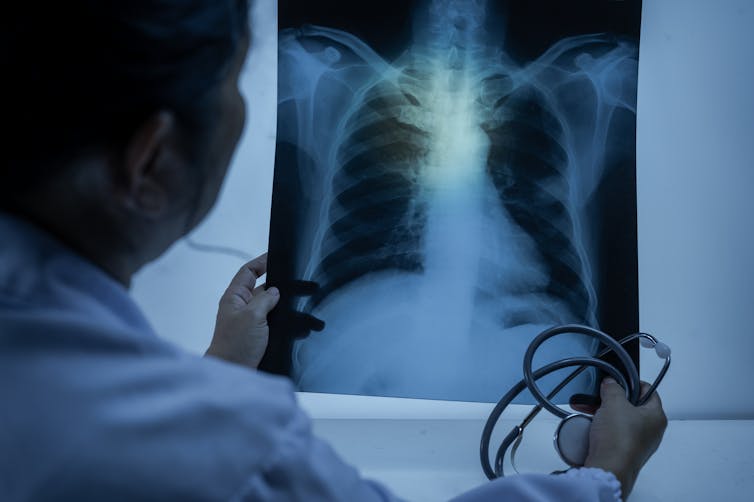
Healthy lungs look “empty” on an X-ray, because they are filled with air. But pneumonia fills the lungs with fluid.
This means it’s usually very easy to see where pneumonia is affecting them, because the infection shows up as solid white mass on the scan.
How is it treated?
The sputum or swab helps detect what is causing the infection and determine treatment. For example, a specific antibiotic will be used to target a certain bacterium.
Usually this works well. But if the infection is polymicrobial, the normal treatment might not be effective.
For example, the antibiotics may work on the bacteria. But if there’s also a virus – which can’t be treated with antibiotics – it may become the dominant pathogen driving the infection.
As a result, the patient may initially respond well to medication and then begin deteriorating again.
If the infection is caused by multiple bacteria, the patient might be given a broad-spectrum antibiotic rather than a single targeted drug.
A viral infection is harder to treat, as the anti-viral drugs that are available aren’t very effective or targeted.
In severe cases, a patient will also need to be in intensive care on a breathing machine because they can’t breathe alone. This helps make sure they receive enough oxygen while their body fights the infection.
Who is most susceptible?
It’s possible to recover, even from severe infections. However having pneumonia can damage the lungs, and this can make a repeat infection more likely.
Most people will never have a severe infection from these same pathogens. They may only experience a minor cold or flu, because their immune system can adequately fight the infection.
However, certain groups are much more vulnerable to developing a serious case of pneumonia.
Risk factors include:
- age: babies under two, whose immune systems are still developing, and adults over 65, who tend to have weakened immune systems
- lung damage: previous infections can cause scarring
- lung disease: for example, if you have emphysema or chronic obstructive pulmonary disease
- being a smoker
- immunosuppression: if your immune system is weakened, for example by medication you take after a transplant or during cancer treatment.
Pope Francis has a number of these risk factors. The pontiff is 88 years old and has a history of respiratory illness.
He also had pleurisy (a condition that inflames the lungs) as a young adult. As a result, he had part of one lung removed, making him susceptible to lung infections.
On Tuesday, the Vatican said Pope Francis remains “in good spirits” while he receives medical care and is grateful for the support he has received.
Brian Oliver, Professor, School of Life Sciences, University of Technology Sydney and Min Feng, PhD Candidate in Respiratory Disease, University of Technology Sydney
This article is republished from The Conversation under a Creative Commons license. Read the original article.
Don’t Forget…
Did you arrive here from our newsletter? Don’t forget to return to the email to continue learning!
Recommended
Learn to Age Gracefully
Join the 98k+ American women taking control of their health & aging with our 100% free (and fun!) daily emails:
-
10 Mistakes To Sabotage Your Ozempic Progress
10almonds is reader-supported. We may, at no cost to you, receive a portion of sales if you purchase a product through a link in this article.
Ozempic has a good reputation for getting reliable results, but there are ways to mess it up:
It’s not just inject-and-go
We’ll not keep the 10 ways a secret; they are:
- Increasing the dose too quickly: avoid cranking doses up too high too quickly, to prevent severe nausea, appetite suppression, and muscle loss. It’s worth being aware that high doses without proper management can lead to metabolic health disasters.
- Pushing through side effects: severe nausea or vomiting means you probably have an unhelpfully high dose; consult your prescribing doctor—it’s easy to feel “more is better; I don’t want to have less!”, but there really is a sweet spot, and if you’re not in it, then adjustments are needed in order to find it.
- Eating nutritionally scant food: reducing the quantity of unhealthy food isn’t enough—please prioritize nutrient-rich foods instead. Remember, “it’s not the calories in your food; it’s the food in your calories”.
- Consuming fried food and refined carbs: their general metabolic woes aside, fried foods and ultra-refined carbs can exacerbate nausea and other side effects, so it really is best to skip them. The good news is that Ozempic will help overcome those cravings more easily.
- Neglecting muscle protection: especially women, especially middle-aged or older, are at higher risk of osteoporosis and should maintain muscle mass (strong muscles and strong bones go together, by necessity). So, eat protein and do resistance training!
- Assuming it’s a monotherapy: GLP-1 drugs work best as part of a holistic protocol, including proper nutrition, strength training, and hormone therapy if appropriate.
- Not addressing metabolic health first: GLP-1 drugs are less effective in people with poor baseline metabolic health, so there’s a bit of a catch-22 here, but it’s important to be aware of. Fortunately, Ozempic and adopting a healthy lifestyle will each make the other work better.
- Neglecting comprehensive treatment plans: in other words, going through the motions of a holistic protocol and then expecting Ozempic to do all the work.
- Upping doses to overcome plateaus: plateaus often signal other issues (e.g. lack of protein, no strength training), so do address these before increasing dosage.
- Lack of collaboration with doctors: the human body is complex, and what’s going on metabolically is complex too, so there’s a lot a layperson can easily miss. For that matter, there’s a lot that doctors can easily miss too, but more heads are better than one.
For more on all of these, enjoy:
Click Here If The Embedded Video Doesn’t Load Automatically!
Want to learn more?
You might also like:
5 Ways To Naturally Boost The Ozempic Effect
Take care!
Share This Post
-
From Painkillers To Hunger-Killers
10almonds is reader-supported. We may, at no cost to you, receive a portion of sales if you purchase a product through a link in this article.
Here’s this week’s selection of health news discoveries, the science behind them, what they mean for you, and where you can go from there:
Killing more than pain
It’s well-known that overuse of opioids can lead to many problems, and here’s another one: messing with the endocrine system. This time, mostly well-evidenced in men—however, the researchers are keen to point out that absence of evidence is very much not evidence of absence, hence “the hidden effects” in the headline below. It’s not that the effects are hard to see—it’s that a lot of the research has yet to be done. For now, though, we know at the very least that there’s an association between opioid use and hyperprolactinemia in men. The same research also begins to shine a light on the effects of opioid use on the hypothalamic-pituitary system and bone health, too:
Read in full: The hidden effects of opioid use on the endocrine system
Related: The 7 Approaches To Pain Management
Gut microbiome dysbiosis may lead to slipping disks
These things sound quite unconnected, but the association is strong. The likely mechanism of action is that the gut dysbiosis influences systemic inflammation, and thus spinal health—because the gut-spine axis cannot really be disconnected (while you’re alive, at least). It’s especially likely if you’re over 50 and female:
Read in full: Are back problems influenced by your gut?
Related: Is Your Gut Leading You Into Osteoporosis?
The Internet is really really great (for brains)
It’s common to see many articles on the Internet telling us, paradoxically, that we should spend less time on the Internet. However… Remember when in the 90s, it was all about “the information superhighway”? It turns out, the fact that it’s more like “the information spaghetti junction” these days doesn’t change the fact that stimulation is good for our brains, and daily Internet use improves memory, because of the different way that we index and store information that came from a virtual source. While there are parts of your brain for “things at home” and “things at the local supermarket”, there are also parts for “things at 10almonds” and “things at Facebook” and so forth. You are, in effect, building a vast mental library as you surf:
Read in full: Daily internet use supercharges your memory!
Related: Make Social Media Work For Your Mental Health
Fall back
Around this time of year in many places in the Northern Hemisphere, the clocks go back an hour (it’s next weekend in the US and Canada, by the way, and this weekend in most of Europe). Many enjoy this as the potential for an extra hour’s sleep, but for night owls, it can be more of a nuisance than a benefit—throwing out what’s often an already difficult relationship with the clock, and presenting challenges both practical and physiological (different processing of melatonin, for instance). Here be science:
Read in full: Why night owls struggle more when the clocks go back
Related: Early Bird Or Night Owl? Genes vs Environment
Can you outrun your hunger?
It seems so, though benefits are strongest in women. We say “outrun”, though this study did use stationary cycling. To put it in few words, intense exercise (but not moderate exercise) significantly reduced acylated ghrelin (hunger hormone) levels, and subjective reports of hunger, especially in women:
Read in full: Study finds intense exercise may suppress appetite in healthy humans
Related: 3 Appetite Suppressants Better Than Ozempic
Take care!
Share This Post
-
Sweet Potato vs Turnip – Which is Healthier?
10almonds is reader-supported. We may, at no cost to you, receive a portion of sales if you purchase a product through a link in this article.
Our Verdict
When comparing sweet potato to turnip, we picked the sweet potato.
Why?
It wasn’t close:
In terms of macros, sweet potato has more fiber, carbs, and protein, making it the more nutrient-dense option in this category.
In the category of vitamins, sweet potato has a lot more of vitamins A, B1, B2, B3, B5, B6, C, E, and K, while turnips have a little more vitamin B9, yielding a very convincing 9:1 victory to sweet potato here.
Looking at minerals next, sweet potatoes have more calcium, copper, iron, magnesium, manganese, phosphorus, potassium, and zinc, while turnips are not higher in any minerals. Another easy win for sweet potatoes!
Adding up the sections makes for a clear overall win for sweet potato, but by all means do enjoy either or both, as diversity is best, and watch how you cook them!
In this comparison, we used data from them both being steamed skin-on, in the interests of fairness, so there’s a difference between that and if you decided to make sweet potato fries or somesuch 😉
Want to learn more?
You might like:
Carb-Strong or Carb-Wrong? Should You Go Light Or Heavy On Carbs?
Enjoy!
Share This Post
Related Posts
-
The Best Hair Loss Treatments That Aren’t Minoxidil
10almonds is reader-supported. We may, at no cost to you, receive a portion of sales if you purchase a product through a link in this article.
Minoxidil is a great tool, but it’s not for everyone. Dr. Sam Ellis gives us the other options:
Keep your hair on
Minoxidil is many people’s go-to treatment for hair loss. It improves blood flow to follicles and prolongs the anagen (growth) phase, but doesn’t address dihydrogen testosterone (DHT, which is testosterone’s more potent form that’s responsible for a lot of thinning hair), so it works best as part of a combination approach.
Other options, thus, include:
- Systemic DHT-targeting medications: finasteride and dutasteride block testosterone-to-DHT conversion and are effective alone or with minoxidil, while spironolactone is commonly used for premenopausal women to block androgen effects at follicles.
- Topical hormone blockers: finasteride, dutasteride, and spironolactone also exist in topical forms, offering an option for people avoiding systemic medication with some supporting evidence.
- PRP injections: platelet-rich plasma involves injecting concentrated growth factors from your blood into your scalp, which is low risk but costly, and works best in carefully selected patients without advanced loss or active scalp inflammation.
- Low-level laser therapy: red light helmets or combs have strong clinical evidence, minimal side effects, and are easy to integrate into daily routines for supporting hair growth.
- Scalp microneedling: creating controlled micro-injuries one to two times weekly can stimulate growth and increase topical treatment penetration when done hygienically and not excessively.
- Minoxidil-free hair serums: non-minoxidil serums may support density and shedding reduction, but they have less robust evidence than minoxidil and require at least six months of consistent use to judge effectiveness.
- Hair growth shampoos: ketoconazole shampoo may (usually “will”, but per science, “may”) reduce scalp inflammation and DHT effects, while other such shampoos can be supportive additions rather than primary treatments. We say”can”, as of course there are a lot out there and we can’t do a comprehensive list.
- DHT-modulating supplements: pumpkin seed oil and saw palmetto also inhibit DHT, but are neither regulated nor standardized for potency, thus offering more variable benefits compared with prescription options.
- Supplement strategies in general: supplements are most useful when correcting established deficiencies such as iron, vitamin D, or zinc, and routine use without deficiency has less clear benefit.
For more on all of this, enjoy:
Click Here If The Embedded Video Doesn’t Load Automatically!
Want to learn more?
You might also like:
What’s The Difference Between Minoxidil For Men vs For Women?
Take care!
Don’t Forget…
Did you arrive here from our newsletter? Don’t forget to return to the email to continue learning!
Learn to Age Gracefully
Join the 98k+ American women taking control of their health & aging with our 100% free (and fun!) daily emails:
-
Artichoke vs Brussels Sprouts – Which is Healthier?
10almonds is reader-supported. We may, at no cost to you, receive a portion of sales if you purchase a product through a link in this article.
Our Verdict
When comparing artichoke to Brussels sprouts, we picked the sprouts.
Why?
Finally, a vegetable that beats artichoke—after it previously beat many healthy high-scorers including cabbage and even broccoli! It was still close though, which is impressive for artichoke, considering what a nutritional powerhouse Brussels sprouts are:
In terms of macros, the only meaningful difference is that artichoke has slightly more carbs and fiber, so artichoke gets the most marginal of nominal wins in this category.
In the category of vitamins, however, artichoke has only more of vitamins B3, and B9, while Brussels sprouts have more of vitamins A, B1, B2, B6, C, E, and K, giving sprouts the clear victory here, especially with much higher margins of difference (e.g. 58x more vitamin A, as well as 7x more vitamin C, and 10x more vitamin K).
When it comes to minerals, artichoke has more copper, magnesium, phosphorus, and zinc, while Brussels sprouts have more iron, manganese, potassium, and selenium, resulting in a 4:4 tie, and the small margins of difference are mostly comparable, with the exception that sprouts have 8x more selenium. So, Brussels sprouts win this category very marginally on that tie-breaker.
In other considerations, artichoke has more polyphenols, while the sprouts have sulforaphane, to we’re calling this round a tie on balance.
Adding up the sections we see that most recent tie, while macros and minerals gave a small win each to artichoke and sprouts respectively, while the vitamins category was an overwhelming win for sprouts, so—with this deciding factor in mind—sprouts win the day today.
Want to learn more?
You might like to read:
Sprout Your Seeds, Grains, Beans, Etc
Enjoy!
Don’t Forget…
Did you arrive here from our newsletter? Don’t forget to return to the email to continue learning!
Learn to Age Gracefully
Join the 98k+ American women taking control of their health & aging with our 100% free (and fun!) daily emails:
-
The Gut-Healthiest Yogurt
10almonds is reader-supported. We may, at no cost to you, receive a portion of sales if you purchase a product through a link in this article.
Not only is this yogurt, so it’s winning from the start with its probiotic goodness, but also it’s full of several kinds of fiber, and gut-healthy polyphenols too. Plus, it’s delicious. The perfect breakfast, but don’t let us stop you from enjoying it at any time of day!
You will need
- 1 cup yogurt with minimal additives. Live Greek yogurt is a top-tier choice, and plant-based varieties are fine too (just watch out, again, for needless additives)
- 7 dried figs, roughly chopped
- 6 fresh figs, thinly sliced
- 5 oz chopped pitted dates
- 4 tbsp mixed seeds (pumpkin, sunflower, and chia are a great combination)
Method
(we suggest you read everything at least once before doing anything)
1) Soak the dried figs, the dates, and half the seeds in hot water for at least 5 minutes. Drain (be careful not to lose the chia seeds) and put in a blender with ¼ cup cold water.
2) Blend the ingredients from the last step into a purée (you can add a little more cold water if it needs it).
3) Mix this purée into the yogurt in a bowl, and add in the remaining seeds, mixing them in thoroughly.
4) Top with the sliced figs, and serve (or refrigerate, up to a few days, until needed).
Enjoy!
Want to learn more?
For those interested in some of the science of what we have going on today:
- Making Friends With Your Gut (You Can Thank Us Later)
- Dates vs Figs – Which is Healthier?
- The Tiniest Seeds With The Most Value
Take care!
Don’t Forget…
Did you arrive here from our newsletter? Don’t forget to return to the email to continue learning!
Learn to Age Gracefully
Join the 98k+ American women taking control of their health & aging with our 100% free (and fun!) daily emails:


