
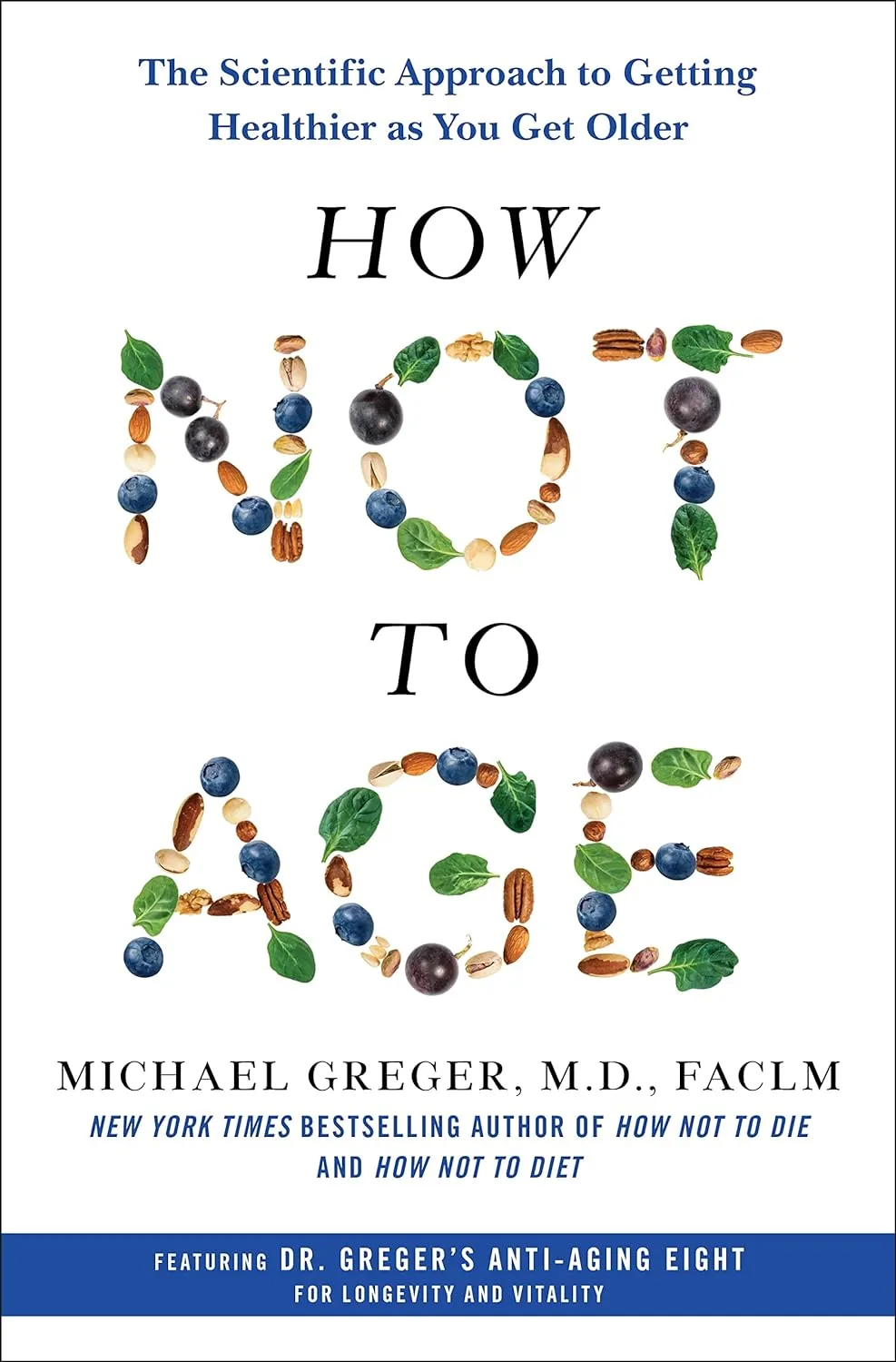
How Not to Age – by Dr. Michael Greger
10almonds is reader-supported. We may, at no cost to you, receive a portion of sales if you purchase a product through a link in this article.
First things first: it’s a great book, and it’s this reviewer’s favorite of Dr. Greger’s so far (for posterity: it’s just been published and this reviewer has just finished reading the copy she got on pre-order)
Unlike many popular physician authors, Dr. Greger doesn’t rehash a lot of old material, and instead favours prioritizing new material in each work. Where appropriate, he’ll send the reader to other books for more specific information (e.g: you want to know how to avoid premature death? Go read How Not To Die. You want to know how to lose weight? How Not To Diet. Etc).
In the category of new information, he has a lot to offer here. And with over 8,000 references, it’s information, not conjecture. On which note, we recommend the e-book version if that’s possible for you, for three reasons:
- It’s possible to just click the references and be taken straight to the cited paper itself online
- To try to keep the book’s size down, Dr. Greger has linked to other external resources too
- The only negative reviews on Amazon, so far, are people complaining that the print copy’s text is smaller than they’d like
For all its information-density (those 8,000+ references are packed into 600ish pages), the book is very readable even to a lay reader; the author is a very skilled writer.
As for the content, we can’t fit more than a few sentences here so forgive the brevity, but we’ll mention that he covers:
- Slowing 11 pathways of aging
- The optimal anti-aging regimen according to current best science
- Preserving function (specific individual aspects of aging, e.g. hearing, sight, cognitive function, sexual function, hair, bones, etc)
- “Dr. Greger’s Anti-Aging Eight”
In terms of “flavor” of anti-aging science, his approach can be summed up as: diet and lifestyle as foundation; specific supplements and interventions as cornerstones.
Bottom line: this is now the anti-aging book.
Click here to check out How Not To Age, and look after yourself with the best modern science!
Don’t Forget…
Did you arrive here from our newsletter? Don’t forget to return to the email to continue learning!
Recommended
Learn to Age Gracefully
Join the 98k+ American women taking control of their health & aging with our 100% free (and fun!) daily emails:
-
Melatonin vs Chronic Pain?
10almonds is reader-supported. We may, at no cost to you, receive a portion of sales if you purchase a product through a link in this article.
We’ve previously wrote about about melatonin:
❝Melatonin is a hormone normally made in our pineal gland. It helps regulate our circadian rhythm, by making us sleepy.
It has other roles too—it has a part to play in regulating immune function, something that also waxes and wanes as a typical day goes by.
Additionally, since melatonin and cortisol are antagonistic to each other, a sudden increase in either will decrease the other. Our brain takes advantage of this, by giving us a cortisol spike in the morning to help us wake up.
As a supplement, it’s generally enjoyed with the intention of inducing healthy, natural, restorative sleep.❞
Read in full: Melatonin: A Safe, Natural Sleep Aid? ← our research review article that does cover the pros and cons, and yes, there are indeed downsides too, including some contraindications e.g. melatonin helps regulate immune function, so that’s something to bear in mind if you’re on immunosuppressants or otherwise have an autoimmune disorder. It can also interfere with blood pressure medications and blood thinners, and may make epilepsy meds less effective.
We’ve also written about how it can help with specific chronic diseases, such as: Melatonin vs Lupus!
…so, what’s this about melatonin vs chronic pain?
The sleep-pain relationship
This one came to our attention because of a rather eye-catching headline: Melatonin may ease chronic pain, study finds
Which is a fascinating headline to come from a study of 254 adults (mean average age 60.8 years; 87% women) with chronic musculoskeletal (MSK) pain, and whose results were as follows:
❝Sleep disturbances were reported by 73 % of participants, with insomnia most common. Forty percent had previously used melatonin, primarily for sleep, yet 57 % of users were uncertain about its analgesic effects. Willingness to use melatonin was expressed by 79 % of users and 83 % of non-users for pain management. General concerns included side effects, drug interactions, efficacy, and cost.❞
Yes, it was a survey-based study, and the main pain-related finding was “I don’t know”.
Further, if we break down the responses of those with chronic pain and using melatonin, more participants regarded it as “not effective at all” than regarded it as “moderately effective or very effective” (i.e. even if we stack those latter categories on top of each other, they still don’t add up to as many as the responses for “not effective at all”:
Source: Patients’ attitudes toward melatonin for musculoskeletal pain: Insights for rehabilitation practice
However, as anyone with chronic pain will know, chronic pain and poor sleep adversely affect each other (i.e. each being bad makes the other worse), and therefore it is reasonable to infer that the inverse is true—reducing pain can improve sleep, and improving sleep can reduce pain.
And, of course, if you literally just need a break… If you’re asleep, you’re not consciously* in pain and thus not suffering.
*Unconsciously, your nerves are still doing their thing and so your body still “knows” that you are in pain and responds accordingly. This is also the main reason that strong painkillers are given to a patient who is about to undergo surgery under general anaesthesia—they won’t be experiencing the pain, the body will still think it’s being eaten by a tiger or something and respond accordingly in terms of heart rate, inflammatory responses, etc.
So while it’s fair to say “no, the study didn’t at all establish that melatonin can help vs chronic pain”, and nor was that even the question being examined in the study, it doesn’t mean that getting better sleep can’t help you manage chronic pain better, and so there may be an indirect help.
See also:
Want to learn more?
We’ve written quite a bit about pain management, including:
- Before You Reach For That Tylenol…
- How To Stop Pain Spreading
- How To Dial Down Your Pain
- Managing Chronic Pain (Realistically!)
- Get The Right Help For Your Pain
- The 7 Approaches To Pain Management
- Science-Based Alternative Pain Relief (When Painkillers Aren’t Helping, These Things Might)
Take care!
Share This Post
-
Tips For Avoiding/Managing Rheumatoid Arthritis
10almonds is reader-supported. We may, at no cost to you, receive a portion of sales if you purchase a product through a link in this article.
Avoiding/Managing Rheumatoid Arthritis
Arthritis is the umbrella term for a cluster of joint diseases involving inflammation of the joints, hence “arthr-” (joint) “-itis” (suffix used to denote inflammation). These are mostly, but not all, autoimmune diseases, in which the body’s immune system mistakenly attacks our own joints.
Inflammatory vs Non-Inflammatory Arthritis
Arthritis is broadly divided into inflammatory arthritis and non-inflammatory arthritis.
You may be wondering: how does one get non-inflammatory inflammation of the joints?
The answer is, in “non-inflammatory” arthritis, such as osteoarthritis, the damage comes first (by general wear-and-tear) and inflammation generally follows as part of the symptoms, rather than the cause. So the name can be a little confusing. In the case of osteo- and other “non-inflammatory” forms of arthritis, you definitely still want to keep your inflammation at bay as best you can, but it’s not as absolutely critical a deal as it is for “inflammatory” forms of arthritis.
We’ll tackle the beast that is osteoarthritis another day, however.
Today we’re going to focus on…
Rheumatoid Arthritis
This is the most common of the autoimmune forms of arthritis. Some quick facts:
- It affects a little under 1% of the global population, but the older we get, the more likely it becomes
- Early onset of rheumatoid arthritis is most likely to show up around the age of 50 (but it can show up at any age)
- However, incidence (not onset) of rheumatoid arthritis peaks in the 70s age bracket
- It is 2–4 times more common in women than in men
- Approximately one third of people stop work within two years of its onset, and this increases thereafter.
Well, that sounds gloomy.
Indeed it’s not fun. There’s a lot of stiffness and aching of joints (often with swelling too), loss of joint function can be common, and then there are knock-on effects like fatigue, weakness, and loss of appetite.
Beyond that it’s an autoimmune disorder, its cause is not known, and there is no known cure.
Is there any good news?
If you don’t have rheumatoid arthritis at the present time, you can reduce your risk factors in several ways:
- Having an anti-inflammatory diet. Get plenty of fiber, greens, and berries. Fatty fish is great too, as are oily nuts. On the other side of things, high consumption of salt, sugar, alcohol, and red meat are associated with a greater risk of developing rheumatoid arthritis.
- Not smoking. Smoking is bad for pretty much everything, including your chances of developing rheumatoid arthritis.
- Not being obese. This one may be more a matter of correlation than causation, because of the dietary factors (if one eats an anti-inflammatory diet, obesity is less likely), but the association is there.
There are other risk factors that are harder to control, such as genetics, age, sex, and having a mother who smoked.
See: Genetic and environmental risk factors for rheumatoid arthritis
What if I already have rheumatoid arthritis?
If you already have rheumatoid arthritis, it becomes a matter of symptom management.
First, reduce inflammation any (reasonable) way you can. We did a main feature on this before, so we’ll just drop that again here:
Next, consider the available medications. Your doctor may or may not have discussed all of the options with you, so be aware that there are more things available than just pain relief. To talk about them all would require a whole main feature, so instead, here’s a really well-compiled list, along with explanations about each of them, up to date as of this year:
Rheumatoid Arthritis Medication List (And What They Do, And How)
Finally, consider other lifestyle adjustments to manage your symptoms. These include:
- Exercise—gently, though! You do not want to provoke a flare-up, but you do want to maintain your mobility as best you can. There’s a use-it-or-lose-it factor here. Swimming and yoga are great options, as is tai chi. You may want to avoid exercises that involve repetitive impacts to your joints, like running.
- Rest—while keeping mobility going. Get good sleep at night (this is important), but don’t make your bed your new home, or your mobility will quickly deteriorate.
- Hot & cold—both can help, and alternating them can reduce inflammation and stiffness by improving your body’s ability to respond appropriately to these stimuli rather than getting stuck in an inappropriate-response state of inflammation.
- Mobility aids—if it helps, it helps. Maybe you only need something during a flare-up, but when that’s the case, you want to be as gentle on your body as possible while keeping moving, so if crutches, handrails etc help, then by all means get them and use them.
- Go easy on the use of braces, splints, etc—these can offer short-term relief, but at a long term cost of loss of mobility. Only you can decide where to draw the line when it comes to that trade-off.
You can also check out our previous article:
Managing Chronic Pain (Realistically!)
Take good care of yourself!
Share This Post
-
Almonds vs Pine Nuts – Which is Healthier?
10almonds is reader-supported. We may, at no cost to you, receive a portion of sales if you purchase a product through a link in this article.
Our Verdict
When comparing almonds to pine nuts, we picked the almonds.
Why?
It’s not just our pro-almond bias, but it was closer than you might have expected in some rounds!
In terms of macros, almonds have more than 2x the fiber and carbs and nearly 2x the protein, while pine nuts have somewhat more fats (healthy ones, though); we say that on balance, that’s a first-round win for almonds.
In the category of vitamins, almonds have more of vitamins B2, B5, B6, B7, B9, and E, while pine nuts have more of vitamins B1 and B3, an easy win for almonds here.
Looking at minerals, almonds have more calcium, magnesium, potassium, and selenium, while pine nuts have more copper, iron, magnesium, and zinc, for a 4:4 tie in this round.
In other considerations, almonds are much higher in polyphenols, so that’s another point in their favor. Do note however that this is for almonds with their skin on, not blanched. Blanching them would greatly reduce their polyphenol content.
Adding up the sections makes for an overall win for almonds, but by all means do enjoy either or both, as diversity is best!
Want to learn more?
You might like:
Why You Should Diversify Your Nuts!
Enjoy!
Share This Post
Related Posts
-
Knee Pain Won’t Get Better Unless You Fix This First
10almonds is reader-supported. We may, at no cost to you, receive a portion of sales if you purchase a product through a link in this article.
Most knee pain is mechanical, caused by excessive stress or strain on specific parts of the knee joint. However, it’s weak glutes that are often the root cause of excess knee strain, because when glutes are weak, they fail to keep the pelvis level and legs aligned, leading to improper knee movement.
The seat of the problem
Weak glutes cause the pelvis to drop and the thigh bone to roll inwards (called “valgus knee”). This misalignment creates shearing forces and excessive pressure on different parts of the knee. However, it can usually be fixed, and the following exercises are recommended:
- Seated band abductions: use a resistance band around the thighs while seated. Push your knees apart, and hold for a few seconds.
- Glute bridge with resistance band: lie on your back with your feet flat and a resistance band around your thighs. Push your hips up into a bridge position, then press your knees outward against the band.
- Clamshell exercise: lie on your side, with your knees bent at 90°. Keep your body slightly tilted forward, then lift the top knee while keeping your heels together.
- Hip abductions (lateral leg raises): lie on your side, keeping your legs straight. Lift the top leg slightly backward and upward, leading with your heel.
- Standing hip abductions: stand upright, using a wall for support. Lift one leg sideways and slightly backward while keeping your spine straight. Unlike the other exercises, this one has the benefit of being doable almost anywhere.
For more on each of these plus visual demonstrations, enjoy:
Click Here If The Embedded Video Doesn’t Load Automatically!
Want to learn more?
You might also like:
The Secret to Better Squats: Foot, Knee, & Ankle Mobility
Take care!
Don’t Forget…
Did you arrive here from our newsletter? Don’t forget to return to the email to continue learning!
Learn to Age Gracefully
Join the 98k+ American women taking control of their health & aging with our 100% free (and fun!) daily emails:
-
Tofu vs Seitan – Which is Healthier?
10almonds is reader-supported. We may, at no cost to you, receive a portion of sales if you purchase a product through a link in this article.
Our Verdict
When comparing tofu to seitan, we picked the tofu.
Why?
This one is not close!
In terms of macros, seitan does have about 2x the protein, but it also has 6x the carbs and 6x the sodium of tofu, as well as less fiber than tofu.. So we’ll call it a tie on macros. But…
Seitan is also much more processed than tofu, as tofu has usually just been fermented and possibly pressed (depending on kind). Seitan, in contrast, is processed gluten that has been extracted from wheat and usually had lots of things happen to it on the way (depending on kind).
About that protein… Tofu is a complete protein, meaning it has all of the essential amino acids. Seitain, meanwhile, is lacking in lysine.
When it comes to vitamins and minerals, again tofu easily comes out on top; tofu has 5x the calcium, similar iron, more magnesium, 2x the phosphorous, 150% of the potassium, and contains several other nutrients that seitan doesn’t, such as folate and choline.
So, easy winning for tofu across the board on micronutrients.
Tofu is also rich in isoflavones, antioxidant phytonutrients, while seitan has no such benefits.
So, another win for tofu.
There are two reasons you might choose seitan:
- prioritizing bulk protein above all other health considerations
- you are allergic to soy and not allergic to gluten
If neither of those things are the case, then tofu is the healthier choice!
Want to learn more?
You might like to read:
- Tempeh vs Tofu – Which is Healthier? ← tempeh is, nutritionally speaking, tofu but better. Of course on a culinary level, there are many recipes where tofu will work and tempeh wouldn’t, though.
- Gluten: What’s The Truth?
Take care!
Don’t Forget…
Did you arrive here from our newsletter? Don’t forget to return to the email to continue learning!
Learn to Age Gracefully
Join the 98k+ American women taking control of their health & aging with our 100% free (and fun!) daily emails:
-
Bell Pepper vs Zucchini – Which is Healthier?
10almonds is reader-supported. We may, at no cost to you, receive a portion of sales if you purchase a product through a link in this article.
Our Verdict
When comparing bell pepper to zucchini, we picked the bell pepper.
Why?
In terms of macros, bell peppers have nearly 2x the fiber for slightly more carbs and comparable (negligible) protein, winning this category.
In the category of vitamins, amounts of vitamins A and C do vary by bell pepper color (more on that in the “learn more” section below), but even using the most conservative numbers for each, bell peppers have more of vitamins A, B1, B3, B6, C, E, and K, while zucchini has more of vitamins B2, B5, and B9, giving bell peppers a 7:3 win here.
Looking at minerals, bell peppers have more copper, while zucchini have more calcium, iron, magnesium, manganese, phosphorus, potassium, selenium, and zinc, giving zucchini a compelling win in this round.
In other considerations, bell peppers have more polyphenols (especially quercetin and luteolin), as well as some good carotenoids not otherwise covered, such as lutein, so this round’s another win for bell peppers.
Adding up the sections makes for a clear overall win for bell peppers, but by all means enjoy either or both, as diversity is good (and those minerals are great)!
Want to learn more?
You might like:
- Brain Food? The Eyes Have It! ← this is mostly about lutein
- Which Bell Peppers To Pick? A Spectrum Of Specialties ← for the differences between the different colors
Enjoy!
Don’t Forget…
Did you arrive here from our newsletter? Don’t forget to return to the email to continue learning!
Learn to Age Gracefully
Join the 98k+ American women taking control of their health & aging with our 100% free (and fun!) daily emails:


