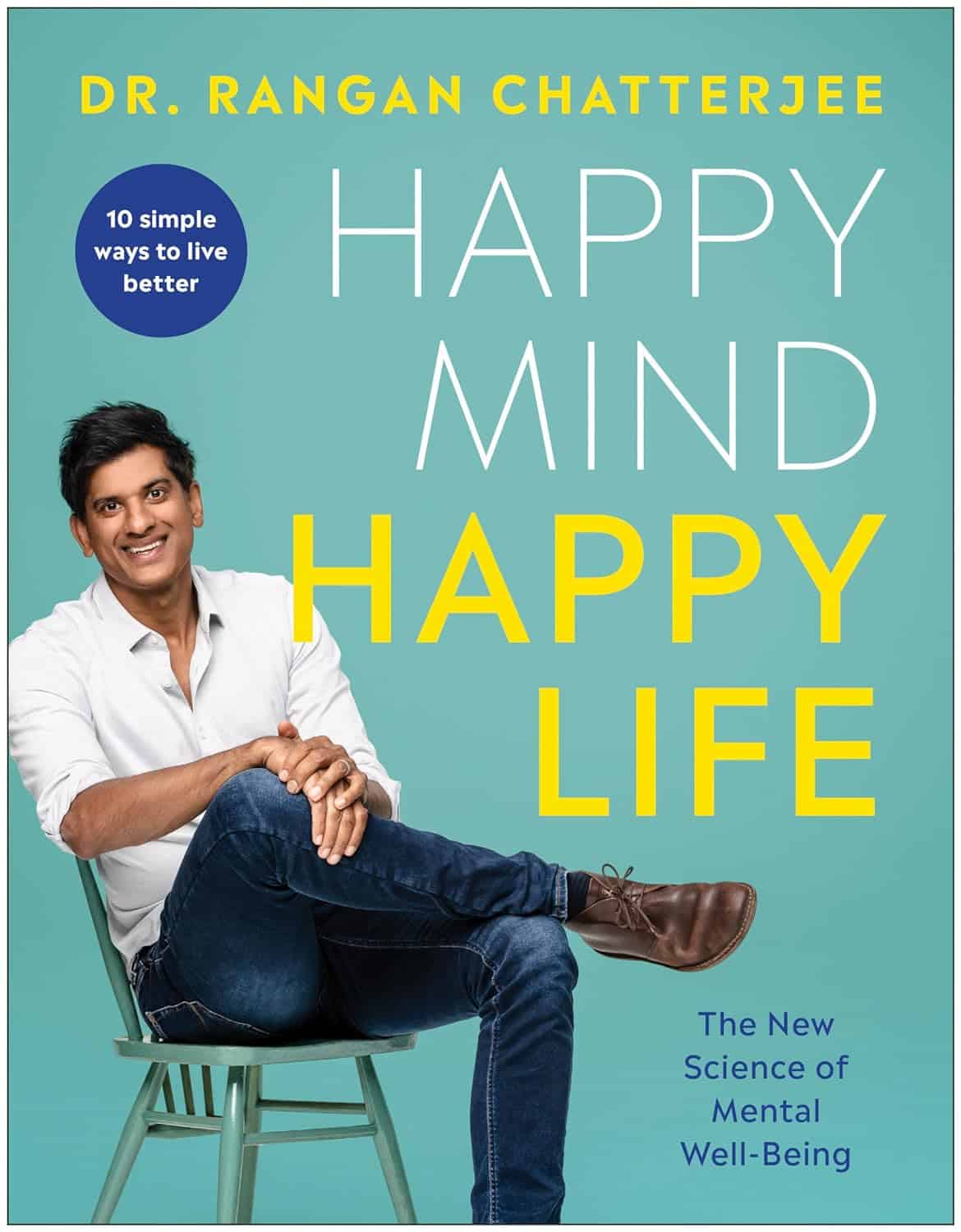
Happy Mind, Happy Life – by Dr. Rangan Chatterjee

10almonds is reader-supported. We may, at no cost to you, receive a portion of sales if you purchase a product through a link in this article.

Let’s start with a “why”. If happiness doesn’t strike you as a worthwhile goal in and of itself, Dr. Chatterjee discusses the health implications of happiness/unhappiness.

And, yes, including in studies where other factors were controlled for, so he shows how happiness/unhappiness does really have a causal role in health—it’s not just a matter of “breaking news: sick people are less happy”.

The author, a British GP (General Practitioner, the equivalent of what the US calls a “family doctor”) with decades of experience, has found a lot of value in the practice of holistic medicine. For this reason, it’s what he recommends to his patients at work, in his books, his blog, and his regular spot on a popular BBC breakfast show.

The writing style is relaxed and personable, without skimping on information density. Indeed, Dr. Chatterjee offers many pieces of holistic health advice, and dozens of practical exercises to boost your happiness and proof you against adversity.

Because, whatever motivational speakers may say, we can’t purely “think ourselves happy”; sometimes we have real external threats and bad things in life. But, we can still improve our experience of even these things, not to mention suffer less, and get through it in better shape with a smile at the end of it.

Bottom line: if you’d like to be happier and healthier (who wouldn’t?), then this book is a sure-fire way to set you on that path.

Click here to check out Happy Mind, Happy Life and upgrade yours!

Don’t Forget…

Did you arrive here from our newsletter? Don’t forget to return to the email to continue learning!

Learn to Age Gracefully

Join the 98k+ American women taking control of their health & aging with our 100% free (and fun!) daily emails:

  • The Threshold For Binge-Drinking Is Lower Than Most Think… Do You Qualify?

    10almonds is reader-supported. We may, at no cost to you, receive a portion of sales if you purchase a product through a link in this article.

    The term “binge-drinking” typically conjures images of people in the 18–22 age range (general figure; if we get geographic about it, then perhaps 21–25 in the US, or 15–21 in Europe) swinging around lampposts while very drunk, very loud, minimally-clothed, and liable to waking up somewhere new and exciting that they’ve never seen before.

    But in fact, while definitions do vary a bit, a prevailing and representative scientific definition is:

    ❝consuming four or more standard drinks on one occasion for women and five or more standard drinks on one occasion for men❞

    Learn more: Heterogeneity of definitions and measurements of binge drinking in research on adolescents and young adults

    Now, that paper’s looking at research on adolescents and younger adults because that’s where most of the research is, but it doesn’t mean older adults are magically immune—quite the opposite!

    As we can learn from…

    The Death Database

    It’s not a cheery heading, is it? Doesn’t bode well.

    But…

    Researchers (Dr. Esme Fuller-Thomsom et al.) analyzed 129,470 adults aged 50 and older using the 2005–2014 Canadian Community Health Survey linked to the Canadian Vital Statistics Death Database and followed participants for up to 12 years (“up to”, because more than 14,740 of those participants died during the study).

    Some notes:

    • Prevalence: 40% of older adults who drank alcohol at least monthly reported binge-drinking at least once in the previous year, and 8% reported binge-drinking weekly or more.
    • Mortality risk: there was a strong association between binge-drinking frequency and all-cause mortality, with risk increasing as binge-drinking became more frequent. After controlling for sociodemographic and health factors, those who never binge-drank had a 19% lower mortality risk than those who occasionally did.

    You can read the paper in full, here: Binge drinking and mortality among older adults: Findings from the Canadian Community Health Survey linked to the Canadian Vital Statistics Death Database

    So, what does this mean, in practical terms?

    ❝Public health messaging tends to focus on college campuses, but our findings show we need to think about retirement communities too❞

    ~ Dr Esme Fuller-Thomson

    And for you, dear reader… Based on the above statistics, tens of thousands of our readers fall into the binge-drinking category. Maybe you are one.

    Note that that “four standard drinks” is often only two drinks where each drink is a “double measure”, such as a double-shot of spirits or a large glass of wine.

    This gets particularly relevant for those who “only drink on special occasions”, but then have several drinks.

    Here’s a good example of that: You’d Better Watch Out: Why More Cardiac Deaths Happen On Dec 25 Than Any Other Day

    Want to not do that?

    Let us also remember that per the World Health Organization, the only safe amount of alcohol is zero.

    So, with that in mind, you might want to check out: How To Reduce Or Quit Alcohol

    Or for a deeper dive, we recommend: Quit Drinking – by Rebecca Dolton

    Take care!

    Share This Post

  • The Four Pillar Plan – by Dr. Rangan Chatterjee

    10almonds is reader-supported. We may, at no cost to you, receive a portion of sales if you purchase a product through a link in this article.

    Dr. Rangan Chatterjee, a medical doctor, felt frustrated with how many doctors in his field focus on treating the symptoms of disease, rather than the cause. Sometimes, of course, treating the symptom is necessary too! But neglecting the cause is a recipe for long-term woes.

    What he does differently is take lifestyle as a foundation, and even that, he does differently than many authors on the topic. How so, you may wonder?

    Rather than look first at exercise and diet, he starts with “relax”. His rationale is reasonable: diving straight in with marathon training or a whole new diet plan can be unsustainable without this as a foundation to fall back on.

    Many sources look first at exercise (because it can be a very simple “prescription”) before diet (often more complex)… but how does one exercise well with the wrong fuel in the tank? So Dr. Chatterjee’s titular “Four Pillars” come in the following order:

    1. Relax
    2. Eat
    3. Move
    4. Sleep

    He also goes for “move” rather than “exercise” as the focus here is more on minimizing time spent sitting, and thus involving a lot of much more frequent gentle activities… rather than intensive training programs and the like.

    And as for sleep? Yes, that comes last because—no matter how important it is—the other things are easier to directly control. After all, one can improve conditions for sleep, but one cannot simply choose to sleep better! So with the other three things covered first, good sleep is the fourth and final thing to fall into place.

    All in all, this is a great book to cut through the catch-22 problem of lifestyle factors negatively impacting each other.

    Click here to check out “The 4 Pillar Plan” and start improving your life in the most impactful ways!

    Share This Post

  • Huperzine A: A Natural Nootropic

    10almonds is reader-supported. We may, at no cost to you, receive a portion of sales if you purchase a product through a link in this article.

    Huperzine A: A Natural Nootropic

    Huperzine A is a compound, specifically a naturally occurring sesquiterpene alkaloid, that functions as an acetylcholinesterase inhibitor. If that seems like a bunch of big words, don’t worry, we’ll translate in a moment.

    First, a nod to its origins: it is found in certain kinds of firmoss, especially the “toothed clubmoss”, Huperzia serrata, which grows in many Asian countries.

    What’s an acetylcholinesterase inhibitor?

    Let’s do this step-by-step:

    • An acetylcholinesterase inhibitor is a compound that inhibits acetylcholinesterase.
    • Acetylcholinesterase is an enzyme that catalyzes (speeds up) the breakdown of acetylcholine.
    • Acetylcholine is a neurotransmitter; it’s an ester of acetic acid and choline.
      • This is the main neurotransmitter of the parasympathetic nervous system, and is also heavily involved in cognitive functions including memory and creative thinking.

    What this means: if you take an acetylcholinesterase inhibitor like huperzine A, it will inhibit acetylcholinesterase, meaning you will have more acetylcholine to work with. That’s good.

    What can I expect from it?

    Huperzine A has been well-studied for a while, mostly for the prevention and treatment of Alzheimer’s disease:

    However, research has suggested that huperzine A is much better as a prevention than a treatment:

    ❝A central event in the pathogenesis of Alzheimer’s disease (AD) is the accumulation of senile plaques composed of aggregated amyloid-β (Aβ) peptides.

    Ex vivo electrophysiological experiments showed that 10 μM of Aβ1-40 significantly decreased the effect of the AChE inhibitor huperzine A on the synaptic potential parameters. ❞

    ~ Dr. Irina Zueva

    Source: Can Activation of Acetylcholinesterase by β-Amyloid Peptide Decrease the Effectiveness of Cholinesterase Inhibitors?

    In other words: the answer to the titular question is “Yes, yes it can”

    And, to translate Dr. Zueva’s words into simple English:

    • People with Alzheimer’s have amyloid-β plaque in their brains
    • That plaque reduces the effectiveness of huperzine A

    So, what if we take it in advance? That works much better:

    ❝Pre-treatment with [huperzine A] at concentrations of 50, 100, and 150 µg/mL completely inhibited the secretion of PGE2, TNF-α, IL-6, and IL-1β compared to post-treatment with [huperzine A].

    This suggests that prophylactic treatment is better than post-inflammation treatment. ❞

    ~ Dr. Thu Kim Dang

    Source: Anti-neuroinflammatory effects of alkaloid-enriched extract from Huperzia serrata

    As you may know, neuroinflammation is a big part of Alzheimer’s pathology, so we want to keep that down. The above research suggests we should do that sooner rather than later.

    Aside from holding off dementia, can it improve memory now, too?

    There’s been a lot less research done into this (medicine is generally more concerned with preventing/treating disease, than improving the health of healthy people), but there is some:

    Huperzine-A capsules enhance memory and learning performance in 34 pairs of matched adolescent students

    ^This is a small (n=68) old (1999) study for which the full paper has mysteriously disappeared and we only get to see the abstract. It gave favorable results, though.

    The effects of huperzine A and IDRA 21 on visual recognition memory in young macaques

    ^This, like most non-dementia research into HupA, is an animal study. But we chose to spotlight this one because, unlike most of the studies, it did not chemically lobotomize the animals first; they were and remained healthy. That said, huperzine A improved the memory scores most for the monkeys that performed worst without it initially.

    Where can I get it?

    As ever, we don’t sell it, but here’s an example product on Amazon for your convenience

    Enjoy!

    Share This Post

  • What Happens In Your Brain When You Can’t Recall A Word

    10almonds is reader-supported. We may, at no cost to you, receive a portion of sales if you purchase a product through a link in this article.

    Dr. Cella Wright explains:

    Tip-of-the-tongue

    “Tip-of-the-tongue” is a temporary retrieval glitch where you feel you know the word but can’t pull it up, even though its meaning and associations are partly accessible.

    What’s happening: alongside normal word-retrieval activity, the conflict-detecting anterior cingulate becomes active, generating the familiar sense of frustration and near-recall.

    Why it’s happening: while the word retrieval moves from meaning → associations → sound, the “sound” step seems most vulnerable to slipping, making the final step of recall stall. Note that if you’re trying to write it, the process is just the same, except that there’s a four step (spelling) that you also never get to because of not passing the “sound” step

    This happens more with some words than others; proper nouns, infrequently used words, and abstract or less-visual terms—like “idiosyncrasy” or “revelation”—are most likely to trigger the state.

    Further, related (but incorrect) words can act as blocking distractors, such as remembering “Dorothy” instead of “Judy Garland”, derailing your retrieval pathway.

    Fun fact: this is one thing where multilingual people are at a disadvantage, a change from the usual “multilingualism has only benefits except in early years whereby it has the tradeoff of slowing the path to speech”. Multilingual speakers experience more tip-of-the-tongue states, likely because words from one language interfere with retrieval in another, especially during language switching.

    Writer’s anecdote: I definitely have this often, with sometimes a word coming to me in a whole bunch of languages, just not the one I need!

    You might be wondering about the extent to which this correlates with age, and yes, frequency does increase with age, but this can be for good reasons as well as bad, i.e. while it can potentially be due to cognitive decline in speech-related regions, it can also be a matter of simply knowing more words. And while there is theoretically no known limit to how much information can be stored in the brain, and in fact more items means more connections and therefore often greater ease of access, the fact remains that more connections also means more opportunity to errantly go off-piste.

    For more on all of this plus a bonus tip for how to get unstuck, enjoy:

    Click Here If The Embedded Video Doesn’t Load Automatically!

    Want to learn more?

    You might also like:

    How To Boost Your Memory Immediately (Without Supplements)

    Take care!

    Don’t Forget…

    Did you arrive here from our newsletter? Don’t forget to return to the email to continue learning!

    Learn to Age Gracefully

    Join the 98k+ American women taking control of their health & aging with our 100% free (and fun!) daily emails:

  • Eat to Beat Depression and Anxiety – by Dr. Drew Ramsey

    10almonds is reader-supported. We may, at no cost to you, receive a portion of sales if you purchase a product through a link in this article.

    Most of us could use a little mood boost sometimes, and some of us could definitely stand to have our baseline neurochemistry elevated a bit. We’ve probably Googled “foods to increase dopamine”, and similar phrases. So, why is this a book, and not just an article saying to eat cashews and dark chocolate?

    Dr. Drew Ramsey takes a holistic approach to health. By this we mean that to have good health, the whole body and mind must be kept healthy. Let a part slip, and the others will soon follow. Improve a part, and the others will soon follow, too.

    Of course, there is only so much that diet can do. Jut as no diet will replace a Type 1 Diabetic’s pancreas with a working one, no diet will treat the causes of some kinds of depression and anxiety.

    For this reason, Dr. Ramsey, himself a psychiatrist (and a farmer!) recommends a combination of talking therapy and diet, with medications as a “third leg” to be included when necessary. The goal, for him, is to reduce dependence on medications, while still recognizing when they can be useful or even necessary.

    As for the practical, actionable advices in the book, he does (unsurprisingly) recommend a Mediterranean diet. Heavy on the greens and beans, plenty of colorful fruit and veg, small amounts of fish and seafood, even smaller amounts of grass-fed beef and fermented dairy. He also discusses a bunch of “superfoods” he particularly recommends.

    Nor does he just hand-wave the process; he talks about the science of how and why each of these things helps.

    And in practical terms, he even devotes some time to helping the reader get our kitchen set up, if we’re not already ready-to-go in that department. He also caters to any “can’t cook / won’t cook” readers and how to work around that too.

    Bottom line: if you’d like to get rewiring your brain (leveraging neuroplasticity is a key component of the book), this will get you on track. A particular strength is how the author “thinks of everything” in terms of common problems that people (especially: depressed and anxious people!) might have in implementing his advices.

    Click here to check out “Eat to Beat Depression and Anxiety” and get rebuilding your brain for a happier future!

    Don’t Forget…

    Did you arrive here from our newsletter? Don’t forget to return to the email to continue learning!

    Learn to Age Gracefully

    Join the 98k+ American women taking control of their health & aging with our 100% free (and fun!) daily emails:

  • Here’s Looking At Ya!

    10almonds is reader-supported. We may, at no cost to you, receive a portion of sales if you purchase a product through a link in this article.

    This Main Feature Should Take You Two Minutes (and 18 Seconds) To Read*

    *Or at least, that’s what we’re told by this software that checks things for readability!

    There’s a problem nobody wants to talk about when it comes to speed-reading

    If you’re not very conscientious in your method, information does get lost. Especially, anything over 500 words per minute is almost certainly skimming and not true speed-reading.

    One of the reasons information gets lost is because of a weird and wonderful feature of our eyes and brain: saccades.

    Basically, our eyes can either collect visual information or they can move; they can’t do both at once. And as you may know, our eyes are almost always moving. So why aren’t we blind most of the time?

    We actually are.

    Did you know: your eyes take two upside-down 2D images and your brain presents you one 3D image the right way around instead? You probably did know that. So: it’s a bit like that.

    Your brain takes a series of snapshots from whenever your eyes weren’t moving, and mentally fills in the blanks for you, just like a studio animation. We have a “frame rate” of about 60 frames per second, by the way—that’s why many computer monitors use that frequency. Lower frequencies can result in a noticeable flicker, and higher frequencies are wasted on us mere mortals!

    Our eyes do some super-speedy movements called saccades (up to 500º per second! Happily no, our eyes don’t rotate 500º, but that’s the “per second” rate) and our brain fills in the gaps with its best guesses. The more you push it, the more it’ll guess wrong.

    We’re not making this up, by the way! See for yourself:

    Eye Movements In Reading And Information Processing: 20 Years Of Research

    Fortunately, it is possible to use your eyes in a way that reduces the brain’s need to guess. That also means it has more processing power left over to guess correctly when it does need to.

    Yes, There’s An App For That

    Actually there are a few! But we’re going to recommend Spreeder as a top-tier option, with very rapid improvement right from day one.

    It works by presenting the text with a single unmoving focal point. This is the opposite of traditional speed-reading methods that involve a rapidly moving pacer (such as your finger on the page, or a dot on the screen).

    This unmoving focal point (while the words move instead) greatly reduces the number of saccades needed, and so a lot less information is lost to optical illusions and guesswork.

    Try Spreeder (any platform) Here Now!

    If you find that easy to use and would like something with a few more features, you might like another app that works on the same principle: Spritz.

    It can take a bit more getting-used-to, but allows for greater integrations with all your favourite content in the long-run:

    Check Out Spritz: Android App / iOS App / Free Chrome Extension

    Lastly, if you don’t want any of those fancy apps and would just like to read more quickly and easily with less eye-strain, Beeline has you covered.

    For free, unless you want to unlock some premium features!

    How Beeline works is by adding a color gradient to text on websites and in documents. This makes it a lot easier for the eye to track without going off-piste, skipping a line, or re-reading the same bit again, etc.

    Try Out Beeline Reader (any platform) Here Now!

    Don’t Forget…

    Did you arrive here from our newsletter? Don’t forget to return to the email to continue learning!

    Learn to Age Gracefully

    Join the 98k+ American women taking control of their health & aging with our 100% free (and fun!) daily emails: