
Collard Greens vs Red Lettuce – Which is Healthier?
10almonds is reader-supported. We may, at no cost to you, receive a portion of sales if you purchase a product through a link in this article.
Our Verdict
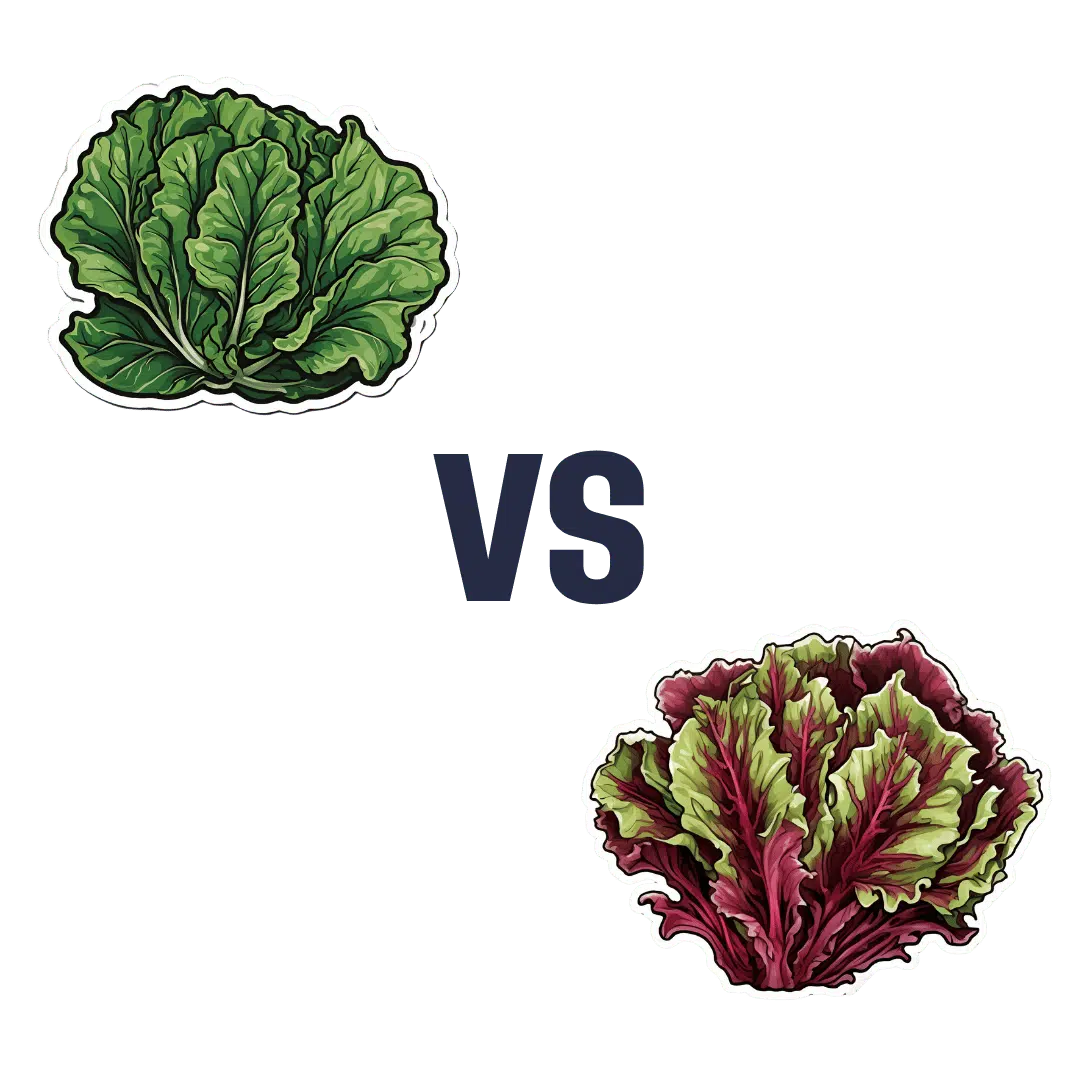
When comparing collard greens to red lettuce, we picked the collard greens.
Why?
In terms of macros, collard greens have nearly 4x the fiber, as well as slightly more protein and carbs, winning this round.
In the category of vitamins, collard greens have more of vitamins A, B2, B3, B6, B7, B9, and C, while red lettuce has slightly more of vitamins B1 and B5. An easy win for collard greens.
Looking at minerals, collard greens have more calcium, copper, magnesium, manganese, potassium, and zinc, while red lettuce has a tiny bit more iron. Another clear win for collard greens.
When it comes to other considerations, red lettuce does have more polyphenols (most notably a wide range of flavonoids including multiple anthocyanins, luteolin, and 6 different kinds of quercetin), so red lettuce scores a point finally here.
Adding up the sections makes for an overall win for collard greens, but by all means enjoy either or both; diversity is good!
Want to learn more?
You might like:
What Matters Most For Your Heart? Eat More (Of This) For Lower Blood Pressure
Enjoy!
Don’t Forget…
Did you arrive here from our newsletter? Don’t forget to return to the email to continue learning!
Recommended
Learn to Age Gracefully
Join the 98k+ American women taking control of their health & aging with our 100% free (and fun!) daily emails:
-
The Polyvagal Theory – by Dr. Stephen Porges
10almonds is reader-supported. We may, at no cost to you, receive a portion of sales if you purchase a product through a link in this article.
Do you ever find that your feelings (or occasionally: lack thereof) sometimes can seem mismatched with the observed facts of your situation? This book unravels that mystery—or rather, that stack of mysteries.
Dr. Porges’ work on this topic is, by the way, the culmination of 40 years of research. While he’s not exactly a household name to the layperson, he’s very respected in his field, and this book is his magnum opus.
Here he explains the disparate roles of the two branches of the vagus nerve (hence: polyvagal theory). At least, the two branches that we mammals have; non-mammalian vertebrates have only one. This makes a big difference, because of the cascade of inhibitions that this allows.
The answer to the very general question “What stops you from…?” is usually found somewhere down this line of cascade of inhibitions.
These range from “what stops you from quitting your job/relationship/etc” to “what stops you from freaking out” to “what stops you from relaxing” to “what stops you from reacting quickly” to “what stop you from giving up” to “what stops you from gnawing your arm off” and many many more.
And because sometimes we wish we could do something that we can’t, or wish we wouldn’t do something that we do, understanding this process can be something of a cheat code to life.
A quick note on style: the book is quite dense and can be quite technical, but should be comprehensible to any layperson who is content to take their time, because everything is explained as we go along.
Bottom line: if you’d like to better understand the mysteries of how you feel vs how you actually are, and what that means for what you can or cannot wilfully do, this is a top-tier book
Click here to check out Polyvagal Theory, and take control of your responses!
Share This Post
-
10 Skin Warning Signs You Should Never Ignore
10almonds is reader-supported. We may, at no cost to you, receive a portion of sales if you purchase a product through a link in this article.
Do you have armpits? Don’t ignore them!
Heed the signs:
Without further ado, they are:
- Acanthosis nigricans: dark, velvety brown skin thickening on the neck, underarms, backs of the hands, or sides of the face can signal insulin resistance, prediabetes, or PMOS. The good news, however, is that despite common concerns of such, sudden widespread onset is rarely associated with cancer.
- Unexplained bruising: bruises appearing without remembered injury may be linked to platelet disorders, clotting disorders, vitamin deficiencies, liver disease, certain cancers, or medications such as blood thinners and corticosteroids; bruising accompanied by nosebleeds, bleeding gums, or large purple patches is especially concerning and merits medical attention.
- Yellowing of the skin or eyes: jaundice can indicate liver disease, bile duct obstruction, or increased breakdown of red blood cells; yellowing often appears under the tongue and inside the mouth before becoming obvious elsewhere. It’s worth knowing that unlike harmless carotene-related skin discoloration (i.e. you drank a lot of carrot juice and turned orange), jaundice also affects the eyes and mouth.
- Severe itching without a rash: persistent whole-body itching lasting more than six weeks with no visible rash can be associated with liver disease, kidney disease, thyroid disorders, iron deficiency, or cancers such as Hodgkin lymphoma. Itching triggered by showering is another warning sign.
- Thick, waxy, or tight skin: swollen, shiny, waxy skin on the shins may occur with Graves’ disease, while skin tightening on the fingers may suggest diabetes or Scleroderma, particularly when hand mobility becomes restricted.
- Butterfly rash on the face: a rash across the cheeks and nose that spares the folds beside the nose famously may indicate systemic lupus erythematosus, especially if it worsens with sun exposure and is accompanied by fatigue or joint pain.
- Dark streaks under the nails: a new dark band in a single nail, particularly one that widens, contains multiple colors, or extends onto the surrounding skin, can be a warning sign of melanoma and should be evaluated for such.
- Sudden hair shedding: rapid diffuse hair loss, known as telogen effluvium, often occurs about three months after a physical stressor and may be associated with thyroid disease, iron deficiency, infection, surgery, trauma, nutritional deficiencies, pregnancy, or rapid weight loss.
- Non-healing wounds or recurrent infections: cuts, scrapes, or ulcers that remain open for more than four weeks generally suggest poor circulation, vascular disease, diabetes, or impaired immune function.
- Yellow, thick, or crumbly nails: commonly caused by a fungal infection, but when accompanied by respiratory symptoms and leg swelling, they may indicate bigger problems and should be checked out.
For more on all of this plus visual illustrations, enjoy:
Click Here If The Embedded Video Doesn’t Load Automatically!
Want to learn more?
You might also like:
What Your Skin Texture Says About Your Health
Take care!
Share This Post
-
Almonds vs Pecans – Which is Healthier?
10almonds is reader-supported. We may, at no cost to you, receive a portion of sales if you purchase a product through a link in this article.
Our Verdict
When comparing almonds to pecans, we picked the almonds.
Why?
In terms of macros, almonds have more protein, carbs, and fiber, as well as the lower glycemic index. A strong start for almonds here, though pecans have more fat (and the healthy blend of fats is quite comparable from one nut to the other).
In the category of vitamins, almonds have more of vitamins B2, B3, B9, E, and choline, while pecans have more of vitamins A, B1, B5, B6, and K. Numerically that’s a tie, though the biggest margins of difference are for vitamins A and E, respectively, and we might want to prioritize almonds’ extra vitamin E, over pecans’ extra vitamin A, given that vitamin A is more easily found in large quantities in many foods, whereas vitamin E is not quite so abundant generally. So in short, either a tie or a slight win for almonds here.
When it comes to minerals, both contain a lot of goodness, but almonds have more calcium, iron, magnesium, phosphorus, potassium, and selenium, while pecans have more copper, manganese, and zinc. A clear win for almonds, though as we say, pecans are also great for this, just not as great as almonds.
As a side-note, both of these nuts have been found to have anticancer properties against breast cancer cell lines. In all likelihood this means they help against other cancers too, but breast cancer is what the extant research has been for.
So, naturally, enjoy either or both (in fact, both is ideal). But if you want to choose one for nutritional density, it’s almonds.
Want to learn more?
You might like to read:
Why You Should Diversify Your Nuts
Take care!
Share This Post
Related Posts
-
Protein: How Much Do We Need, Really?
10almonds is reader-supported. We may, at no cost to you, receive a portion of sales if you purchase a product through a link in this article.
Mythbusting Protein!
Yesterday, we asked you for your policy on protein consumption. The distribution of responses was as follows:
- A marginal majority (about 55%) voted for “Protein is very important, but we can eat too much of it”
- A large minority (about 35%) voted for “We need lots of protein; the more, the better!”
- A handful (about 4%) voted for “We should go as light on protein as possible”
- A handful (6%) voted for “If we don’t eat protein, our body will create it from other foods”
So, what does the science say?
If we don’t eat protein, our body will create it from other foods: True or False?
Contingently True on an absurd technicality, but for all practical purposes False.
Our body requires 20 amino acids (the building blocks of protein), 9 of which it can’t synthesize and absolutely must get from food. Normally, we get those amino acids from protein in our diet, and we can also supplement them by buying amino acid supplements.
Specifically, we require (per kg of bodyweight) a daily average of:
- Histidine: 10 mg
- Isoleucine: 20 mg
- Leucine: 39 mg
- Lysine: 30 mg
- Methionine: 10.4 mg
- Phenylalanine*: 25 mg
- Threonine: 15 mg
- Tryptophan: 4 mg
- Valine: 26 mg
*combined with the non-essential amino acid tyrosine
Source: Protein and Amino Acid Requirements In Human Nutrition: WHO Technical Report
However, to get the requisite amino acid amounts, without consuming actual protein, would require gargantuan amounts of supplementation (bearing in mind bioavailability will never be 100%, so you’ll always need to take more than it seems), using supplements that will have been made by breaking down proteins anyway.
So unless you live in a laboratory and have access to endless amounts of all of the required amino acids (you can’t miss even one; you will die), and are willing to do that for the sake of proving a point, then you do really need to eat protein.
Your body cannot, for example, simply break down sugar and use it to make the protein you need.
On another technical note… Do bear in mind that many foods that we don’t necessarily think of as being sources of protein, are sources of protein.
Grains and grain products, for example, all contain protein; we just don’t think of them as that because their macronutritional profile is heavily weighted towards carbohydrates.
For that matter, even celery contains protein. How much, you may ask? Almost none! But if something has DNA, it has protein. Which means all plants and animals (at least in their unrefined forms).
So again, to even try to live without protein would very much require living in a laboratory.
We can eat too much protein: True or False?
True. First on an easy technicality; anything in excess is toxic. Even water, or oxygen. But also, in practical terms, there is such a thing as too much protein. The bar is quite high, though:
❝Based on short-term nitrogen balance studies, the Recommended Dietary Allowance of protein for a healthy adult with minimal physical activity is currently 0.8 g protein per kg bodyweight per day❞
❝To meet the functional needs such as promoting skeletal-muscle protein accretion and physical strength, dietary intake of 1.0, 1.3, and 1.6 g protein per kg bodyweight per day is recommended for individuals with minimal, moderate, and intense physical activity, respectively❞
❝Long-term consumption of protein at 2 g per kg bodyweight per day is safe for healthy adults, and the tolerable upper limit is 3.5 g per kg bodyweight per day for well-adapted subjects❞
❝Chronic high protein intake (>2 g per kg bodyweight per day for adults) may result in digestive, renal, and vascular abnormalities and should be avoided❞
Source: Dietary protein intake and human health
To put this into perspective, if you weigh about 160lbs (about 72kg), this would mean eating more than 144g protein per day, which grabbing a calculator means about 560g of lean beef, or 20oz, or 1¼lb.
If you’re eating quarter-pounder burgers though, that’s not usually so lean, so you’d need to eat more than nine quarter-pounder burgers per day to get too much protein.
High protein intake damages the kidneys: True or False?
True if you have kidney damage already; False if you are healthy. See for example:
- Effects of dietary protein restriction on the progression of advanced renal disease in the modification of diet in renal disease study
- A high protein diet has no harmful effects: a one-year crossover study in healthy male athletes
High protein intake increases cancer risk: True or False?
True or False depending on the source of the protein, so functionally false:
- Eating protein from red meat sources has been associated with higher risk for many cancers
- Eating protein from other sources has been associated with lower risk for many cancers
Source: Red Meat Consumption and Mortality Results From 2 Prospective Cohort Studies
High protein intake increase risk of heart disease: True or False?
True or False depending on the source of the protein, so, functionally false:
- Eating protein from red meat sources has been associated with higher risk of heart disease
- Eating protein from other sources has been associated with lower risk of heart disease
Source: Major Dietary Protein Sources and Risk of Coronary Heart Disease in Women
In summary…
Getting a good amount of good quality protein is important to health.
One can get too much, but one would have to go to extremes to do so.
The source of protein matters:
- Red meat is associated with many health risks, but that’s not necessarily the protein’s fault.
- Getting plenty of protein from (ideally: unprocessed) sources such as poultry, fish, and/or plants, is critical to good health.
- Consuming “whole proteins” (that contain all 9 amino acids that we can’t synthesize) are best.
Learn more: Complete proteins vs. incomplete proteins (explanation and examples)
Don’t Forget…
Did you arrive here from our newsletter? Don’t forget to return to the email to continue learning!
Learn to Age Gracefully
Join the 98k+ American women taking control of their health & aging with our 100% free (and fun!) daily emails:
-
Easy Fixes for Common Nail Problems
10almonds is reader-supported. We may, at no cost to you, receive a portion of sales if you purchase a product through a link in this article.
Dr. Andrea Suarez shows us how:
Getting off on the right foot
We won’t tip-toe around these tips:
- Dealing with hangnails on the fingernails: dehydrated nails crack and lift into painful hangnails, so moisturize nightly with products containing urea and/or glycerin, avoid pulling or tearing hangnails, trim them with manicure scissors instead, and if it seems sensible for your situation, seal a small flap with a drop of superglue to reduce discomfort while it grows out naturally. Do note that excessive cuticle trimming, nail polish, nail polish remover, and/or long nails can dry the nail plate and increase splitting, so it can be a good idea to keep your nails shorter and regularly hydrate them.
- Preventing toenail fungus from spreading: applying a small drop of distilled white vinegar under each toenail may help discourage fungal spread because fungi prefer a more neutral environment, although vinegar won’t cure advanced fungal infections, which often require prescription oral or topical antifungal medications.
- Managing difficulty trimming thick toenails: thick nails from aging, physical trauma, or prior fungal infections can sometimes be softened with salicylic acid and urea products applied overnight for about two weeks, after which gentle filing with a pumice stone can certainly help, though very thick or painful nails should be treated by a podiatrist.
- Reducing thick skin around the toenails: you can soften built-up keratin with a urea-based foot or callus cream before gently scraping it away, rather than cutting dry skin with scissors, because softened skin is easier and safer to remove.
- Preventing ingrown toenails: wear shoes with enough toe room, trim toenails straight across rather than curved, and if a nail starts growing inward, gently lift the edge with a tiny rolled cotton piece tucked underneath using tweezers.
Final note, on when to seek medical care: redness, swelling, drainage, severe pain, or signs of infection around a nail are best tended-to by a podiatrist.
For more on all of this plus visual illustrations, enjoy;
Click Here If The Embedded Video Doesn’t Load Automatically!
Want to learn more?
You might also like:
The Foot Book – by Dr. Todd Brennan & Dr. Leslie Johnston
Take care!
Don’t Forget…
Did you arrive here from our newsletter? Don’t forget to return to the email to continue learning!
Learn to Age Gracefully
Join the 98k+ American women taking control of their health & aging with our 100% free (and fun!) daily emails:
-
Cardio vs Strength Training: Which Is Better For Brain Health?
10almonds is reader-supported. We may, at no cost to you, receive a portion of sales if you purchase a product through a link in this article.
Dr. Tracey Marks, psychiatrist, explains:
It depends on which kind of brain health
Here at 10almonds, often say “what’s good for your heart is good for your brain” and it’s true, largely because the blood is what nourishes the brain (with oxygen and nutrients), and ultimately takes away detritus that shouldn’t be there (including α-synuclein and β-amyloid clearance, to protect you from Parkinson’s and Alzheimer’s, respectively).
And obviously, having good vasculature will have a protective effect against vascular dementia and stroke.
So, this is a hands-down win for cardio, right? Cardio also has further specific brain benefits in the short- and long-term:
- Short-term: within one exercise session (and certainly within 30 minutes of such), cardio exercise increases levels of the neurotransmitters dopamine, serotonin, and norepinephrine, resulting in an immediate mood boost.
- Long-term: if you do it consistently over time, it strengthens connections between the prefrontal cortex and amygdala, improving emotional regulation and stress resilience, and also reducing the risk of depression and anxiety.
However, strength-training also has its place, including for brain health.
Specifically, it boosts brain growth factors, which is as good as it sounds (and promotes healthy brain cell survival and synaptic plasticity, both of which are good things). It also helps regulate cortisol and, consequently, reduces chronic brain inflammation, as measurable by the reduced prevalence of inflammatory markers like CRP and TNF-Alpha. In terms of results we can see without lab equipment, it also improves executive function and memory, especially in older adults.
For more on all of this plus Dr. Marks’ recommendation of how to combine the two, enjoy:
Click Here If The Embedded Video Doesn’t Load Automatically!
Want to learn more?
You might also like:
How Your Exercise Today Gives A Brain Boost Tomorrow
Take care!
Don’t Forget…
Did you arrive here from our newsletter? Don’t forget to return to the email to continue learning!
Learn to Age Gracefully
Join the 98k+ American women taking control of their health & aging with our 100% free (and fun!) daily emails:


