
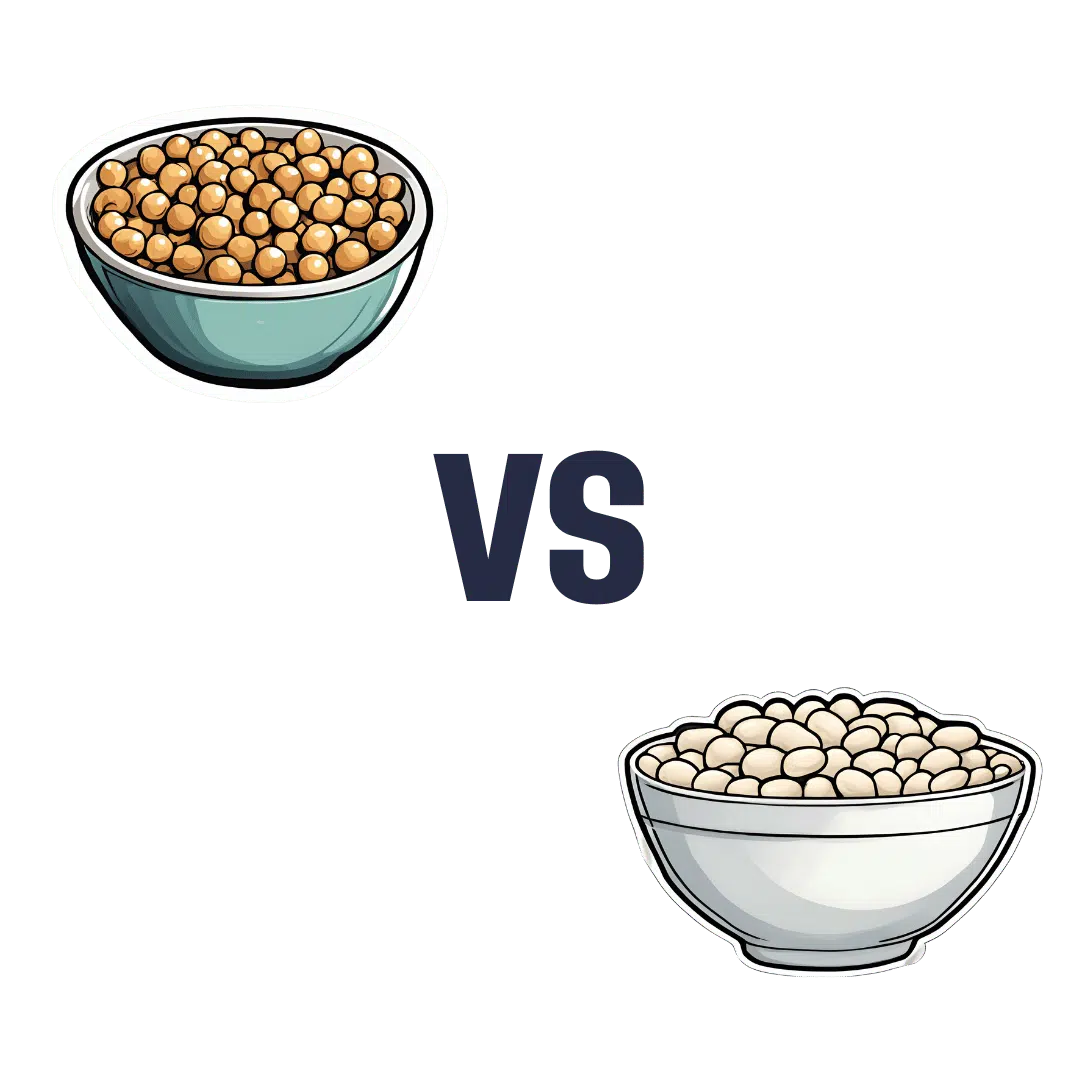
Chickpeas vs White Beans – Which is Healthier?

10almonds is reader-supported. We may, at no cost to you, receive a portion of sales if you purchase a product through a link in this article.

Our Verdict

When comparing chickpeas to white beans, we picked the chickpeas.

Why?

They are both excellent, top-tier choices! But…

In terms of macros, chickpeas have notably more fiber while white beans have slightly more protein. While we’d like to emphasize that both are great for both, we say that on balance, this means a slight win for chickpeas in this category. But if you’d rather call it a tie, you can.

In the category of vitamins, chickpeas have more of vitamins A, B2, B3, B5, B6, B7, B9, C, and K, while white beans have more vitamin E, yielding an overwhelming win for chickpeas.

Looking at minerals, chickpeas have more copper, manganese, phosphorus, selenium, and zinc, while white beans have more calcium, iron, magnesium, and potassium, giving chickpeas a modest 5:4 win in this round.

Adding up the sections makes for a clear overall win for chickpeas, by all means do enjoy either or both, as they’re both very strong contenders, and diversity is best!

Want to learn more?

You might like:

What’s Your Plant Diversity Score?

Enjoy!

Don’t Forget…

Did you arrive here from our newsletter? Don’t forget to return to the email to continue learning!

Learn to Age Gracefully

Join the 98k+ American women taking control of their health & aging with our 100% free (and fun!) daily emails:

  • How To Stop Foot Cramps At Night

    10almonds is reader-supported. We may, at no cost to you, receive a portion of sales if you purchase a product through a link in this article.

    Over-50s specialist physio Will Harlow shows us how:

    Reset & relax

    Foot cramps at night are common, especially with age. Low electrolytes can contribute—consider a pinch of salt (if safe) or use electrolyte tablets.

    However, this is only usually the case if a) you are on a very low-sodium diet, and/or b) you have been sweating and/or peeing a lot (which latter can be the case if you are taking diuretics, which includes meds that have that as a side effect rather than the main purpose).

    Magnesium salt rubs (or soaks) applied to the feet before bed can also help relax muscles and prevent cramps, on a similar principle (and have the bonus that the body is generally much more likely to be deficient in magnesium than sodium, making magnesium salts preferable).

    If that fails, then massage is in order:

    • Stretch the top of the foot by pulling toes downward while the leg is crossed; hold for 30 seconds, repeat a few times.
    • Stretch the bottom of the foot by pulling toes upward and flexing the ankle; hold for 30 seconds, repeat on each side.
    • Stretch your calves by leaning into a wall with one leg back and heel down; this helps relieve tension that contributes to foot and calf cramps.
    • Use a massage ball under your foot to release tension—gently roll it under the fleshy areas, adding pressure if needed (avoid bones and heel).

    For more on all of this plus a visual demonstration, enjoy:

    Click Here If The Embedded Video Doesn’t Load Automatically!

    Want to learn more?

    You might also like:

    When To Take Electrolytes (And When We Shouldn’t!)

    Take care!

    Share This Post

  • Pear vs Prickly Pear – Which is Healthier?

    10almonds is reader-supported. We may, at no cost to you, receive a portion of sales if you purchase a product through a link in this article.

    Our Verdict

    When comparing pear to prickly pear, we picked the prickly.

    Why?

    Both of these fruits are fine and worthy choices, but the prickly pear wins out in nutritional density.

    Looking at the macros to start with, the prickly pear is higher in fiber and lower in carbs, resulting in a much lower glycemic index. However, non-prickly pears are already low GI, so this is not a huge matter. Whether it’s pear’s GI of 38 or prickly pear’s GI of 7, you’re unlikely to experience a glucose spike.

    In the category of vitamins, pear has a little more of vitamins B5, B9, E, K, and choline, but the margins are tiny. On the other hand, prickly pear has more of vitamins A, B1, B2, B3, B6, and C, with much larger margins of difference (except vitamin B1; that’s still quite close). Even before taking margins of difference into account, this is a slight win for prickly pear.

    When it comes to minerals, things are more pronounced; pear has more manganese, while prickly pear has more calcium, iron, magnesium, phosphorus, potassium, selenium, and zinc.

    In short, both pears are great (so do enjoy the pair), but prickly pear is the clear winner where one must be declared.

    Want to learn more?

    You might like to read:

    Apple vs Pear – Which is Healthier?

    Take care!

    Share This Post

  • Your Daily Dose Of B12 From Just 15g Of Pea Shoots!

    10almonds is reader-supported. We may, at no cost to you, receive a portion of sales if you purchase a product through a link in this article.

    …and other items from this week’s health news:

    Efficient and inexpensive B12-bearing pea shoots

    Because plants don’t create vitamin B12, and meat and dairy carry assorted health risks, what’s a person to do, who wants to be healthy?

    Well, there is yeast, which has the best of both worlds, but maybe you don’t want nutritional yeast with every meal. There’s supplementation too, but wouldn’t it be nicer to get it from our diet?

    Researchers (Dr. Bethany Eldridge et al.) have found an answer, having developed pea shoots that naturally contain high levels of vitamin B12 using indoor aeroponic farming.

    How it works: much like how cows are supplemented with B12 that is then passed on to humans to eat them, they simply supplemented the pea plants, via their exposed roots in an aeroponics setting. Drawing nutrients up from the roots, the leaves accumulated enough B12 that a 15-gram serving of pea shoots provides more than the recommended daily allowance of vitamin B12.

    The researchers estimate adding B12 through this method could increase the price of a bag of pea shoots by less than 1 penny, making it extremely inexpensive at scale:

    Read in full: New aeroponic technology delivers essential Vitamin B12 through salad crops ← small error in the article; it says cyanocobalamin is the most bioavailable form of B12; it isn’t, that would be methylcobalamin or adenosylcobalamin. However, they did test the cyanocobalamine stored in the pea shoots and found that it was bioavailable, including after harvesting and storage. To be clear, the “most bioavailable” claim error was only in the pop-science article, not in the paper to which it links.

    Related: Which B Vitamins? It Makes A Difference

    Worse than “just” measles

    Measles is bad enough already, to the point that it has a body count in the US in the past year, mostly unvaccinated children.

    However, even if one recovers from an initial measles infection, there’s another problem that can strike later.

    Subacute sclerosing panencephalitis (SSPE) is a rare but usually fatal neurological disease caused by the measles virus persisting in the brain for years after the original infection. Early signs often include stumbling, personality changes, jerking movements, seizures, hallucinations, and gradual loss of speech and mobility as brain damage progresses. The disease usually worsens steadily, leading to severe disability such as paralysis or inability to swallow, and it is almost always fatal.

    Again, children suffer most. Or rather, the adolescents that these children briefly survived to become. That’s because children who catch measles very young—especially before age 5 or during infancy—have the highest risk of later developing SSPE.

    Due to declining vaccinations in the US and parts of Europe, clinicians have begun seeing cases again after decades when they were extremely rare, including a California child who died after contracting measles as an infant. Doctors expect many more SSPE cases to appear in years to come as the “delayed echo” of the recent waves of infections.

    Some quick notes on treatment and prevention:

    • Treatment: doctors currently have no cure for SSPE, and available therapies only slow the disease slightly rather than reversing brain damage.
    • Prevention: the two-dose measles vaccine dramatically reduces infection risk—from about 90% to roughly 3% after exposure—making vaccination the most effective way to prevent SSPE entirely.

    Read in full: Doctors warn of a deadly complication from measles outbreaks

    Related: Vaccine Mythbusting

    Save money, save your heart

    What’s better, simple red meat, or plant-based meats?

    Research (linked below) has answered this question and found that replacing red meat with processed plant-based meat substitutes significantly (and rapidly!) lowers levels of the cardiovascular-risk metabolite trimethylamine N-oxide (TMAO).

    The benefits at a glance:

    • TMAO levels: the plant-based meat diet significantly lowered circulating TMAO levels compared with the red-meat diet by about 0.61 log units, showing that the metabolite can change within only a few days of dietary substitution.
    • Cholesterol changes: during the plant-based phase, total cholesterol dropped by about 7 mg/dL and LDL cholesterol by about 6 mg/dL, although the trial was powered primarily to detect TMAO changes rather than lipid outcomes.

    Were there any drawbacks? Yes, two:

    1. Participants gained an average of 0.6 kg during the plant-based phase, which researchers suggested may reflect fluid retention from the higher sodium content of processed plant-based patties. In practical terms, this means that…
      • one can still have too much of a good thing, and while the swap is a mostly healthier one, it’s still important to watch the sodium levels, and
      • if you are going to consume more sodium for some reason (most of us will have a saltier meal once in a while), it’s good to balance that with water and non-sodium electrolytes, especially potassium, which counterbalances sodium in the body’s homeostatic system.
    2. A few participants reported mild gastrointestinal symptoms, including abdominal discomfort and diarrhea, during the plant-based diet phase. Basically, since this was an interventional trial, this was a case of “people who aren’t used to eating plant-based don’t yet have a gut that’s accustomed to plant-based fiber levels“, and would not be relevant after a short period, when the gut adapts.

    Read in full: Swapping red meat for plant-based meat rapidly lowers a key heart risk metabolite, trial finds

    Related: Are plant-based burgers really bad for your heart? Here’s what’s behind the scary headlines

    Take care!

    Share This Post

  • Fix Chronic Fatigue & Regain Your Energy, By Science

    10almonds is reader-supported. We may, at no cost to you, receive a portion of sales if you purchase a product through a link in this article.

    Chronic fatigue is on the rise. A lot of it appears to be Long COVID-related, but whether that’s the case for you or not, one thing that will make a big difference to your energy levels is something that French biochemist Jessie Inchauspé is here to explain:

    Mitochondrial management

    Inchauspé explains it in terms of a steam train; to keep running, it must have coal burning in its furnace. However, if more coal is delivered to the engine room faster than it can be put in the furnace and burned, and the coal just keeps on coming, the worker there will soon be overwhelmed trying to find places to put it all; the engine room will be full of coal, and the furnace will sputter and go out because the worker can’t even reach it on account of being buried in coal.

    So it is with our glucose metabolism also. If we get spikes of glucose faster than our body can deal with them, it will overload the body’s ability to process that energy at all. Just like the steam train worker, our body will try! It’ll stuff that extra glucose wherever it can (storing as glycogen in the liver is a readily available option that’s easy to do and/but also gives you non-alcoholic fatty liver disease and isn’t quickly broken down into useable energy), and meanwhile, your actual mitochondria aren’t getting what they need (which is: a reliable, but gentle, influx of glucose).

    You can imagine that the situation we described in the steam train isn’t good for the engine’s longevity, and the corresponding situation in the human body isn’t good for our mitochondria either (or our pancreas, or our liver, or… the list goes on). Indeed, damaged mitochondria affect exercise capacity and stress resilience—as well as being a long-term driver of cancer.

    The remedy, of course, is blood sugar management. Specifically, avoiding glucose spikes. She has a list of 10 ways to do this (small changes to how we eat; what things to eat with what, in which order, etc) that make a huge measurable difference. For your convenience, we’ve linked those ten ways below; first though, if you’d like to hear it from Inchauspé directly (her style is very pleasant), enjoy:

    Click Here If The Embedded Video Doesn’t Load Automatically!

    Want to learn more?

    You might also like to read:

    Take care!

    Don’t Forget…

    Did you arrive here from our newsletter? Don’t forget to return to the email to continue learning!

    Learn to Age Gracefully

    Join the 98k+ American women taking control of their health & aging with our 100% free (and fun!) daily emails:

  • Study links microplastics with human health problems – but there’s still a lot we don’t know

    10almonds is reader-supported. We may, at no cost to you, receive a portion of sales if you purchase a product through a link in this article.

    Mark Patrick Taylor, Macquarie University and Scott P. Wilson, Macquarie University

    A recent study published in the prestigious New England Journal of Medicine has linked microplastics with risk to human health.

    The study involved patients in Italy who had a condition called carotid artery plaque, where plaque builds up in arteries, potentially blocking blood flow. The researchers analysed plaque specimens from these patients.

    They found those with carotid artery plaque who had microplastics and nanoplastics in their plaque had a higher risk of heart attack, stroke, or death (compared with carotid artery plaque patients who didn’t have any micro- or nanoplastics detected in their plaque specimens).

    Importantly, the researchers didn’t find the micro- and nanoplastics caused the higher risk, only that it was correlated with it.

    So, what are we to make of the new findings? And how does it fit with the broader evidence about microplastics in our environment and our bodies?

    What are microplastics?

    Microplastics are plastic particles less than five millimetres across. Nanoplastics are less than one micron in size (1,000 microns is equal to one millimetre). The precise size classifications are still a matter of debate.

    Microplastics and nanoplastics are created when everyday products – including clothes, food and beverage packaging, home furnishings, plastic bags, toys and toiletries – degrade. Many personal care products contain microsplastics in the form of microbeads.

    Plastic is also used widely in agriculture, and can degrade over time into microplastics and nanoplastics.

    These particles are made up of common polymers such as polyethylene, polypropylene, polystyrene and polyvinyl chloride. The constituent chemical of polyvinyl chloride, vinyl chloride, is considered carcinogenic by the US Environmental Protection Agency.

    Of course, the actual risk of harm depends on your level of exposure. As toxicologists are fond of saying, it’s the dose that makes the poison, so we need to be careful to not over-interpret emerging research.

    A closer look at the study

    This new study in the New England Journal of Medicine was a small cohort, initially comprising 304 patients. But only 257 completed the follow-up part of the study 34 months later.

    The study had a number of limitations. The first is the findings related only to asymptomatic patients undergoing carotid endarterectomy (a procedure to remove carotid artery plaque). This means the findings might not be applicable to the wider population.

    The authors also point out that while exposure to microplastics and nanoplastics has been likely increasing in recent decades, heart disease rates have been falling.

    That said, the fact so many people in the study had detectable levels of microplastics in their body is notable. The researchers found detectable levels of polyethylene and polyvinyl chloride (two types of plastic) in excised carotid plaque from 58% and 12% of patients, respectively.

    These patients were more likely to be younger men with diabetes or heart disease and a history of smoking. There was no substantive difference in where the patients lived.

    Inflammation markers in plaque samples were more elevated in patients with detectable levels of microplastics and nanoplastics versus those without.

    Plastic bottles washed up on a beach.
    Microplastics are created when everyday products degrade. JS14/Shutterstock

    And, then there’s the headline finding: patients with microplastics and nanoplastics in their plaque had a higher risk of having what doctors call “a primary end point event” (non-fatal heart attack, non-fatal stroke, or death from any cause) than those who did not present with microplastics and nanoplastics in their plaque.

    The authors of the study note their results “do not prove causality”.

    However, it would be remiss not to be cautious. The history of environmental health is replete with examples of what were initially considered suspect chemicals that avoided proper regulation because of what the US National Research Council refers to as the “untested-chemical assumption”. This assumption arises where there is an absence of research demonstrating adverse effects, which obviates the requirement for regulatory action.

    In general, more research is required to find out whether or not microplastics cause harm to human health. Until this evidence exists, we should adopt the precautionary principle; absence of evidence should not be taken as evidence of absence.

    Global and local action

    Exposure to microplastics in our home, work and outdoor environments is inevitable. Governments across the globe have started to acknowledge we must intervene.

    The Global Plastics Treaty will be enacted by 175 nations from 2025. The treaty is designed, among other things, to limit microplastic exposure globally. Burdens are greatest especially in children and especially those in low-middle income nations.

    In Australia, legislation ending single use plastics will help. So too will the increased rollout of container deposit schemes that include plastic bottles.

    Microplastics pollution is an area that requires a collaborative approach between researchers, civil societies, industry and government. We believe the formation of a “microplastics national council” would help formulate and co-ordinate strategies to tackle this issue.

    Little things matter. Small actions by individuals can also translate to significant overall environmental and human health benefits.

    Choosing natural materials, fabrics, and utensils not made of plastic and disposing of waste thoughtfully and appropriately – including recycling wherever possible – is helpful.

    Mark Patrick Taylor, Chief Environmental Scientist, EPA Victoria; Honorary Professor, School of Natural Sciences, Macquarie University and Scott P. Wilson, Research Director, Australian Microplastic Assessment Project (AUSMAP); Honorary Senior Research Fellow, School of Natural Sciences, Macquarie University

    This article is republished from The Conversation under a Creative Commons license. Read the original article.

    The Conversation

    Don’t Forget…

    Did you arrive here from our newsletter? Don’t forget to return to the email to continue learning!

    Learn to Age Gracefully

    Join the 98k+ American women taking control of their health & aging with our 100% free (and fun!) daily emails:

  • Radical Remission – by Dr. Kelly Turner

    10almonds is reader-supported. We may, at no cost to you, receive a portion of sales if you purchase a product through a link in this article.

    First, what this is not:an autobiographical account of the “I beat cancer and you can too” pep-talk style.

    What it is: a very readable pop-science book based on the author’s own PhD research into radical remission.

    She knew that a very small percentage of people experience spontaneous radical remission (or quasi-spontaneous, if the remission is attributed to lifestyle changes, and/or some alternative therapy), but a small percentage of people means a large number worldwide, so she travelled the world studying over 1,000 cases of people with late-stage cancer who had either not gone for conventional anticancer drugs, or had and then stopped, and lived to tell the tale.

    While she doesn’t advocate for any particular alternative therapy, she does report on what things came to her attention. She does advocate for some lifestyle changes.

    Perhaps the biggest value this book offers is in its promised “9 key factors that can make a real difference”, which are essentially her conclusions from her PhD dissertation.

    There isn’t room to talk about them here in a way that wouldn’t be misleading/unhelpful for a paucity of space, so perhaps we’ll do a main feature one of these days.

    Bottom line: if you have (or a loved one has) cancer, this is an incredibly sensible book to read. If you don’t, then it’s an interesting and thought-provoking book to read.

    Click here to check out Radical Remission, and learn about the factors at hand!

    Don’t Forget…

    Did you arrive here from our newsletter? Don’t forget to return to the email to continue learning!

    Learn to Age Gracefully

    Join the 98k+ American women taking control of their health & aging with our 100% free (and fun!) daily emails: