Black Beans vs Pinto Beans – Which is Healthier?

10almonds is reader-supported. We may, at no cost to you, receive a portion of sales if you purchase a product through a link in this article.

Our Verdict

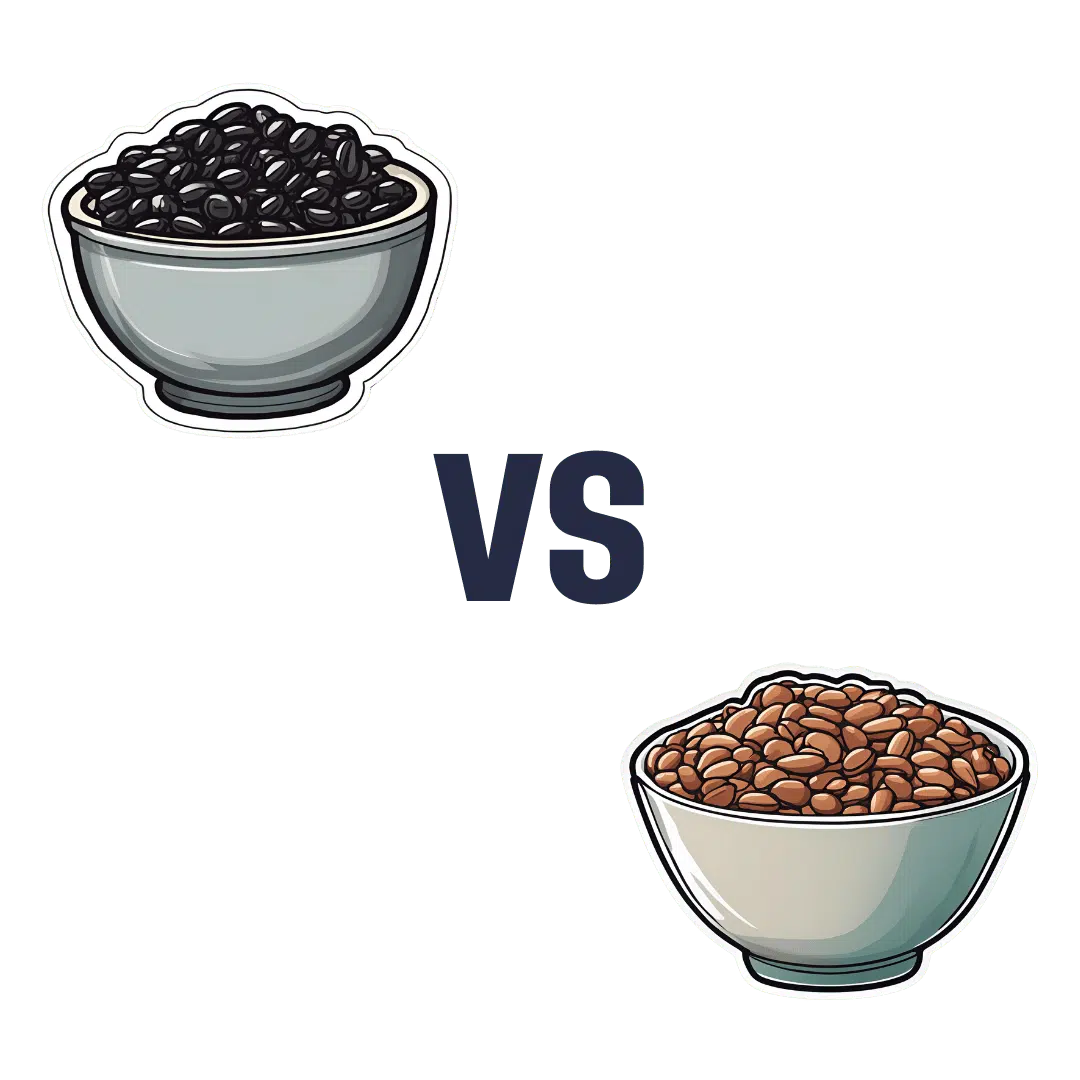
When comparing black beans to pinto beans, we picked the pinto beans.

Why?

Both of these beans won all their previous comparisons, so it’s no surprise that this one was very close. Despite their different appearance, taste, and texture, their nutritional profiles are almost identical:

In terms of macros, pinto beans have a tiny bit more protein, carbs, and fiber. So, a nominal win for pinto beans, but again, the difference is very slight.

When it comes to vitamins, black beans have more of vitamins A, B1, B3, and B5, while pinto beans have more of vitamins B2, B6, B9, C, E, and K. Superficially, again this is nominally a win for pinto beans, but in most cases the differences are so slight as to be potentially the product of decimal place rounding.

In the category of minerals, black beans have more calcium, copper, iron, and phosphorus, while pinto beans have more magnesium, manganese, selenium, and zinc. That’s a 4:4 tie, but the only one with a meaningful margin of difference is selenium (of which pinto beans have 4x more), so we’re calling this one a very modest win for pinto beans.

All in all, adding these up makes for a “if we really are pressed to choose” win for pinto beans, but honestly, enjoy either in accordance with your preference (this writer prefers black beans!), or better yet, both.

Want to learn more?

You might like to read:

What’s Your Plant Diversity Score?

Take care!

Don’t Forget…

Did you arrive here from our newsletter? Don’t forget to return to the email to continue learning!

Learn to Age Gracefully

Join the 98k+ American women taking control of their health & aging with our 100% free (and fun!) daily emails:

  • How Older People Are Reaping Brain Benefits From New Tech

    10almonds is reader-supported. We may, at no cost to you, receive a portion of sales if you purchase a product through a link in this article.

    It started with a high school typing course.

    Wanda Woods enrolled because her father advised that typing proficiency would lead to jobs. Sure enough, the federal Environmental Protection Agency hired her as an after-school worker while she was still a junior.

    Her supervisor “sat me down and put me on a machine called a word processor,” Woods, now 67, recalled. “It was big and bulky and used magnetic cards to store information. I thought, ‘I kinda like this.’”

    Decades later, she was still liking it. In 2012 — the first year that more than half of Americans 65 and older were internet users — she started a computer training business.

    Now she is an instructor with Senior Planet in Denver, an AARP-supported effort to help older people learn and stay abreast of technology. Woods has no plans to retire. Staying involved with tech “keeps me in the know, too,” she said.

    Some neuroscientists researching the effects of technology on older adults are inclined to agree. The first cohort of seniors to have contended — not always enthusiastically — with a digital society has reached the age when cognitive impairment becomes more common.

    Given decades of alarms about technology’s threats to our brains and well-being — sometimes called “digital dementia” — one might expect to start seeing negative effects.

    The opposite appears true. “Among the digital pioneer generation, use of everyday digital technology has been associated with reduced risk of cognitive impairment and dementia,” said Michael Scullin, a cognitive neuroscientist at Baylor University.

    It’s almost akin to hearing from a nutritionist that bacon is good for you.

    “It flips the script that technology is always bad,” said Murali Doraiswamy, director of the Neurocognitive Disorders Program at Duke University, who was not involved with the study. “It’s refreshing and provocative and poses a hypothesis that deserves further research.”

    Scullin and Jared Benge, a neuropsychologist at the University of Texas at Austin, were co-authors of a recent analysis investigating the effects of technology use on people over 50 (average age: 69).

    They found that those who used computers, smartphones, the internet, or a mix did better on cognitive tests, with lower rates of cognitive impairment or dementia diagnoses, than those who avoided technology or used it less often.

    “Normally, you see a lot of variability across studies,” Scullin said. But in this analysis of 57 studies involving more than 411,000 seniors, published in Nature Human Behavior, almost 90% of the studies found that technology had a protective cognitive effect.

    Much of the apprehension about technology and cognition arose from research on children, sometimes focused on adolescents, whose brains are still developing.

    “There’s pretty compelling data that difficulties can emerge with attention or mental health or behavioral problems” when young people are overexposed to screens and digital devices, Scullin said.

    Older adults’ brains are also malleable, but less so. And those who began grappling with technology in midlife had already learned “foundational abilities and skills,” Scullin said.

    Then, to participate in a swiftly evolving society, they had to learn a whole lot more.

    Years of online brain-training experiments lasting a few weeks or months have produced varying results. Often, they improve a person’s ability to perform the task in question without enhancing other skills.

    “I tend to be pretty skeptical” of their benefit, said Walter Boot, a psychologist at the Center on Aging and Behavioral Research at Weill Cornell Medicine. “Cognition is really hard to change.”

    The new analysis, however, reflects “technology use in the wild,” he said, with adults “having to adapt to a rapidly changing technological environment” over several decades. He found the study’s conclusions “plausible.”

    Analyses like this can’t determine causality. Does technology improve older people’s cognition, or do people with low cognitive ability avoid technology? Is tech adoption just a proxy for enough wealth to buy a laptop?

    “We still don’t know if it’s chicken or egg,” Doraiswamy said.

    Yet when Scullin and Benge accounted for health, education, socioeconomic status, and other demographic variables, they still found significantly higher cognitive ability among older digital technology users.

    What might explain the apparent connection?

    “These devices represent complex new challenges,” Scullin said. “If you don’t give up on them, if you push through the frustration, you’re engaging in the same challenges that studies have shown to be cognitively beneficial.”

    Even handling the constant updates, the troubleshooting, and the sometimes maddening new operating systems might prove advantageous. “Having to relearn something is another positive mental challenge,” he said.

    Still, digital technology may also protect brain health by fostering social connections, known to help stave off cognitive decline. Or its reminders and prompts could partially compensate for memory loss, as Scullin and Benge found in a smartphone study, while apps help preserve functional abilities like shopping and banking.

    Numerous studies have shown that while the number of people with dementia is increasing as the population ages, the proportion of older adults who develop dementia has been falling in the United States and several European countries.

    Researchers have attributed the decline to a variety of factors, including reduced smoking, higher education levels, and better blood pressure treatments. Possibly, Doraiswamy said, engaging with technology has been part of the pattern.

    Of course, digital technologies present risks, too. Online fraud and scams often target older adults, and while they are less apt to report fraud losses than younger people, the amounts they lose are much higher, according to the Federal Trade Commission. Disinformation poses its own hazards.

    And as with users of any age, more is not necessarily better.

    “If you’re bingeing Netflix 10 hours a day, you may lose social connections,” Doraiswamy pointed out. Technology, he noted, cannot “substitute for other brain-healthy activities” like exercising and eating sensibly.

    An unanswered question: Will this supposed benefit extend to subsequent generations, digital natives more comfortable with the technology their grandparents often labored over? “The technology is not static — it still changes,” Boot said. “So maybe it’s not a one-time effect.”

    Still, the change tech has wrought “follows a pattern,” he added. “A new technology gets introduced, and there’s a kind of panic.”

    From television and video games to the latest and perhaps scariest development, artificial intelligence, “a lot of it is an overblown initial reaction,” he said. “Then, over time, we see it’s not so bad and may actually have benefits.”

    Like most people her age, Woods grew up in an analog world of paper checks and paper maps. But as she moved from one employer to another through the ’80s and ’90s, she progressed to IBM desktops and mastered Lotus 1-2-3 and Windows 3.1.

    Along the way, her personal life turned digital, too: a home desktop when her sons needed one for school, a cellphone after she and her husband couldn’t summon help for a roadside flat, a smartwatch to track her steps.

    These days, Woods pays bills and shops online, uses a digital calendar, and group-texts her relatives. And she seems unafraid of AI, the most earthshaking new tech.

    Last year, Woods turned to AI chatbots like Google Gemini and OpenAI’s ChatGPT to plan an RV excursion to South Carolina. Now, she’s using them to arrange a family cruise celebrating her 50th wedding anniversary.

    The New Old Age is produced through a partnership with The New York Times.

    KFF Health News is a national newsroom that produces in-depth journalism about health issues and is one of the core operating programs at KFF—an independent source of health policy research, polling, and journalism. Learn more about KFF.

    USE OUR CONTENT

    This story can be republished for free (details).

    KFF Health News is a national newsroom that produces in-depth journalism about health issues and is one of the core operating programs at KFF—an independent source of health policy research, polling, and journalism. Learn more about KFF.

    Subscribe to KFF Health News’ free Morning Briefing.

    This article first appeared on KFF Health News and is republished here under a Creative Commons Attribution-NoDerivatives 4.0 International License.

    Share This Post

  • Important Stretching Mistakes To Avoid

    10almonds is reader-supported. We may, at no cost to you, receive a portion of sales if you purchase a product through a link in this article.

    When it comes to stretching, what you do makes a difference, but what matters most is…

    How you do it

    While different stretches will yield different results (as per the thumbnail of this video), the following mistakes are much more certain to sabotage progress:

    • Entering stretches too quickly: stretching too fast activates the stretch reflex, causing muscles to contract and resist the stretch. Instead, ease into stretches gradually in phases to help the nervous system relax and allow flexibility gains.
    • Not timing your stretches: due to subjective time distortion/dilation, not timing how long you hold each stretch often leads to durations shorter than needed, especially on the second side. Use a timer* and aim for at least 30 seconds per muscle to be effective.
    • Lacking intensity in stretches: stretching without enough intensity won’t trigger the changes needed to increase flexibility. Stretches should be mildly uncomfortable but controlled, where breathing is calm and muscles not being stretched can stay relaxed.

    *Because stretches often require having one’s spine a certain way and not craning around to see the timer, and it can be tedious to have to keep moving the timer to where one’s face is going to be next, this writer’s personal solution is simply to stretch in a room with an audibly ticking clock, and count the ticks

    For more detailed explanations of these three things, enjoy:

    Click Here If The Embedded Video Doesn’t Load Automatically!

    Want to learn more?

    You might also like:

    The 4 Best Stretches To Do Before Bed (And Even: To Do In Bed!) ← for any who are wondering “yes but what actual stretches should I do?”, this is a great, easy, effective, starting place!

    Take care!

    Share This Post

  • Complex PTSD – by Pete Walker

    10almonds is reader-supported. We may, at no cost to you, receive a portion of sales if you purchase a product through a link in this article.

    We’ve written before about Complex PTSD, but there’s a lot more to be said than we can fit into an article or two.

    Pete Walker, a licensed marriage and family therapist, does an excellent job and pulls no punches, starting from the book’s dedication and carrying the hard-hitting seriousness all the way through to the Appendices.

    To this end, it absolutely may not be an easy book to read at times (emotionally speaking), especially if you have C-PTSD. On the other hand, you may also find it a very validating 300-odd pages of “Yes, he is telling my life story in words, now this makes sense!”

    That said, it’s mostly not an anecdotes-based book and nor is it just a feelsy ride; it’s also a textbook and a how-to manual. It’s a textbook of how and why things come about the way they do, and a manual of how to effectively manage C-PTSD, and find peace. There’s no silver bullet here, but there is a very comprehensive guide, and chapters full of tools to use (and no, not the same CBT things you’ve probably read a hundred times, this is C-PTSD-specific stuff).

    Bottom line: this is the C-PTSD book; if you buy only one book on the topic, make it this one.

    Click here to check out Complex PTSD: From Surviving To Thriving, and indeed thrive!

    Share This Post

  • The Oh She Glows Cookbook – by Angela Liddon

    10almonds is reader-supported. We may, at no cost to you, receive a portion of sales if you purchase a product through a link in this article.

    Let’s get the criticism out of the way first: notwithstanding the subtitle promising over 100 recipes, there are about 80-odd here, if we discount recipes that are no-brainer things like smoothies, sides such as for example “roasted garlic”, or meta-ingredients such as oat flour (instructions: blend the oats and you get oat flour).

    The other criticism is more subjective: if you are like this reviewer, you will want to add more seasonings than recommended to most of the recipes. But that’s easy enough to do.

    As for the rest: this is a very healthy cookbook, and quite wide-ranging and versatile, with recipes that are homely, with a lot of emphasis on comfort foods (but still, healthy), though certainly some are perfectly worthy of entertaining too.

    A nice bonus of this book is that it offers a lot of available substitutions (much like we do at 10almonds), and also ways of turning the recipe into something else entirely with just a small change. This trait more than makes up for the slight swindle in terms of number of recipes, since some of the recipes have bonus recipes snuck in.

    Bottom line: if you’d like to broaden your plant-based cooking range, this book is a fine option for expanding your repertoire.

    Click here to check out The Oh She Glows Cookbook, and indeed glow!

    Don’t Forget…

    Did you arrive here from our newsletter? Don’t forget to return to the email to continue learning!

    Learn to Age Gracefully

    Join the 98k+ American women taking control of their health & aging with our 100% free (and fun!) daily emails:

  • Come Together – by Dr. Emily Nagoski

    10almonds is reader-supported. We may, at no cost to you, receive a portion of sales if you purchase a product through a link in this article.

    From Dr. Emily Nagoski, author of the bestseller “Come As You Are” (which we reviewed very favorably before) we now present: Come Together.

    What it is not about: simultaneous orgasms. The title is just a play on words.

    What it is about: improving sexual wellbeing, particularly in long-term relationships where one or more partner(s) may be experiencing low desire.

    Hence: come together, in the closeness sense.

    A lot of books (or advice articles) out there take the Cosmo approach of “spicing things up”, and that can help for a night perhaps, but relying on novelty is not a sustainable approach.

    Instead, what Dr. Nagoski outlines here is a method for focusing on shared comfort and pleasure over desire, creating the right state of mind that’s more conducive to sexuality, and reducing things that put the brakes on sexuality.

    She also covers things whereby sexuality can often be obliged to change (for example, with age and/or disability), but that with the right attitude, change can sometimes just be growth in a different way, as you explore the new circumstances together, and continue to find shared pleasure in the ways that best suit your changing circumstances,

    Bottom line: if you and/or your partner(s) would like to foster and maintain intimacy and pleasure, then this is a top-tier book for you.

    Click here to check out Come Together, and, well, come together!

    Don’t Forget…

    Did you arrive here from our newsletter? Don’t forget to return to the email to continue learning!

    Learn to Age Gracefully

    Join the 98k+ American women taking control of their health & aging with our 100% free (and fun!) daily emails:

  • Squat Variations for Painful Knees (No More Pain!)

    10almonds is reader-supported. We may, at no cost to you, receive a portion of sales if you purchase a product through a link in this article.

    Having bad knees can be a bit of a catch-22; you want to squat to make them stronger, but you can’t do that because your knees are not good. But, there are ways to do it!

    Dr. Alyssa Kuhn, a doctor of physical therapy, advises:

    Gently does it

    Ten ways to choose from:

    1. Pool Squats: performed in a pool for joint-friendly support. Can use both hands, one hand, or no support. Focus on sitting back and standing up, aiming for 10–20 reps.
    2. Supported Squats: use a sink, rings, or handles for support. Stand a distance away and sit back while keeping your knees behind your heels. Perform 10–20 reps for 2–3 sets.
    3. Chair Loop Squats: use a resistance band around your knees while sitting on a chair. Press your knees outward as you stand and sit to strengthen hip and knee stability. Do 8–12 reps for 2–3 sets.
    4. Heel Elevated Squats: place your heels on dumbbells to shift emphasis to thighs and reduce knee strain. Ideal for stiff ankles or back tightness. Perform 10–15 reps for 2–3 sets.
    5. Sumo Squats: a wide stance squat, good for hip strength and reducing knee stress. Adjust your foot positioning for comfort. Perform 15–20 reps for 2–3 sets.
    6. Chair Squats: hold a weight close to your chest while sitting and standing from a chair. Can use kettlebells or dumbbells. Do 8–10 reps for 2–3 sets.
    7. Band Squats: use a resistance band secured behind your knees to provide support and encourage proper squat mechanics. Perform 5–12 reps for 2–3 sets.
    8. Modified Single Leg Squat: sit-to-stand using one leg with the other as a kickstand. Adjust your foot position for difficulty. Perform 8–12 reps per side for 2–3 sets.
    9. Weighted Squats: add weight using dumbbells or a barbell. Maintain an upright torso. Adjust the weight and reps based on difficulty, and do 5–10 reps for 2–4 sets.
    10. Split Squat: a stationary lunge, keeping your feet in place and lowering straight down. Focus on your front leg while keeping balance. Can add weight if you want. Perform 5–12 reps per side based on difficulty.

    For more on each of these plus visual demonstrations, enjoy:

    Click Here If The Embedded Video Doesn’t Load Automatically!

    Want to learn more?

    You might also like to read:

    The Squat Bible: The Ultimate Guide to Mastering the Squat and Finding Your True Strength – by Dr. Aaron Horschig

    Take care!

    Don’t Forget…

    Did you arrive here from our newsletter? Don’t forget to return to the email to continue learning!

    Learn to Age Gracefully

    Join the 98k+ American women taking control of their health & aging with our 100% free (and fun!) daily emails: