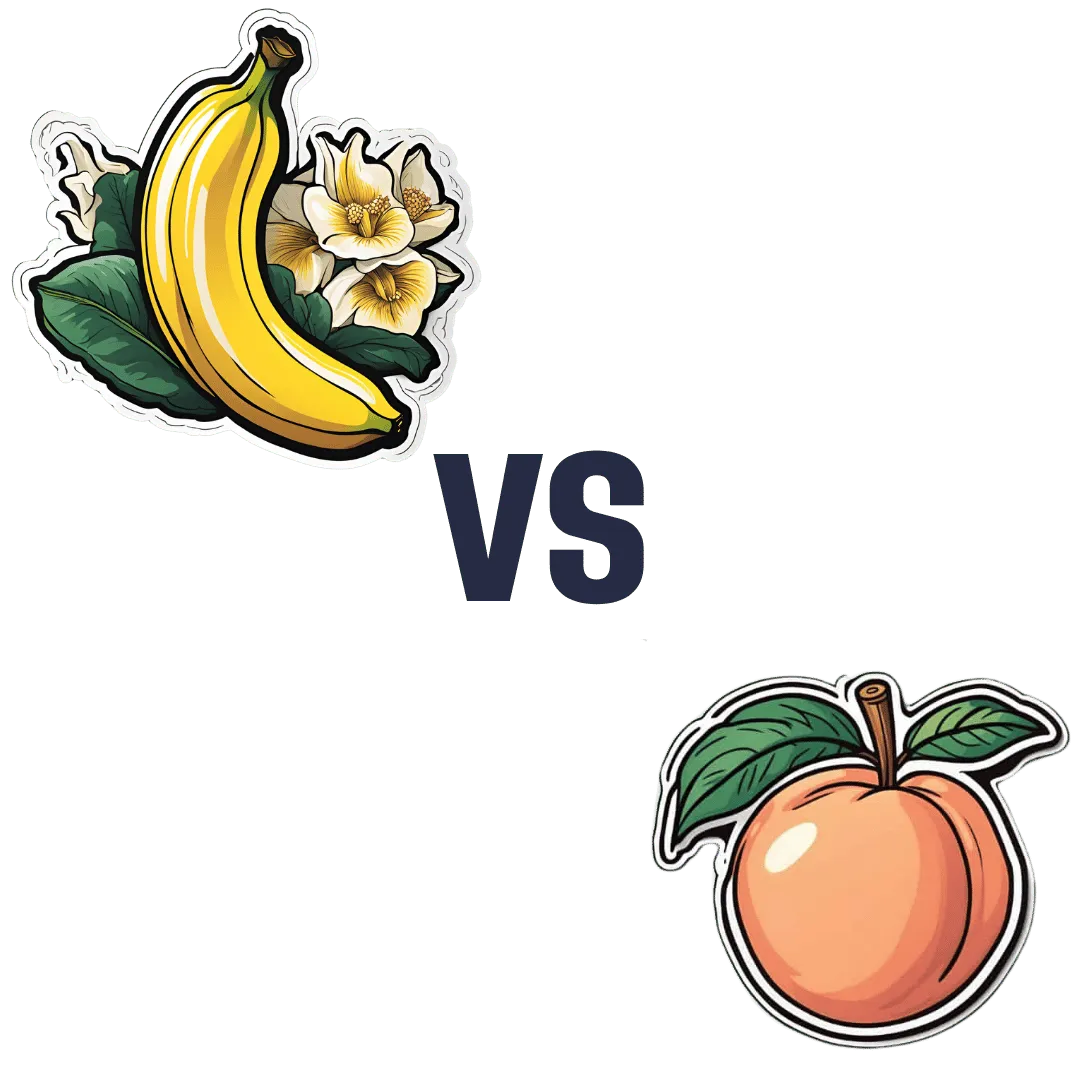
Banana vs Peach – Which is Healthier?

10almonds is reader-supported. We may, at no cost to you, receive a portion of sales if you purchase a product through a link in this article.

Our Verdict

When comparing banana to peach, we picked the banana.

Why?

In terms of macros, bananas have more fiber, carbs, and protein, making them the more nutrient-dense option in this category.

In the category of vitamins, bananas have more of vitamins B1, B2, B5, B6, B7, B9, C, and choline, while peaches have more of vitamins A, B3, E, and K. An 8:4 win for bananas here, though peaches are still good too.

Looking at minerals, bananas have more copper, iron, magnesium, manganese, phosphorus, potassium, and selenium, while peaches have more calcium and zinc. An easy win for bananas.

When it comes to phytochemicals, both have their merits, but peaches have some anticancer properties that bananas don’t—see link below. So that’s a point in peaches’ favor.

Adding up the sections makes for an overall win for bananas, but by all means enjoy either both; diversity is good!

Want to learn more?

You might like:

Top 8 Fruits That Prevent & Kill Cancer

Enjoy!

Don’t Forget…

Did you arrive here from our newsletter? Don’t forget to return to the email to continue learning!

Learn to Age Gracefully

Join the 98k+ American women taking control of their health & aging with our 100% free (and fun!) daily emails:

  • Three Surprising Ways Microplastics Can Enter Your Body

    10almonds is reader-supported. We may, at no cost to you, receive a portion of sales if you purchase a product through a link in this article.

    How many are you and your family subject to?

    The wrong plasticity

    We’ll not keep the three ways a mystery; they are:

    • Inhalation: breathing in airborne microplastics from indoor and urban environments where particles are suspended in the air
    • Ingestion: consuming plastics through food and drink, especially from packaging, bottled water, and contaminated seafood especially
    • Absorption: absorbing tiny particles and associated chemicals through your skin from cosmetics, personal care products, and more

    This is a problem, because nanoplastics are small enough to cross cell membranes and accumulate in tissues like your liver, brain, and lungs, where your immune system triggers inflammation but cannot fully remove them.

    The futile immune response then becomes a problem of its own, as repeated immune responses mean chronic inflammation, which is a recipe for disaster in more ways than we have room to list here, but the gist is: your body will get cumulatively rundown over time.

    Another way it causes harm is that many such plastics release endocrine-disrupting chemicals like BPA, phthalates, and PFAS, which are well-documented to affect hormones and metabolism in humans (spoiler: the effects are not good effects).

    The science of microplastics is (for obvious reasons) young and ongoing, for example, there’s a lot that still unknown about such things as:

    • direct disease causation: while it certainly appears that microplastics cause specific diseases like cancer, dementia, and diabetes in humans, the causality has not technically been proven yet.
    • dose-response effects: scientists don’t yet know how much exposure (if any) is “safe” over a lifetime in humans
    • organ-specific damage: plastics have been found in organs (including the brain), but the the full list exact health consequences of that accumulation are still being investigated. We know it is strongly associated with increased aggregation of tau proteins, amyloid-beta, alpha-synuclein, and so forth, though, amongst other things (see the “learn more” for more on this).
    • relative importance of sources: it’s still uncertain which exposure sources (air vs food vs products) contribute most to long-term health risk.
    • long-term human outcomes: the strongest current evidence comes from in vitro or non-human animal studies, while long-term human data is still limited and evolving (simply, mouse autopsies stack up more quickly than human ones).

    For more on all of this, enjoy:

    Click Here If The Embedded Video Doesn’t Load Automatically!

    Want to learn more?

    You might also like:

    Microplastics Now, Alzheimer’s/Parkinson’s Later?

    Take care!

    Share This Post

  • What happens to your vagina as you age?

    10almonds is reader-supported. We may, at no cost to you, receive a portion of sales if you purchase a product through a link in this article.

    The vagina is an internal organ with a complex ecosystem, influenced by circulating hormone levels which change during the menstrual cycle, pregnancy, breastfeeding and menopause.

    Around and after menopause, there are normal changes in the growth and function of vaginal cells, as well as the vagina’s microbiome (groups of bacteria living in the vagina). Many women won’t notice these changes. They don’t usually cause symptoms or concern, but if they do, symptoms can usually be managed.

    Here’s what happens to your vagina as you age, whether you notice or not.

    Let’s clear up the terminology

    We’re focusing on the vagina, the muscular tube that goes from the external genitalia (the vulva), past the cervix, to the womb (uterus). Sometimes the word “vagina” is used to include the external genitalia. However, these are different organs and play different roles in women’s health.

    What happens to the vagina as you age?

    Like many other organs in the body, the vagina is sensitive to female sex steroid hormones (hormones) that change around puberty, pregnancy and menopause.

    Menopause is associated with a drop in circulating oestrogen concentrations and the hormone progesterone is no longer produced. The changes in hormones affect the vagina and its ecosystem. Effects may include:

    • less vaginal secretions, potentially leading to dryness
    • less growth of vagina surface cells resulting in a thinned lining
    • alteration to the support structure (connective tissue) around the vagina leading to less elasticity and more narrowing
    • fewer blood vessels around the vagina, which may explain less blood flow after menopause
    • a shift in the type and balance of bacteria, which can change vaginal acidity, from more acidic to more alkaline.

    What symptoms can I expect?

    Many women do not notice any bothersome vaginal changes as they age. There’s also little evidence many of these changes cause vaginal symptoms. For example, there is no direct evidence these changes cause vaginal infection or bleeding in menopausal women.

    Some women notice vaginal dryness after menopause, which may be linked to less vaginal secretions. This may lead to pain and discomfort during sex. But it’s not clear how much of this dryness is due to menopause, as younger women also commonly report it. In one study, 47% of sexually active postmenopausal women reported vaginal dryness, as did around 20% of premenopausal women.

    Other organs close to the vagina, such as the bladder and urethra, are also affected by the change in hormone levels after menopause. Some women experience recurrent urinary tract infections, which may cause pain (including pain to the side of the body) and irritation. So their symptoms are in fact not coming from the vagina itself but relate to changes in the urinary tract.

    Not everyone has the same experience

    Women vary in whether they notice vaginal changes and whether they are bothered by these to the same extent. For example, women with vaginal dryness who are not sexually active may not notice the change in vaginal secretions after menopause. However, some women notice severe dryness that affects their daily function and activities.

    In fact, researchers globally are taking more notice of women’s experiences of menopause to inform future research. This includes prioritising symptoms that matter to women the most, such as vaginal dryness, discomfort, irritation and pain during sex.

    If symptoms bother you

    Symptoms such as dryness, irritation, or pain during sex can usually be effectively managed. Lubricants may reduce pain during sex. Vaginal moisturisers may reduce dryness. Both are available over-the-counter at your local pharmacy.

    While there are many small clinical trials of individual products, these studies lack the power to demonstrate if they are really effective in improving vaginal symptoms.

    In contrast, there is robust evidence that vaginal oestrogen is effective in treating vaginal dryness and reducing pain during sex. It also reduces your chance of recurrent urinary tract infections. You can talk to your doctor about a prescription.

    Vaginal oestrogen is usually inserted using an applicator, two to three times a week. Very little is absorbed into the blood stream, it is generally safe but longer-term trials are required to confirm safety in long-term use beyond a year.

    Women with a history of breast cancer should see their oncologist to discuss using oestrogen as it may not be suitable for them.

    Are there other treatments?

    New treatments for vaginal dryness are under investigation. One avenue relates to our growing understanding of how the vaginal microbiome adapts and modifies around changes in circulating and local concentrations of hormones.

    For example, a small number of reports show that combining vaginal probiotics with low-dose vaginal oestrogen can improve vaginal symptoms. But more evidence is needed before this is recommended.

    Where to from here?

    The normal ageing process, as well as menopause, both affect the vagina as we age.

    Most women do not have troublesome vaginal symptoms during and after menopause, but for some, these may cause discomfort or distress.

    While hormonal treatments such as vaginal oestrogen are available, there is a pressing need for more non-hormonal treatments.

    Dr Sianan Healy, from Women’s Health Victoria, contributed to this article.

    Louie Ye, Clinical Fellow, Department of Obstetrics and Gynecology, The University of Melbourne and Martha Hickey, Professor of Obstetrics and Gynaecology, The University of Melbourne

    This article is republished from The Conversation under a Creative Commons license. Read the original article.

    The Conversation

    Share This Post

  • Mango vs Peach – Which is Healthier?

    10almonds is reader-supported. We may, at no cost to you, receive a portion of sales if you purchase a product through a link in this article.

    Our Verdict

    When comparing mango to peach, we picked the mango.

    Why?

    Both have their merits:

    In terms of macros, mango has slightly more carbs, and the other macros are too close to call. Since the carbs difference also isn’t very big, we’re calling this round a tie, but you could call it a small nominal win if you like.

    In the category of vitamins, mango has more of vitamins A, B1, B2, B3, B5, B6, B7, B9, C, E, K, and choline, while peaches are not higher in any vitamins. An easy win for mangos.

    Looking at minerals, mango has more calcium, copper, magnesium, manganese, and selenium, while peaches have more iron, phosphorus, potassium, and zinc. A marginal 5:4 win for mangos, though it’s worth noting that mango did also have the wider margins of difference (thus setting it a little further ahead if we want to count that).

    In other considerations, peaches do have more polyphenols, as well as some anticancer properties that aren’t known of mangos. So that’s a point in peaches’ favor.

    Adding up the sections makes for an overall win for mangos, but it’s close, since as we say, both have their merits.

    Want to learn more?

    You might like:

    Top 8 Fruits That Prevent & Kill Cancer

    Enjoy!

    Share This Post

  • Surviving with Beans And Rice – by Eliza Whool

    10almonds is reader-supported. We may, at no cost to you, receive a portion of sales if you purchase a product through a link in this article.

    If you’d like to be well-set the next time a crisis shuts down supply lines, this is one of those books you’ll want to have read.

    Superficially, “have in a large quantity of dried beans and rice” is good advice, but obvious. Why a book?

    Whool gives a lot of advice on keeping your nutrition balanced while subsisting on the same quite few ingredients, which is handy.

    More than that, she offers 100 recipes using the ingredients that will be in your long-term pantry. That’s over three months without repeating a meal! And if you don’t think rice and beans can be tasty and exciting and varied, then most of the chefs of the Global South might want to have a word about that.

    Anyway, we’re not here to sell you rice and beans (we’re just enthusiastic and correct). What we are here to do is to give you a fair overview of this book.

    The recipes are just-the-recipes, very simple clear instructions, one two-page spread per recipe. Most of the book is devoted to these. As a quick note, it does cover making things gluten-free if necessary, and other similar adjustments for medical reasons.

    The planning-and-storage section of the book is helpful too though, especially as it covers common mistakes to avoid.

    Bottom line: this is a great book, and remember what we said about doing the things now that future you will thank you for!

    Get yourself a copy of Surviving with Beans And Rice from Amazon today!

    Don’t Forget…

    Did you arrive here from our newsletter? Don’t forget to return to the email to continue learning!

    Learn to Age Gracefully

    Join the 98k+ American women taking control of their health & aging with our 100% free (and fun!) daily emails:

  • Apple vs Gooseberries – Which is Healthier?

    10almonds is reader-supported. We may, at no cost to you, receive a portion of sales if you purchase a product through a link in this article.

    Our Verdict

    When comparing apple to gooseberries, we picked the apple.

    Why?

    These two fruits are popular contenders for losing most head-to-head contests on here, but…

    In terms of macros, gooseberries have more than 2x the fiber, scoring them a first-round win.

    When it comes to vitamins, apples are not higher in any vitamins, while gooseberries are higher in vitamins A, B1, B2, B3, B5, B6, B7, B9, C, E, and K, sweeping this category.

    Looking at minerals, apples are not higher in any minerals, while gooseberries have more calcium, copper, iron, magnesium, manganese, phosphorus, potassium, selenium, and zinc, winning overwhelmingly again.

    Adding up the sections makes for a clear overall win for gooseberries, but by all means enjoy either or both, as diversity is best!

    Want to learn more?

    You might like:

    Are You Getting The Right Kinds Of Flavonoids? ← while both of these fruits today are quite modest in their polyphenol content, they have different ones, which is another reason to get a variety

    Enjoy!

    Don’t Forget…

    Did you arrive here from our newsletter? Don’t forget to return to the email to continue learning!

    Learn to Age Gracefully

    Join the 98k+ American women taking control of their health & aging with our 100% free (and fun!) daily emails:

  • The Comfort Book – by Matt Haig

    10almonds is reader-supported. We may, at no cost to you, receive a portion of sales if you purchase a product through a link in this article.

    This book “is what it says on the tin”. Matt Haig, bestselling author of “Reasons to Stay Alive” (amongst other works) is here with “a hug in a book”.

    The format of the book is an “open it at any page and you’ll find something of value” book. Its small chapters are sometimes a few pages long, but often just a page. Sometimes just a line. Always deep.

    All of us, who live long enough, will ponder our mortality sometimes. The feelings we may have might vary on a range from “afraid of dying” to “despairing of living”… but Haig’s single biggest message is that life is full of wonder; each moment precious.

    • That hope is an incredible (and renewable!) resource.
    • That we are more than a bad week, or month, or year, or decade.
    • That when things are taken from us, the things that remain have more value.

    Bottom line: you might cry (this reviewer did!), but it’ll make your life the richer for it, and remind you—if ever you need it—the value of your amazing life.

    Get your copy of “The Comfort Book” from Amazon today

    Don’t Forget…

    Did you arrive here from our newsletter? Don’t forget to return to the email to continue learning!

    Learn to Age Gracefully

    Join the 98k+ American women taking control of their health & aging with our 100% free (and fun!) daily emails: