
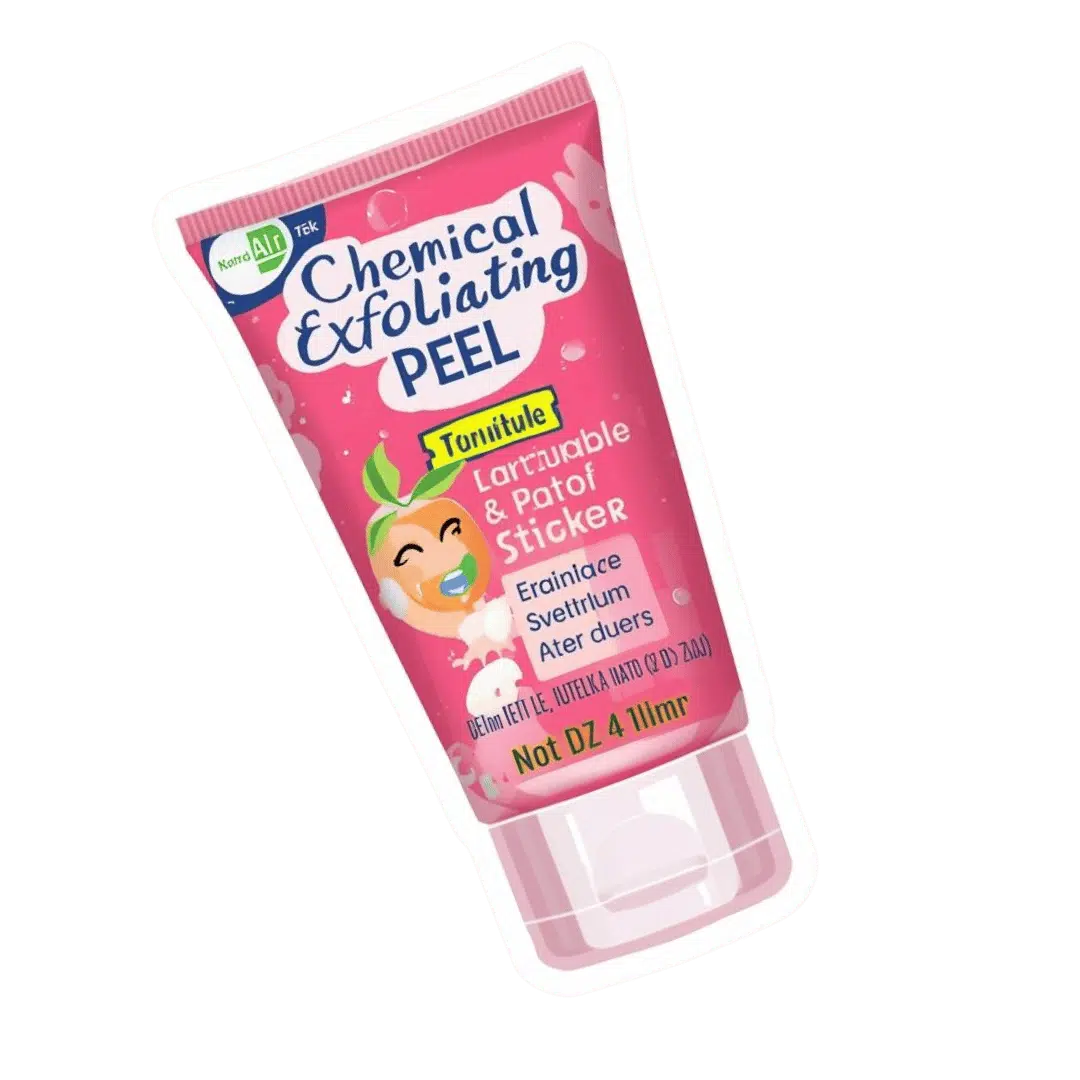
Are Chemical Exfoliant Peels Safe?
10almonds is reader-supported. We may, at no cost to you, receive a portion of sales if you purchase a product through a link in this article.

It’s Q&A Day at 10almonds!
Have a question or a request? We love to hear from you!
In cases where we’ve already covered something, we might link to what we wrote before, but will always be happy to revisit any of our topics again in the future too—there’s always more to say!
No question/request too big or small 😎
❝Are chemical exfoliating skin peels safe / healthy?❞
This is a fun one, because it seems easy to guess the answer to what is, in essence, asking whether it is safe to use a product whose stated purpose is “take your skin off”.
And the answer, much like the answer to “is it safe to put castor oil in your eyes?“, is “surprisingly, yes”.
Of course, there are caveats, including:
- Our standard legal/medical disclaimer; we can talk about what has been found by established science to be safe in general; we cannot say what will be safe for you.
- The current condition of your skin does matter. The expectation is that your skin is mostly fine, perhaps a little rougher/drier than you’d like it, and at worst you have mild to moderate (not severe) acne, which it can often help treat, and even in that case, often a retinoid treatment is recommended before a skin peel. Anything else, and chemical exfoliant peels are probably not for you right now.
- There are different kinds of chemical exfoliant peels, and they have slightly different properties.
About that last one, we’ll quote from a rather informative paper on the topic:
❝A wide variety of peels are available with different mechanisms of actions, which can be modulated by altering concentrations. Agents for superficial peels today include the alpha hydroxy acids (AHAs), such as glycolic acid (GA), and the beta hydroxy acids (BHAs), including salicylic acid (SA). A derivative of SA, β-lipohydroxy acid (LHA, up to 10%) is widely used in Europe and was recently introduced in the United States. Tretinoin peels are used to treat melasma and postinflammatory hyperpigmentation (PIH) Trichloroacetic acid (TCA) can be used for superficial (10–20%) peels and for medium-depth peels (35%). Combination peels, such as Monheit’s combination (Jessner’s solution with TCA) Brody’s combination (solid carbon dioxide with TCA), Coleman’s combination (GA 70% + TCA), and Jessner’s solution with GA, have been used for medium-depth peels where a deeper effect on the skin is required but deep peeling is not an option. Deep peels are typically performed with phenol-based solutions, including Baker-Gordon phenol peel and the more recent Hetter phenol-croton oil peel.❞
So, that’s a lot, and for the sake of time/space we’ll sadly not go into the specificities of each of them. If you’d like to learn about the specificities of each of them though, by all means do click through to read the paper, because that is what the paper is about 🙂
Another issue is that of course it must be applied correctly. That means either getting it done in a salon, or getting a good quality product and following the instructions to the letter.
Those instructions will generally include:
- Do not use in the case of these contraindications (and they will give a list)
- Prepare the area to be treated (for at-home treatments, this is most often the feet, and most commonly the advice is to soak them in warm water beforehand)
- Apply the treatment (and they will say how, and, importantly, for how long—do not exceed the recommended time)
- What to do after the treatment (generally: moisturize and avoid sunlight, wait for it to work, this will take n–n+x days (they will specify, e.g. “3–7 days”))
- What to do during peeling (generally: leave it alone, don’t touch, don’t try to help it off, just let it do its thing)
- What to do after peeling (generally: continue your life, consider reapplying in 6+ weeks if you like)
Note: the above is an example of what to expect and what to look for, and is not a how-to from us, as it is missing critical details pertaining to whatever treatment you get.
Of course, not every report is glowing, and not every product is necessarily safe.
For example, the FDA takes a dim view of products it hasn’t approved, and, notably, the FDA hasn’t approved any chemical peel products:
FDA warns against purchasing or using chemical peel skin products without professional supervision
Of course, the FDA is not the WHO, and what it does and does not approve can come down to what companies will and won’t pay it for that approval.
The WHO, by the way, does not have a statement on exfoliating chemical peels, that we could find.
If in any doubt at all for your personal sitiation, of course please do consult with a local dermatologist!
Want to learn more?
If this question had feet in mind (or if another reader might), since that’s the most common use of at-home exfoliating peels, then do check out:
The Foot Book – by Dr. Todd Brennan & Dr. Leslie Johnston ← this book really is what the subtitle claims it to be: “everything you need to know to take care of your feet”.
For example: arthritis, bunions, corns, diabetes, eczema, fungus, gout, heel pain, ingrown toenails, joint issues, and that’s just one item for each of the first 10 letters of the alphabet.
Take care!
Don’t Forget…
Did you arrive here from our newsletter? Don’t forget to return to the email to continue learning!
Recommended

Learn to Age Gracefully
Join the 98k+ American women taking control of their health & aging with our 100% free (and fun!) daily emails: