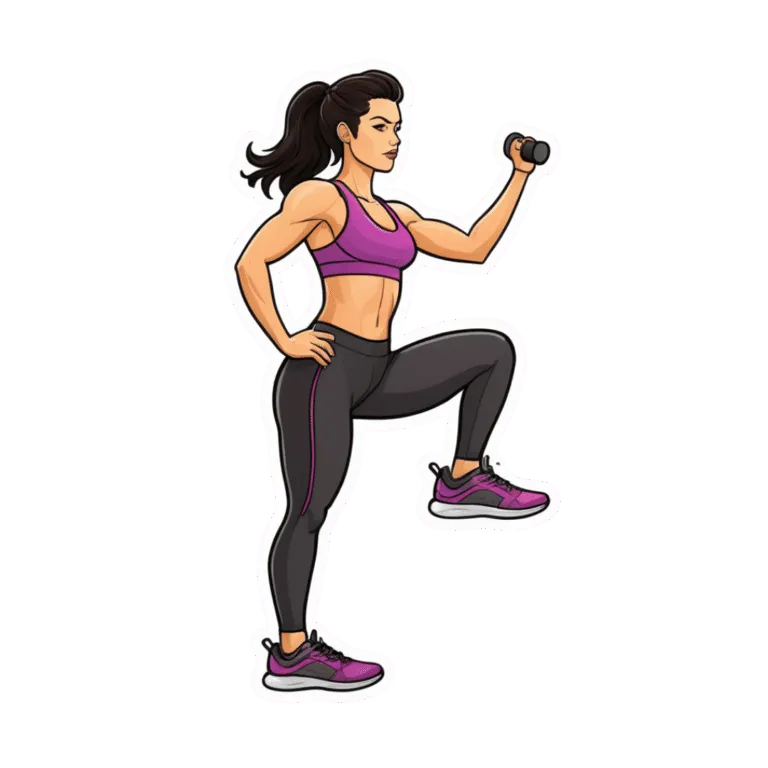
10 Ways To Progress Your Workouts (Without Adding Weight)

10almonds is reader-supported. We may, at no cost to you, receive a portion of sales if you purchase a product through a link in this article.

Cor Lefkowitz, of “Redefining Strength” and “Strong At Every Age”, advises:

Light โ‰  Easy

10 ways:

  1. Combine equipment: use two tools together (e.g. resistance bands with dumbbells) to increase resistance and muscle engagement.
  2. Adjust range of motion: increase or decrease the movement range to change muscle activation, time under tension, and difficulty.
  3. Create instability: make the exercise less stable using tools (like sliders or a suspension trainer) or by progressing from bilateral to unilateral variations (i.e. two-handed to single-handed, or two-legged to one-legged).
  4. Adjust load placement: hold the same weight in different positions (e.g. goblet, offset, suitcase) to challenge stability and target different muscles.
  5. Change up the tempo: vary the speed of movement (slower eccentrics, pauses, or faster concentrics) to affect power, strength, and control.
  6. Spend more time under tension: extend the time muscles are active during a set by slowing reps or using continuous motion variations like get-up lunges.
  7. Switch up postures and positions: alter the bodyโ€™s position (e.g. seated vs standing) or joint angles to affect how muscles are worked and reduce compensation.
  8. Vary your workout design: change reps, sets, rest periods, or use formats like supersets, circuits, or compound/isolation exercises to increase challenge.
  9. Increase training density: do more work in the same amount of time by minimizing rest or combining moves without making workouts longer.
  10. Adjust your workout schedule: train muscle groups more frequently across the week (e.g. full body, upper/lower splits, anterior/posterior splits) to increase volume.

For more on all of this plus some visual demonstrations, enjoy:

Click Here If The Embedded Video Doesnโ€™t Load Automatically!

Want to learn more?

You might also like:

Resistance Beyond Weights

Take care!

Don’t Forget…

Did you arrive here from our newsletter? Don’t forget to return to the email to continue learning!

Learn to Age Gracefully

Join the 98k+ American women taking control of their health & aging with our 100% free (and fun!) daily emails:

  • Advance Warnings Of Multiple Sclerosis (15-Year Timeline!)

    10almonds is reader-supported. We may, at no cost to you, receive a portion of sales if you purchase a product through a link in this article.

    There’s a lot of mystery to multiple sclerosis (MS). We donโ€™t know what causes it. We donโ€™t know how it happens. We donโ€™t know how it can be fixed.

    We do know approximately what it is, though; it’s not a “the doctors are half-sure the patient is making it up” thing. In MS, we know it’s an autoimmune condition, and that it degrades the myelination of nerves. We don’t know the mechanism of how the autoimmune condition actually degrades the myelin, but we see specific markers of chronic inflammation and we see myelin withering away, so we’re pretty sure the former leads to the latter somehow.

    Another thing we know: we do know what heralds its coming! We wrote about that before, here: Five Advance Warnings of Multiple Sclerosis

    If you don’t want to click through, we’ll not keep the 5 signs a secret, they are:

    1. depression
    2. sexual disorders
    3. constipation
    4. cystitis
    5. urinary tract infections

    And indeed:

    โThis association was sufficiently robust at the statistical level for us to state that these are early clinical warning signs, probably related to damage to the nervous system, in patients who will later be diagnosed with multiple sclerosis. The overrepresentation of these symptoms persisted and even increased over the five years after diagnosis.โž

    ~ Dr. Cรฉline Louapre

    But now there’s more: we have a timeline!

    A plucky band of researchers (Dr. Marta Ruiz-Alguerรณ et al.) looked at thousands of patients with (n=2,038) and without (n=10,182) MS, and looked at their medical histories over 25 years prior to the onset of clinical symptoms of MS (e.g., the characteristic demyelination of nerves).

    They found some surprisingly clear patterns, and the timeline looks like this:

    • 15 years before: increased visits to general practitioners for fatigue, pain, dizziness, and mental health concerns.
    • 12 years before: increased psychiatrist visits.
    • 8โ€“9 years before: increased visits to neurologists and ophthalmologists (especially: blurry vision, eye pain).
    • 3โ€“5 years before: rise in emergency medicine and radiology visits.
    • 1 year before: peak in physician visits across multiple specialties.

    You may be wondering: where are the UTIs, constipation, etc from the other study? The answer is they are in the last few years, and come under the umbrella terms mentioned.

    In short, there is a long, complex prodromal period (much longer and more complex than previously known) where early signs, often initially mental health-related, emerge before the disease’s clear neurological symptoms. This is interesting, because prodromal phases are also seen in Parkinsonโ€™s disease, which as the researchers suggested, might reflect a similar progression pattern (or it might notโ€”that research is yet to be done).

    You can read the paper in full, here: Health Care Use Before Multiple Sclerosis Symptom Onset

    So, forewarned is fore-armed, as they say. On which note…

    Is there anything that can be done?

    Yes! While there is as yet no known cure, it isโ€”per the case study of Dr. Saray Stancicโ€”possible to at least become mostly symptom-free, which is a big win:

    โDr. Saray Stancic is another from the ranks of โ€œdoctors who got a serious illness and it completely changed how they view the treatment of serious illnessโ€.

    In her case, Stancic was diagnosed with multiple sclerosis, and wasnโ€™t impressed with the results from the treatments offered, so (after 8 years of pain, suffering, and many medications, only for her condition to worsen) she set about doing better with an evidence-based lifestyle medicine approach.

    After 7 years of her new approach, she would go on to successfully run a marathon and live symptom-free.

    All this to say: her approach isnโ€™t a magic quick fix, but it is a serious method for serious results, and after all, while itโ€™d be nice to be magically in perfect health tomorrow, whatโ€™s important is being in good health for life, right?โž

    You can read all about what she did and how to do it, here: Lifestyle vs Multiple Sclerosis & More โ† the “and more” is because the same model can be applied to quite a number of other conditions too ๐Ÿ˜Ž

    Take care!

    Share This Post

  • Do We Need Sunscreen In Winter, Really?

    10almonds is reader-supported. We may, at no cost to you, receive a portion of sales if you purchase a product through a link in this article.

    Itโ€™s Q&A Day at 10almonds!

    Have a question or a request? We love to hear from you!

    In cases where weโ€™ve already covered something, we might link to what we wrote before, but will always be happy to revisit any of our topics again in the future tooโ€”thereโ€™s always more to say!

    As ever: if the question/request can be answered briefly, weโ€™ll do it here in our Q&A Thursday edition. If not, weโ€™ll make a main feature of it shortly afterwards!

    So, no question/request too big or small ๐Ÿ˜Ž

    โI keep seeing advice that we shoudl wear sunscreen out in winter even if itโ€™s not hot or sunny, but is there actually any real benefit to this?โž

    Short answer: yes (but itโ€™s indeed not as critical as it is during summerโ€™s hot/sunny days)

    Longer answer: first, letโ€™s examine the physics of summer vs winter when it comes to the sunโ€ฆ

    In summer (assuming we live far enough from the equator to have this kind of seasonal variation), the part of the planet where we live is tilted more towards the sun. This makes it closer, and more importantly, itโ€™s more directly overhead during the day. The difference in distance through space isnโ€™t as big a deal as the difference in distance through the atmosphere. When the sun is more directly overhead, its rays have a shorter path through our atmosphere, and thus less chance of being blocked by cloud cover / refracted elsewhere / bounced back off into space before it even gets that far.

    In winter, the opposite of all that is true.

    Morning/evening also somewhat replicate this compared to midday, because the sun being lower in the sky has a similar effect to seasonal variation causing it to be less directly overhead.

    For this reason, even though visually the sun may be just as bright on a winter morning as it is on a summer midday, the rays have been filtered very differently by the time they get to us.

    This is one reason why youโ€™re much less likely to get sunburned in the winter, compared to the summer (others include the actual temperature difference, your likely better hydration, and your likely more modest attire protecting you).

    Howeverโ€ฆ

    The reason it is advisable to wear sunscreen in winter is not generally about sunburn, and is rather more about long-term cumulative skin damage (ranging from accelerated aging to cancer) caused by the UV raysโ€”specifically, mostly UVA rays, since UVB rays (with their higher energy but shorter wavelength) have nearly all been blocked by the atmosphere.

    Hereโ€™s a good explainer of that from the American Cancer Society:

    UV (Ultraviolet) Radiation and Cancer Risk

    ๐Ÿ‘† this may seem like a no-brainer, but thereโ€™s a lot explained here that demystifies a lot of things, covering ionizing vs non-ionizing radiation, x-rays and gamma-rays, the very different kinds of cancer caused by different things, and what things are dangerous vs which thereโ€™s no need to worry about (so far as best current science can say, at least).

    Consequently: yes, if you value your skin health and avoidance of cancer, wearing sunscreen when out even in the winter is a good idea. Especially if your phoneโ€™s weather app says the UV index is โ€œmoderateโ€ or above, but even if itโ€™s โ€œlowโ€, it doesnโ€™t hurt to include it as part of your skincare routine.

    But what if sunscreens are dangerous?

    Firstly, not all sunscreens are created equal:

    Learn more: Who Screens The Sunscreens?

    Secondly: consider putting on a protective layer of moisturizer first, and then the sunscreen on top. Bear in mind, this is winter weโ€™re talking about, so youโ€™re probably not going out in a bikini, so this is likely a face-neck-hands job and youโ€™re done.

    What about vitamin D?

    Humans evolved to have more or less melanin in our skin depending on where we lived, and white people evolved to wring the most vitamin D possible out of the meagre sun far from the equator. Black peopleโ€™s greater melanin, on the other hand, offers some initial protection against the sun (but any resultant skin cancer is then more dangerous than it would be for white people if it does occur, so please do use sunscreen whatever your skintone).

    Nowadays many people live in many places which may or may not be the places we evolved for, and so we have to take that into account when it comes to sun exposure.

    Hereโ€™s a deeper dive into that, for those who want to learn:

    The Sun Exposure Dilemma

    Take care!

    Share This Post

  • Why you shouldnโ€™t drink raw milk

    10almonds is reader-supported. We may, at no cost to you, receive a portion of sales if you purchase a product through a link in this article.

    What you need to know 

    • Raw milk, also known as unpasteurized milk, is animal milk that has not gone through pasteurizationโ€”the heating process that kills harmful bacteria and other germs. 
    • Consuming raw milk and its products can expose you to dangerous germs that can cause food poisoning, severe illness, and even death. 
    • Children under 5 years, adults over 65, pregnant people, and people with weakened immune systems are most at risk for harmful effects from consuming raw milk. 

    On February 3, New Mexico health officials warned against consuming raw milk products following the death of a newborn from Listeria infection. Authorities said the babyโ€™s infection was likely linked to the motherโ€™s consumption of raw milk during pregnancy. 

    Then on March 15, the Food and Drug Administration announced it was investigating a multistate outbreak of E. coli infection in California, Florida, and Texas, linked to raw cheddar cheese from the Raw Farm brand. As of April 3, the FDA and the Centers for Disease Control and Prevention have reported nine cases of illness, more than half of them in children under 5 years. Three people were hospitalized, and one developed hemolytic uremic syndrome, a condition that can cause life-threatening kidney failure.

    Raw milk can carry dangerous germs that may lead to severe illnesses and even death. Studies have linked the increased sale of raw milk products to an increase in disease outbreaks. Despite these risks, raw milk consumption has grown in popularity in the U.S., promoted by influencers and high-profile politicians.

    Read on to learn what raw milk is, its risks, and why pasteurization matters. 

    What is raw milk?

    Raw milk is animal milk that has not gone through pasteurizationโ€”the process that kills harmful bacteria, viruses (like bird flu), and other germs. Developed by Louis Pasteur in the 1860s, pasteurization involves heating milk to a very high temperature to kill harmful germs without significantly affecting its nutritional value.

    Raw milk isnโ€™t just consumed on its own. Itโ€™s also used to make a range of dairy products, including certain cheeses (like queso fresco), yogurt, and butter. In some casesโ€”especially with fresh, soft cheesesโ€”people may not realize a product was made with unpasteurized milk.

    What happens if you consume raw milk or raw milk products?

    Because raw milk is not pasteurized, it can contain harmful bacteria such as Brucella, Campylobacter, E. coli, Listeria, and Salmonella. These can cause food poisoning and severe illness. 

    According to the American Medical Association, common symptoms include diarrhea, vomiting, and stomach cramps. The CDC notes that infections can also lead to severe conditions such as Guillain-Barrรฉ and hemolytic uremic syndrome, which can result in stroke, paralysis, kidney failure, or death.

    Those most at risk include: 

    • Children under 5 years
    • Adults over 65 
    • Pregnant people 
    • People with weakened immune systems 

    โ€œIf you look at the statistics for outbreaks for people consuming raw dairy, whether itโ€™s milk or cheeseโ€ฆa very high percentage of the people who get very sick and hospitalized tend to be children,โ€ John Lucey, professor of food science and director of the Center for Dairy Research at the University of Wisconsin-Madison, tells Public Good News.

    He adds that infections like Listeria can be especially serious for pregnant people, potentially leading to stillbirth or infant loss.

    Raw milk may also affect how your body responds to antibiotics. โ€œA lot of raw milk contains high levels of antibiotic-resistant bacteria because a lot of the cows are pumped with antibiotics,โ€ Dr. Supriya Rao, a gastroenterologist, partner at Integrated Gastroenterology Consultants, and assistant professor at Tufts University School of Medicine, explains. โ€œSo bacteria is making it through. Theyโ€™re already a highly resistant strain, and so that can lead to infections, and if you have an infection, itโ€™s very difficult to treat if youโ€™re already limited [in] the types of antibiotics you can use.โ€

    Why is pasteurization so important?

    Milk can be exposed to bacteria from soil, feed, manure, and infections in cows, such as mastitis. Even with careful farming practices, contamination risks remain.

    โ€œThe farm has places that contain pathogens, thatโ€™s their environment, and so the farmer is always trying to reduce the risk of contamination by keeping the animals as healthy as possible,โ€ Lucey adds. โ€œItโ€™s just a constant; they have to be very vigilant, but that means that itโ€™s not foolproof.โ€

    Pasteurization, which has been studied for over 150 years, Lucey adds, makes milk safer to consume by killing harmful pathogens. โ€œThis process is an important safeguard for the milk,โ€ he says. โ€œIn raw milk production, they donโ€™t have that additional safeguard.โ€ 

    โ€œBefore pasteurization was introduced in the U.S. and around the world, consumption of milk was a major source of food contamination or foodborne illnesses,โ€ Lucey explains. โ€œNow, if you look at milk and dairy products, less than 1 percent of all the foodborne outbreaks are related to any dairy product, whether itโ€™s raw or pasteurizedโ€ฆThatโ€™s an amazing change, [and] that change was due to pasteurization.โ€ 

    What about raw milk products like cheese?

    Raw milk products, including cheese, also carry risksโ€”as shown by the recent outbreak linked to raw cheddar. Rao notes that while both milk and cheese can be risky, โ€œthe milk [has] higher risk because oftentimes pus and blood and other things present in the milk. [Meanwhile,] the cheese gets processed a bit, so the likelihood of it harboring that is less than of milk itself.โ€ 

    It also can depend on the type of cheese. The FDA allows raw milk cheeses to be sold if they are aged for at least 60 days, a process intended to reduce bacterial levels. However, this does not guarantee that all pathogens are eliminated. Some cheeses, particularly soft or high-moisture varieties (like cottage and mozzarella), may carry higher risk.

    Why are people consuming raw milk?

    Some influencers and public figures, including Health and Human Services Secretary Robert F. Kennedy Jr., have promoted raw milk as part of broader โ€œnatural healthโ€ trends.

    Raw milk is often portrayed as more โ€œnaturalโ€ or less processed than pasteurized milk. Others believe it has added health benefits, such as improving digestion or preventing allergiesโ€”claims that circulate widely online but have been consistently debunked. Thereโ€™s also a growing interest in buying food directly from farms or local producers, which can make raw milk feel like a more wholesome or trustworthy option.

    Are there any benefits to drinking raw milk over pasteurized milk?

    Public health experts say those perceived benefits arenโ€™t supported by strong scientific evidence. According to the FDA, pasteurization does not significantly change the nutritional value of milkโ€”meaning raw milk doesnโ€™t offer a meaningful nutritional advantage.

    What is well established, experts say, is the risk of consuming raw milk products. โ€œThe risk of dangerous illness far outweighs any alleged benefit,โ€ says Rao.

    For more information, talk to your health care provider.

    This article first appeared on Public Good News and is republished here under a Creative Commons Attribution-NoDerivatives 4.0 International License.

    Share This Post

  • Carrots vs Zucchini โ€“ Which is Healthier?

    10almonds is reader-supported. We may, at no cost to you, receive a portion of sales if you purchase a product through a link in this article.

    Our Verdict

    When comparing carrots to zucchini, we picked the carrots.

    Why?

    Both have their merits! But…

    In terms of macros, carrots have 3x the fiber and carbs, for approximately the same (minimal) protein, winning in this category.

    In the category of vitamins, carrots have more of vitamins A, B1, B3, B5, and K, while zucchini have more of vitamins B2, B6, B9, and C, meaning carrots win a second round.

    Looking at minerals, carrots have more calcium and potassium, while zucchini have more copper, iron, magnesium, manganese, selenium, and zinc, winning a round finally.

    Adding up the sections makes for an overall win for carrots, but by all means do enjoy either or both, as both are great and diversity is good!

    Want to learn more?

    You might like:

    Whatโ€™s Your Plant Diversity Score?

    Enjoy!

    Don’t Forget…

    Did you arrive here from our newsletter? Don’t forget to return to the email to continue learning!

    Learn to Age Gracefully

    Join the 98k+ American women taking control of their health & aging with our 100% free (and fun!) daily emails:

  • Anti-Inflammatory Pineapple Fried Rice

    10almonds is reader-supported. We may, at no cost to you, receive a portion of sales if you purchase a product through a link in this article.

    Fried rice is not most people’s go-to when one thinks of health food, but this one is. It’s packed with plenty of nutrients, many of which are anti-inflammatory, but the real star is the pineapple (with its high bromelain content and thus particularly potent benefits).

    You will need

    • 2ยฝ cups cooked wholegrain basmati rice (you can use our Tasty Versatile Rice recipe if you don’t already have leftovers to use)
    • 1 cup pineapple chunks
    • ยฝ red onion, diced
    • 1 red bell pepper, diced
    • ยฝ cup sweetcorn
    • ยฝ peas
    • 3 green onions, chopped
    • 2 serrano peppers, chopped (omit if you don’t care for heat)
    • 2 tbsp coconut oil
    • 1 tbsp grated fresh ginger
    • 1 tbsp black pepper, coarse ground

    Method

    (we suggest you read everything at least once before doing anything)

    1) Fry the red onion, serrano peppers, and ginger in the coconut oil over a medium heat, stirring frequently, for about 3 minutes.

    2) Add the pineapple, bell pepper, sweetcorn, peas, and black pepper, stirring frequently, for about another 3 minutes.

    3) Add the rice, stirring gently but thoroughly, until fully reheated and mixed in.

    4) Serve, garnishing with the green onions.

    Enjoy!

    Want to learn more?

    For those interested in some of the science of what we have going on today:

    Take care!

    Don’t Forget…

    Did you arrive here from our newsletter? Don’t forget to return to the email to continue learning!

    Learn to Age Gracefully

    Join the 98k+ American women taking control of their health & aging with our 100% free (and fun!) daily emails:

  • Does โ€˜fastedโ€™ cardio help you lose weight? Hereโ€™s theย science

    10almonds is reader-supported. We may, at no cost to you, receive a portion of sales if you purchase a product through a link in this article.

    Every few years, the concept of fasted exercise training pops up all over social media.

    Fasted training refers to exercising in the morning, before eating breakfast.

    Fans will claim itโ€™s the most efficient way to lose body fat. Opponents say itโ€™s a terrible idea and will cause you to gain weight.

    Whoโ€™s right and what does the research evidence say?

    Photo by Leandro Boogalu/Pexels

    Where did the idea come from?

    Fasted exercise, proponents say, will cause better changes in body composition โ€“ the proportion of lean mass (muscle), bone and fat. In particular, they say fasted exercise leads to fat loss.

    Positive changes in body composition can occur through losses of fat mass, while either maintaining or gaining lean mass. Or even through gaining lean mass in the absence of any loss of body fat. All of which may be considered positive.

    The idea fasted exercises leads to such positive body composition changes stems from research that shows exercising after eating versus exercise before eating affects metabolism differently.

    Aerobic exercise in a fasted state causes you to burn more fat as a fuel (what researchers would call โ€œfat oxidationโ€) when measured at a single point in time.

    So it wasnโ€™t a big leap to assume this would translate to longer-term fat loss.

    However, a 2017 systematic review from my team demonstrated that a fasted exercise training program doesnโ€™t seem to translate into long-term differences in body fat loss.

    This discrepancy between fat burned as a fuel during exercise, and changes in body fat in the long term has often been misunderstood.

    This apparent contradiction may come down to the fact the body seems to find ways to compensate. Fat burning seems to reduce once you eat, and people who have exercised hard may end up expending less total energy over the course of the day.

    In exercise science, itโ€™s actually pretty common to find that short-term effects donโ€™t always translate to longer-term impacts.

    For example, intense short-term exercise can negatively affect your immune system in the moment, but doing regular exercise can actually affect it positively in the longer term.

    A woman prepares for a deadlift
    Exercising after eating improves performance in activities lasting over 60 minutes. Photo by Jonathan/Pexels

    What does eating soon after or just before your workout do?

    Eating a meal featuring carbohydrates and protein close to when you exercise is likely to help with performance during your next exercise session.

    However, whether that meal is before or after your workout seems to have limited impact.

    Interestingly, research has shown that increasing the proportion of the food you eat in the morning โ€“ and in particular, eating more protein โ€“ may help to improve body composition and enhance weight loss.

    However, this timing is not in relation to exercise, rather in relation to when in the day you eat.

    What about sports performance?

    Itโ€™s fairly clear eating before exercising improves performance in activities lasting over 60 minutes but has little effect on performance of shorter duration activities.

    This is also evidenced by the lack of elite athletes supporting fasted exercise. A survey completed by almost 2,000 endurance athletes showed non-professional athletes are more likely to exercise fasted compared to professional athletes.

    What about strength training?

    So do you get differences in muscle strength, size, and body composition changes in response to doing resistance training (such as weightlifting) when youโ€™ve fasted versus when youโ€™ve eaten? Unfortunately, the research is limited and low quality.

    This limited evidence so far suggests it makes no difference.

    One recent randomised controlled trial also found no difference in strength, power, or lean body mass when resistance training was done twice a week for 12 weeks either after fasting or after eating.

    What are the potential drawbacks?

    Fasted training can make you feel really hungry after exercise, which can lead you to make poorer food choices.

    Some people may even get headaches and nausea when trying to exercise fasted. This isnโ€™t universal experience, though; social media is full of people who say exercising while fasting makes them feel great.

    In summary, there is no clear winner.

    The evidence doesnโ€™t support the superiority of fasted exercise for weight loss, or sports performance.

    However, the evidence also doesnโ€™t show it causes a problem in many scenarios (except perhaps elite sports performance).

    So if youโ€™re short on time and skipping breakfast is going to allow you to get out and get that run or workout in, then go for it. Donโ€™t worry too much about the consequence.

    But if the idea of exercising on an empty tummy makes you want to avoid the gym, then grab some breakfast before you go. Rest assured it wonโ€™t be working against your goals.

    Exercise fads and wellness hacks come and go but the thing backed by solid and consistent evidence is exercise.

    Simply doing it matters the most.

    Not the time of day, not the exact exercise choice, not even the exact amount โ€“ and definitely, not if you have or havenโ€™t eaten before you exercise.

    Mandy Hagstrom, Senior Lecturer, Exercise Physiology. School of Health Sciences, UNSW Sydney

    This article is republished from The Conversation under a Creative Commons license. Read the original article.

    Don’t Forget…

    Did you arrive here from our newsletter? Don’t forget to return to the email to continue learning!

    Learn to Age Gracefully

    Join the 98k+ American women taking control of their health & aging with our 100% free (and fun!) daily emails: