
What is black sesame? Is it really the new matcha? An expert explains

10almonds is reader-supported. We may, at no cost to you, receive a portion of sales if you purchase a product through a link in this article.

Black sesame is the latest plant-based product to go viral, with its appealing colour and nutty taste.

Social media is full of claims these dark sesame seeds are better for you than the white ones. They’re said to be better at reducing your blood sugar levels, risk of heart disease, and even reversing grey hair.

But is black sesame really the new matcha? You might remember this green tea was another plant-based, viral sensation with potential health benefits.
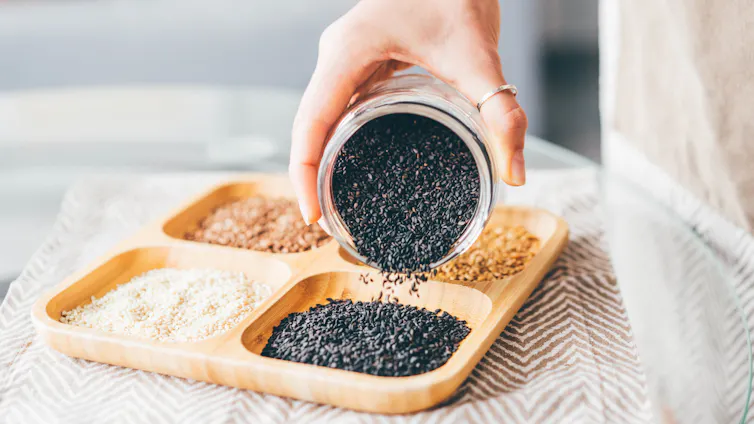
Maria Korneeva/Getty

What is black sesame? What’s in it?

Sesame seeds grow in white, yellow and black varieties. They’ve been used for centuries in traditional Asian cuisine.

Today, they’re used in both savoury and sweet dishes, and are a good source of protein. Due to sesame’s high fat content (about 50–64%, see table below) it is also valued for its oil.

But there are differences between black and white sesame in some key nutrients.

Black sesame has higher levels of fat, protein and carbohydrate, but is also higher in energy (kilojoules). Vitamin and mineral levels are also generally higher in black sesame.

Sesame seeds are clearly highly nutritious products, but the amounts of nutrients in the table are for 100 grams, which is about two-thirds of a metric cup. Most of us would find it hard to eat this every day.

Typically sesame seeds are eaten as a garnish for stir-frys, curries and bread. In some cultures they are used more widely as a major ingredient in discretionary foods that also contain sugar and fat – such as halva, biscuits, tahini paste and sesame seed bars.

Sesame seeds also contain anti-nutrients. These are natural compounds, such as oxalic acid and phytic acid. These bind to minerals (iron, calcium and zinc) and reduce how much the body can absorb and use.

For most of us, eating foods in normal quantities that contain oxalate and phytic acid is not a concern. But if you have a known deficiency, increasing your intake of sesame seeds is not a good idea. If this applies to you, it is worth discussing with an accredited practising dietitian.

What about antioxidants?

Free radicals are formed naturally as a byproduct of all our usual bodily processes such as breathing and moving, as well as from UV (ultraviolet) light exposure, smoking, air pollutants and industrial chemicals. These can damage our proteins, cell membranes and DNA.

Sesame seeds contain antioxidants, chemicals that “mop up” these free radicals so they cannot cause damage.

One study found higher levels of phenols (a type of antioxidant) in black sesame seeds compared to white ones.

Black sesame also contains higher levels of lignans, an important group of phenols, than white sesame.

Cell and animal studies have looked at sesamin, the main type of lignan. These demonstrate its antioxidant properties, as well as cholesterol-lowering, blood pressure-reducing and anti-tumour effects.

But higher antioxidant levels don’t always automatically translate into proven health benefits.

Is black sesame healthy?

BMI, blood pressure and cholesterol

A systematic review, which included the results of six studies with a total of 465 participants, looked into the health benefits of sesame. This included any type of sesame as either a seed, oil or capsule.

The authors reported a statistically significant decrease in BMI (body-mass index), blood pressure and cholesterol. Sesame doses were 0.06–35g/day over four to eight weeks. But not all these studies compared it to a placebo, were double-blinded (when neither participants nor researchers know who is receiving a particular treatment or placebo) and in some of the included studies medications were still being used.

Because of this the authors said the evidence was of low quality, and so could not make any health recommendations.

Only one study in the review looked at black sesame seed specifically. This looked at the effect of taking 2.52g a day as capsules compared with a placebo for four weeks. It showed a drop in systolic blood pressure (the top number in your blood pressure reading) from about 129 mmHg (a measure of blood pressure) to about 121 mmHg in people with prehypertension (blood pressure slightly higher than normal).

Grey hair

I could find no scientific studies that have looked at black sesame seeds and hair colour.

Similarly there is no current evidence any specific food or supplement can reverse grey hair.

Any risks?

Yes, about 0.1–0.9% of the population around the world have a sesame allergy, a rate that appears to be rising.

Like all food allergies, the symptoms can be mild to severe. An anaphylactic response requires emergency medical treatment.

So what should I do?

The rise of black sesame does present a new ingredient you can enjoy in your cooking. If it doesn’t appeal, regular sesame seeds are also an option.

Given the small amounts we typically eat, it won’t make an overall difference to your health if you prefer black or white sesame seeds.

And as for black sesame to reverse grey hair, don’t count on it.

Ensuring you have a wide and varied diet is the best way to ensure you get all the nutrients you need for optimal physical and mental health.

Evangeline Mantzioris, Program Director of Nutrition and Food Sciences, Accredited Practising Dietitian, Adelaide University

This article is republished from The Conversation under a Creative Commons license. Read the original article.

Don’t Forget…

Did you arrive here from our newsletter? Don’t forget to return to the email to continue learning!

Learn to Age Gracefully

Join the 98k+ American women taking control of their health & aging with our 100% free (and fun!) daily emails:

  • The Brain at Rest – by Dr. Joseph Jebelli

    10almonds is reader-supported. We may, at no cost to you, receive a portion of sales if you purchase a product through a link in this article.

    The author, a neuroscientist, having watched his parents’ health go from good to bad to worse on account of overwork, makes the case for rest.

    Not just as a “necessarily evil” in the sense of “if you don’t schedule time for rest, your body will schedule it for you” (i.e. break down and thus force the issue), but also, because it is during periods of rest when our brain’s “default mode network” (DMN) takes the wheel, and without the DMN, there are a lot of important cognitive functions that will barely happen, if at all.

    This is the reason why, for example, people perform better on cognitive tasks after a short rest, than people who had more time to solve the cognitive tasks, but not rest. In essence, rest is time that pays for itself in productivity.

    How much rest? Dr. Jebelli presents evidence for there being measurable benefits from 5 minutes; more benefits from 20 minutes, more from an hour, more from 4 hours, 8 hours, 24 hours, 48 hours. And so on. In other words: the benefits are dose-dependent.

    That said, it’s not just about productivity. Yes, getting adequate rest will ultimately result in better work, but there’s also a whole chapter devoted to avoiding what the Japanese call karoshi—death from overwork.

    The style of the book is mostly explanatory, and in part instructional. It’s mostly very soft science, with hard science merely being pointed to in citations, so it’s very easy to understand. As for the instructional parts, Dr. Jebelli advises on how best to rest (not prescribing hobbies, so much as: there are different kinds of rest, and it’s important to get a good coverage of the different kinds), and how to enjoy the greatest benefits.

    Bottom line: if you sometimes feel like you need a break, but at the same time feel like you “can’t, because…”, then this book will empower you to find a way (he advises about that, too).

    Click here to check out The Brain at Rest, and rest your brain!

    Share This Post

  • The Procrastination Cure – by Jeffery Combs

    10almonds is reader-supported. We may, at no cost to you, receive a portion of sales if you purchase a product through a link in this article.

    Why do we procrastinate? It’s not usually because we are lazy, and in fact we can often make ourselves very busy while procrastinating. And at some point, the bad feelings about procrastinating become worse than the experience of actually doing the thing. And still we often procrastinate. So, why?

    Jeffery Combs notes that the reasons can vary, but generally fall into six mostly-distinct categories. He calls them:

    1. The neurotic perfectionist
    2. The big deal chaser
    3. The chronic worrier
    4. The rebellious rebel
    5. The drama addict
    6. The angry giver

    These may overlap somewhat, but the differences are important when it comes to differences of tackling them.

    Giving many illustrative examples, Combs gives the reader all we’ll need to know which category (or categories!) we fall into.

    Then, he draws heavily on the work of Dr. Albert Ellis to find ways to change the feelings that we have that are holding us back.

    Those feelings might be fear, shame, resentment, overwhelm, or something else entirely, but the tools are in this book.

    A particular strength of this book is that it takes an approach that’s essentially Rational Emotive Behavior Therapy (REBT) repackaged for a less clinically-inclined audience (Combs’ own background is in marketing, not pyschology). Thus, for many readers, this will tend to make the ideas more relatable, and the implementations more accessible.

    Bottom line: if you’ve been meaning to figure out how to beat your procrastination, but have been putting it off, now’s the time to do it.

    Click here to check out The Procrastination Cure sooner rather than later!

    Share This Post

  • Planning Ahead For Better Sleep

    10almonds is reader-supported. We may, at no cost to you, receive a portion of sales if you purchase a product through a link in this article.

    Sleep: 6 Dimensions And 24 Hours!

    A woman with dark hair, planning ahead for better sleep, against a white background.

    This is Dr. Lisa Matricciani, a sleep specialist from the University of South Australia, where she teaches in the School of Health Sciences.

    What does she want us to know?

    Healthy sleep begins before breakfast

    The perfect bedtime routine is all well and good, but we need to begin much earlier in the day, Dr. Matricciani advises.

    Specifically, moderate to vigorous activity early in the day plays a big part.

    Before breakfast is best, but even midday/afternoon exercise is associated with better sleep at night.

    Read more: Daytime Physical Activity is Key to Unlocking Better Sleep

    Plan your time well to sleep—but watch out!

    Dr. Matricciani’s research has also found that while it’s important to plan around getting a good night’s sleep (including planning when this will happen), allocating too much time for sleep results in more restless sleep:

    ❝Allocating more time to sleep was associated with earlier sleep onsets, later sleep offsets, less efficient and more consistent sleep patterns for both children and adults.❞

    ~ Dr. Lisa Matricciani et al.

    Read more: Time use and dimensions of healthy sleep: A cross-sectional study of Australian children and adults

    (this was very large study involving 1,168 children and 1.360 adults, mostly women)

    What counts as good sleep quality? Is it just efficiency?

    It is not! Although that’s one part of it. You may remember our previous main feature:

    The 6 Dimensions Of Sleep (And Why They Matter)

    Dr. Matricciani agrees:

    ❝Everyone knows that sleep is important. But when we think about sleep, we mainly focus on how many hours of sleep we get, when we should also be looking at our sleep experience as a whole❞

    ~ Dr. Lisa Matricciani

    Read more: Trouble sleeping? You could be at risk of type 2 diabetes

    That’s not a cheery headline, but here’s her paper about it:

    Multidimensional Sleep and Cardiometabolic Risk Factors for Type 2 Diabetes: Examining Self-Report and Objective Dimensions of Sleep

    And no, we don’t get a free pass on getting less sleep / less good quality sleep as we get older (alas):

    Why You Probably Need More Sleep

    So, time to get planning for the best sleep!

    Enjoy videos?

    Here’s how 7News Australia broke the news of Dr. Matricciani’s more recent work:

    !

    Rest well!

    Share This Post

  • Wheat Belly, Revised & Expanded Edition – by Dr. William Davis

    10almonds is reader-supported. We may, at no cost to you, receive a portion of sales if you purchase a product through a link in this article.

    This review pertains to the 2019 edition of the book, not the 2011 original, which will not have had all of the same research.

    We are told, by scientific consensus, to enjoy plenty of whole grains as part of our diet. So, what does cardiologist Dr. William Davis have against wheat?

    Firstly, not all grains are interchangeable, and wheat—in particular, modern strains of wheat—cannot be described as the same as the wheat of times past.

    While this book does touch on the gluten aspect (and Celiac disease), and notes that modern wheat has a much higher gluten content than older strains, most of this book is about other harms that wheat can do to us.

    Dr. Davis explores and explains the metabolic implications of wheat’s unique properties on organs such as our pancreas, liver, heart, and brain.

    The book does also have recipes and meal plans, though in this reviewer’s opinion they were a little superfluous. Wheat is not hard to cut out unless you are living in a food desert or are experiencing food poverty, in which case, those recipes and meal plans would also not help.

    Bottom line: this book, filled with plenty of actual science, makes a strong case against wheat, and again, mostly for reasons other than its gluten content. You might want to cut yours down!

    Click here to check out Wheat Belly, and see if skipping the wheat could be good for you!

    Don’t Forget…

    Did you arrive here from our newsletter? Don’t forget to return to the email to continue learning!

    Learn to Age Gracefully

    Join the 98k+ American women taking control of their health & aging with our 100% free (and fun!) daily emails:

  • How Aging Changes At 44 And Again At 60 (And What To Do About It)

    10almonds is reader-supported. We may, at no cost to you, receive a portion of sales if you purchase a product through a link in this article.

    As it turns out, aging is not linear. Or rather: chronological aging may be, but biological aging isn’t, and there are parts of our life where it kicks into a different gear. This study looked at 108 people (65 of whom women) between the ages of 25 and 75, as part of a longitudinal cohort study, tracked for around 2–8 years (imprecise as not all follow-up durations were the same). They took frequent blood and urine samples, and tested them for thousands of different molecules and analyzing changes in gene expression, proteomic, blood biomarkers, and more. All things that are indicators of various kinds of health/disease, and which might seem more simple but it isn’t: aging.

    Here’s what they found:

    Landmark waypoints

    At 44, significant changes occur in the metabolism, including notably the metabolism of carbs, caffeine, and alcohol. A large portion of this may be hormone related, as that’s a time of change not just for those undergoing the menopause, but also the andropause (not entirely analogous to the menopause, but it does usually entail a significant reduction in sex hormone production; in this case, testosterone).

    However, the study authors also hypothesize that lifestyle factors may be relevant, as one’s 40s are often a stressful time, and an increase in alcohol consumption often occurs around the same time as one’s ability to metabolize it drops, resulting in further dysfunctional alcohol metabolism.

    At 60, carb metabolism slows again, with big changes in glucose metabolism specifically, as well as an increased risk of cardiovascular disease, and a decline in kidney function. In case that wasn’t enough: also an increase free radical pathology, meaning a greatly increased risk of cancer. Immune function drops too.

    What to do about this: the recommendation is of course to be proactive, and look after various aspects of your health before it becomes readily apparent that you need to. For example, good advice for anyone approaching 44 might be to quit alcohol, go easy on caffeine, and eat a diet that is conducive to good glucose metabolism. Similarly, good advice for anyone approaching 60 might be to do the same, and also pay close attention to keeping your kidneys healthy. Getting regular tests done is also key, including optional extras that your doctor might not suggest but you should ask for, such as blood urea nitrogen levels (biomarkers of kidney function). The more we look after each part of our body, the more they can look after us in turn, and the fewer/smaller problems we’ll have down the line.

    If you, dear reader, are approaching the age 44 or 60… Be neither despondent nor complacent. We must avoid falling into the dual traps of “Well, that’s it, bad health is around the corner, nothing I can do about it; that’s nature”, vs “I’ll be fine, statistics are for other people, and don’t apply to me”.

    Those are averages, and we do not have to be average. Every population has statistical outliers. But it would be hubris to think none of this will apply to us and we can just carry on regardless. So, for those of us who are approaching one of those two ages… It’s time to saddle up, knuckle down, and do our best!

    For more on all of this, enjoy:

    Click Here If The Embedded Video Doesn’t Load Automatically!

    Want to learn more?

    You might also like to read:

    Also, if you’d like to read the actual paper by Dr. Xiaotao Shen et al., here it is:

    Nonlinear dynamics of multi-omics profiles during human aging ← honestly, it’s a lot clearer and more informative than the video, and also obviously discusses things in a lot more detail than we have room to here

    Take care!

    Don’t Forget…

    Did you arrive here from our newsletter? Don’t forget to return to the email to continue learning!

    Learn to Age Gracefully

    Join the 98k+ American women taking control of their health & aging with our 100% free (and fun!) daily emails:

  • Beginner Stretches: 6 Easy Alternatives That Actually Work

    10almonds is reader-supported. We may, at no cost to you, receive a portion of sales if you purchase a product through a link in this article.

    Sometimes, it can seem that all the stretches that “everyone” does are actually kinda hard to get into.

    Here’s a better way to get where you want to be:

    Easing into it

    Six ways to stretch the same muscles as popular stretches, much more easily and just as effectively:

    1. Forward fold: avoid rounding your back and bouncing to touch the floor; instead, lie on your back, use a strap or towel, pull your leg towards you, holding for 30 seconds
    2. Hip flexor couch stretch: skip the advanced couch stretch that can strain your knee, and instead do a kneeling or standing hip flexor stretch, focusing on tucking your pelvis in for an equally effective but safer stretch
    3. Overhead shoulder stretch: avoid the classic ineffective version; instead, put your arms on a chair and lean forwards or use the child’s pose to stretch both shoulders, thoracic spine, hamstrings, and glutes at once
    4. Standing quad stretch: instead of standing versions where hips shift and pelvis misaligns, lie on your stomach with a strap around your foot to keep your hips and pelvis aligned, and safely stretch your quads from there
    5. Pigeon stretch: skip the advanced hip opener that may cause hip pain; instead, do a lying figure-4 stretch to target your hips and glutes with less intensity, pressing your elbow to your knee for a deeper stretch if you like
    6. Butterfly stretch: avoid bouncing your knees up and down which doesn’t stretch adductors effectively; instead try the frog stretch (hips relax under gravity) or a lying butterfly stretch (feet together, knees drop with gravity, cushions optional) for safer and deeper hip flexibility

    For more on each of these plus visual demonstrations, enjoy:

    Click Here If The Embedded Video Doesn’t Load Automatically!

    Want to learn more?

    You might also like:

    How To Do A Forward Fold For The First Time

    Take care!

    Don’t Forget…

    Did you arrive here from our newsletter? Don’t forget to return to the email to continue learning!

    Learn to Age Gracefully

    Join the 98k+ American women taking control of their health & aging with our 100% free (and fun!) daily emails: