

What are heart rate zones, and how can you incorporate them into your exercise routine?
10almonds is reader-supported. We may, at no cost to you, receive a portion of sales if you purchase a product through a link in this article.
If you spend a lot of time exploring fitness content online, you might have come across the concept of heart rate zones. Heart rate zone training has become more popular in recent years partly because of the boom in wearable technology which, among other functions, allows people to easily track their heart rates.
Heart rate zones reflect different levels of intensity during aerobic exercise. They’re most often based on a percentage of your maximum heart rate, which is the highest number of beats your heart can achieve per minute.
But what are the different heart rate zones, and how can you use these zones to optimise your workout?
The three-zone model
While there are several models used to describe heart rate zones, the most common model in the scientific literature is the three-zone model, where the zones may be categorised as follows:
- zone 1: 55%–82% of maximum heart rate
- zone 2: 82%–87% of maximum heart rate
- zone 3: 87%–97% of maximum heart rate.
If you’re not sure what your maximum heart rate is, it can be calculated using this equation: 208 – (0.7 × age in years). For example, I’m 32 years old. 208 – (0.7 x 32) = 185.6, so my predicted maximum heart rate is around 186 beats per minute.
There are also other models used to describe heart rate zones, such as the five-zone model (as its name implies, this one has five distinct zones). These models largely describe the same thing and can mostly be used interchangeably.
What do the different zones involve?
The three zones are based around a person’s lactate threshold, which describes the point at which exercise intensity moves from being predominantly aerobic, to predominantly anaerobic.
Aerobic exercise uses oxygen to help our muscles keep going, ensuring we can continue for a long time without fatiguing. Anaerobic exercise, however, uses stored energy to fuel exercise. Anaerobic exercise also accrues metabolic byproducts (such as lactate) that increase fatigue, meaning we can only produce energy anaerobically for a short time.
On average your lactate threshold tends to sit around 85% of your maximum heart rate, although this varies from person to person, and can be higher in athletes.
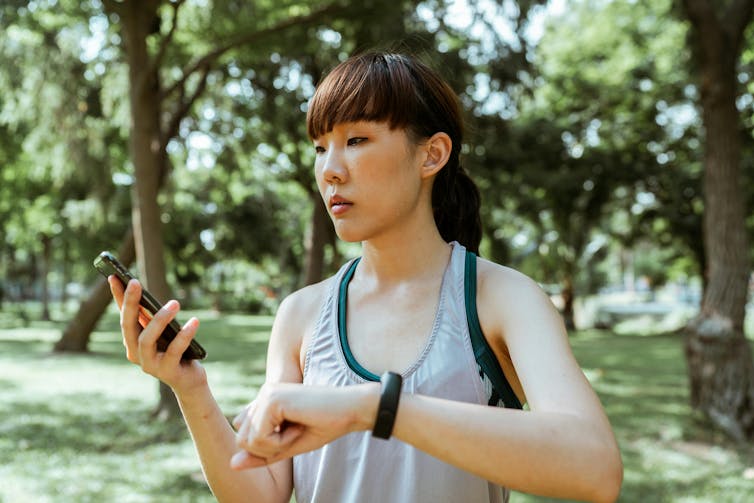
In the three-zone model, each zone loosely describes one of three types of training.
Zone 1 represents high-volume, low-intensity exercise, usually performed for long periods and at an easy pace, well below lactate threshold. Examples include jogging or cycling at a gentle pace.
Zone 2 is threshold training, also known as tempo training, a moderate intensity training method performed for moderate durations, at (or around) lactate threshold. This could be running, rowing or cycling at a speed where it’s difficult to speak full sentences.
Zone 3 mostly describes methods of high-intensity interval training, which are performed for shorter durations and at intensities above lactate threshold. For example, any circuit style workout that has you exercising hard for 30 seconds then resting for 30 seconds would be zone 3.
Striking a balance
To maximise endurance performance, you need to strike a balance between doing enough training to elicit positive changes, while avoiding over-training, injury and burnout.
While zone 3 is thought to produce the largest improvements in maximal oxygen uptake – one of the best predictors of endurance performance and overall health – it’s also the most tiring. This means you can only perform so much of it before it becomes too much.
Training in different heart rate zones improves slightly different physiological qualities, and so by spending time in each zone, you ensure a variety of benefits for performance and health.
So how much time should you spend in each zone?
Most elite endurance athletes, including runners, rowers, and even cross-country skiers, tend to spend most of their training (around 80%) in zone 1, with the rest split between zones 2 and 3.
Because elite endurance athletes train a lot, most of it needs to be in zone 1, otherwise they risk injury and burnout. For example, some runners accumulate more than 250 kilometres per week, which would be impossible to recover from if it was all performed in zone 2 or 3.
Of course, most people are not professional athletes. The World Health Organization recommends adults aim for 150–300 minutes of moderate intensity exercise per week, or 75–150 minutes of vigorous exercise per week.
If you look at this in the context of heart rate zones, you could consider zone 1 training as moderate intensity, and zones 2 and 3 as vigorous. Then, you can use heart rate zones to make sure you’re exercising to meet these guidelines.
What if I don’t have a heart rate monitor?
If you don’t have access to a heart rate tracker, that doesn’t mean you can’t use heart rate zones to guide your training.
The three heart rate zones discussed in this article can also be prescribed based on feel using a simple 10-point scale, where 0 indicates no effort, and 10 indicates the maximum amount of effort you can produce.
With this system, zone 1 aligns with a 4 or less out of 10, zone 2 with 4.5 to 6.5 out of 10, and zone 3 as a 7 or higher out of 10.
Heart rate zones are not a perfect measure of exercise intensity, but can be a useful tool. And if you don’t want to worry about heart rate zones at all, that’s also fine. The most important thing is to simply get moving.
Hunter Bennett, Lecturer in Exercise Science, University of South Australia
This article is republished from The Conversation under a Creative Commons license. Read the original article.
Don’t Forget…
Did you arrive here from our newsletter? Don’t forget to return to the email to continue learning!

Recommended
Learn to Age Gracefully
Join the 98k+ American women taking control of their health & aging with our 100% free (and fun!) daily emails:
-
Signs Of Lupus Not To Miss (Butterfly Rash Is Just One Thing Of Many)
10almonds is reader-supported. We may, at no cost to you, receive a portion of sales if you purchase a product through a link in this article.
Different kinds of lupus can look quite different:
Things to recognize
Lupus is a chronic autoimmune inflammatory disease where your immune system attacks your own body. In the case of systemic lupus, it usually affects your skin, joints, kidneys, lungs, heart, brain, and other organs, while cutaneous lupus refers specifically to lupus affecting your skin.
No matter what kind of lupus it is, though, the skin is the first likely place to notice the signs, so, let’s get into it:
- Lupus in general: lupus can cause a butterfly-shaped facial rash over your cheeks and nose, round scaly plaques, painful mouth or nose sores, widespread flaky rashes, purple-red bumps on your fingers or toes, deep painful nodules under your skin, and scarring hair loss on your scalp.
- Discoid lupus: the most common skin-only form causes thick round scaly lesions on your face or scalp that can scar permanently, leave dark or light patches, and cause permanent hair loss if untreated.
- Tumid lupus: a rarer skin-only form causing firm raised plaques, often on your chest, that heal without scars or pigment changes.
- Chilblain lupus: causes itchy dusky-purple bumps on your fingers, toes, ears, elbows, knees, or nose after cold damp exposure.
- Lupus profundus: a deeper form affecting the fat under your skin, causing painful nodules that can heal with permanent hollows or indentations.
- Subacute cutaneous lupus: produces ring-shaped, scaly, sun-triggered rashes that can resemble eczema or psoriasis, and are more associated with systemic disease.
- Acute cutaneous lupus: includes the classic butterfly or malar rash triggered by sun exposure and is strongly associated with systemic lupus erythematosus.
One other thing to bear in mind is that many other conditions can mimic a lupus butterfly rash, including rosacea and seborrheic dermatitis, so facial redness alone doesn’t confirm lupus.
Since there is no proven cure for lupus yet, lupus generally requires long-term treatment to manage inflammation, prevent organ damage, reduce scarring, and limit permanent hair loss or other unwanted aesthetic effects.
Avoiding common lupus triggers where possible is good in general, for example UV light from the sun or tanning beds, smoking, vaping, infections, stress, surgery, illness, and some medications (always read labels and check for contraindications).
For more on all of this plus visual illustrations, enjoy:
Click Here If The Embedded Video Doesn’t Load Automatically!
Want to learn more?
For a much more in-depth treatment of lupus management, you might like this excellent book we reviewed a while back:
The “et al.” in question? Jemima Albayda, MD; Divya Angra, MD; Alan N. Baer, MD; Sasha Bernatsky, MD, PhD; George Bertsias, MD, PhD; Ashira D. Blazer, MD; Ian Bruce, MD; Jill Buyon, MD; Yashaar Chaichian, MD; Maria Chou, MD; Sharon Christie, Esq; Angelique N. Collamer, MD; Ashté Collins, MD; Caitlin O. Cruz, MD; Mark M. Cruz, MD; Dana DiRenzo, MD; Jess D. Edison, MD; Titilola Falasinnu, PhD; Andrea Fava, MD; Cheri Frey, MD; Neda F. Gould, PhD; Nishant Gupta, MD; Sarthak Gupta, MD; Sarfaraz Hasni, MD; David Hunt, MD; Mariana J. Kaplan, MD; Alfred Kim, MD; Deborah Lyu Kim, DO; Rukmini Konatalapalli, MD; Fotios Koumpouras, MD; Vasileios C. Kyttaris, MD; Jerik Leung, MPH; Hector A. Medina, MD; Timothy Niewold, MD; Julie Nusbaum, MD; Ginette Okoye, MD; Sarah L. Patterson, MD; Ziv Paz, MD; Darryn Potosky, MD; Rachel C. Robbins, MD; Neha S. Shah, MD; Matthew A. Sherman, MD; Yevgeniy Sheyn, MD; Julia F. Simard, ScD; Jonathan Solomon, MD; Rodger Stitt, MD; George Stojan, MD; Sangeeta Sule, MD; Barbara Taylor, CPPM, CRHC; George Tsokos, MD; Ian Ward, MD; Emma Weeding, MD; Arthur Weinstein, MD; Sean A. Whelton, MD
The reason we mention this is to render it clear that this isn’t one man’s opinions (as happens with many books about certain topics), but rather, a panel of that many doctors all agreeing that this is correct and good, evidence-based, up-to-date (as of the publication of this latest revised edition all so recently) information.
Want to learn less?
If the aforementioned 848-page opus seems a little too overwhelming, then you might prefer:
The Lupus Solution – by Dr. Tiffany Caplan & Dr. Brent Caplan ← a much slimmer tome; just 182 pages 🙂
Take care!
Share This Post
-
Are plant-based burgers really bad for your heart? Here’s what’s behind the scary headlines
10almonds is reader-supported. We may, at no cost to you, receive a portion of sales if you purchase a product through a link in this article.
We’re hearing a lot about ultra-processed foods and the health effects of eating too many. And we know plant-based foods are popular for health or other reasons.
So it’s not surprising new research out this week including the health effects of ultra-processed, plant-based foods is going to attract global attention.
And the headlines can be scary if that research and the publicity surrounding it suggests eating these foods increases your risk of heart disease, stroke or dying early.
Here’s how some media outlets interpreted the research. The Daily Mail ran with:
Vegan fake meats are linked to increase in heart deaths, study suggests: Experts say plant-based diets can boost health – but NOT if they are ultra-processed
The New York Post’s headline was:
Vegan fake meats linked to heart disease, early death: study
But when we look at the study itself, it seems the media coverage has focused on a tiny aspect of the research, and is misleading.
So does eating supermarket plant-based burgers and other plant-based, ultra-processed foods really put you at greater risk of heart disease, stroke and premature death?
Here’s what prompted the research and what the study actually found.
Nina Firsova/Shutterstock Remind me, what are ultra-processed foods?
Ultra-processed foods undergo processing and reformulation with additives to enhance flavour, shelf-life and appeal. These include everything from packet macaroni cheese and pork sausages, to supermarket pastries and plant-based mince.
There is now strong and extensive evidence showing ultra-processed foods are linked with an increased risk of many physical and mental chronic health conditions.
Although researchers question which foods should be counted as ultra-processed, or if all of them are linked to poorer health, the consensus is that, generally, we should be eating less of them.
We also know plant-based diets are popular. These are linked with a reduced risk of chronic health conditions such as heart disease and stroke, cancer and diabetes. And supermarkets are stocking more plant-based, ultra-processed food options.
How about the new study?
The study looked for any health differences between eating plant-based, ultra-processed foods compared to eating non-plant based, ultra-processed foods. The researchers focused on the risk of cardiovascular disease (such as heart disease and stroke) and deaths from it.
Plant-based, ultra-processed foods in this study included mass-produced packaged bread, pastries, buns, cakes, biscuits, cereals and meat alternatives (fake meats). Ultra-processed foods that were not plant-based included milk-based drinks and desserts, sausages, nuggets and other reconstituted meat products.
The researchers used data from the UK Biobank. This is a large biomedical database that contains de-identified genetic, lifestyle (diet and exercise) and health information and biological samples from half a million UK participants. This databank allows researchers to determine links between this data and a wide range of diseases, including heart disease and stroke.
They used data from nearly 127,000 people who provided details of their diet between 2009 and 2012. The researchers linked this to their hospital records and death records. On average, the researchers followed each participant’s diet and health for nine years.
Plant-based, ultra-processed foods included in this study included packaged supermarket bread. doublelee/Shutterstock What did the study find?
With every 10% increase of total energy from plant-sourced, ultra-processed foods there was an associated 5% increased risk of cardiovascular disease (such as heart disease or stroke) and a 12% higher risk of dying from cardiovascular disease.
But for every 10% increase in plant-sourced, non-ultra-processed foods consumed there was an associated 7% lower risk of cardiovascular disease and a 13% lower risk of dying from cardiovascular disease.
The researchers found no evidence for an association between all plant-sourced foods (whether or not they were ultra-processed) and either an increased or decreased risk of cardiovascular disease or dying from it.
This was an observational study, where people recalled their diet using questionnaires. When coupled with other data, this can only tell us if someone’s diet is associated with a particular risk of a health outcome. So we cannot say that, in this case, the ultra-processed foods caused the heart disease and deaths from it.
Why has media coverage focused on fake meats?
Much of the media coverage has focused on the apparent health risks associated with eating fake meats, such as sausages, burgers, nuggets and even steaks.
These are considered ultra-processed foods. They are made by deconstructing whole plant foods such as pea, soy, wheat protein, nuts and mushrooms, and extracting the protein. They are then reformulated with additives to make the products look, taste and feel like traditional red and white meats.
However this was only one type of plant-based, ultra-processed food analysed in this study. This only accounted for an average 0.2% of the dietary energy intake of all the participants.
Compare this to bread, pastries, buns, cakes and biscuits, which are other types of plant-based, ultra-processed foods. These accounted for 20.7% of total energy intake in the study.
This image was at the top of the media release. Screenshot/Imperial It’s hard to say why the media focused on fake meat. But there is one clue in the media release issued to promote the research.
Although the media release did not mention the words “fake meat”, an image of plant-based burgers, sausages and meat balls or rissoles featured prominently.
The introduction of the study itself also mentions plant-sourced, ultra-processed foods, such as sausages, nuggets and burgers.
So it’s no wonder people can be confused.
Does this mean fake meats are fine?
Not necessarily. This study analysed the total intake of plant-based, ultra-processed foods, which included fake meats, albeit a very small proportion of people’s diets.
From this study alone we cannot tell if there would be a different outcome if someone ate large amounts of fake meats.
In fact, a recent review of fake meats found there was not enough evidence to determine their impact on health.
We also need more recent data to reflect current eating patterns of fake meats. This study used dietary data collected from 2009 to 2012, and fake meats have become more popular since.
What if I really like fake meat?
We have known for a while that ultra-processed foods can harm our health. This study tells us that regardless if an ultra-processed food is plant-based or not, it may still be harmful.
We know fake meat can contain large amounts of saturated fats (from coconut or palm oil), salt and sugar.
So like other ultra-processed foods, they should be eaten infrequently. The Australian Dietary Guidelines currently recommends people should only consume foods like this sometimes and in small amounts.
Are some fake meats healthier than others?
Check the labels and nutrition information panels. Look for those lowest in fat and salt. Burgers and sausages that are a “pressed cake” of minced ingredients such as nuts, beans and vegetables will be preferable to reformulated products that look identical to meat.
You can also eat whole plant-based protein foods such as legumes. These include beans, lentils, chickpeas and soy beans. As well as being high in protein and fibre, they also provide essential nutrients such as iron and zinc. Using spices and mushrooms alongside these in your recipes can replicate some of the umami taste associated with meat.
Evangeline Mantzioris, Program Director of Nutrition and Food Sciences, Accredited Practising Dietitian, University of South Australia
This article is republished from The Conversation under a Creative Commons license. Read the original article.
Share This Post
-
When You Don’t Have Enough Time To Exercise…
10almonds is reader-supported. We may, at no cost to you, receive a portion of sales if you purchase a product through a link in this article.
That’s not quite right:
The time we have
The problem: thinking workouts only count if they are long, perfectly planned, and high-energy leads to doing nothing when those standards cannot be met.
In reality: something always beats nothing, and aiming for possibility instead of perfection allows us to build consistency.
Think of in terms of three types of time: micro time is 1–5 minute pockets, window time is 10–20 minute openings, and anchor time is planned, predictable sessions.
Most people’s fitness plans fail because building fitness only around anchor time causes routines to collapse when life intervenes, as it all so often does. So, instead, using micro, window, and anchor time together creates hours of movement without changing your schedule.
For this reason, “exercise snacking” helps a lot, e.g. short bursts of squats while dinner cooks, or push-ups between calls, this kind of thing. With just a few such impromptu sessions per day, you can easily build momentum without disrupting your schedule.
In terms of habit-forming, it also helps to attach movement to routines you already do, such as stretching after brushing your teeth, or walking after closing your laptop.
In short: for even the busiest person, time is not the real problem! Outdated beliefs about what counts as a workout are usually the real issue, and designing an approach that fits for real life is what makes consistency possible.
For more on all of this, enjoy:
Click Here If The Embedded Video Doesn’t Load Automatically!
Want to learn more?
You might also like:
Take care!
Share This Post
Related Posts
-
Do Probiotics Work For Weight Loss?
10almonds is reader-supported. We may, at no cost to you, receive a portion of sales if you purchase a product through a link in this article.
It’s Q&A Day at 10almonds!
Have a question or a request? We love to hear from you!
In cases where we’ve already covered something, we might link to what we wrote before, but will always be happy to revisit any of our topics again in the future too—there’s always more to say!
As ever: if the question/request can be answered briefly, we’ll do it here in our Q&A Thursday edition. If not, we’ll make a main feature of it shortly afterwards!
So, no question/request too big or small
❝Can you talk about using probiotics for weight loss? Thanks❞
Great question! First, a quick catch-up:
How Much Difference Do Probiotic Supplements Make, Really?
Our above-linked article covers a number of important benefits of probiotic supplements, but we didn’t talk about weight loss at all. So let’s examine whether probiotics are useful for weight loss.
Up-front summary: the science is unclear
This 2021 systematic review found that they are indeed very effective:
❝The intake of probiotics or synbiotics could lead to significant weight reductions, either maintaining habitual lifestyle habits or in combination with energy restriction and/or increased physical activity for an average of 12 weeks.
Specific strains belonging to the genus Lactobacillus and Bifidobacterium were the most used and those that showed the best results in reducing body weight.
Both probiotics and synbiotics have the potential to help in weight loss in overweight and obese populations.❞
This slightly older (2015) systematic review and meta-analysis found the opposite:
❝Collectively, the RCTs examined in this meta-analysis indicated that probiotics have limited efficacy in terms of decreasing body weight and BMI and were not effective for weight loss.❞
Source: Probiotics for weight loss: a systematic review and meta-analysis
And in case that’s not balanced enough, this 2020 randomized controlled trial got mixed results:
❝Regression analysis performed to correlate abundance of species following supplementation with body composition parameters and biomarkers of obesity found an association between a decrease over time in blood glucose and an increase in Lactobacillus abundance, particularly in the synbiotic group.
However, the decrease over time in body mass, BMI, waist circumstance, and body fat mass was associated with a decrease in Bifidobacterium abundance.❞
Source: Effects of Synbiotic Supplement on Human Gut Microbiota, Body Composition and Weight Loss in Obesity
Summary
Probiotics may or may not work for weight loss.
In all likelihood, it depends on the blend of cultures contained in the supplement. It’s possible that Lactobacillus is more beneficial for weight loss than Bifidobacterium, which latter may actually reduce weight loss.
Or it might not, because that was just one study and correlation ≠ causation!
We’d love to give you a hard-and-fast answer, but if the data doesn’t support a hard-and-fast answer, we’re not going to lie to you.
What we can say for sure though is that probiotics come with very many health benefits, so whether or not weight loss is one of them, they’re a good thing to have for most people.
Some further articles that may interest you:
- How Much Difference Do Probiotic Supplements Make, Really? ← the aforementioned article
- Making Friends With Your Gut (You Can Thank Us Later) ← gut health 101
- Burn! How To Boost Your Metabolism ← these things can help change your metabolic base rate, which is highly relevant to weight loss
- How To Do HIIT (Without Wrecking Your Body) ←unlike most forms of exercise, which cause the body to slow the metabolism afterwards to compensate, high-intensity interval training results in an increased metabolic rate (so generally: fat-burning) for several hours after training.
Take care!
Don’t Forget…
Did you arrive here from our newsletter? Don’t forget to return to the email to continue learning!
Learn to Age Gracefully
Join the 98k+ American women taking control of their health & aging with our 100% free (and fun!) daily emails:
-
Limitless Expanded Edition – by Jim Kwik
10almonds is reader-supported. We may, at no cost to you, receive a portion of sales if you purchase a product through a link in this article.
This is a little flashier in presentation than we usually go for here, but the content is actually very good. Indeed, we’ve featured Jim Kwik before, with different, but also good content—in that case, physical exercises that strengthen the brain.
This time, Kwik (interspersed with motivational speeches that you may or may not benefit from, but they are there) offers a step-by-step course in improving various metrics of cognitive ability. His methods were produced by trial and error, and now have been refined and enjoyed by man. If it sounds like a sales gimmick, it is a bit, but the good news is that everything you need to benefit is in the book; it’s not about upselling to a course or “advanced” books or whatnot.
The style is enthusiastically conversational, and instructions when given (which is often) are direct and clear.
Bottom line: one of the most critical abilities a brain can have is the ability to improve itself, so whatever level your various cognitive abilities are at right now, if you apply this book, you will almost certainly improve in one or more areas, which will make it worth the price of the book.
Click here to check out Limitless, and find out what you can do!
Don’t Forget…
Did you arrive here from our newsletter? Don’t forget to return to the email to continue learning!
Learn to Age Gracefully
Join the 98k+ American women taking control of their health & aging with our 100% free (and fun!) daily emails:
-
5 Exercises You Shouldn’t Do With Osteoporosis
10almonds is reader-supported. We may, at no cost to you, receive a portion of sales if you purchase a product through a link in this article.
Can you guess what they are?
Hold up a little…
Per Dr. Lisa Moore, anyone with osteoporosis or osteopenia should avoid movements that stress the spine in risky ways, for example:
- Sit-ups: avoid because they round your spine into flexion, increasing pressure on your vertebrae
- Crunches: avoid all variations (floor, ball, side) because repeated spinal rounding raises fracture risk
- Forceful pelvic tilts: avoid aggressive ab squeezing that flattens your lower back, as it mimics spinal flexion under load
- Russian twists: avoid because rapid, weighted rotation adds excessive torque to your spine
- Forward folds: avoid repeated spinal rounding in yoga or Pilates, including seated forward bends and lateral bending
- Jefferson curls: avoid because loaded spinal flexion (rolling down and up with weight) places high stress on weakened vertebrae
Instead, she recommends to focus on isometric exercises such as planks, using forearm, full, side, or hover planks to train your core without spinal movement.
The general idea is to brace your core with a neutral pelvis instead of moving your spine. And when it comes to hip-hinging, she recommends to bend forwards from your hips with a long spine, rather than rounding your back.
Indeed, in the video she cites a study that found the following correlations:
- Flexion exercises: 89% fracture rate
- Combined flexion/extension: 53% fracture rate
- Extension exercises: 16% fracture rate
- No exercise: 67% fracture rate
…which seems a fairly strong argument for extension exercises and not flexion exercises!
For more on all of this plus visual demonstrations, enjoy:
Click Here If The Embedded Video Doesn’t Load Automatically!
Want to learn more?
You might also like:
Osteoporosis & Exercises: Which To Do (And Which To Avoid) ← for our main feature on this topic
Take care!
Don’t Forget…
Did you arrive here from our newsletter? Don’t forget to return to the email to continue learning!
Learn to Age Gracefully
Join the 98k+ American women taking control of their health & aging with our 100% free (and fun!) daily emails:


