The Power of When – by Dr. Michael Breus

10almonds is reader-supported. We may, at no cost to you, receive a portion of sales if you purchase a product through a link in this article.

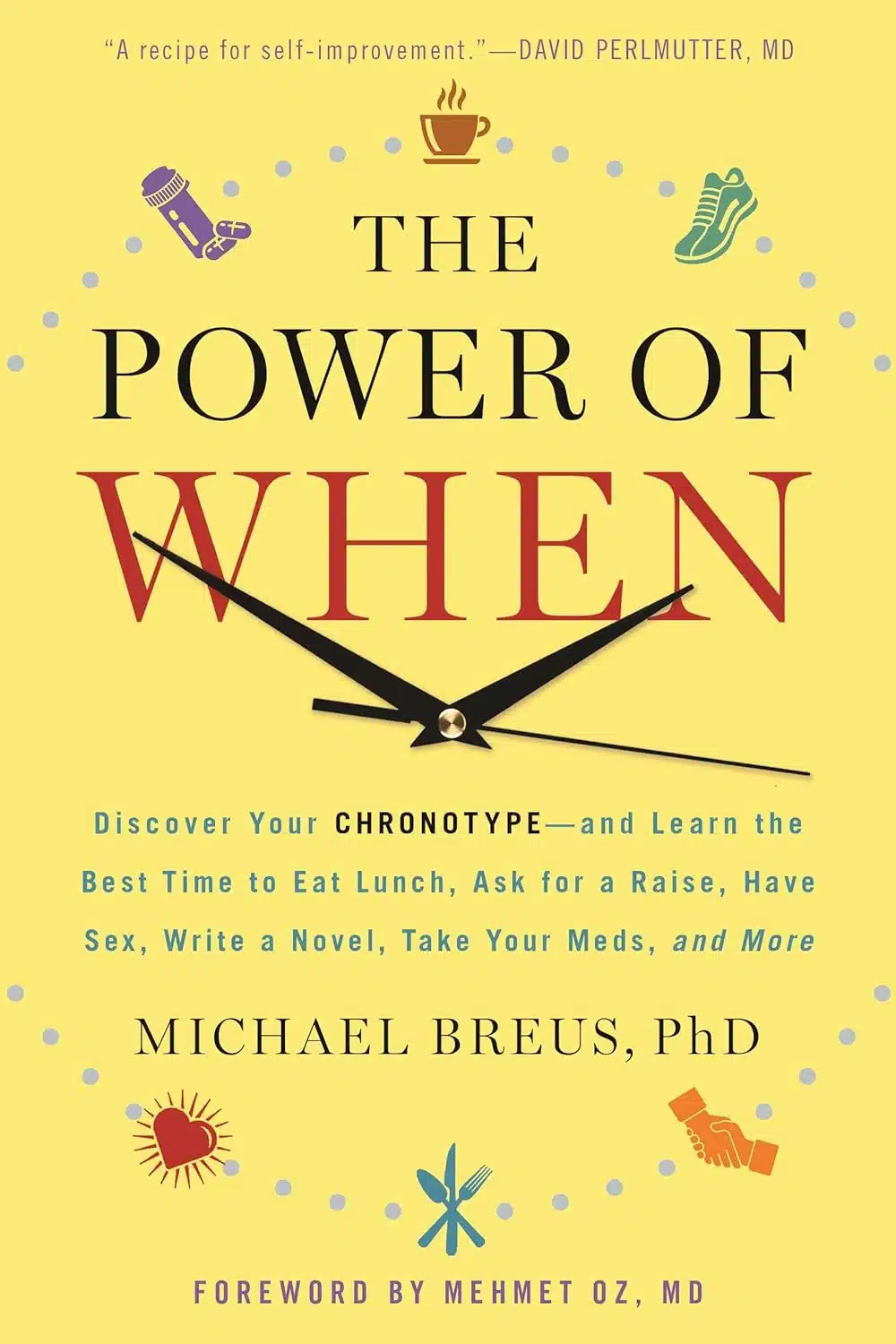
There’s a lot more to one’s circadian rhythm than just when one wakes and sleeps. This book goes into that quite deeply!

For example, those items in the subtitle? You could do them all at the same time, but it probably wouldn’t be optimal (although honestly, that does sound like quite a good life!). Rather, there are distinct times of day that we’re going to be better at certain things, and there are distinct times of day when certain things are going to be better for us.

Of course, some items are not so simple as a one-size fits all, so Dr. Breus outlines for us how to figure out our own chronotype (within four main schemas), and how to make that work for us as well as possible.

They style is easy-reading pop-science, with frequent summaries, bullet-points, quizzes, and so forth, making it easy to understand, learn, and apply.

Bottom line: if you feel like your sleep could use a do-over, then this book can help you get it into order—and the rest of your daily activities too!

Click here to check out The Power of When, and optimize your health!

Don’t Forget…

Did you arrive here from our newsletter? Don’t forget to return to the email to continue learning!

  • How Stress Causes Physical Pain: The Brain–Body Connection Explained Simply
    Dr. Amy Konvalin talks us through why it happens and what to do about it (besides just “manage stress”!): It’s about signalling Stress has a lot of effects when it comes to pain-signalling: it changes nervous system activity, increases cortisol, activates the fight-or-flight response, raises muscle tension, and can also excite inflammatory pathways, all of…

Learn to Age Gracefully

Join the 98k+ American women taking control of their health & aging with our 100% free (and fun!) daily emails:

  • Beetroot Juice & Caffeine Work Better Than Either Alone

    10almonds is reader-supported. We may, at no cost to you, receive a portion of sales if you purchase a product through a link in this article.

    Beetroot has many beneficial properties, which we’ve written about before:

    Beetroot For More Than Just Your Blood Pressure

    …and as for caffeine, it’s a mixed bag but for most people, the benefits of moderate caffeine use outweigh the risks:

    Caffeine: Cognitive Enhancer Or Brain-Wrecker?

    Now, caffeine’s less desirable effects can be mitigated somewhat by pairing it with l-theanine, as we’ve also discussed before:

    L-Theanine: What’s The Tea? ← l-theanine also has many wonderful properties of its own, aside from its complementary effects when taken alongside caffeine

    So, what’s the deal with caffeine and beetroot juice?

    A performance-enhancing balancing act

    Caffeine raises blood pressure, while beetroot lowers it, but there’s a lot more to it than that.

    Researchers looked into the effects of caffeine and beetroot juice, together or separately, on athletic performance (in a 1000m run) in non-athletes.

    They found:

    • Caffeine alone enhanced second-run performance but not the first.
    • Beetroot juice alone improved first-run performance but led to a performance decline after recovery.
    • The caffeine + BJ combo resulted in the best initial and repeated 1000m run performances.

    Specifically, they also noted:

    • Caffeine alone caused higher blood lactate levels post-exercise.
    • Beetroot juice increased muscle oxygenation by 25% during runs.
    • The caffeine + BJ combo led to the highest post-exercise heart rate improvements.

    You can read the paper in full here:

    Caffeine and Beetroot Juice Optimize 1,000-m Performance: Shapley Additive Explanations Analysis

    Now, maybe you don’t have a 1000m run to do, let alone multiple ones back-to-back, but most of us could sometimes do with an energy boost during the day, and this seems like an excellent way to get it.

    That said, caffeine timing can be important too; midday is generally the best time for it, because:

    • of course it should not be too late in the day, because the elimination half-life of caffeine (4–8 hours to eliminate just half of the caffeine, depending on genes, call it 6 hours as an average though honestly for most people it will either be 4 or 8, not 6) is such that it can easily interfere with sleep for most people
    • because caffeine is an adenosine blocker, not an adenosine inhibitor, taking caffeine in the morning means either there’s no adenosine to block, or it’ll just “save” that adenosine for later, i.e. when the caffeine is eliminated, then the adenosine will kick in, meaning that your morning sleepiness has now been deferred to the afternoon, rather than eliminated.

    Another reminder that caffeine is the “payday loan” of energy. So, midday it is. No morning sleepiness to defer, and yet also not so late as to interfere with sleep.

    See also: Calculate (And Enjoy) The Perfect Night’s Sleep

    Want to learn more?

    Check out:

    The Best Form Of Sugar For Energy During Exercise

    Enjoy!

    Share This Post

  • How To Leverage Placebo Effect For Yourself

    10almonds is reader-supported. We may, at no cost to you, receive a portion of sales if you purchase a product through a link in this article.

    Placebo Effect: Making Things Work Since… Well, A Very Long Time Ago

    The placebo effect is a well-known, well-evidenced factor that is very relevant when it comes to the testing and implementation of medical treatments:

    NIH | National Center for Biotechnology Information | Placebo Effect

    Some things that make placebo effect stronger include:

    • Larger pills instead of small ones: because there’s got to be more going on in there, right?
    • Thematically-colored pills: e.g. red for stimulant effects, blue for relaxing effects
    • Things that seem expensive: e.g. a well-made large heavy machine, over a cheap-looking flimsy plastic device. Similarly, medication from a small glass jar with a childproof lock, rather than popped out from a cheap blister-pack.
    • Things that seem rational: if there’s an explanation for how it works that you understand and find rational, or at least you believe you understand and find rational ← this works in advertising, too; if there’s a “because”, it lands better almost regardless of what follows the word “because”
    • Things delivered confidently by a professional: this is similar to the “argument from authority” fallacy (whereby a proposed authority will be more likely trusted, even if this is not their area of expertise at all, e.g. celebrity endorsements), but in the case of placebo trials, this often looks like a well-dressed middle-aged or older man with an expensive haircut calling for a young confident-looking aide in a lab coat to administer the medicine, and is received better than a slightly frazzled academic saying “and, uh, this one’s yours” while handing you a pill.
    • Things with ritual attached: this can be related to the above (the more pomp and circumstance is given to the administration of the treatment, the better), but it can also be as simple as an instruction on an at-home-trial medication saying “take 20 minutes before bed”. Because, if it weren’t important, they wouldn’t bother to specify that, right? So it must be important!

    And now for a quick personality test

    Did you see the above as a list of dastardly tricks to watch out for, or did you see the above as a list of things that can make your actual medication more effective?

    It’s arguably both, of course, but the latter more optimistic view is a lot more useful than the former more pessimistic one.

    Since placebo effect works at least somewhat even when you know about it, there is nothing to stop you from leveraging it for your own benefit when taking medication or doing health-related things.

    Next time you take your meds or supplements or similar, pause for a moment for each one to remember what it is and what it will be doing for you. This is a lot like the principles (which are physiological as well as psychological) of mindful eating, by the way:

    How To Get More Nutrition From The Same Food

    Placebo makes some surprising things evidence-based

    We’ve addressed placebo effect sometimes as part of an assessment of a given alternative therapy, often in our “Mythbusting Friday” edition of 10almonds.

    • In some cases, placebo is adjuvant to the therapy, i.e. it is one of multiple mechanisms of action (example: chiropractic or acupuncture)
    • In some cases, placebo is the only known mechanism of action (example: homeopathy)
    • In some cases, even placebo can’t help (example: ear candling)

    One other fascinating and far-reaching (in a potentially good way) thing that placebo makes evidence-based is: prayer

    …which is particularly interesting for something that is fundamentally faith-based, i.e. the opposite of evidence-based.

    Now, we’re a health science publication, not a theological publication, so we’ll consider actual divine intervention to be beyond the scope of mechanisms of action we can examine, but there’s been a lot of research done into the extent to which prayer is beneficial as a therapy, what things it may be beneficial for, and what factors affect whether it helps:

    Prayer and healing: A medical and scientific perspective on randomized controlled trials

    👆 full paper here, and it is very worthwhile reading if you have time, whether or not you are religious personally

    Placebo works best when there’s a clear possibility for psychosomatic effect

    We’ve mentioned before, and we’ll mention again:

    • psychosomatic effect does not mean: “imagining it”
    • psychosomatic effect means: “your brain regulates almost everything else in your body, directly or indirectly, including your autonomic functions, and especially notably when it comes to illness, your immune responses”

    So, a placebo might well heal your rash or even shrink a tumor, but it probably won’t regrow a missing limb, for instance.

    And, this is important: it’s not about how credible/miraculous the outcome will be!

    Rather, it is because we have existing pre-programmed internal bodily processes for healing rashes and shrinking tumors, that just need to be activated—whereas we don’t have existing pre-programmed internal bodily processes for regrowing a missing limb, so that’s not something our brain can just tell our body to do.

    So for this reason, in terms of what placebo can and can’t do:

    • Get rid of cancer? Yes, sometimes—because the body has a process for doing that; enjoy your remission
    • Fix a broken nail? No—because the body has no process for doing that; you’ll just have to cut it and wait for it to grow again

    With that in mind, what will you use the not-so-mystical powers of placebo for? What ever you go for… Enjoy, and take care!

    Share This Post

  • Broccoli vs Zucchini – Which is Healthier?

    10almonds is reader-supported. We may, at no cost to you, receive a portion of sales if you purchase a product through a link in this article.

    Our Verdict

    When comparing broccoli to zucchini, we picked the broccoli.

    Why?

    This one wasn’t close:

    In terms of macros, broccoli has more than 2x the fiber, 2x the carbs, and 2x the protein, winning this first round easily.

    In the category of vitamins, broccoli has more of vitamins A, B1, B2, B3, B5, B6, B7, B9, C, E, and K, while zucchini is not higher in any vitamins—another easy win for broccoli.

    Looking at minerals, broccoli has more calcium, copper, iron, magnesium, manganese, phosphorus, potassium, selenium, and zinc, sweeping yet another category as zucchini is not higher in any minerals.

    In other consideration, broccoli has sulforaphane, which is another point in its favor.

    Adding up the sections makes for a very clear overall win for broccoli, but still, do enjoy either or both, as diversity is best!

    Want to learn more?

    You might like:

    Broccoli Sprouts & Sulforaphane

    Enjoy!

    Share This Post

  • Sunflower Corn Burger

    10almonds is reader-supported. We may, at no cost to you, receive a portion of sales if you purchase a product through a link in this article.

    Burgers are rarely a health food, but in this case, everything in the patty is healthy, and it’s packed with protein, fiber, and healthy fats.

    You will need

    • 1 can chickpeas
    • ¾ cup frozen corn
    • ½ cup chopped fresh parsley
    • ⅓ cup sunflower seeds
    • ⅓ cup cornichon pickles
    • ⅓ cup wholegrain bread crumbs (gluten-free, if desired/required)
    • ¼ bulb garlic (or more if you want a stronger flavor)
    • 1 tbsp extra virgin olive oil, plus more for frying
    • 1 tbsp nutritional yeast (or 1 tsp yeast extract)
    • 2 tsp ground cumin
    • 2 tsp red pepper flakes
    • 2 tsp black pepper, coarse ground
    • 1 tsp Dijon mustard
    • To serve: 4 burger buns; these are not usually healthy, so making your own is best, but if you don’t have the means/time, then getting similarly shaped wholegrain bread buns works just fine.
    • Optional: your preferred burger toppings, e.g. greenery, red onion, tomato slices, avocado, jalapeños, whatever does it for you

    Note: there is no need to add salt; there is enough already in the pickles.

    Method

    (we suggest you read everything at least once before doing anything)

    1) Combine all the ingredients except the buns (and any optional toppings) in a food processor, pulsing a few times for a coarse texture (not a purée).

    2) Shape the mixture into 4 burger patties, and let them chill in the fridge for at least 30 minutes.

    3) Heat a skillet over a medium-high heat with some olive oil, and fry the burgers on both sides until they develop a nice golden crust; this will probably take about 4 minutes per side.

    4) Assemble in the buns with any toppings you want, and serve:

    Enjoy!

    Want to learn more?

    For those interested in some of the science of what we have going on today:

    Take care!

    Don’t Forget…

    Did you arrive here from our newsletter? Don’t forget to return to the email to continue learning!

    Learn to Age Gracefully

    Join the 98k+ American women taking control of their health & aging with our 100% free (and fun!) daily emails:

  • Beetroot vs Eggplant – Which is Healthier?

    10almonds is reader-supported. We may, at no cost to you, receive a portion of sales if you purchase a product through a link in this article.

    Our Verdict

    When comparing beetroot to eggplant, we picked the beetroot.

    Why?

    It’s close!

    In terms of macros, they’re equal on fiber, while beetroot has slightly more protein and carbs. In both cases, despite being quite firm vegetables when raw, they are nevertheless both mostly water. We’re calling this category a tie.

    In the category of vitamins, beetroot has more of vitamins A, B2, B9, and C, while eggplant has more of vitamins B3, B5, B6, E, and K. That’s a marginal victory for eggplant.

    When it comes to minerals, however, beetroot has more calcium, copper, iron, magnesium, manganese, phosphorus, potassium, selenium, and zinc, while eggplant is not higher in any minerals. A clear and easy win for beetroot this time.

    In terms of polyphenols, both have good-but-different health-giving polyphenols to share, including the quercetin in beetroot and caffeic acid in eggplant—nothing that would tip one ahead of the other, though.

    All in all, the categories added up are balanced, but beetroot won the minerals category much more convincingly than eggplant won the vitamins category, so we’re giving this one to beetroot, even if only on tie-breakers!

    Of course, enjoy either or both; diversity is good 😎

    Want to learn more?

    You might like to read:

    Beetroot For More Than Just Your Blood Pressure ← more beetroot benefits

    Take care!

    Don’t Forget…

    Did you arrive here from our newsletter? Don’t forget to return to the email to continue learning!

    Learn to Age Gracefully

    Join the 98k+ American women taking control of their health & aging with our 100% free (and fun!) daily emails:

  • No-Exercise Exercise!

    10almonds is reader-supported. We may, at no cost to you, receive a portion of sales if you purchase a product through a link in this article.

    Do you love to go to the gym?

    If so, today’s article might not be for you so much. Or maybe it will, because let’s face it, exercise is fun!

    At least… It can be, and should be 😎

    So without further ado, here’s a slew of no-exercise exercise ideas; we’re willing to bet that somewhere in the list there’s at least some you haven’t tried before, and probably some you haven’t done in a while but might enjoy making a reprise!

    Walking

    No surprises here: walking is great. Hopefully you have some green spaces near you, but if you don’t, [almost] any walking is better than no walking. So unless there’s some sort of environmental disaster going on outside, lace up and get stepping.

    If you struggle to “walk for walking’s sake” give yourself a little mission. Walk to the shop to buy one item. Walk to the park and find a flower to photograph. Walk to the library and take out a book. Whatever works for you!

    See also: The Doctor Who Wants Us To Exercise Less, And Move More

    Take the stairs

    This one doesn’t need many words, just: make it a habit.

    Treat the elevators as though they aren’t there!

    See also: How To Really Pick Up (And Keep!) Those Habits

    Dance

    Dance is amazing! Any kind of dance, whatever suits your tastes. This writer loves salsa and tango, but no matter whether for you it’s zouk or zumba, breakdancing or line dancing, whatever gets you moving is going to be great for you.

    If you don’t know how, online tutorials abound, and best of all is to attend local classes if you can, because they’re always a fun social experience too.

    Make music

    Not something often thought of as an exercise, but it is! Most instruments require that we be standing or siting with good posture, focusing intently on our movements, and often as not, breathing very mindfully too. And yes, it’s great for the brain as well!

    Check out: This Is Your Brain on Music: The Science of a Human Obsession – by Dr. Daniel Levitin

    Take a stand

    If you spend a lot of time at a desk, please consider investing in a standing desk; they can be truly life-changing. Not only is it so much better for your back, hips, neck, and internal organs, but also it burns hundreds more calories than sitting, due to the no-exercise exercise that is keeping your body constantly stabilized while on your feet.

    (or, if you’re like this writer: on your foot. I do have two feet, I just spend an inordinate amount of time at my desk standing on one leg at a time; I’m a bit of a flamingo like that)

    See also: Deskbound: Standing Up to a Sitting World – by Kelly Starrett and Glen Cordoza

    Sit, but…

    Sit in a sitting squat! Sometimes called a Slav squat, or an Asian squat, or a resting squat, or various other names:

    Click Here If The Embedded Video Doesn’t Load Automatically!

    Alternatively, sitting in seiza (the traditional Japanese sitting position) is also excellent, but watch out! While it’s great once your body is accustomed to it, if you haven’t previously sat this way much, you may cut off your own circulation, hurt your knees, and (temporarily) lose feeling in your feet. So if you don’t already sit in seiza often, gradually work up the time period you spend sitting in seiza, so that your vasculature can adapt and improve, which honestly, is a very good thing for your legs and feet to have.

    Breathe

    Perhaps the absolute most “no-exercise exercise” there is. And yes, of course you are (hopefully) breathing all the time, but how you are breathing matters a lot:

    The Inside Job Of Fixing Our Breathing: Exercises That Can Fix Sinus Problems (And More)

    Clean

    This doesn’t have to mean scrubbing floors like a sailor—even merely giving your house the Marie Kondo treatment counts, because while you’re distracted with all the objects, you’re going to be going back and forth, getting up and down, etc, clocking up lots of exercise that you barely even notice!

    PS, check out: The Life-Changing Manga Of Tidying Up – by Marie Kondo

    Garden

    As with the above, it’s lots of activity that doesn’t necessarily feel like it (assuming you’re doing more pruning and weeding etc, and less digging ditches etc), and as a bonus, there are a stack of mental health benefits to being in a green natural environment and interacting with soil:

    Read more: The Antidepressant In Your Garden

    Climb

    Depending on where you live, this might mean an indoor climbing wall, but give it a go! They have color-coded climbs from beginner to advanced, so don’t worry about being out of your depth.

    And the best thing is, the beginner climbs will be as much a workout to a beginner as the advanced climbs will be to an advanced climber, because at the end of the day, you’re still clinging on for dear life, no matter whether it’s a sizeable handhold not far from the ground, or the impression of a fingernail crack in an overhang 100ft in the air.

    Video games (but…)

    Less in the category of Stardew Valley, and more in the category of Wii Fit.

    So, dust off that old controller (or treat yourself to one if you didn’t have one already), and get doing a hundred sports and other physical activities in the comfort of your living room, with a surprisingly addictive gaming system!

    Sex!

    You probably don’t need instructions here, and if you do, well honestly, we’re running out of space today. But the answer to “does xyz count?” is “did it get your heart racing?” because if so, it counts

    Take care!

    Don’t Forget…

    Did you arrive here from our newsletter? Don’t forget to return to the email to continue learning!

    Learn to Age Gracefully

    Join the 98k+ American women taking control of their health & aging with our 100% free (and fun!) daily emails: