
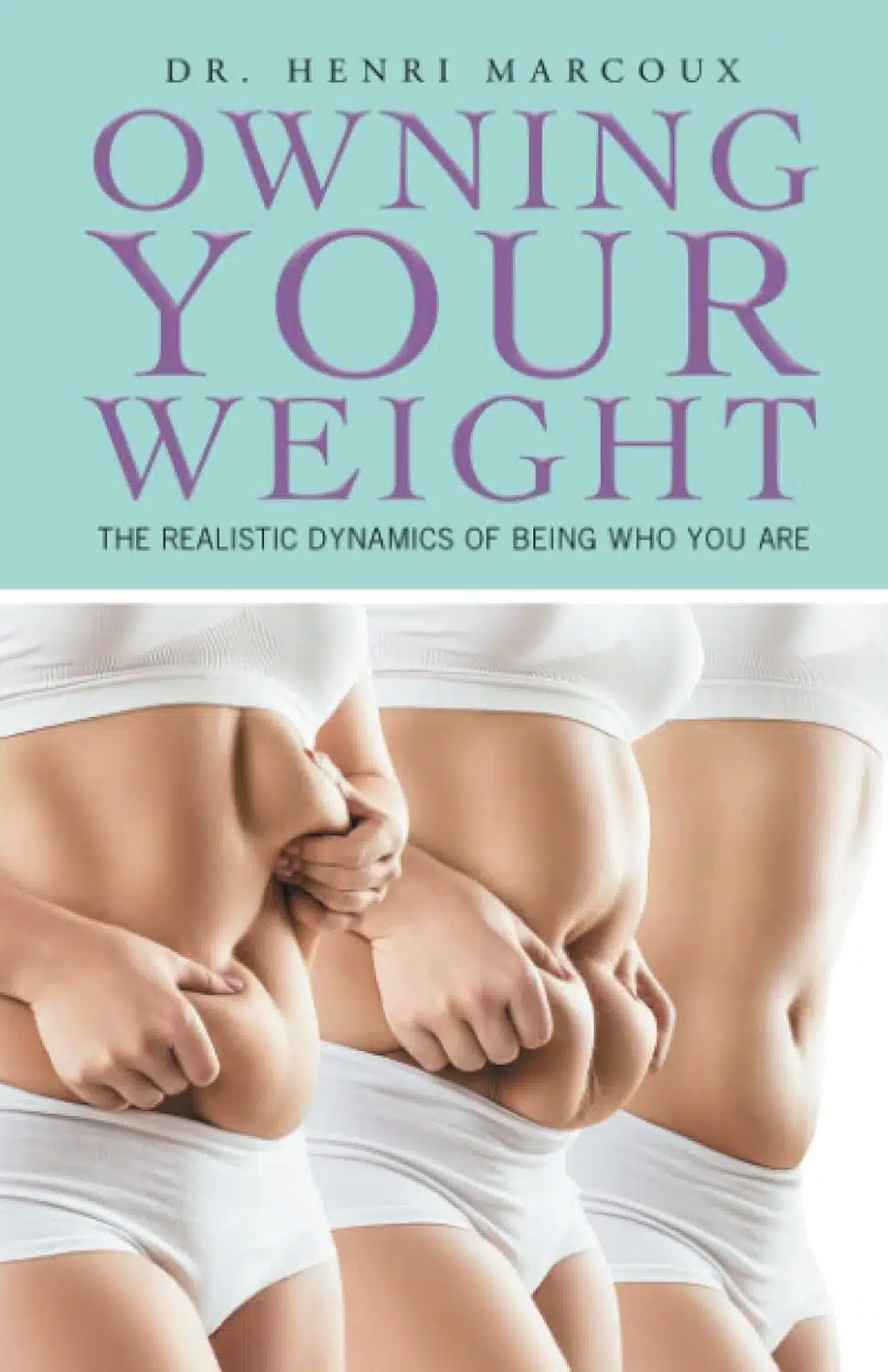
Owning Your Weight – by Henri Marcoux

10almonds is reader-supported. We may, at no cost to you, receive a portion of sales if you purchase a product through a link in this article.

A lot of diet books—which this isn’t—presuppose that the reader wants to lose weight, and varyingly encourage and shame the reader into trying to do so.

Dr. Henri Marcoux takes a completely different approach.

He starts by assuming we are—whether consciously or not—the weight we want to be, and looks at the various physical and psychological factors that influence us to such. Ranging from food poverty to eating our feelings to social factors and more, he bids us examine our relationship with food and eating—not just in the sense of mindful eating, but from multiple scientific angles too.

From this, Dr. Marcoux gives us questions and suggestions to ensure that our relationship with food and eating is what we want it to be, for us.

Much of the latter part of the book covers not just how to go about the requisite lifestyle changes… But also how to implement things in a way that sticks, and is a genuine pleasure to implement. If this sounds over-the-top, the truth is that it’s just because it honestly is a lower-stress way of living.

Bottom line: if you want to gain or lose weight, there’s a good chance this book will help you. If you want to be happier and healthier at the weight you are, there’s a good chance this book will help you with that, too.

Click here to check out Owning Your Weight, and take control of yours!

Don’t Forget…

Did you arrive here from our newsletter? Don’t forget to return to the email to continue learning!

Learn to Age Gracefully

Join the 98k+ American women taking control of their health & aging with our 100% free (and fun!) daily emails:

  • The Starch Solution – by Dr. John McDougall & Mary McDougall

    10almonds is reader-supported. We may, at no cost to you, receive a portion of sales if you purchase a product through a link in this article.

    Carb-strong or carb-wrong? We’ve written about this ourselves before, and it comes down to clarifying questions of what and how and why. Even within the general field of carbs, even within the smaller field of starch, not all foods are equal. A slice of white bread and a baked potato are both starchy, but the latter also contains fiber, vitamins, minerals, and suchlike.

    The authors make the case for a whole-foods plant-based diet in which one need not shy away from starchy foods in general; one simply must enjoy them discriminately—whole grains, and root vegetables that have not been processed to Hell and back, for examples.

    The style is “old-school pop-sci” but with modern science; claims are quite well-sourced throughout, with nine pages of bibliography at the end. Right after the ninety-nine pages of recipes!

    Bottom line: if you’re a carb-enjoyer, all is definitely not lost healthwise, and in fact on the contrary, this can be the foundation of a very healthy and nutrient-rich diet.

    Click here to check out The Starch Solution, and enjoy the foods you love, healthily!

    Share This Post

  • Fruit & Veg In The Fridge: Pros & Cons

    10almonds is reader-supported. We may, at no cost to you, receive a portion of sales if you purchase a product through a link in this article.

    It’s Q&A Day at 10almonds!

    Have a question or a request? We love to hear from you!

    In cases where we’ve already covered something, we might link to what we wrote before, but will always be happy to revisit any of our topics again in the future too—there’s always more to say!

    As ever: if the question/request can be answered briefly, we’ll do it here in our Q&A Thursday edition. If not, we’ll make a main feature of it shortly afterwards!

    So, no question/request too big or small

    ❝What effect does refrigeration have on the nutritional value of fruit and vegetables??❞

    It’s difficult to give a single definitive answer, because naturally there are a lot of different fruits and vegetables, and a lot of different climates. The answer may be different for tomatoes in Alaska vs bananas in Arizona!

    However, we can still generalize at least somewhat

    Refrigeration will generally slow down any degradation process, and in the case of fruit and vegetables, that can mean slowing down their “ripening” too, as applicable.

    However…

    Refrigeration will also impede helpful bioactivity too, and that includes quite a list of things.

    Here’s a good study that’s quite illustrative; we’d summarize the conclusions but the rather long title already does that nicely:

    Storage of Fruits and Vegetables in Refrigerator Increases their Phenolic Acids but Decreases the Total Phenolics, Anthocyanins and Vitamin C with Subsequent Loss of their Antioxidant Capacity

    So, this really is a case of “there are pros and cons, but probably more cons on balance”.

    In practical terms, a good take-away from this can be twofold:

    1. don’t keep fruit and veg in the fridge unless the ambient temperature really requires it
    2. if the ambient temperature does require it, it’s best to get the produce in fresh each day if that’s feasible, to minimize time spent in the fridge

    An extra thing not included there: often when it comes to the spoilage of fruit and veg, the problem is that it respires and oxidizes; reducing the temperature does lower the rate of those, but often a far better way is to remove the oxygen. So for example, if you get carried away and chop too many carrot batons for your hummus night, then putting them in a sealed container can go a long way to keeping them fresh.

    See also: How Does the Nutritional Value of Fruits and Vegetables Change Over Time?

    Enjoy!

    Share This Post

  • 3 Ways To Increase Your Push-Ups (In Just 30-Days!)

    10almonds is reader-supported. We may, at no cost to you, receive a portion of sales if you purchase a product through a link in this article.

    Cori Lefkowitz, of “Strong at Every Age”, shows us how:

    Pushing it up

    A lot of people who struggle with push-ups will do make-it-easier modifications; doing them one one’s knees is a popular one, for example. However, more reps of a modified push-up only makes you stronger at that modification, not at the full push-up.

    So, how to get around this problem?

    Three ways:

    1. Cluster sets: do 3–5 rounds at the start of your workout; set a target of 6–10 total reps per round, and do 1–3 reps of the hardest variation you can, resting 15–30 seconds between mini-sets until the round is complete (rest for at least a minute between rounds).
    2. Slow eccentric push-ups: for 3–5 seconds, focus only on lowering yourself down, then reset at the top. This lets you train harder variations and build control even if you can’t push back up yet.
    3. Push-up holds: hold the push-up at weak points (e.g. bottom, halfway, or top—whatever it is for you) to build slow-twitch tension and improve your form (so that you no longer find yourself wobbly). This helps develop mind–muscle connection, which in turn helps pretty much all other parts of this endeavor.

    For an extra upwards push, you can combine these three ways with incline push-ups. As a very strong general rule, it’s almost always better to push towards harder variations rather than higher reps of the same easier version.

    Why “almost always”? Well, if you’re doing some push-up challenge and specifically want to do very many reps for the sake of it, then building rep count will be what you want. But for anything that’s not “high reps for the sake high reps”, the above method will stand you in better stead.

    Click Here If The Embedded Video Doesn’t Load Automatically!

    Want to learn more?

    You might also like:

    How To Get Your First Pull-Up

    Take care!

    Share This Post

  • Basil vs Parsley – Which is Healthier?

    10almonds is reader-supported. We may, at no cost to you, receive a portion of sales if you purchase a product through a link in this article.

    Our Verdict

    When comparing basil to parsley, we picked the parsley.

    Why?

    You may be thinking: these are just herbs; we don’t eat enough of these for the nutritional values to be relevant!

    And to this we say: there’s nothing stopping you :p Herbs are full of flavor and goodness and there is really no reason to deny yourself. On this note, check out the sabzi khordan (traditional Levantine herb platter), linked below. You’ll start thinking about herbs in new ways, and you can thank us later!

    So, onwards to the comparisons…

    In terms of macros, they are similar aside from that parsley has 2x the fiber, and this scores a first-round win.

    In the category of vitamins, basil has more of vitamin B6, while parsley has more of vitamins A, B1, B2, B3, B5, B7, B9, C, E, and K, winning easily in this round too.

    Looking at minerals next, basil has more copper, manganese, and selenium, while parsley has more iron, potassium, and zinc, for a tie in this category.

    In other considerations, both are good sources of polyphenols, but parsley has more, so that’s another point in parsley’s favor.

    Adding up the sections makes for a clear overall win for parsley, but by all means do enjoy either or both, as diversity is best!

    Want to learn more?

    You might like:

    Enjoy!

    Don’t Forget…

    Did you arrive here from our newsletter? Don’t forget to return to the email to continue learning!

    Learn to Age Gracefully

    Join the 98k+ American women taking control of their health & aging with our 100% free (and fun!) daily emails:

  • What Two Days Of Oats Will Do To Your Lipids

    10almonds is reader-supported. We may, at no cost to you, receive a portion of sales if you purchase a product through a link in this article.

    Oats are great for the health, as a general rule of thumb. They have a great nutritional profile in general, for example:

    …but its benefits go beyond mere nutrients:

    More oats, less cholesterol

    The fact that oats lower cholesterol is not new news. Simply, the fiber content of oats, most notably β-glucan, helps the body to remove LDL (“bad”) cholesterol (which binds to certain kinds of fibers, and that’s one of them, then it gets passed through with that fiber, instead of staying in the body).

    You can read more about the other benefits of β-glucan, here: The Best Kind Of Fiber For Overall Health?

    Researchers (Dr. Linda Klümpen et al.) found, in few words, that just 48 hours of a high-dose oat diet reduced LDL (“bad”) cholesterol by 10% in people with metabolic syndrome—and the effect was still measurable six weeks later.

    What they did and how they did it:

    • 32 adults with metabolic syndrome completed a two-day oat phase, during which…
    • They ate 100 grams of oatmeal 3x per day (that’s equivalent to a medium-sized portion of oatmeal porridge)
      • In fact, that is how they took it; as a porridge made with water
    • Calories were controlled in an equal manner in both the intervention and control groups

    What they found:

    • LDL cholesterol dropped by 10% in the oat group.
    • Those in the oat group lost an average of 2 kilograms (about 5 lbs) each
    • Blood pressure also fell slightly in the oat group.

    Why it worked, beyond just the already-known fiber effect: enjoying that quantity of oats per day increased the levels of certain beneficial bacteria, which produce phenolic compounds, including ferulic acid and dihydroferulic acid, which are linked to improved cholesterol metabolism. Other increased-by-oats bacteria also reduced histidine-related pathways connected to insulin resistance.

    You may be thinking: shouldn’t I skip the oats and just take probiotics, then?

    And the answer is: no, they will just die, they need the specific kinds of fiber from the oats in order to live

    Learn more: Stop Sabotaging Your Gut

    As for this study (and also to learn about the more modest benefits from less generous oat-substitution options, you can read the paper in full, here:

    Cholesterol-lowering effects of oats induced by microbially produced phenolic metabolites in metabolic syndrome: a randomized controlled trial

    Don’t find oats exciting?

    You might want to spice it up with:

    Spiced Pear & Pecan Polyphenol Porridge

    …or even try:

    Anti-Cholesterol Cardamom & Pistachio Porridge

    Enjoy!

    Don’t Forget…

    Did you arrive here from our newsletter? Don’t forget to return to the email to continue learning!

    Learn to Age Gracefully

    Join the 98k+ American women taking control of their health & aging with our 100% free (and fun!) daily emails:

  • Surviving A Heart Attack? Stroke? There’s An App For That

    10almonds is reader-supported. We may, at no cost to you, receive a portion of sales if you purchase a product through a link in this article.

    ❝Stopped.❞

    ~ The last words of Dr. Joseph Henry Green, President of the Royal College of Surgeons, who had been taking his own pulse

    Sometimes, self-diagnosis isn’t so clear as that, though, especially when it comes to life-threatening issues with the heart and brain (i.e. things we can’t readily look at, and diagnose with the same ease we might diagnose a broken arm or such). Indeed, many people have a heart attack or stroke and, upon finding that they are not dead, conclude “I guess I’m fine after all” and continue about their day

    Unfortunately, it’s often the case that in fact they still needed medical attention within the hour (literally: the hour after a heart attack or stroke is called “the golden hour” by doctors in the field, as medical treatments are most effective then, and less likely to help so much afterwards).

    As a result, a lot of people die because they didn’t seek medical attention because they dismissed their own experience once the immediate symptoms abated.

    About The “Emergency Call for Heart Attack and Stroke” (ECHAS) App

    This is a smartphone app that can be used at home to identify the signs of heart attacks and strokes, including:

    • A virtual exam using questions similar to those asked in ERs.
    • A finger-tapping test to detect one-sided body weakness.
    • A risk score to advise whether to call 911, a hotline, or a doctor.

    In a moderate-size (n=202) study, it successfully detected strokes in under 2 minutes and heart attacks in 1 minute, and when we say “successfully”, it was 100% accurate in identifying patients who were later admitted to the hospital. Obviously, we cannot say about the patients who didn’t go to hospital, because there was (consequently) no further data for them, but we can conclude:

    • there were no false positives (that’s the “100% accurate in identifying patients who were later admitted to the hospital” part)
    • while we can’t say for sure there were no false negatives, it is promising that there were no reports of “app said patient was fine, patient then deteriorated/died”, which would have been picked up. So, it looks promisingly like there were no false negatives either.

    In terms of ease of use, it was rated by the study participants as very easy to use, making it suitable for people without medical training, and for that matter, people without medical training in the middle of a medical crisis who thus might not be at their best when using it.

    You can read the study paper in full, here: Assessment of the Sensitivity of a Smartphone App to Assist Patients in the Identification of Stroke and Myocardial Infarction: Cross-Sectional Study

    Sounds great; where can I get it?

    At time of writing, it’s not publicly available just yet, but the researchers want to trial it on a much larger scale, so we’ll keep an eye out for invitations to that trial (probably in a huge, crowdsourced data way, like ZOE and 1 Million Nights and such) and advise you to do so, too.

    In all likelihood, it’ll appear soon for iPhone and Android in their respective app stores.

    In the meantime, you might want to check out:

    Take care!

    Don’t Forget…

    Did you arrive here from our newsletter? Don’t forget to return to the email to continue learning!

    Learn to Age Gracefully

    Join the 98k+ American women taking control of their health & aging with our 100% free (and fun!) daily emails: