
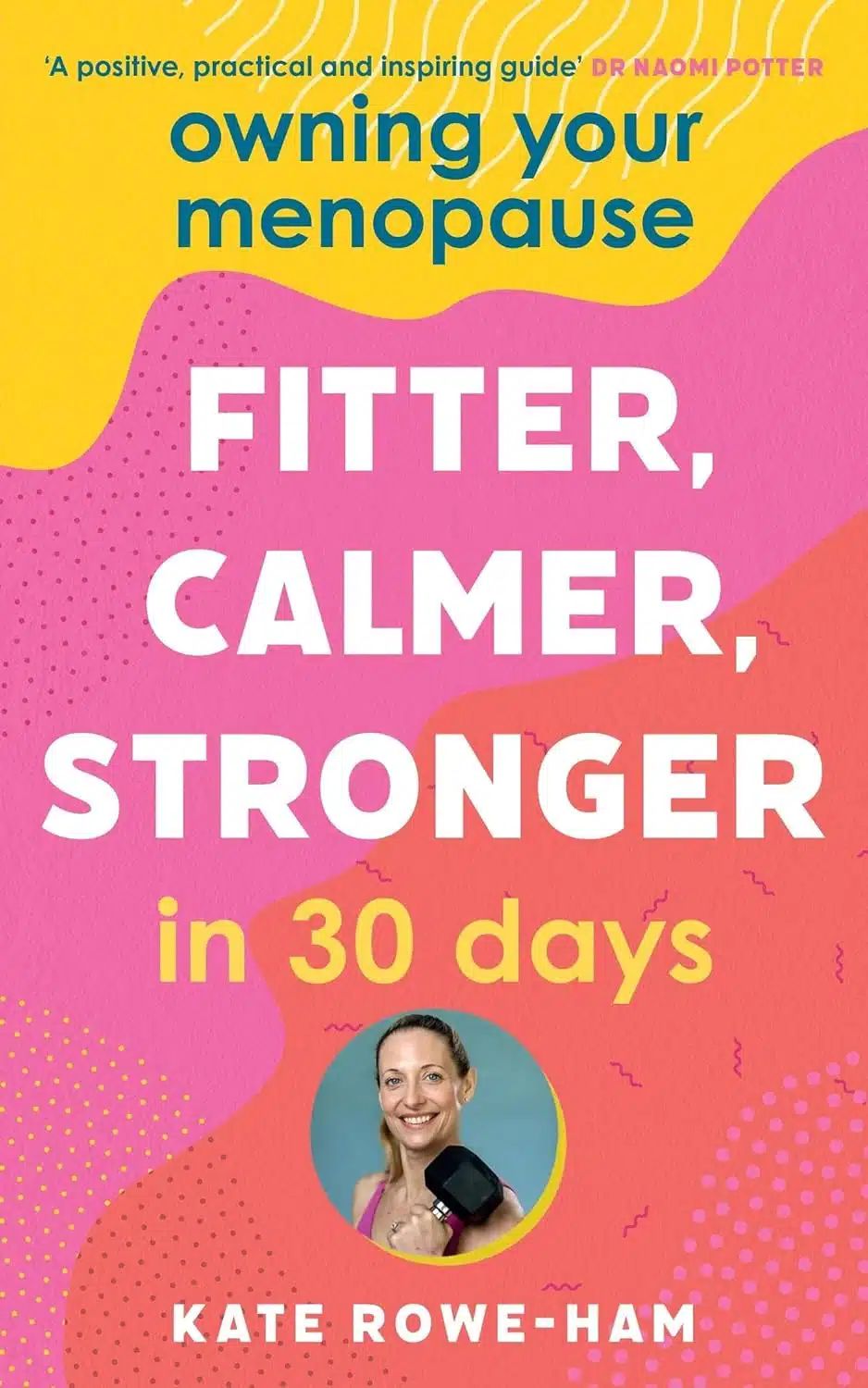
Owning Your Menopause: Fitter, Calmer, Stronger in 30 Days – by Kate Rowe-Ham
10almonds is reader-supported. We may, at no cost to you, receive a portion of sales if you purchase a product through a link in this article.
Likely written in response to the popularity of “Thinner, Leaner, Stronger”, this book has different goals: being fitter, calmer, and stronger.
Which, at the end of the day, must surely be an improvement. While society certainly wants us (women in general, and at least some men) to be thinner and leaner, it’s not always what’s best for us, whereas fitter and calmer? It’s hard to go wrong with that.
Much of the book is given over to detailing the processes involved in menopause, and the ways in which changes can be managed with diet, exercise, and other lifestyle interventions. For example, the author herself quit alcohol partially because she knew it was sabotaging her hormone metabolism (amongst many other things, of course). She also recommends HRT and discusses it in depth, but notes that there are some exceptions, details those too, and leaves us to make our own decisions in consultation with our own medical providers.
The “30 days” in the subtitle refers to an exercise plan and meal plan, and yes, the latter includes recipes. The recipes themselves are a little on the basic side for this reviewer’s taste, but then, perhaps that leaves room for personalization, so it is not so bad.
You’ll notice that we haven’t talked a lot about “calmer”, the reason is that neither does she; it’s mostly a recurrent theme presented as a result of following the other advices, and thus getting to better health in a stress-free fashion. She does discuss recovery and sleep, though.
The style is light pop-science, as one might expect from someone who is a personal trainer by career, not a research scientist or medical doctor. The author is British, so you will see spellings such as “oestrogen”, but we’ll trust this is not an insurmountable barrier to understanding.
Bottom line: if you are navigating menopause and want to stay healthy (or maybe even level up your health and fitness), this book can help with that.
Click here to check out Owning Your Menopause, and get fitter, calmer, and stronger in 30 days!
Don’t Forget…
Did you arrive here from our newsletter? Don’t forget to return to the email to continue learning!
Recommended
Learn to Age Gracefully
Join the 98k+ American women taking control of their health & aging with our 100% free (and fun!) daily emails:
-
Overactive Bladder? How’s Your Magnesium Depletion Score?
10almonds is reader-supported. We may, at no cost to you, receive a portion of sales if you purchase a product through a link in this article.
Overactive bladder (OAB) gets increasingly common after a certain age. This is often put down to “the body is getting older and weaker, so naturally the bladder is too, as are its associated muscles”.,
And while that’s true, it’s not exactly useful, is it? Happily, new science has shone a light on a previously underexamined consideration:
0Mg!
If you have zero magnesium (Mg) in your in body then well, you’re dead, because that’s an essential mineral.
But, low magnesium? That’s just normal. And by “normal” here we do mean in literal sense of: “it’s the statistical norm”, and without implication of “and that’s fine” (because it’s not).
A study looking at data from 28,621 participants aged 20–80 found that each each 1-point increase in magnesium depletion score (MgDS) was linked to 9% higher risk of OAB.
You may be wondering: how do I calculate my magnesium depletion score / do I need a blood test or something?
So, here’s how it’s calculated, step-by-step:
❝The MgDS is a validated clinical index designed to reflect chronic magnesium depletion risk by combining multiple clinical factors known to influence magnesium homeostasis. MgDS calculation includes the following step-by-step criteria:
(1) Diuretic use: Participants using diuretics scored 1 point; no diuretic use scored 0 points.
(2) PPI use: Participants using PPIs scored 1 point; non-users scored 0 points.
(3) Renal function assessment: Estimated glomerular filtration rate (eGFR) categories scored as follows: eGFR ≥ 90 mL/min/1.73 m2 scored 0 points; eGFR ≥ 60 and < 90 mL/min/1.73 m² scored 1 point; eGFR < 60 mL/min/1.73 m² scored 2 points.
(4) Alcohol consumption: Heavy alcohol use (defined as > 2 drinks/day for men and > 1 drink/day for women) scored 1 point; other consumption levels (never, former, mild, moderate) scored 0 points.❞Or more simply, start with a score of zero, and then…
- Do you use diuretics? If so, add 1 point
- Do you use PPIs? If so, add 1 point
- How are your kidneys?
- Great = add 0 points
- Neither amazing nor terrible = add 1 point
- Terrible = add 2 points
- Multiple units of alcohol per day? Add 1 point
If unsure how to guesstimate your kidney health, check out: Are your Kidneys Ok? Detect Early To Protect Kidney Health (Here’s How)
Now, in the bullet points above we’ve simplified the alcohol a bit (men typically have a little more wiggle-room there than women, but it’s not something that should be counted on, and as for the eGFR scores, we’ve gone for a “make an educated guess” analog in lieu of the lab test that’d be needed for that one. However, even a ±2 inaccuracy in your score due to guessing on that will still give you a general idea of which end of the scale you’re on, and it also means…
In practical terms:
- Do you use diuretics? If so, consider whether that’s best for you
- Do you use PPIs? If so, consider whether that’s best for you
- Are you neglecting your kidneys? If so, consider being more attentive to them
- Are you drinking regularly? If so, consider not doing that
Now, we are not the boss of you, and also some of those are things for conversations between you and your doctor (especially the first two).
But it does provide a good guideline for reference, and possible things to improve!
To read the paper in full, see: Association between magnesium depletion score and overactive bladder among U.S. Adults using data from NHANES 2005–2018
You can also, of course, regardless of your magnesium depletion score, enjoy magnesium-rich foods and/or take supplemental magnesium.
Note: this association does not prove causality. For example, it could be that OAB and MgDS are both caused by the same third thing, or it could be that the OAB causes the high MgDS. However, since most people are deficient in magnesium, supplementation is rarely a bad idea anyway.
So, with that in mind:
But: Which Magnesium? (And: When?) ← it makes a difference! Especially as the most widely-sold kind of magnesium (magnesium oxide, which is cheapest) is barely usable by the human body. The article we’ve just linked to discusses the pros and cons of alternatives magnesium glycinate, magnesium citrate, magnesium lactate, and magnesium gluconate. Choose wisely!
And if you’re relying on diet, do be aware of: Foods Linked To Urinary Incontinence In Middle-Age (& Foods That Avert It)
Want to do more?
Check out these previous articles of ours:
Pelvic Floor Exercises (Not Kegels!) To Prevent Urinary Incontinence
and
Keeping Your Kidneys Happy: It’s About More Than Just Hydration! ← important at all ages, but especially relevant after 60
Take care!
Share This Post
-
Chetna’s Healthy Indian – by Chetna Makan
10almonds is reader-supported. We may, at no cost to you, receive a portion of sales if you purchase a product through a link in this article.
Indian food is wonderful—a subjective opinion perhaps, but a popular view, and one this reviewer certainly shares. And of course, cooking with plenty of vegetables and spices is a great way to get a lot of health benefits.
There are usually downsides though, such as that in a lot of Indian cookbooks, every second thing is deep-fried, and what’s not deep-fried contains an entire day or more’s saturated fat content in ghee, and a lot of sides have more than their fair share of sugar.
This book fixes all that, by offering 80 recipes that prioritize health without sacrificing flavor.
The recipes are, as the title suggests, vegetarian, though many are not vegan (yogurt and cheese featuring in many recipes). That said, even if you are vegan, it’s pretty easy to veganize those with the obvious plant-based substitutions. If you have soy yogurt and can whip up vegan paneer yourself (here’s our own recipe for that), you’re pretty much sorted.
The cookbook strikes a good balance of being neither complicated nor “did we really need a recipe for this?” basic, and delivers value in all of its recipes. The ingredients, often a worry for many Westerners, should be easily found if you have a well-stocked supermarket near you; there’s nothing obscure here.
Bottom line: if you’d like to cook more Indian food and want your food to be exciting without also making your blood pressure exciting, then this is an excellent book for keeping you well-nourished, body and soul.
Click here to check out Chetna’s Healthy Indian, and spice up your culinary repertoire!
Share This Post
-
It’s A Wrap
10almonds is reader-supported. We may, at no cost to you, receive a portion of sales if you purchase a product through a link in this article.
We hope all our readers have had a great and healthy week! Here are some selections from health news from around the world:
A lack of transparency
Thousands of chemicals blanket-approved for food contact in packaging, under the FDA’s “Generally Recognized As Safe” umbrella, have been found in humans.
This highlights a gap in the safeguarding system, because the GRAS classification is given when there’s no known significant association with disease—but in this case, a problem can occur when the build-up in the blood and brain cause problems much later.
Read in full: Thousands of toxins from food packaging found in humans – research
Learn more: We Are Such Stuff As Bottles Are Made Of (It’s Not Fantastic To Be Plastic)
Cafestol for weight loss?
Most coffee intervention studies use instant coffee. Which is understandable; they are scientists on a budget, not coffee shop baristas. But, instant coffee is low in some of coffee’s important compounds, such as cafestol—which as it turns out, can lower not only overall body fat, but also (importantly!) visceral fat.
Read in full: 12-week coffee compound study shows promising results for weight and fat reduction in at-risk individuals
Learn more: The Bitter Truth About Coffee (or is it?)
Doing something is better than doing nothing
While a lot of the bad news both locally and around the world can be infuriating and/or depressing, turning a blind eye may not be the best approach for dealing with it. This study was in teens, but it’s likely that the benefits are similar for other ages too:
Read in full: Racial justice activism, advocacy found to reduce depression, anxiety in some teens
Learn more: Make Social Media Work For Your Mental Health
A ray of hope!
Sometimes, the topic of sun and sunscreens can seem like “damned if you do; damned if you don’t”, with regard to the harmful effects of the sun, and in some cases, potentially harmful effects of some sunscreen chemicals. We’ve argued ultimately in favor of sunscreens in this tug-of-war, but it’s nice to see improvements being made, in this case, with lignin-based sunscreen (a plant-based by-product of the pulp industry).
Read in full: Researchers create high-performing, eco-friendly sunscreen
Learn more: Who Screens The Sunscreens?
All about the pores
Researchers have identified a protein, and from that, a stack of protein fragments, that are involved in the formation of large pores. This is important, as it’s pointing to a means of relief for a lot of inflammatory diseases.
Read in full: Scientists unravel the process of pore formation in cells
Learn more: Why Do We Have Pores, And Could We Not?
Getting to the bottom of Crohn’s
If you have Crohn’s, or perhaps someone close to you has it, then you’ll be familiar with the common medical refrain of “we don’t know”. While this honesty is laudable, it’s not reassuring. So, it’s good that researchers are making progress in understanding why many people with Crohn’s may respond differently not only to lifestyle interventions, but also to various relevant drugs—allowing doctors to prescribe the right treatment for the right person.
Read in full: Patient-derived gut organoids reveal new insights into Crohn’s disease subtypes
Learn more: Diet Tips for Crohn’s Disease
Another carotenoid that holds back Alzheimer’s
Phytoene is a carotenoid that is found in many red, orange, or yellow foods, including tomatoes, carrots, apricots, red peppers, oranges, mandarins and passion fruit, among others. Researchers have found that it slows the onset of symptoms associated with the formation of amyloid plaques, by 30–40%, and increases longevity by 10–19%:
Read in full: Carotenoid phytoene shows potential in slowing Alzheimer’s plaque formation and increasing lifespan
Learn more: Brain Food? The Eyes Have It! ← this is about a different carotenoid, lutein, found mostly in dark green leafy vegetables, but it’s best to enjoy both 😎
Take care!
Share This Post
Related Posts
-
Science of HIIT – by Ingrid Clay
10almonds is reader-supported. We may, at no cost to you, receive a portion of sales if you purchase a product through a link in this article.
We previously reviewed another book in this series, Science of Yoga. This one’s about HIIT: High Intensity Interval Training!
We’ve written about HIIT before too, but our article doesn’t have the same amount of room as a book, so…
This one lays out 90 key HIIT exercises that you can do at home without special equipment. By “without special equipment”, we mean: there are a few exercises that use dumbbells, but if you don’t want to get/use dumbbells, you can improvize (e.g. with water bottles as weights) or skip those. All the rest require just your body!
The illustrations are clear and the explanations excellent. The book also dives into (as the title promises) the science of HIIT, and why it works the way it does to give results that can’t be achieved with other forms of exercise.
Bottom line: if you’ve been wanting to do HIIT but have not yet found a way of doing it that suits your lifestyle, this book gives many excellent options.
Click here to check out Science of HIIT, and level-up yours!
Don’t Forget…
Did you arrive here from our newsletter? Don’t forget to return to the email to continue learning!
Learn to Age Gracefully
Join the 98k+ American women taking control of their health & aging with our 100% free (and fun!) daily emails:
-
Cured – by Dr. Jeffrey Rediger
10almonds is reader-supported. We may, at no cost to you, receive a portion of sales if you purchase a product through a link in this article.
Our body (for most of us, at least), has a powerful immune system to not only keep pathogens at bay, but also deal with things that are often “inside-job” threats, such as cancer.
Of course, it can only do that if it is kept in good form, which includes nourishing it well and other such lifestyle factors. These Dr. Rediger discusses chapter-by-chapter in the first part of the book.
The second part of the book is given over to more psychological matters, and specifically, psychosomatic matters. Now, in popular parlance, “psychosomatic” is often used to mean “you’re imagining it”, but in medicine/science that’s not what it means at all; rather it is about how psychological factors affect physiological (and thus: somatic) processes.
Assuming you already know about lifestyle medicine, in which case the first part of the book may be superfluous for you, more of the practical value will come from the second part of the book, with explanations of how to improve one’s own regenerative abilities from the brain down.
The style is very old-school pop-science for such a relatively recent book (published 2021); from the style alone we could be forgiven for thinking it was from the 70s–90s, but the content reveals a more modern perspective than that. Dr. Rediger likes telling stories, and as such there are many lengthy anecdotes about patients with various conditions and how their healing journeys went. This is informative and illustrative, but case studies will always feel cherry-picked, so we generally prefer more robust science. On which note, there is a bibliography at the back, so it’s not all anecdotal, of course.
Bottom line: if you like minimal hard science and a lot of illustrative stories, this book will be one you’ll enjoy curling up with.
Click here to check out Cured, and give your body a restorative boost!
Don’t Forget…
Did you arrive here from our newsletter? Don’t forget to return to the email to continue learning!
Learn to Age Gracefully
Join the 98k+ American women taking control of their health & aging with our 100% free (and fun!) daily emails:
-
Why Do We Have Pores, And Could We Not?
10almonds is reader-supported. We may, at no cost to you, receive a portion of sales if you purchase a product through a link in this article.
It’s Q&A Day at 10almonds!
Have a question or a request? We love to hear from you!
In cases where we’ve already covered something, we might link to what we wrote before, but will always be happy to revisit any of our topics again in the future too—there’s always more to say!
As ever: if the question/request can be answered briefly, we’ll do it here in our Q&A Thursday edition. If not, we’ll make a main feature of it shortly afterwards!
So, no question/request too big or small
❝Do we really need pores, and why are they bigger on the face?❞
Pores secrete sweat or sebum (there are different kinds of pores for each).
If we didn’t have sweat pores, we’d be unable to sweat, which superficially may seem like a bonus, but it’d make us prone to overheating (like dogs, pigs, and other mammals that cannot sweat).
If we didn’t have sebum pores (usually called hair follicles, which are supplied by a sebaceous gland), we’d be completely hairless, and also unable to supply our skin with natural oils that keep it healthy. So we’d have no hair and very unhappy skin.
Which is ironic, because to believe beauty magazines, we must at all costs minimize our pores (and indeed, interventions like botox* can kill them).
*Let’s give that its full name though:
Suffice it to say, we do not recommend getting injected with neurotoxins unless it is truly necessary to ward off a greater harm. That said, we’re not the boss of you, and the safety profile is better than you might expect: How Safe Is Botox, Really? ← at least in the short term; if people are getting monthly top-ups for many years, the outcomes may be different.
As for being bigger on the face, they need not be, but sebaceous glands are more active and numerous there, being most active and numerous in the face/forehead—which is why oily skin is more likely to appear there than other parts of the body.
If your facial sebaceous glands are too active for your liking…
…there are ways to reduce that, a simple and relatively gentle way (relative, for example, botox) is with retinoids, including retinols or retinoic acids. Here’s some of the science of that; the paper is about treating acne, but the mechanism of action is the same (down-regulating the sebaceous glands’ action):
The potential side-effects, however were noted as:
- Cheilitis
- Desquamation of the skin
- Pruritus
Which, in translation from sciencese, means:
- Chapped lips
- Flaky skin
- Itchiness
Which aren’t necessarily fun, which is why with retinoids are best taken in very small doses at first to see how your skin reacts.
Remember when we said what your skin would be like without pores? This is what would happen, only much worse.
Take care!
Don’t Forget…
Did you arrive here from our newsletter? Don’t forget to return to the email to continue learning!
Learn to Age Gracefully
Join the 98k+ American women taking control of their health & aging with our 100% free (and fun!) daily emails:


