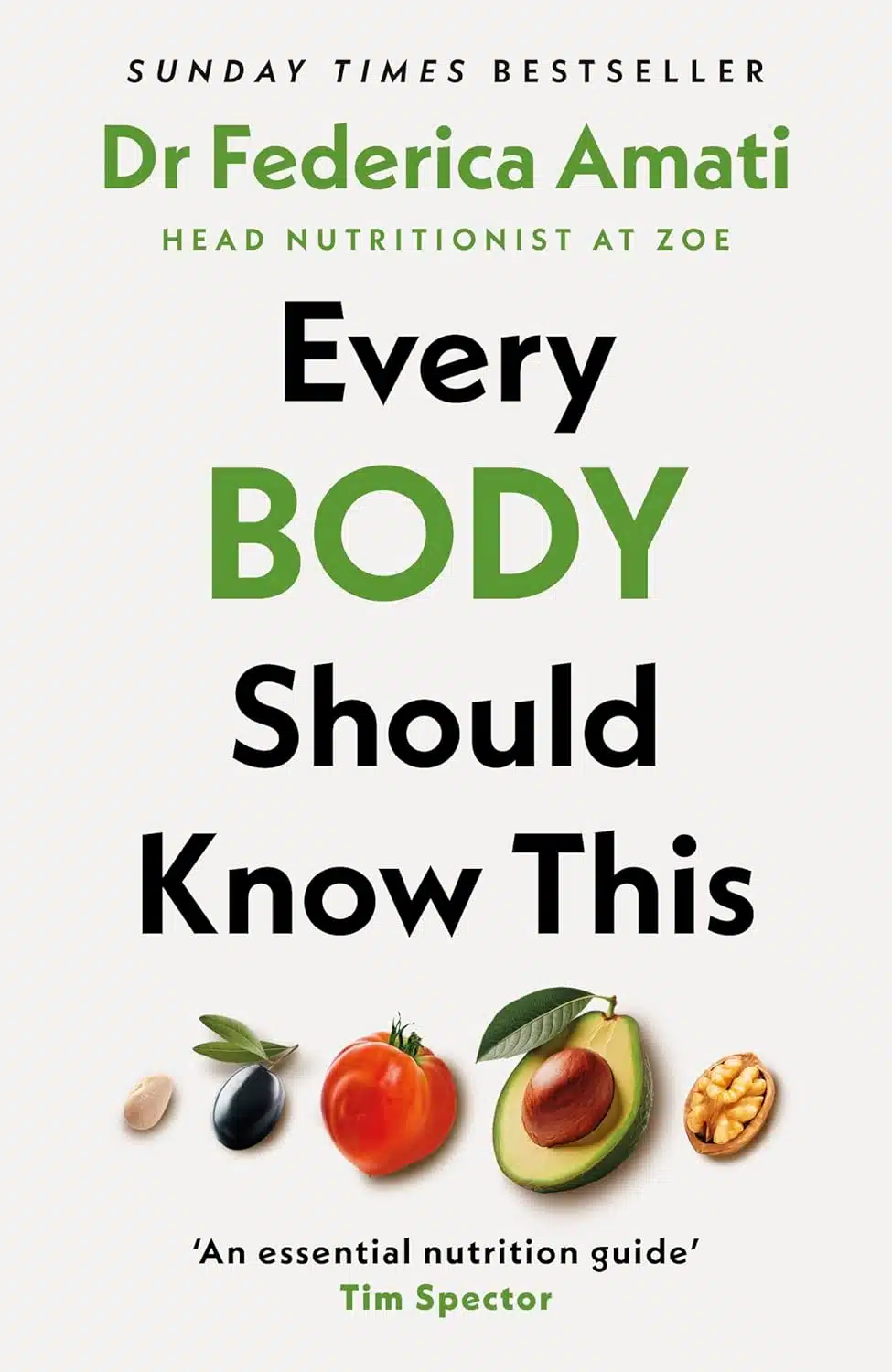
Every Body Should Know This – by Dr. Federica Amati

10almonds is reader-supported. We may, at no cost to you, receive a portion of sales if you purchase a product through a link in this article.

This book is very much a primer on how to eat healthily. The science is high-quality (the author is the head nutritionist at ZOE) and well-explained, and the advice is reasonable.

Limitations: this book is not very deep, which we might expect from a book with this title. So, if you’ve been a long-time 10almonds reader, you might not learn a lot here, and this book might make a better gift for someone else.

In particular, the book may be well-suited for someone who is thinking of having children soon, as there is an unusual amount of focus on fertility and young motherhood—perhaps because the author herself has young children and so was preoccupied with this when writing. For those of us who are definitely not having any more children, the focus on young motherhood is a little superfluous.

The writing style is very readable pop-science, and nobody who is able to read English is likely to struggle with this one. It’s also quite conversational in parts, as the author discusses her own experiences with implementing the science at hand.

Bottom line: if you want a good, solid, primer of how to eat well for a lifetime of health, especially if you are (or are thinking of becoming) a young mother, then this is a very good book. Otherwise, it’s probably a better to give it as a gift.

Click here to check out Every Body Should Know This, and know the things!

Don’t Forget…

Did you arrive here from our newsletter? Don’t forget to return to the email to continue learning!

Learn to Age Gracefully

Join the 98k+ American women taking control of their health & aging with our 100% free (and fun!) daily emails:

  • The voice in your head may help you recall and process words. But what if you don’t have one?

    10almonds is reader-supported. We may, at no cost to you, receive a portion of sales if you purchase a product through a link in this article.

    Can you imagine hearing yourself speak? A voice inside your head – perhaps reciting a shopping list or a phone number? What would life be like if you couldn’t?

    Some people, including me, cannot have imagined visual experiences. We cannot close our eyes and conjure an experience of seeing a loved one’s face, or imagine our lounge room layout – to consider if a new piece of furniture might fit in it. This is called “aphantasia”, from a Greek phrase where the “a” means without, and “phantasia” refers to an image. Colloquially, people like myself are often referred to as having a “blind mind”.

    While most attention has been given to the inability to have imagined visual sensations, aphantasics can lack other imagined experiences. We might be unable to experience imagined tastes or smells. Some people cannot imagine hearing themselves speak.

    A recent study has advanced our understanding of people who cannot imagine hearing their own internal monologue. Importantly, the authors have identified some tasks that such people are more likely to find challenging.

    fizkes/Shutterstock

    What the study found

    Researchers at the University of Copenhagen in Denmark and at the University of Wisconsin-Madison in the United States recruited 93 volunteers. They included 46 adults who reported low levels of inner speech and 47 who reported high levels.

    Both groups were given challenging tasks: judging if the names of objects they had seen would rhyme and recalling words. The group without an inner monologue performed worse. But differences disappeared when everyone could say words aloud.

    Importantly, people who reported less inner speech were not worse at all tasks. They could recall similar numbers of words when the words had a different appearance to one another. This negates any suggestion that aphants (people with aphantasia) simply weren’t trying or were less capable.

    image of boy sitting with diagram of gold brain superimposed over image
    Hearing our own imagined voice may play an important role in word processing. sutadimages/Shutterstock

    A welcome validation

    The study provides some welcome evidence for the lived experiences of some aphants, who are still often told their experiences are not different, but rather that they cannot describe their imagined experiences. Some people feel anxiety when they realise other people can have imagined experiences that they cannot. These feelings may be deepened when others assert they are merely confused or inarticulate.

    In my own aphantasia research I have often quizzed crowds of people on their capacity to have imagined experiences.

    Questions about the capacity to have imagined visual or audio sensations tend to be excitedly endorsed by a vast majority, but questions about imagined experiences of taste or smell seem to cause more confusion. Some people are adamant they can do this, including a colleague who says he can imagine what combinations of ingredients will taste like when cooked together. But other responses suggest subtypes of aphantasia may prove to be more common than we realise.

    The authors of the recent study suggest the inability to imagine hearing yourself speak should be referred to as “anendophasia”, meaning without inner speech. Other authors had suggested anauralia (meaning without auditory imagery). Still other researchers have referred to all types of imagined sensation as being different types of “imagery”.

    Having consistent names is important. It can help scientists “talk” to one another to compare findings. If different authors use different names, important evidence can be missed.

    bare foot on mossy green grass
    We’re starting to broaden our understanding of the senses and how we imagine them. Napat Chaichanasiri/Shutterstock

    We have more than 5 senses

    Debate continues about how many senses humans have, but some scientists reasonably argue for a number greater than 20.

    In addition to the five senses of sight, smell, taste, touch and hearing, lesser known senses include thermoception (our sense of heat) and proprioception (awareness of the positions of our body parts). Thanks to proprioception, most of us can close our eyes and touch the tip of our index finger to our nose. Thanks to our vestibular sense, we typically have a good idea of which way is up and can maintain balance.

    It may be tempting to give a new name to each inability to have a given type of imagined sensation. But this could lead to confusion. Another approach would be to adapt phrases that are already widely used. People who are unable to have imagined sensations commonly refer to ourselves as “aphants”. This could be adapted with a prefix, such as “audio aphant”. Time will tell which approach is adopted by most researchers.

    Why we should keep investigating

    Regardless of the names we use, the study of multiple types of inability to have an imagined sensation is important. These investigations could reveal the essential processes in human brains that bring about a conscious experience of an imagined sensation.

    In time, this will not only lead to a better understanding of the diversity of humans, but may help uncover how human brains can create any conscious sensation. This question – how and where our conscious feelings are generated – remains one of the great mysteries of science.

    Derek Arnold, Professor, School of Psychology, The University of Queensland

    This article is republished from The Conversation under a Creative Commons license. Read the original article.

    Share This Post

  • Mindfulness: An Eight-Week Plan – by Dr. Mark Williams & Dr. Danny Penman

    10almonds is reader-supported. We may, at no cost to you, receive a portion of sales if you purchase a product through a link in this article.

    The authors, with their PhDs in psychology and biochemistry, respectively, bring the science that you might expect (and some that you might not!) to this book about mindfulness meditation and mindfulness in everyday life.

    The book’s realism comes not just from studies, though, but also from a realistic perspective on modern life, in which many of us have sufficient responsibilities to afford us only limited downtime, and we certainly cannot all take time off for a mountaintop retreat.

    What we can do, however, is enjoy this eight-week program for finding peace in a frantic world, while still going about our necessary business in that frantic world on a daily basis.

    The eight weeks go as follows:

    1. Waking up to the autopilot
    2. Keeping the body in mind
    3. The mouse in the maze
    4. Moving beyond the rumor mill
    5. Turning toward difficulties
    6. Trapped in the past or living in the present?
    7. When did you stop dancing?
    8. Your wild and precious life

    …with meditations, as well as reframes and other tools, for each.

    The style is very easy-reading, with neither scientific jargon nor spiritual arcana, just clear explanations, instructions, and guidance.

    Bottom line: if you’re the sort of person who tries to take each day as it comes, but sometimes several days gang up on you at once, then this book can help get things into order.

    Click here to check out Mindfulness: An Eight-Week Plan for Finding Peace in a Frantic World, and indeed find peace in a frantic world!

    Share This Post

  • Track Your Blood Sugars For Better Personalized Health

    10almonds is reader-supported. We may, at no cost to you, receive a portion of sales if you purchase a product through a link in this article.

    There Will Be Blood

    Are you counting steps? Counting calories? Monitoring your sleep? Heart rate zones? These all have their merits:

    About calories: this writer (it’s me, hi) opines that intermittent fasting has the same benefits as caloric restriction, without the hassle of counting, and is therefore superior. I also personally find fasting psychologically more pleasant. However, our goal here is to be informative, not prescriptive, and some people may have reasons to prefer CR to IF!

    Examples that come to mind include ease of adherence in the case of diabetes management, especially Type 1, or if one’s schedule (and/or one’s “medications that need to be taken with food” schedule) does not suit IF.

    And now for the blood…

    A rising trend in health enthusiasts presently is the use of Continuous Glucose Monitors (CGMs), which do exactly what is sounds like they do: they continually monitor glucose. Specifically, the amount of it in your blood.

    Of course, these have been in use in diabetes management for years; the technology is not new, but the application of the technology is.

    A good example of what benefits a non-diabetic person can gain from the use of a CGM is Jessie Inchauspé, the food scientist of “Glucose Revolution” and “The Glucose Goddess Method” fame.

    By wearing a CGM, she was able to notice what things did and didn’t spike her blood sugars, and found that a lot of the things were not stuff that people knew/advised about!

    For example, much of diabetes management (including avoiding diabetes in the first place) is based around paying attention to carbs and little else, but she found that it made a huge difference what she ate (or didn’t) with the carbs. By taking many notes over the course of her daily life, she was eventually able to isolate these patterns, showed her working-out in The Glucose Revolution (there’s a lot of science in that book), and distilled that information into bite-size (heh) advice such as:

    10 Ways To Balance Blood Sugars

    That’s great, but since people like Inchauspé have done the work, I don’t have to, right?

    You indeed don’t have to! But you can still benefit from it. For example, fastidious as her work was, it’s a sample size of one. If you’re not a slim white 32-year-old French woman, there may be some factors that are different for you.

    All this to say: glucose responses, much like nutrition in general, are not a one-size-fits-all affair.

    With a CGM, you can start building up your own picture of what your responses to various foods are like, rather than merely what they “should” be like.

    This, by the way, is also one of the main aims of personalized health company ZOE, which crowdsourced a lot of scientific data about personalized metabolic responses to standardized meals:

    ZOE: Gut Health 2.0

    Not knowing these things can be dangerous

    We don’t like to scaremonger here, but we do like to point out potential dangers, and in this case, blindly following standardized diet advice, if your physiology is not standard, can have harmful effects, see for example:

    Diabetic-level glucose spikes seen in non-diabetic people

    Where can I get a CGM?

    We don’t sell them, and neither does Amazon, but you can check out some options here:

    The 4 Best CGM Devices For Measuring Blood Sugar in 2024

    …and if your doctor is not obliging with a prescription, note that the device that came out top in the above comparisons, will be available OTC soon:

    The First OTC Continuous Glucose Monitor Will Be Available Summer 2024

    Take care!

    Share This Post

  • Stickers and wristbands aren’t a reliable way to prevent mosquito bites. Here’s why

    10almonds is reader-supported. We may, at no cost to you, receive a portion of sales if you purchase a product through a link in this article.

    Protecting yourself and family from mosquito bites can be challenging, especially in this hot and humid weather. Protests from young children and fears about topical insect repellents drive some to try alternatives such as wristbands, patches and stickers.

    These products are sold online as well as in supermarkets, pharmacies and camping stores. They’re often marketed as providing “natural” protection from mosquitoes.

    But unfortunately, they aren’t a reliable way to prevent mosquito bites. Here’s why – and what you can try instead.

    Why is preventing mosquito bites important?

    Mosquitoes can spread pathogens that make us sick. Japanese encephalitis and Murray Valley encephalitis viruses can have potentially fatal outcomes. While Ross River virus won’t kill you, it can cause potentially debilitating illnesses.

    Health authorities recommend preventing mosquito bites by: avoiding areas and times of the day when mosquitoes are most active; covering up with long sleeved shirts, long pants, and covered shoes; and applying a topical insect repellent (a cream, lotion, or spray).

    I don’t want to put sticky and smelly repellents on my skin!

    While for many people, the “sting” of a biting mosquitoes is enough to prompt a dose of repellent, others are reluctant. Some are deterred by the unpleasant feel or smell of insect repellents. Others believe topical repellents contain chemicals that are dangerous to our health.

    However, many studies have shown that, when used as recommended, these products are safe to use. All products marketed as mosquito repellents in Australia must be registered by the Australian Pesticides and Veterinary Medicines Authority; a process that provides recommendations for safe use.

    How do topical repellents work?

    While there remains some uncertainty about how the chemicals in topical insect repellents actually work, they appear to either block the sensory organs of mosquitoes that drive them to bite, or overpower the smells of our skin that helps mosquitoes find us.

    Diethytolumide (DEET) is a widely recommended ingredient in topical repellents. Picaridin and oil of lemon eucalyptus are also used and have been shown to be effective and safe.

    How do other products work?

    “Physical” insect-repelling products, such as wristbands, coils and candles, often contain a botanically derived chemical and are often marketed as being an alternative to DEET.

    However, studies have shown that devices such as candles containing citronella oil provide lower mosquito-bite prevention than topical repellents.

    A laboratory study in 2011 found wristbands infused with peppermint oil failed to provide full protection from mosquito bites.

    Even as topical repellent formulations applied to the skin, these botanically derived products have lower mosquito bite protection than recommended products such as those containing DEET, picaridin and oil of lemon eucalyptus.

    Wristbands infused with DEET have shown mixed results but may provide some bite protection or bite reduction. DEET-based wristbands or patches are not currently available in Australia.

    There is also a range of mosquito repellent coils, sticks, and other devices that release insecticides (for example, pyrethroids). These chemicals are primarily designed to kill or “knock down” mosquitoes rather than to simply keep them from biting us.

    What about stickers and patches?

    Although insect repellent patches and stickers have been available for many years, there has been a sudden surge in their marketing through social media. But there are very few scientific studies testing their efficacy.

    Our current understanding of the way insect repellents work would suggest these small stickers and patches offer little protection from mosquito bites.

    At best, they may reduce some bites in the way mosquito coils containing botanical products work. However, the passive release of chemicals from the patches and stickers is likely to be substantially lower than those from mosquito coils and other devices actively releasing chemicals.

    One study in 2013 found a sticker infused with oil of lemon eucalyptus “did not provide significant protection to volunteers”.

    Clothing impregnated with insecticides, such as permethrin, will assist in reducing mosquito bites but topical insect repellents are still recommended for exposed areas of skin.

    Take care when using these products

    The idea you can apply a sticker or patch to your clothing to protect you from mosquito bites may sound appealing, but these devices provide a false sense of security. There is no evidence they are an equally effective alternative to the topical repellents recommended by health authorities around the world. It only takes one bite from a mosquito to transmit the pathogens that result in serious disease.

    It is also worth noting that there are some health warnings and recommendations for their use required by Australian Pesticides and Veterinary Medicines Authority. Some of these products warn against application to the skin (recommending application to clothing only) and to keep products “out of reach of children”. This is a challenge if attached to young children’s clothing.

    Similar warnings are associated with most other topical and non-topical mosquito repellents. Always check the labels of these products for safe use recommendations.

    Are there any other practical alternatives?

    Topical insect repellents are safe and effective. Most can be used on children from 12 months of age and pose no health risks. Make sure you apply the repellent as a thin even coat on all exposed areas of skin.

    But you don’t need “tropical strength” repellents for short periods of time outdoors; a range of formulations with lower concentrations of repellent will work well for shorter trips outdoors. There are some repellents that don’t smell as strong (for example, children’s formulations, odourless formulations) or formulations that may be more pleasant to use (for example, pump pack sprays).

    Finally, you can always cover up. Loose-fitting long-sleeved shirts, long pants, and covered shoes will provide a physical barrier between you and mosquitoes on the hunt for your or your family’s blood this summer.The Conversation

    Cameron Webb, Clinical Associate Professor and Principal Hospital Scientist, University of Sydney

    This article is republished from The Conversation under a Creative Commons license. Read the original article.

    Don’t Forget…

    Did you arrive here from our newsletter? Don’t forget to return to the email to continue learning!

    Learn to Age Gracefully

    Join the 98k+ American women taking control of their health & aging with our 100% free (and fun!) daily emails:

  • How To Get More Nutrition From The Same Food

    10almonds is reader-supported. We may, at no cost to you, receive a portion of sales if you purchase a product through a link in this article.

    How To Get More Out Of What’s On Your Plate

    Where does digestion begin? It’s not the stomach. It’s not even the mouth.

    It’s when we see and smell our food; maybe even hear it! “Sell the sizzle, not the steak” has a biological underpinning.

    At that point, when we begin to salivate, that’s just one of many ways that our body is preparing itself for what we’re about to receive.

    When we grab some ready-meal and wolf it down, we undercut that process. In the case of ready-meals, they often didn’t have much nutritional value, but even the most nutritious food isn’t going to do us nearly as much good if it barely touches the sides on the way down.

    We’re not kidding about the importance of that initial stage of our external senses, by the way:

    So, mindful eating is not just something for Instagrammable “what I eat in a day” aesthetic photos, nor is just for monks atop cold mountains. There is actual science here, and a lot of it.

    It starts with ingredients

    “Eating the rainbow” (no, Skittles do not count) is great health advice for getting a wide variety of micronutrients, but it’s also simply beneficial for our senses, too. Which, as above-linked, makes a difference to digestion and nutrient absorption.

    Enough is enough

    That phrase always sounds like an expression of frustration, “Enough is enough!”. But, really:

    Don’t overcomplicate your cooking, especially if you’re new to this approach. You can add in more complexities later, but for now, figure out what will be “enough”, and let it be enough.

    The kitchen flow

    Here we’re talking about flow in the Csikszentmihalyi sense of the word. Get “into the swing of things” and enjoy your time in the kitchen. Schedule more time than you need, and take it casually. Listen to your favourite music. Dance while you cook. Taste things as you go.

    There are benefits, by the way, not just to our digestion (in being thusly primed and prepared for eating), but also to our cognition:

    In The Zone: Flow State and Cognition in Older Adults

    Serve

    No, not just “put the food on the table”, but serve.

    Have a pleasant environment; with sensory pleasures but without too many sensory distractions. Think less “the news on in the background” and more smooth jazz or Mozart or whatever works for you. Use your favourite (small!) plates/bowls, silverware, glasses. Have a candle if you like (unscented!).

    Pay attention to presentation on the plate / in the bowl / in any “serve yourself” serving-things. Use a garnish (parsley is great if you want to add a touch of greenery without changing the flavor much). Crack that black pepper at the table. Make any condiments count (less “ketchup bottle” and more “elegant dip”).

    Take your time

    Say grace if that fits with your religious traditions, and/or take a moment to reflect on gratitude.

    In many languages there’s a pre-dinner blessing that most often translates to “good appetite”. This writer is fond of the Norwegian “Velbekommen”, and it means more like “May good come of it for you”, or “May it do you good”.

    Then, enjoy the food.

    For the most even of blood sugar levels, consider eating fiber, protein/fat, carbs, in that order.

    Why? See: 10 Ways To Balance Blood Sugars

    Chew adequately and mindfully. Put your fork (or spoon, or chopsticks, or whatever) down between bites. Drink water alongside your meal.

    Try to take at least 20 minutes to enjoy your meal, and/but any time you go to reach for another helping, take a moment to check in with yourself with regard to whether you are actually still hungry. If you’re not, and are just eating for pleasure, consider deferring that pleasure by saving the food for later.

    At this point, people with partners/family may be thinking “But it won’t be there later! Someone else will eat it!”, and… That’s fine! Be happy for them. You can cook again tomorrow. You prepared delicious wholesome food that your partner/family enjoyed, and that’s always a good thing.

    Want to know more about the science of mindful eating?

    Check out Harvard’s Dr. Lilian Cheung on Mindful Eating here!

    Don’t Forget…

    Did you arrive here from our newsletter? Don’t forget to return to the email to continue learning!

    Learn to Age Gracefully

    Join the 98k+ American women taking control of their health & aging with our 100% free (and fun!) daily emails:

  • Artichoke vs Brussels Sprouts – Which is Healthier?

    10almonds is reader-supported. We may, at no cost to you, receive a portion of sales if you purchase a product through a link in this article.

    Our Verdict

    When comparing artichoke to Brussels sprouts, we picked the sprouts.

    Why?

    Finally, a vegetable that beats artichoke—after it previously beat many healthy high-scorers including cabbage and even broccoli! It was still close though, which is impressive for artichoke, considering what a nutritional powerhouse Brussels sprouts are:

    In terms of macros, the only meaningful difference is that artichoke has slightly more carbs and fiber, so artichoke gets the most marginal of nominal wins in this category.

    In the category of vitamins, however, artichoke has only more of vitamins B3, and B9, while Brussels sprouts have more of vitamins A, B1, B2, B6, C, E, and K, giving sprouts the clear victory here, especially with much higher margins of difference (e.g. 58x more vitamin A, as well as 7x more vitamin C, and 10x more vitamin K).

    When it comes to minerals, artichoke has more copper, magnesium, phosphorus, and zinc, while Brussels sprouts have more iron, manganese, potassium, and selenium, resulting in a 4:4 tie, and the small margins of difference are mostly comparable, with the exception that sprouts have 8x more selenium. So, Brussels sprouts win this category very marginally on that tie-breaker.

    In other considerations, artichoke has more polyphenols, while the sprouts have sulforaphane, to we’re calling this round a tie on balance.

    Adding up the sections we see that most recent tie, while macros and minerals gave a small win each to artichoke and sprouts respectively, while the vitamins category was an overwhelming win for sprouts, so—with this deciding factor in mind—sprouts win the day today.

    Want to learn more?

    You might like to read:

    Sprout Your Seeds, Grains, Beans, Etc

    Enjoy!

    Don’t Forget…

    Did you arrive here from our newsletter? Don’t forget to return to the email to continue learning!

    Learn to Age Gracefully

    Join the 98k+ American women taking control of their health & aging with our 100% free (and fun!) daily emails: